

Difference in hospital readmission among patients with atrial fibrillation undergoing ablation using nonintegrated pulsed field catheter with CARTO™ 3 versus EnSite™ electroanatomical mapping system
Publication: Journal of Comparative Effectiveness Research
Abstract
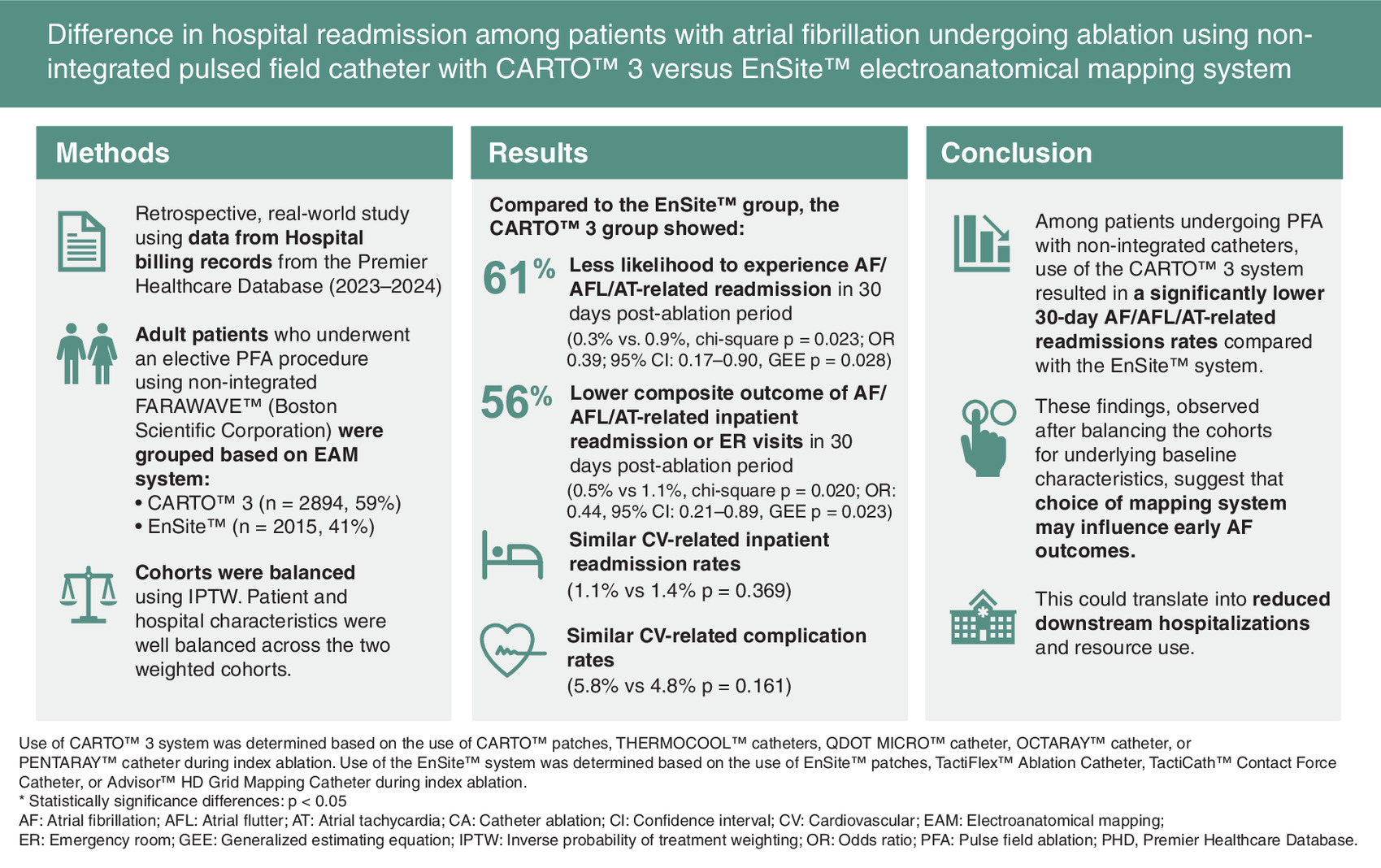
Aim: Pulsed field ablation (PFA) is a minimally thermal alternative to traditional thermal catheter ablation for atrial fibrillation (AF), with comparable efficacy and minimal risk of collateral tissue injury. Three-dimensional (3D) electroanatomical mapping systems have been adopted with nonintegrated PFA catheters to improve precision and procedural efficiency. This study compared arrhythmia-related hospital readmissions and procedure-related complications among patients with AF treated with PFA, using either the CARTO™ 3 or EnSite™ electroanatomical mapping system. Materials & methods: Patients who underwent PFA for AF using nonintegrated pulsed field catheters with either CARTO 3 or EnSite were identified from the 2023–2024 Premier Healthcare Database (PHD). The primary outcome was 30-day inpatient readmission and emergency room (ER) visit for AF/atrial flutter (AFL)/atrial tachycardia following the index PFA procedure. Secondary outcomes included 30-day cardiovascular-related readmissions and procedure-related complications. Cohorts were balanced using inverse probability of treatment weighting. Descriptive analyses and a weighted Generalized Estimating Equation (GEE) model were used to assess differences in outcomes between groups. Results: A total of 2894 patients were treated using CARTO 3 and 2015 using EnSite. After weighting, patient and hospital characteristics were well balanced across cohorts. The CARTO 3 group was significantly less likely to experience AF/AFL/atrial tachycardia-related readmissions (0.3% vs 0.9%, chi-square p = 0.023; odds ratio [OR], 0.39; 95% CI, 0.17–0.90, GEE p = 0.028) and a composite outcome of AF/AFL/atrial tachycardia-related inpatient readmission or ER visits (0.5% vs 1.1%, chi-square p = 0.020; OR: 0.44, 95% CI: 0.21–0.89, GEE p = 0.023) within 30 days of PFA procedure than the EnSite group. No differences were observed in cardiovascular-related readmission or complications. Conclusion: In this retrospective, real-world study, patients with AF who underwent PFA using CARTO 3 had lower 30-day AF/AFL/atrial tachycardia-related readmissions rates than those treated with EnSite suggesting that choice of mapping system may influence early AF outcomes and could translate into reduced downstream hospitalizations and resource use.
Plain language summary
What is this article about?
Atrial fibrillation (AF) is a common heart rhythm disorder that can be treated with a procedure called pulsed field ablation (PFA), which uses electrical pulses to target and destroy heart muscle cells responsible for the abnormal rhythm. During the procedure, electroanatomical mapping systems help guide the treatment by creating a detailed map of the heart. This study compared hospital readmission rates and complications after PFA procedures performed using two different electroanatomical mapping systems: CARTO™ 3 and EnSite™.
What were the results?
This study analyzed the data of 4909 patients with AF treated with PFA in 2023–2024. Patients treated using the CARTO 3 system were 56% less likely to be readmitted to the hospital or emergency room within 30 days for AF, atrial flutter, or atrial tachycardia compared with those treated using the EnSite system. Both groups had similar rates of cardiovascular-related hospital readmissions and procedure-related complications.
What do the results mean?
These findings suggest that the choice of mapping system used to guide PFA may influence early heart rhythm-related hospital readmissions. The CARTO 3 system may offer an advantage in preventing recurrence of arrhythmia after the procedure.
Graphical abstract
Supplementary Material
File (supplementary materials.docx)
References
1.
Go AS, Hylek EM, Phillips KA et al. Prevalence of diagnosed atrial fibrillation in adults: national implications for rhythm management and stroke prevention: the AnTicoagulation and Risk Factors in Atrial Fibrillation (ATRIA) Study. JAMA 285(18), 2370–2375 (2001).
2.
Benjamin EJ, Muntner P, Alonso A et al. Heart disease and stroke statistics-2019 update: a report from the American Heart Association. Circulation 139(10), e56–e528 (2019).
3.
Asad ZUA, Yousif A, Khan MS, Al-Khatib SM, Stavrakis S. Catheter ablation versus medical therapy for atrial fibrillation: a systematic review and meta-analysis of randomized controlled trials. Circ. Arrhythm. Electrophysiol. 12(9), e007414 (2019).
4.
Mark DB, Anstrom KJ, Sheng S et al. Effect of catheter ablation vs medical therapy on quality of life among patients with atrial fibrillation: the CABANA randomized clinical trial. JAMA 321(13), 1275–1285 (2019).
5.
Marrouche NF, Brachmann J, Andresen D et al. Catheter ablation for atrial fibrillation with heart failure. N. Engl. J. Med. 378(5), 417–427 (2018).
6.
Packer DL, Piccini JP, Monahan KH et al. Ablation versus drug therapy for atrial fibrillation in heart failure: results from the CABANA trial. Circulation 143(14), 1377–1390 (2021).
7.
Batista Napotnik T, Polajžer T, Miklavčič D. Cell death due to electroporation - a review. Bioelectrochemistry 141, 107871 (2021).
8.
Bradley CJ, Haines DE. Pulsed field ablation for pulmonary vein isolation in the treatment of atrial fibrillation. J. Cardiovasc. Electrophysiol. 31(8), 2136–2147 (2020).
9.
Kotnik T, Rems L, Tarek M, Miklavčič D. Membrane electroporation and electropermeabilization: mechanisms and models. Annu. Rev. Biophys. 48, 63–91 (2019).
10.
Verma A, Haines DE, Boersma LV et al. Pulsed field ablation for the treatment of atrial fibrillation: PULSED AF pivotal trial. Circulation 147(19), 1422–1432 (2023).
11.
Muthalaly RG, John RM, Schaeffer B et al. Temporal trends in safety and complication rates of catheter ablation for atrial fibrillation. J. Cardiovasc. Electrophysiol. 29(6), 854–860 (2018).
12.
Falasca Zamponi A, Olson J, Scheel S, Englund A, Scorza R, Tabrizi F. Procedural efficiency is enhanced combining the pentaspline pulsed field ablation catheter with three-dimensional electroanatomical mapping system for pulmonary vein isolation. J. Interv. Card. Electrophysiol. 67(9), 1993–2001 (2024).
13.
Kueffer T, Seiler J, Madaffari A et al. Pulsed-field ablation for the treatment of left atrial reentry tachycardia. J. Interv. Card. Electrophysiol. 66(6), 1431–1440 (2023).
14.
Mittal A, Hong K, Fitzpatrick N et al. A hybrid approach using pulse field ablation and three-dimensional mapping in atrial fibrillation ablation: a relatively early worldwide experience. Heart 108(Suppl. 3), A4–A6 (2022).
15.
Costea AI, Khanna R, Iglesias M, Rong Y. Hospital readmissions following catheter ablation for atrial fibrillation with THERMOCOOL™ STSF/THERMOCOOL™ ST catheter with CARTO™ 3 system versus TactiCath™ catheter with EnSite™ system. J. Comp. Eff. Res. 14(1), e240075 (2025).
16.
Arai H, Miyazaki S, Nitta J et al. Acute procedural safety of the latest radiofrequency ablation catheters in atrial fibrillation ablation: data from a large prospective ablation registry. J. Cardiovasc. Electrophysiol. 35(11), 2109–2118 (2024).
17.
Plank K, Bordignon S, Urbanek L et al. Early recurrences predict late therapy failure after pulsed field ablation of atrial fibrillation. J. Cardiovasc. Electrophysiol. 34(12), 2425–2433 (2023).
18.
Li Z, Wang S, Hidru TH et al. Long atrial fibrillation duration and early recurrence are reliable predictors of late recurrence after radiofrequency catheter ablation. Front Cardiovasc. Med. 9, 864417 (2022).
19.
Kim YG, Boo KY, Choi JI et al. Early recurrence is reliable predictor of late recurrence after radiofrequency catheter ablation of atrial fibrillation. JACC Clin. Electrophysiol. 7(3), 343–351 (2021).
20.
Austin PC, Stuart EA. Moving towards best practice when using inverse probability of treatment weighting (IPTW) using the propensity score to estimate causal treatment effects in observational studies. Stat. Med. 34(28), 3661–3679 (2015).
21.
Bazoukis G, Elkholey K, Stavrakis S, Heist EK, Armoundas AA. Efficacy of commonly used 3D mapping systems in acute success rates of catheter ablation procedures. Heart Int. 18(1), 9–25 (2024).
22.
Kim YH, Chen SA, Ernst S et al. 2019 APHRS expert consensus statement on three-dimensional mapping systems for tachycardia developed in collaboration with HRS, EHRA, and LAHRS. J. Arrhythm. 36(2), 215–270 (2020).
23.
Hofer D, Steffel J, Duru F et al. Feasibility, efficiency, and safety of zero-fluoroscopy catheter interventions for right-sided cardiac arrhythmias using only electroanatomic mapping. Cardiology 147(5–6), 547–556 (2022).
24.
Obeng-Gyimah E, Nazarian S. Advancements in imaging for atrial fibrillation ablation: is there a potential to improve procedural outcomes? J. Innov. Card. Rhythm. Manag. 11(7), 4172–4178 (2020).
25.
Di Biase L, Zou F, Lin AN et al. Feasibility of three-dimensional artificial intelligence algorithm integration with intracardiac echocardiography for left atrial imaging during atrial fibrillation catheter ablation. Europace 25(9), euad211 (2023).
26.
Schwartz AL, Chorin E, Mann T et al. Reconstruction of the left atrium for atrial fibrillation ablation using the machine learning CARTO 3 m-FAM software. J. Interv. Cardi. Electrophysiol. 64(1), 39–47 (2022).
Information & Authors
Information
Published In
Copyright
© 2026 The authors. This work is licensed under the Creative Commons Attribution 4.0 License
History
Received: 19 September 2025
Accepted: 4 December 2025
Published online: 8 January 2026
Keywords:
Topics
Authors
Metrics & Citations
Metrics
Article Usage
Article usage data only available from February 2023. Historical article usage data, showing the number of article downloads, is available upon request.
Citations
How to Cite
Difference in hospital readmission among patients with atrial fibrillation undergoing ablation using nonintegrated pulsed field catheter with CARTO™ 3 versus EnSite™ electroanatomical mapping system. (2026) Journal of Comparative Effectiveness Research. DOI: 10.57264/cer-2025-0151
Export citation
Select the citation format you wish to export for this article or chapter.
Citing Literature
- Benjamin J. Behers, Christoph A. Stephenson-Moe, Sammy Shihadeh, Tonya S. King, Omar Hozayen, Joseph Hozayen, Maria Moreno, Karen M. Hamad, Antonio Moretta, Effect of Pulsed Field Ablation System and Post-Ablation Mapping on Atrial Fibrillation Recurrence, Journal of Cardiovascular Development and Disease, 10.3390/jcdd13060243, 13, 6, (243), (2026).