

ISPOR Europe 2026 daily round-ups: Insights from Day 2
Following a busy opening day in Vienna, ISPOR Europe 2026 continues with another full program of discussion, research and debate. The Evidence Base is on site highlighting some of the key conversations and takeaways from Day 2.
Day 1 at ISPOR Europe 2026 set out many of the questions running through this year’s meeting, from how value should be defined to what increasingly complex evidence and AI-enabled approaches mean for decision-making.
Today, those debates continue across sessions on health system optimization, RWE, pragmatic trials, HTA, pricing and access, alongside further discussion of how evidence requirements are evolving across Europe and beyond.
With The Evidence Base team continuing our coverage from Vienna, here are some of the highlights from Day 2.
ISPOR Presidential Address

ISPOR President Beth Devine (University of Washington) opened Day 2 by setting out the scientific focus of her presidency, connecting advances in AI and RWE with broader approaches to value and stakeholder engagement. Priorities included work on AI-supported decision modeling and systematic reviews, alongside the joint ISPOR–ISPE statement on scientific transparency for RWE studies. Beth also positioned Whole Health within ISPOR’s Strategic Plan 2030, extending attention beyond clinical care to prevention and non-clinical interventions. Partnerships with clinicians and investors reflected a wider ambition to embed HEOR in decisions across healthcare and earlier in technology development, rather than treating market access as a late-stage consideration.
Plenary 2: We Optimize Treatments – But How Do We Optimize the System?
The second plenary of the conference extended the discussions from plenary 1 by examining the workforce, infrastructure and governance needed to translate innovation into better care. Ricardo Baptista Leite (HealthAI) discussed how AI should support redesigned pathways, with continuing oversight and clear accountability. Jakub Dvoracek (ECRIN) illustrated the implementation challenge through the example of Czech preparations for Alzheimer’s treatments, where reimbursement discussions exposed constraints in staffing, diagnostics and social care.
In the panel moderated by Rasmus Gjesing (WHO Europe), Carole Longson (University of Manchester) cautioned against equating optimization with stopping services, emphasizing better targeting of interventions and earlier assessment of system impacts. The discussion connected horizon scanning and linked outcomes and reimbursement data with the practical and political challenges of redirecting resources.
Read our in-depth summary of Plenary 2 here >>>
Spotlight: Bridging China and Europe: When Is China-Generated Evidence Fit for European HTA?
As China’s biopharmaceutical sector expands internationally, questions are emerging about how clinical trial data and RWE generated in China can inform European HTA. The panel examined the transferability of evidence, methodological credibility and the practical challenges of meeting European evidence requirements for reimbursement decisions.
Moderator Ruslan Horblyuk (Aesara) outlined the growth of China’s pharmaceutical innovation and RWD infrastructure, arguing that the central question is no longer whether evidence generated in China is relevant, but which decisions it can reliably support. He explained that clinical trial findings may be more readily transferable when study designs and patient populations meet international expectations, while the applicability of RWE depends more heavily on differences in healthcare systems, clinical pathways and data characteristics.
Jing Wu (Tianjin University) outlined how China’s HTA landscape has evolved since the introduction of its national drug negotiation program in 2017. Clinical trials, indirect treatment comparisons, economic evaluations, and RWE are playing an increasingly important role in reimbursement decisions, supported by updated pharmacoeconomic guidelines and methodological guidance. She also noted the growing internationalization of clinical development, with 410 multiregional clinical trials registered in China in 2025, approximately double the number in 2020.
Jing described government initiatives to strengthen China’s RWD infrastructure, including national pilot programs involving 14 cities and 79 tertiary hospital evaluation sites. She also discussed new reimbursement policies that may offer a price premium under specified conditions to manufacturers committing to approved real-world studies. Illustrating the potential contribution of Chinese RWD to international research, she described a European hematology study in which the inclusion of patient cases from China substantially increased the number available for analysis.
Huajie Jin (King's College London) examined how evidence generated in China could help address gaps in European HTA submissions, distinguishing between methodological credibility and applicability to specific decisions. She explained that evidence can be methodologically robust without necessarily being applicable to European populations, clinical pathways or decision-making contexts, stating:
“The key question is not simply where the evidence comes from, but whether it's credible and applicable to the European HTA questions.”
She outlined five categories of economic model inputs, each with different considerations for transferability. Relative treatment effects may be more readily transferable when relevant treatment effect modifiers are comparable across populations. By contrast, absolute risks, natural history, resource use and care pathways often require local adaptation. Unit costs should generally reflect European healthcare settings, while health-related quality-of-life estimates need to account for country-specific values.
To address these differences, Huajie recommended assessing transferability for each model input individually and using value-of-information analysis to establish whether remaining uncertainty could affect cost-effectiveness conclusions. Where additional European studies are impractical, targeted analyses of Chinese data or limited local data collection could offer alternative ways to address evidence gaps.
Ross A Selby (Italfarmaco SpA) questioned whether existing clinical development programs consistently meet European HTA expectations, noting that pivotal trials are primarily designed to support regulatory approval. He argued that evidence gaps are not unique to China, and pointed to EU Joint Clinical Assessment (JCA) requirements as an additional consideration for manufacturers seeking European market access.
Rather than questioning whether Chinese evidence is inherently suitable for European HTA, Ross argued that the focus should be on whether Chinese companies are willing to adapt their evidence-generation strategies to meet European requirements. He encouraged early engagement with HTA bodies through scientific advice, stressing that the ultimate goal should be to support patient access, particularly in areas of substantial unmet medical need. He also welcomed growing competition from Chinese innovators, stating that “competition keeps us on our toes,” and suggested that this could stimulate further innovation across the life sciences sector.
Audience discussion explored whether European assessments of Chinese evidence are driven by methodological concerns or geographical bias. Huajie pointed to differences in patient populations and care pathways that can affect transferability, while Ross acknowledged the potential for unconscious bias against using Chinese data. The panel also considered whether requirements for local evidence could create unnecessary barriers to patient access, particularly in rare diseases.
Questions about restrictions on transferring patient-level data from China raised further challenges around transparency, standardization and data governance. Jing outlined limitations affecting government-controlled datasets, while Huajie explained that individual patient-level data are not always essential for HTA. Where international data transfers are restricted, she suggested agreeing on analytical protocols in advance and conducting the analyses locally.
The session concluded with three key takeaways:
- Jing stressed that adapting evidence to different healthcare settings should remain patient-centered and focused on quality, with the ultimate aim of improving healthcare decisions and patient outcomes globally.
- Huajie recommended that researchers “assess transferability input by input” and focus on uncertainties that could materially affect cost-effectiveness conclusions. Additional evidence generation should be prioritized where its expected value justifies the cost.
- Ross underscored the pace of pharmaceutical innovation in China, stating, “Chinese innovation is here to stay. It's rapid.” He suggested that its continued expansion could increase competition, encourage improvements in evidence generation and ultimately support patient access in Europe.
Concurrent sessions
Other Breakout Sessions: Responsible AI in HTA - Introducing the NICE AI Methods Framework
The newly published National Institute for Health and Care Excellence (NICE) AI Methods for Evidence Framework provided the starting point for a wider discussion about how AI can be introduced into HTA and evidence generation with sufficient trust, transparency and human oversight.
Mitch Higashi (ISPOR) placed the framework within a broader shift in the field. ISPOR’s own LLM analysis of research presented at ISPOR Europe 2026 identified three emerging themes around AI: trust and governance, traceability and standardization, and human judgment and the development of an AI-ready workforce. The question, he suggested, is moving beyond whether AI can support activities such as dossier development to whether decision-makers will trust and accept the resulting evidence.
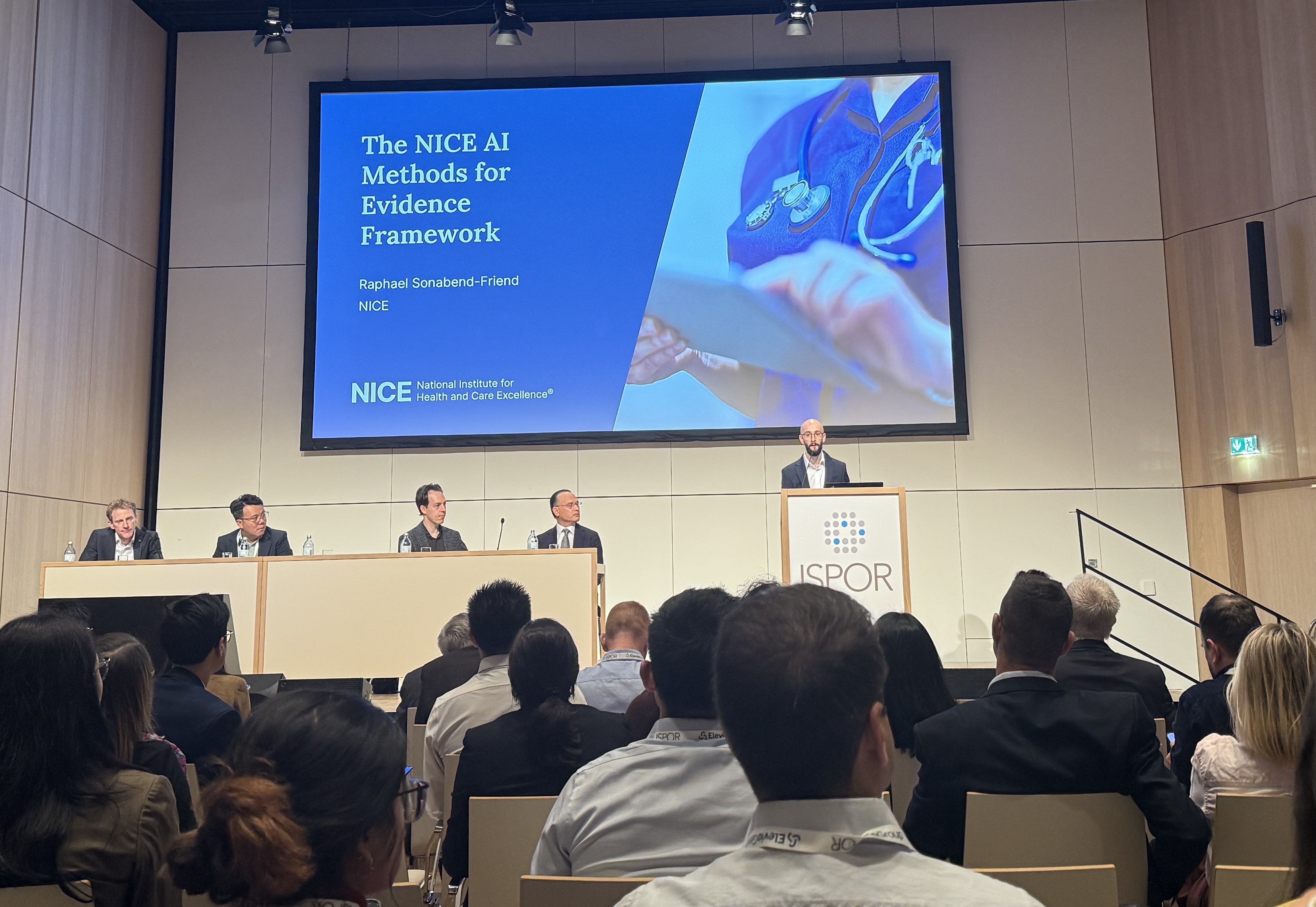
Raphael Sonabend-Friend (NICE) introduced the principles-based, living framework, which covers AI use across primary evidence generation, evidence synthesis, health economic evaluation and technical document development and review. Its 10 principles span data compliance and responsible use; accountability and human oversight; validation, fairness, reproducibility and lifecycle management; and explainability and transparency. The accompanying AI declaration checklist is intended to support proportionate reporting based on the risk and influence of each AI application.
Reflecting that approach, Raphael emphasized that the framework is intended to support responsible adoption rather than create additional barriers to AI use:
“We want AI to be an enabling function, we want the framework to be designed that really supports use of AI.”
Raphael also emphasized the importance of international alignment. NICE is working with the Agency for Care Effectiveness in Singapore and CDA-AMC in Canada, with standardization seen as important for avoiding fragmented expectations across HTA systems. The draft framework is open for public feedback until the end of 2026 and will continue to evolve as the evidence base develops.
From an industry perspective, Sven Klijn (Bristol Myers Squibb) welcomed the technology-agnostic principles and the clarity provided by the declaration checklist. He highlighted the need to apply the framework not only within companies but also across relationships with consultancies and vendors, particularly around validation, traceability and accountability. He also distinguished between “human in the loop” and “human at the helm,” arguing that agentic AI may require a different model of oversight.
Yan Teck Ho (Agency for Care Effectiveness) supported a common international core of terminology, checklists, reporting standards and expectations, while recognizing that complete harmonization is unlikely. James Fotheringham (University of Sheffield; NICE Committee Chair) considered what the framework means for decision-makers, arguing that a shared understanding of “what good looks like” could help committees focus on genuine areas of uncertainty rather than create additional information burden. He also pointed to the potential for AI to help answer evidence questions that currently delay decisions or leave some patient populations without sufficient evidence.
Across the discussion, the emphasis was less on prescribing exactly how AI should be used and more on establishing the conditions under which its use can be trusted, scrutinized and adapted as capabilities develop.
Forum: Are New EU Policies Really Going to Improve RWD Availability to Inform Access Decisions?
Sandipan Bhattacharjee (Bayer) moderated a discussion exploring whether new EU policies will genuinely improve the availability and usability of RWD for HTA, reimbursement and access decisions. The session considered the European Health Data Space (EHDS), the EU HTA Regulation and related initiatives, with a particular focus on whether they will help decision-makers answer unresolved questions while evidence can still influence a decision.
Sandipan framed the discussion from the outset:
“When a HTA body or payer faces unresolved questions, will these policies help deliver a credible answer while that answer can still influence a decision?”
Lorenz Dolanski-Aghamanoukjan (Austrian National Public Health Institute) focused on the practical implications of EHDS for secondary use of health data. He emphasized that organizations need to understand whether they will act as data holders, data users or both, and should begin building internal knowledge now. EHDS is intended to mobilize a broad range of health data, but it also brings responsibilities around access, transparency, permitted uses and publication of results.
Niklas Hedberg (TLV) considered what this means from an HTA perspective. Better infrastructure, he argued, will only address part of the problem. Methodological development and practical pilots will also be needed to establish when RWE is sufficiently robust for decision-making. He highlighted DARWIN EU as an important testing ground, although experience remains much stronger for drug utilization than for more complex questions of relative effectiveness.
His distinction between having data and having data that can support a decision was particularly clear:
“When you have to make a decision, a little data is better than no data. Even some data is better than no data, but any data isn’t better than no data, and my job is to find the difference between some and any.”
Alexander Natz (EUCOPE) brought an industry perspective, pointing to potential uses of EHDS for managed entry agreements, long-term outcomes, rare diseases and post-launch evidence generation. He welcomed the opportunity created by greater data access, while stressing that the system needs to remain practical for those expected to use it.
“We need to keep it simple. If that is getting too complicated, I think we might have missed the opportunity.”
Audience discussion highlighted questions that remain unresolved, including the transportability of non-European data, how public and private datasets will be incorporated, and whether common EU guidance on RWE methods will emerge. The discussion also returned to a broader methodological issue: Europe may soon have access to more data, but greater availability will only translate into better decisions if there is shared confidence in how those data should be interpreted and used.
Forum: From Experience to Evidence: Building Patients’ Capabilities for Patient Experience Data (PED) in HTA
The growing role of patient experience data (PED) in HTA, and the skills needed to generate and use this evidence, were explored in a session moderated by Maria Dutarte (EUPATI). Drawing on EUPATI’s HTA4Patients project, Maria discussed the importance of education and training as patients increasingly contribute both evidence and their perspectives to HTA under the EU HTA Regulation.
Anke-Peggy Holtorf (Health Outcomes Strategies) stressed the importance of clearly defined research questions, methodological rigor and collaboration between patients and researchers, while highlighting the lack of established standards and inconsistencies in how HTA bodies assess and incorporate PED.
From an industry perspective, Jose Diaz (Bristol Myers Squibb) argued that evidence generation should begin with questions that matter to patients, supported by appropriate methodologies and clearer expectations from HTA bodies, including dedicated sections for PED in submission dossiers and greater transparency about how this evidence informs decisions. He reinforced the value of combining evidence generation with direct patient involvement, noting that:
“Patient experience data strengthens the evidence, and having patients in the room strengthens the decision.”
Claas Roehl (EUPATI Austria) drew on experiences in neurofibromatosis type 1 to illustrate how patient-generated evidence has helped identify unmet needs and inform improvements in specialist care and patient support services. Encouraging collaboration between patients and researchers from the outset, he argued that “patients don't need to become researchers, but let's make them co-researchers.”
Alan Balch (Patient Advocate Foundation and National Patient Advocate Foundation) discussed the importance of representative patient involvement and capturing the practical burdens of living with a condition, including transportation difficulties, disruption to work and caregiving responsibilities. He also outlined initiatives led by the ISPOR Patient Council to strengthen patient engagement in research, emphasizing that meaningful engagement and patient-centered evidence are inseparable.
The wider discussion addressed research ethics, the need to demonstrate how patient input influences HTA decisions and the integration of patient preferences. Concluding the session, Maria reinforced that PED should complement, rather than replace, clinical evidence and direct patient engagement. She also highlighted EUPATI’s ongoing work to develop dedicated training modules to support patient participation in HTA.
Issue Panel: Delay or Prepare? Navigating EU HTA in the Era of MFN-Driven Launch Uncertainty
The intersection of US Most-Favored-Nation (MFN) pricing policies and the EU JCA is creating uncertainty around pharmaceutical launch strategies, evidence generation and patient access. Drawing a standing-room-only audience, the session, moderated by Eric Faulkner (Passage Health Associates), examined how manufacturers should approach JCA preparation when European market entry remains uncertain.
Drawing on recent industry research, Eric discussed the potential for delayed or forgone European launches, alongside the increasing complexity and administrative burden of JCA submissions. He questioned whether extensive evidence packages and multiple PICO questions necessarily improve decision-making, calling for greater transparency, earlier stakeholder engagement and a more proportionate approach to assessment.
Diane Munch (GSK) explained that launch strategies need to be considered on an asset-by-asset basis, using scenario-based planning that takes into account indications, competition, pricing and patient populations. She also suggested reconsidering the timing of JCA, proposing that assessments conducted two to three years after launch could incorporate RWE to provide a more complete picture of a medicine’s value.
Joerg Ruof (European Access Academy) drew a distinction between centralized clinical assessment at the EU level and national pricing and reimbursement decisions, warning that continued fragmentation across European markets could undermine patient access. He urged manufacturers to prioritize meaningful patient benefit, while calling for greater clinical expertise and coordination, expressing hope for a “slim, meaningful, straightforward process to discriminate the good from the less good.”
Jon Campbell (National Pharmaceutical Council) examined the potential implications of mandatory international reference pricing for patient access and pharmaceutical innovation. He also stressed the importance of demonstrating medicines’ value and using HEOR to inform development decisions and assess unmet need, arguing that “asking why it matters up front is really critical to the research that we all do.”
Across the discussion, speakers identified the need for more flexible launch planning, proportionate evidence requirements and better coordination between pricing policies, HTA processes and efforts to support patient access. The discussion also considered how China's growing pharmaceutical sector could reshape competition and access to medicines in Europe.
Exhibit Hall Theater: From Routine Care to Decision-Grade Evidence: Scaling Pragmatic Trials Across Health Systems
Bruce Feinberg and Nick Lazaro (Cardinal Health) revisited pragmatic trials in a discussion that extended themes raised at ISPOR Europe 2025, moving the focus from establishing their legitimacy to the practical challenge of embedding them within routine clinical care.
Nick explained that the debate has shifted beyond whether pragmatic research is a valid approach. The more pressing questions now are practical: what should be randomized, how can routinely collected clinical data be used, how can patients be identified without disrupting care and how will regulators, HTA bodies and other decision-makers assess the resulting evidence.
Using the ongoing INSIGHT-IBD study in community gastroenterology as an example, Nick described how practice-level cluster randomization, standardized care pathways and routine clinical workflows can be combined within a pragmatic study. He emphasized that the aim is not simply to reduce study visits, but to generate evidence from within care itself while retaining the governance, quality controls and methodological rigor required for research.
“If you standardize everything, then the model stops being pragmatic. You standardize nothing, and the evidence becomes difficult to compare across practices.”
He also described how technology can support patient identification and data capture, while clinical decisions remain with investigators. Routine EMR data can be supplemented with focused research measures, including patient-reported outcomes, but the study still needs to fit around the clinical workflow rather than impose a parallel research structure.
Bruce reflected on why this matters to clinicians, noting that patients enrolled in conventional trials are often younger, healthier and less diverse than those treated in routine practice, leaving clinicians to understand effectiveness in broader populations after launch. He saw particular opportunities for pragmatic trials in comparative effectiveness research, post-market studies, rare diseases and populations that are difficult to recruit into conventional trials.
He closed by positioning pragmatic trials as one way to address some of the limitations of conventional research and extend evidence generation beyond tightly controlled trial populations:
“Having alternatives, having successful methods that can extend the necessary research that benefits all patients, would be a huge asset going forward.”
Both emphasized pragmatic trials not as a replacement for RCTs, but as a way to extend controlled evidence into routine care and better understand how interventions perform across the patients and settings encountered in practice.
Forum: From Evidence to Enterprise Value: Communicating HEOR's Value to Executive Leadership
In this lively forum session, Jan Hansen (Sanofi) examined how HEOR informs enterprise priorities, influences critical business decisions and creates organizational value. She emphasized that strong evidence does not automatically translate into influence within executive decision-making, encouraging HEOR teams to connect their work explicitly to organizational decisions, patient impact and business risk and, importantly, to “lead with the outcome.”
Russ Montgomery (GSK US) illustrated this through a comparative effectiveness study for a medicine approaching Medicare price negotiation under the Inflation Reduction Act. Limited direct comparative evidence created an opportunity to demonstrate differentiation, but transparent disclosure requirements meant neutral or unfavorable findings also carried business risk. Russ described using descriptive analyses, preliminary comparative work and an internally developed probability-of-success assessment to support the investment case alongside market access and medical colleagues.
The study produced positive findings and informed negotiation strategy and other evidence uses. However, Russ noted that the financial benefit could not be quantified precisely upfront and that similar assessments had not supported pursuing studies for every asset. The example showed how HEOR can inform calculated risk-taking without promising a favorable result.
Clark Paramore (Biogen) described a different evidence gap, where HTA bodies questioned whether a statistically significant endpoint change in a rare neuromuscular disease translated into clinically meaningful benefit. Linking the endpoint to natural-history data helped show what the difference could mean for children’s and teenagers’ daily lives. Securing the rapid analysis required a clear explanation of the reimbursement risk and cross-functional support. Clark reported that the findings had helped reimbursement discussions, although negotiations remained ongoing in several markets.
Craig Roberts (MSD) turned to executive forums where HEOR may contribute only a few slides within a much broader presentation. HEOR is one part of a collective story, he observed, so preparation needs to focus on concise messages, minimal jargon and anticipating questions around value, uncertainty and interpretation. The slides themselves may already be familiar; the real contribution lies in the expertise behind them:
“You're in the room because of what you know that is beyond what's on the slide.”
Across the examples, the distinction was between describing completed research and explaining which decision it informed, what uncertainty it reduced and what might have happened without it. Jan encouraged teams to claim that contribution while recognizing that enterprise decisions are rarely attributable to HEOR alone.
Issue Panel: How to Unlock the Usage of Real-World Data for Medical Devices in Health Technology Assessments?
Moderated by Frederique Debroucker (Medtronic), this session examined how RWE can support HTA and decision-making for medical devices, drawing on work from the five-year GREG public–private partnership, which brings together 29 organizations across 15 countries to develop practical guidance and tools for the use of RWE in regulatory and HTA decisions.
Frederique set out why devices require a different evidence discussion from medicines. Outcomes depend not only on the technology itself, but also on the operator, center, workflow and care pathway, while rapid product iteration and software updates mean evidence needs can change throughout the lifecycle. RWD may therefore contribute from early development through post-HTA monitoring, but only if devices can be identified accurately and linked to the right clinical context.
Daniel Prieto-Alhambra (University of Oxford) focused on the data and methodological challenges. He highlighted HERON UK, the Health Data Research UK partnership that has mapped hospital and primary care data to a common data model, as an example of efforts to make data more usable across settings. He also showed how difficult device identification can be, with information often either too broad or highly granular and unique device identifiers not consistently mapped across databases.
For Daniel, the priority is not developing more structures, but making existing approaches work consistently across countries:
“I don't think we need more common data models. I think we just need to settle on one way to harmonize data and then use that consistently for medical devices.”
Using knee replacement research, he also illustrated how operator experience can affect outcomes, with learning curves creating an additional challenge when translating trial evidence into routine practice.
Anastasia Chalkidou (NICE) argued that the central HTA question is whether the available data can answer the decision problem. In practice, missing device identifiers, incomplete longitudinal data and difficult linkage may be greater barriers than analytical methods themselves. She also highlighted NICE’s early use assessment approach, where RWE can help address uncertainty while technologies are introduced conditionally.
From an industry perspective, Jana Boleckova (Edwards Lifesciences) emphasized the need for earlier clarity from HTA bodies on evidence requirements, particularly given the investment needed to generate RWE.
“We need to know the guidance early. What we are supposed to do and what is required, and if it has the potential to be accepted, because we have to invest our time, energy, resources and money to develop the RWE.”
Jana also called for closer collaboration between HTA agencies, academia, clinical societies and industry so that guidance is methodologically robust but also practical to implement.
The panellists returned repeatedly to harmonization, data access and earlier anticipation of evidence needs. AI-enabled devices are likely to make those questions more pressing, as rapid iteration increases the need for ongoing evaluation using RWD.
Issue Panel: Bridging the Gap Between Broader Value Frameworks and Research-Ready Decision-Making
The challenges of incorporating broader societal value into HTA and healthcare decision-making were explored in a session moderated by Malina Müller (WifOR Institute). Malina outlined how health interventions can generate benefits beyond healthcare budgets, including increased productivity, the value of unpaid work and wider societal wellbeing. She raised the question of how these dimensions can be measured robustly and incorporated meaningfully into decision-making.
Valentina Prevolnik Rupel (Institute for Economic Research, Slovenia) examined how ageing populations, workforce shortages and limited healthcare capacity are challenging conventional approaches to economic evaluation. She questioned whether healthcare systems have the resources to deliver treatments considered cost-effective, asking:
“Who will perform these services? Where will these services be performed?”
Drawing on Slovenia’s experience with implementing patient-reported outcome measures (PROMs) and AI applications, she stressed the importance of evaluating healthcare innovations in the context of existing clinical workflows and system capacity.
Petra Došenovic Bonca (University of Ljubljana) highlighted fragmented data systems, inconsistent methodologies, cost shifting between budgets and risks of double-counting societal benefits. Describing the challenge of moving from “data rich, information poor” (DRIP) to “data rich, decision ready” (DR2), she called for more effective use of existing datasets, arguing:
“Let's use what we have in a more efficient way.”
She also stressed the importance of accessible data, stakeholder alignment and feedback mechanisms to support timely decision-making.
Wim Goettsch (Zorginstituut Nederland) examined the Netherlands’ mandatory societal perspective in economic evaluations, which includes productivity losses and informal care costs. Drawing on a review of reimbursement dossiers from 2020 to 2025, he noted that the quality of supporting evidence was frequently poor, while the inclusion of these broader costs generally had a limited impact on cost-effectiveness results. His findings raised questions about how effectively societal value can inform decisions without more robust data.
The discussion reinforced the need for proportionate assessments, reliable evidence and greater clarity around how value is defined and measured, alongside practical improvements in data use and healthcare resource allocation.
Looking ahead to Day 3
As ISPOR Europe 2026 moves into its final day, there is still plenty to come across the program. The Evidence Base will be following the closing sessions and research highlights from Vienna, with our final daily round-up bringing together the key discussions from Day 3.
| Register for free today to become a member of The Evidence Base and receive the latest news straight to your inbox. |