

A trial emulation study indirectly comparing tafamidis and acoramidis in transthyretin amyloid cardiomyopathy: the ReplicATTR study
Publication: Journal of Comparative Effectiveness Research
Abstract
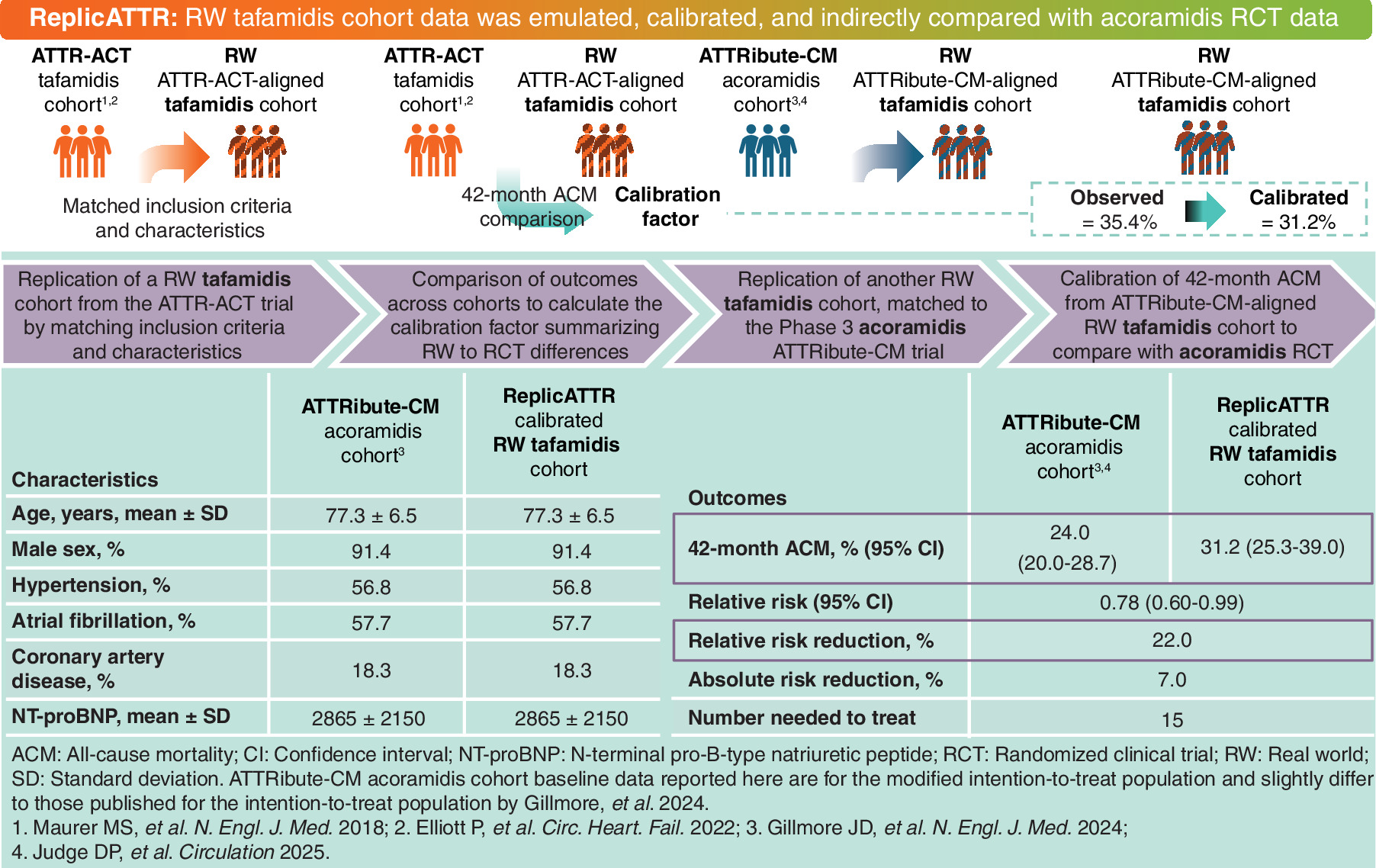
Aim: Tafamidis and acoramidis are transthyretin stabilizers approved for the treatment of transthyretin amyloid cardiomyopathy. We compared the effectiveness of acoramidis versus tafamidis regarding all-cause mortality (ACM). Materials & methods: This study used a hybrid design to compare 42-month ACM with acoramidis versus tafamidis using trial emulation, calibration, and indirect treatment comparison. Two real-world cohorts of participants initiating tafamidis were identified from TriNetX (2019–2024) using observational analogues to emulate ATTR-ACT and ATTRibute-CM trial eligibility criteria and baseline characteristics. A calibration factor was derived by comparing 42-month ACM in the ATTR-ACT tafamidis arm with the ATTR-ACT emulation cohort to quantify the net effect of systematic differences between the populations. This factor was applied to the ATTRibute-CM emulation tafamidis cohort and compared with the ATTRibute-CM acoramidis arm. Using these values and corresponding variance, Monte Carlo simulation (MCS)-estimated medians and percentile-based 95% CIs were derived. Results: In the ATTRibute-CM emulation tafamidis cohort (n = 617), 42-month ACM risk was 35.4% (95% CI: 29.6–42.0), and decreased to a MCS-estimated median of 31.2% (95% CI: 25.3–39.0) after application of the calibration factor (MCS-estimated median: 1.14 [95% CI: 0.91–1.43]). Comparison with 42-month ACM risk observed in the ATTRibute-CM acoramidis arm (24.0%, 95% CI: 20.0–28.7) yielded a relative risk of 0.78 (95% CI: 0.60–0.99), consistent with lower observed ACM risk in the acoramidis arm. Conclusion: Acoramidis was linked to a lower estimated ACM risk in this emulated comparative analysis. These findings should be considered as hypothesis-generating, requiring confirmation in head-to-head studies.
Plain language summary
What is this article about?
Transthyretin amyloid cardiomyopathy is a serious condition caused by abnormal protein buildup in the heart. This buildup can make the heart stiff and less able to pump blood properly. Tafamidis and acoramidis are approved treatments that stabilize this protein and may slow the disease, but they have not been compared directly in a randomized trial.
This study indirectly compared the 42-month risk of death from any cause with acoramidis versus tafamidis. We combined clinical trial findings with real-world data from patients receiving tafamidis. The real-world results were adjusted to make the groups more comparable and account for differences between patients treated in routine practice and clinical trial participants.
What were the results?
Before adjustment, the estimated 42-month risk of death from any cause with tafamidis was 35.4%. After adjustment, the estimated risk was 31.2%, compared with 24.0% among participants receiving acoramidis in the ATTRibute-CM trial. The indirect comparison estimated an 22% lower relative risk of death from any cause with acoramidis, corresponding to a difference of about 7 percentage points.
What do the results mean? Why is this important?
The findings suggest that, in this indirect comparison, acoramidis may be linked with a lower 42-month risk of death from any cause than tafamidis. This provides useful preliminary evidence for patients and clinicians considering these treatments. However, this was an adjusted indirect comparison, not a head-to-head randomized trial. The findings should therefore be interpreted cautiously and confirmed in additional comparative studies.
Graphical abstract
Supplementary Material
File (supplementary material.docx)
References
Papers of special note have been highlighted as: • of interest
1.
Ruberg FL, Grogan M, Hanna M, Kelly JW, Maurer MS. Transthyretin amyloid cardiomyopathy: JACC state-of-the-art review. J. Am. Coll. Cardiol. 73, 2872–2891 (2019).
2.
McDonagh TA, Metra M, Adamo M et al. 2021 ESC Guidelines for the diagnosis and treatment of acute and chronic heart failure: developed by the Task Force for the diagnosis and treatment of acute and chronic heart failure of the European Society of Cardiology (ESC). With the special contribution of the Heart Failure Association (HFA) of the ESC. Eur. J. Heart Fail. 24, 4–131 (2022).
3.
Heidenreich PA, Bozkurt B, Aguilar D et al. 2022 AHA/ACC/HFSA guideline for the management of heart failure: a report of the American College of Cardiology/American Heart Association joint committee on clinical practice guidelines. Circulation 145, e895–e1032 (2022).
4.
Rapezzi C, Aimo A, Serenelli M et al. Critical comparison of documents from scientific societies on cardiac amyloidosis: JACC state-of-the-art review. J. Am. Coll. Cardiol. 79, 1288–1303 (2022).
• A comparison of guidance from five scientific societies identified important differences in the diagnosis, risk stratification and treatment of cardiac amyloidosis, highlighting evidence gaps and areas requiring further investigation.
5.
Maurer MS, Schwartz JH, Gundapaneni B et al. Tafamidis treatment for patients with transthyretin amyloid cardiomyopathy. N. Engl. J. Med. 379, 1007–1016 (2018).
• The randomized ATTR-ACT trial found that tafamidis reduced all-cause mortality and cardiovascular-related hospitalizations and slowed declines in functional capacity and quality of life compared with placebo in patients with transthyretin amyloid cardiomyopathy.
6.
Elliott P, Drachman BM, Gottlieb SS et al. Long-term survival with tafamidis in patients with transthyretin amyloid cardiomyopathy. Circ. Heart Fail. 15, e008193 (2022).
• The ATTR-ACT long-term extension study found that the approved tafamidis dose provided a sustained mortality benefit over a median follow-up of approximately 58 months in patients with transthyretin amyloid cardiomyopathy.
7.
Gillmore JD, Judge DP, Cappelli F et al. Efficacy and safety of acoramidis in transthyretin amyloid cardiomyopathy. N. Engl. J. Med. 390, 132–142 (2024).
• The randomized ATTRibute-CM trial found that acoramidis significantly improved a hierarchical outcome encompassing mortality, cardiovascular morbidity, biomarkers and physical function compared with placebo.
8.
Judge DP, Gillmore JD, Alexander KM et al. Long-term efficacy and safety of acoramidis in ATTR-CM: initial report from the open-label extension of the ATTRibute-CM trial. Circulation 151, 601–611 (2025).
• The ATTRibute-CM open-label extension found that continuous acoramidis treatment through 42 months was associated with sustained clinical benefits in patients with transthyretin amyloid cardiomyopathy.
9.
Aimo A, Castiglione V, Emdin M, Lorenzoni V, Vergaro G. Relative efficacy of tafamidis, acoramidis, patisiran and vutrisiran in patients with transthyretin cardiac amyloidosis: a network meta-analysis. Eur. Heart J. Open 5(6), oeaf147 (2025).
10.
Kelly JW. Transthyretin Kinetic Stabilizers for ATTR Amyloidosis. Cardiol. Ther. 14, 327–331 (2025).
11.
RCT-DUPLICATE. RCT-DUPLICATE. (Accessed 15 January 2026). https://www.rct-duplicate.org/
12.
Schneeweiss S. Enhancing external control arm analyses through data calibration and hybrid designs. Clin. Pharmacol. Ther. 116, 1168–1173 (2024).
13.
Wang SV, Schneeweiss S, Initiative R-D et al. Emulation of randomized clinical trials with nonrandomized database analyses: results of 32 clinical trials. JAMA 329, 1376–1385 (2023).
14.
Wang SV, Russo M, Glynn RJ et al. A benchmark, expand, and calibration (BenchExCal) trial emulation approach for using real-world evidence to support indication expansions: design and process for a planned empirical evaluation. Clin. Pharmacol. Ther. 117, 1820–1828 (2025).
15.
Phillippo DM, Ades AE, Dias S, Palmer S, Abrams KR, Welton NJ. Methods for population-adjusted indirect comparisons in health technology appraisal. Med. Decis. Making 38, 200–211 (2018).
16.
Signorovitch JE, Sikirica V, Erder MH et al. Matching-adjusted indirect comparisons: a new tool for timely comparative effectiveness research. Value Health 15, 940–947 (2012).
• This methods paper introduces matching-adjusted indirect comparison, which reweights individual patient data from one trial to match the published baseline characteristics of another trial, reducing observed population differences when head-to-head evidence is unavailable while remaining vulnerable to unmeasured cross-trial confounding.
17.
Garcia-Pavia P, Kristen AV, Drachman B et al. Survival in a real-world cohort of patients with transthyretin amyloid cardiomyopathy treated with tafamidis: an analysis from the Transthyretin Amyloidosis Outcomes Survey (THAOS). J. Card. Fail. 31, 525–533 (2025).
• The observational THAOS cohort enrolled patients from 2007 to 2023 and found that 42-month mortality decreased over time, demonstrating a secular improvement in ATTR-CM survival.
18.
Austin PC, Stuart EA. Moving towards best practice when using inverse probability of treatment weighting (IPTW) using the propensity score to estimate causal treatment effects in observational studies. Stat. Med. 34, 3661–3679 (2015).
19.
Guyot P, Ades AE, Ouwens MJ, Welton NJ. Enhanced secondary analysis of survival data: reconstructing the data from published Kaplan-Meier survival curves. BMC Med. Res. Methodol. 12, 9 (2012).
20.
Doubilet P, Begg CB, Weinstein MC, Braun P, McNeil BJ. Probabilistic sensitivity analysis using Monte Carlo simulation. A practical approach. Med. Decis. Making 5, 157–177 (1985).
21.
Maurer MS, Cappelli F, Fontana M et al. In participants treated with acoramidis, addition of concomitant tafamidis did not further increase serum TTR levels. J. Am. Coll. Cardiol. 85(Suppl. 12), 1654 (2025).
22.
Maurer MS, Judge DP, Gillmore JD et al. Early increase in serum transthyretin by acoramidis independently predicts improved survival in TTR amyloid cardiomyopathy. J. Am. Coll. Cardiol. 85, 1911–1923 (2025).
23.
Milani P, Sanna GD, Mussinelli R et al. Predictors of early death in patients with wild-type transthyretin cardiac amyloidosis. J. Am. Heart Assoc. 14, e036755 (2025).
24.
Fan Z, Yang Q, Hu Y et al. Evaluating bias in target trial emulation for heart failure across statistical and deep learning methods. Nat. Commun. 17(1), 8618 (2026).
25.
Coleman CI, Martinez R, Torres SA. Methods of identifying transthyretin amyloid cardiomyopathy in secondary data sources: a systematic review. Curr. Med. Res. Opin. 41(11), 2013–2024 (2025).
26.
Damy T, Bourel G, Slama M et al. Incidence and survival of transthyretin amyloid cardiomyopathy from a French nationwide study of in- and out-patient databases. Orphanet J. Rare Dis. 18, 345 (2023).
27.
Peters AE, Solomon N, Chiswell K et al. Transthyretin amyloid cardiomyopathy among patients hospitalized for heart failure and performance of an adapted wild-type ATTR-CM machine learning model: Findings from GWTG-HF. Am. Heart J. 265, 22–30 (2023).
28.
Huda A, Castano A, Niyogi A et al. A machine learning model for identifying patients at risk for wild-type transthyretin amyloid cardiomyopathy. Nat. Commun. 12, 2725 (2021).
Information & Authors
Information
Published In
Copyright
© 2026 The authors. This work is licensed under the Attribution-NonCommercial-NoDerivatives 4.0 Unported License
History
Received: 4 June 2026
Accepted: 2 September 2026
Published online: 14 September 2026
Keywords:
Topics
Authors
Metrics & Citations
Metrics
Article Usage
Article usage data only available from February 2023. Historical article usage data, showing the number of article downloads, is available upon request.
Citations
How to Cite
A trial emulation study indirectly comparing tafamidis and acoramidis in transthyretin amyloid cardiomyopathy: the ReplicATTR study. (2026) Journal of Comparative Effectiveness Research. DOI: 10.57264/cer-2026-0114
Export citation
Select the citation format you wish to export for this article or chapter.