

Evaluation of the efficacy and cost-effectiveness of safinamide versus rasagiline: a systematic review
Publication: Journal of Comparative Effectiveness Research
Abstract
Aim: This systematic review aimed to evaluate the comparative efficacy, safety and cost-effectiveness of safinamide (50/100 mg) versus rasagiline (1 mg) in managing Parkinson’s disease (PD). Materials & methods: Randomized clinical trials were identified through systematic searches of PubMed, Embase and Cochrane databases (last searched September 2023). Eligibility criteria included studies assessing Unified Parkinson’s Disease Rating Scale (UPDRS) scores, On/Off time and adverse events. Risk of bias was evaluated using funnel plots, and data synthesis employed odds ratios, number needed to treat (NNT) and incremental cost-effectiveness ratios, calculated using the current costs of safinamide and rasagiline in Spain. Results: Thirteen trials (n = 4157 participants) were included. Safinamide demonstrated greater efficacy (NNT-UPDRS: 6 vs 8) and safety (number needed to harm-serious adverse events: 135 vs 83) compared with rasagiline. The benefit-risk balance of safinamide was superior, as evidenced by higher likelihood of being helped over harmed ratios. Cost-effectiveness analysis revealed lower costs per NNT for On/Off time with safinamide. While rasagiline treated more patients within a fixed budget, safinamide achieved better responder-to-nonresponder ratios. Conclusion: Safinamide showed superior efficacy, safety and cost-efficiency compared with rasagiline, supporting its use as a preferred adjunct therapy for PD. Limitations include reliance on clinical trial data and Spanish cost models. Future research incorporating real-world evidence is warranted.
Plain language summary
What is this article about?
Parkinson’s disease (PD) is a condition that affects the brain and causes movement problems such as stiffness, shaking and difficulty with balance. As PD gets worse over time, people with the condition may also experience memory and thinking problems. To help manage these symptoms, doctors often use medicines that improve movement and reduce complications. Two such medicines are safinamide and rasagiline, which are used alongside another common treatment called levodopa.
This study compared safinamide and rasagiline to find out which one works better, is safer and is more cost-effective for treating people with PD. Researchers looked at results from 13 studies involving over 4000 people. They measured how well each medicine improved symptoms, how often they caused side effects and how much they cost.
What were the results?
The results showed that safinamide worked slightly better than rasagiline in improving symptoms and had fewer serious side effects. Safinamide also helped reduce the amount of time people spent in ‘Off’ periods (times when their usual medicine stops working well). Although rasagiline could treat more people for the same budget, safinamide was more effective in helping people improve their symptoms.
What do the results mean?
This study helps healthcare providers decide which medicine might be the best option for people with PD, considering both the benefits and the costs. However, the findings are based on clinical trial data and future research is needed to confirm these results in real-world settings.
Supplementary Material
File (supplementary figure.jpg)
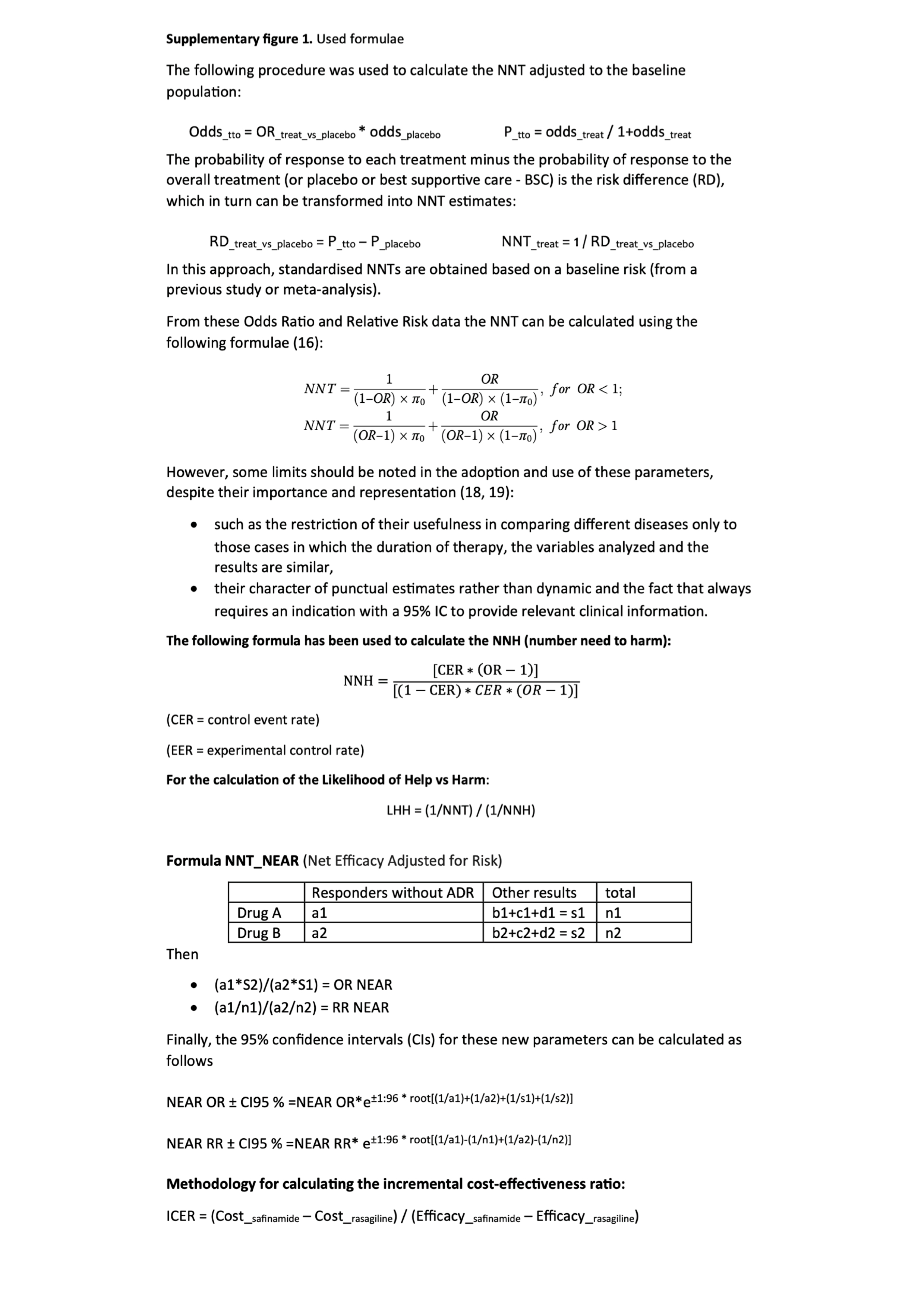
File (supplementary tables.docx)
References
1.
DeMaagd G, Philip A. Parkinson's disease and its management: Part 1: disease entity, risk factors, pathophysiology, clinical presentation, and diagnosis. P.T. 40(8), 504–532 (2015).
2.
Collier TJ, Kanaan NM, Kordower JH. Aging and Parkinson's disease: different sides of the same coin? Mov. Disord. 32(7), 983–990 (2017).
3.
Ball N, Teo WP, Chandra S, Chapman J. Parkinson's disease and the environment. Front. Neurol. 10, 218 (2019).
4.
World Health Organization. Parkinson disease: a public health approach: technical brief (2022).
5.
Kowal SL, Dall TM, Chakrabarti R, Storm MV, Jain A. The current and projected economic burden of Parkinson's disease in the United States. Mov. Disord. 28(3), 311–318 (2013).
6.
Ou Z, Pan J, Tang S et al. Global trends in the incidence, prevalence, and years lived with disability of Parkinson's Disease in 204 countries/territories from 1990 to 2019. Front. Public Health 9, 776847 (2021).
7.
Dorsey ER, Sherer T, Okun MS, Bloem BR. The emerging evidence of the Parkinson pandemic. J. Parkinsons Dis. 8, S3–S8 (2018).
8.
di Biase L, Pecoraro PM, Carbone SP, Caminiti ML, Di Lazzaro V. Levodopa-induced dyskinesias in Parkinson's disease: an overview on pathophysiology, clinical manifestations, therapy management strategies and future directions. J. Clin. Med. 12, (2023).
9.
Tan YY, Jenner P, Chen SD. Monoamine oxidase-B inhibitors for the treatment of Parkinson's disease: past, present, and future. J. Parkinsons Dis. 12, 477–493 (2022).
10.
EMA. Rasagiline ratiopharm: EPAR summary for the public. EMA/723435/2014. Available at: https://www.ema.europa.eu/en/documents/overview/rasagiline-ratiopharm-epar-summary-public_en.pdf
11.
EMA. Xadago: EPAR – Summary for the public. EMA/181382/2015. Available at: https://www.ema.europa.eu/en/documents/overview/xadago-epar-summary-public_en.pdf
12.
Kim Y, Kim Y, Lee HJ et al. The primary process and key concepts of economic evaluation in healthcare. J. Prev. Med. Public Health 55, 415–423 (2022).
13.
Moher D, Liberati A, Tetzlaff J, Altman DG. PRISMA Group. Preferred reporting items for systematic reviews and meta-analyses: the PRISMA statement. PLoS Med. 6, e1000097 (2009).
14.
Boada JN, Boada C, García-Sáiz M, García M, Fernández E, Gómez E. Net efficacy adjusted for risk (NEAR): a simple procedure for measuring risk:benefit balance. PLoS ONE 3, e3580 (2008).
15.
Mendes D, Alves C, Batel-Marques F. Number needed to treat (NNT) in clinical literature: an appraisal. BMC Med. 15, 112 (2017).
16.
Suurmond R, van Rhee H, Hak T. Introduction, comparison, and validation of Meta-Essentials: a free and simple tool for meta-analysis. Res. Synth. Methods 8, 537–553 (2017).
17.
Sociedad Española de Farmacia Hospitaliria (SEFH). Calculadoras y herramientas sobre subgrupos. Available at: https://gruposdetrabajo.sefh.es/genesis/index.php?option=com_content&view=article&id=45&Itemid=41
18.
Rabey JM, Sagi I, Huberman M et al. Rasagiline mesylate, a new MAO-B inhibitor for the treatment of Parkinson's disease: a double-blind study as adjunctive therapy to levodopa. Clin. Neuropharmacol. 23, 324–330 (2000).
19.
Parkinson Study Group. A randomized placebo-controlled trial of rasagiline in levodopa-treated patients with Parkinson disease and motor fluctuations: the PRESTO study. Arch. Neurol. 62, 241–248 (2005).
20.
Rascol O, Brooks DJ, Melamed E et al. LARGO study group. Rasagiline as an adjunct to levodopa in patients with Parkinson's disease and motor fluctuations (LARGO, Lasting effect in Adjunct therapy with Rasagiline Given Once daily, study): a randomised, double-blind, parallel-group trial. Lancet 365, 947–954 (2005).
21.
Zhang L, Zhang Z, Chen Y et al. Efficacy and safety of rasagiline as an adjunct to levodopa treatment in Chinese patients with Parkinson's disease: a randomized, double-blind, parallel-controlled, multi-centre trial. Int. J. Neuropsychopharmacol. 16, 1529–1537 (2013).
22.
Hanagasi HA, Gurvit H, Unsalan P et al. The effects of rasagiline on cognitive deficits in Parkinson's disease patients without dementia: a randomized, double-blind, placebo-controlled, multicenter study. Mov. Disord. 26, 1851–1858 (2011).
23.
Frakey LL, Friedman JH. Cognitive effects of rasagiline in mild-to-moderate stage Parkinson's disease without dementia. J. Neuropsychiatry Clin. Neurosci. 29, 22–25 (2017).
24.
Lim TT, Kluger BM, Rodriguez RL et al. Rasagiline for the symptomatic treatment of fatigue in Parkinson's disease. Mov. Disord. 30, 1825–1830 (2015).
25.
Hauser RA, Silver D, Choudhry A, Eyal E, Isaacson S. ANDANTE study investigators. Randomized, controlled trial of rasagiline as an add-on to dopamine agonists in Parkinson's disease. Mov. Disord. 29, 1028–1034 (2014).
26.
Borgohain R, Szasz J, Stanzione P et al. Randomized trial of safinamide add-on to levodopa in Parkinson's disease with motor fluctuations. Mov. Disord. 29, 229–237 (2014).
27.
Schapira AH, Fox SH, Hauser RA et al. Assessment of safety and efficacy of safinamide as a levodopa adjunct in patients with Parkinson disease and motor fluctuations: a randomized clinical trial. JAMA Neurol. 74, 216–224 (2017).
28.
Hattori N, Tsuboi Y, Yamamoto A, Sasagawa Y, Nomoto M. ME2125-3 Study Group. Efficacy and safety of safinamide as an add-on therapy to L-DOPA for patients with Parkinson's disease: a randomized, double-blind, placebo-controlled, Phase II/III study. Parkinsonism Relat. Disord. 75, 17–23 (2020).
29.
Barone P, Santangelo G, Morgante L et al. A randomized clinical trial to evaluate the effects of rasagiline on depressive symptoms in non-demented Parkinson's disease patients. Eur. J. Neurol. 22, 1184–1191 (2015).
30.
Wei Q, Tan Y, Xu P et al. The XINDI Study: A randomized Phase III clinical trial evaluating the efficacy and safety of safinamide as add-on therapy to levodopa in Chinese patients with Parkinson's disease with motor fluctuations. CNS Drugs 36, 1217–1227 (2022).
31.
Recio RS, Pablo Alonso Pérez De Ágreda J, José Rabanaque M, Aguilar Palacio I. Understanding the effect of economic recession on healthcare services: a systematic review. Iran J. Public Health 51, 495–507 (2022).
32.
Kulkova J, Kulkov I, Rohrbeck R et al. Medicine of the future: how and who is going to treat us? Futures 146, 103097 (2023).
33.
Chaudhuri KR, Azulay JP, Odin P et al. Economic burden of Parkinson's disease: a multinational, real-world, cost-of-illness study. Drugs Real World Outcomes 11, 1–11 (2024).
34.
Laupacis A, Sackett DL, Roberts RS. An assessment of clinically useful measures of the consequences of treatment. N. Engl. J. Med. 318, 1728–1733 (1988).
35.
Eslava AO, Gil RM, Fuentes MDF, López-Briz E, Latorre FP. Guía de evaluación económica e impacto presupuestario en los informes de evaluación de medicamentos. (2017).
36.
Andrade C. The numbers needed to treat and harm (NNT, NNH) statistics: what they tell us and what they do not. J. Clin. Psychiatry 76, e330–333 (2015).
37.
Straus SE. Individualizing treatment decisions – the likelihood of being helped or harmed. Eval. Health Prof. 25, 210–224 (2002).
38.
Marzo A, Dal Bo L, Monti NC et al. Pharmacokinetics and pharmacodynamics of safinamide, a neuroprotectant with antiparkinsonian and anticonvulsant activity. Pharmacol. Res. 50, 77–85 (2004).
39.
Alborghetti M, Nicoletti F. Different generations of type-B monoamine oxidase inhibitors in Parkinson's disease: from bench to bedside. Curr. Neuropharmacol. 17, 861–873 (2019).
40.
Bodrogi J, Kaló Z. Principles of pharmacoeconomics and their impact on strategic imperatives of pharmaceutical research and development. Br. J. Pharmacol. 159, 1367–1373 (2010).
41.
Bang H, Zhao H. Cost-effectiveness analysis: a proposal of new reporting standards in statistical analysis. J. Biopharm. Stat. 24, 443–460 (2014).
42.
Simoens S. How to assess the value of medicines? Front. Pharmacol. 1, 115 (2010).
43.
Mahdiani H, Münch N, Paul NW. A QALY is [still] a QALY is [still] a QALY? BMC Medical Ethics 25, 35 (2024).
44.
Vallejo-Torres L, García-Lorenzo B, Serrano-Aguilar P. Estimating a cost-effectiveness threshold for the Spanish NHS. Health Econ. 27, 746–761 (2018).
45.
Sacristán JA, Oliva J, Campillo-Artero C et al. ¿Qué es una intervención sanitaria eficiente en España en 2020? [What is an efficient health intervention in Spain in 2020?]. Gac. Sanit. 34(2), 189–193 (2020).
46.
O'Day K, Campbell D. The expanded number needed to treat: applying the concept of NNT to continuous health economic outcomes. Value Health 18, A35 (2015).
47.
Nguyen C, Naunton M, Thomas J et al. Availability and use of number needed to treat (NNT) based decision aids for pharmaceutical interventions. Explor. Res. Clin. Soc. Pharm. 2, 100039 (2021).
48.
Abeynayake I, Tanner CM. The economic impact of OFF periods in Parkinson disease. Am. J. Manag. Care 26, S265–S269 (2020).
49.
Winter Y, Balzer-Geldsetzer M, Spottke A et al. Longitudinal study of the socioeconomic burden of Parkinson's disease in Germany. Eur. J. Neurol. 17, 1156–1163 (2010).
Information & Authors
Information
Published In
Copyright
© 2025 The authors. This work is licensed under the Attribution-NonCommercial-NoDerivatives 4.0 Unported License
History
Received: 10 March 2025
Accepted: 2 July 2025
Published online: 14 August 2025
Keywords:
Topics
Authors
Metrics & Citations
Metrics
Article Usage
Article usage data only available from February 2023. Historical article usage data, showing the number of article downloads, is available upon request.
Citations
How to Cite
Evaluation of the efficacy and cost-effectiveness of safinamide versus rasagiline: a systematic review. (2025) Journal of Comparative Effectiveness Research. DOI: 10.57264/cer-2025-0031
Export citation
Select the citation format you wish to export for this article or chapter.