

Cost implications of reproductive outcomes in adult patients with advanced Hodgkin lymphoma in the European Union: evaluated from the Danish and Italian healthcare and societal perspectives
Abstract
Aim: To estimate the reproductive and economic impact of interim positron emission tomography (iPET)-guided brentuximab vedotin, etoposide, cyclophosphamide, doxorubicin, dacarbazine and dexamethasone (BrECADD) versus iPET escalated etoposide, doxorubicin, and cyclophosphamide, bleomycin, vincristine, procarbazine and prednisone (eBEACOPP) in patients of childbearing potential (POCBP) receiving frontline treatment for advanced Hodgkin lymphoma, using healthcare and societal perspectives in Denmark and Italy. Materials & methods: An exploratory cost-consequence analysis was developed using HD21 POCBP patient-level data, expert-defined composite measures of compromised reproductive ability, and cost data across Denmark and Italy. A hypothetical cohort of 1000 patients was modeled over 5- and 10-year horizons to project natural and assisted reproductive technology (ART) pregnancies and births based on treatment-specific gonadal function recovery and progression-free survival. Analyses incorporated pre-treatment fertility preservation, evolving fertility intentions and scenario analyses using a follicle-stimulating hormone (FSH)-only definition of reproductive recovery. Costs included counselling, preservation, ART, pregnancy outcomes and productivity loss. Results: Treatment with BrECADD was associated with lower fertility-related healthcare costs than eBEACOPP, reflecting higher rates of gonadal function recovery and increased natural conception, which reduced ART use. Savings over 5- and 10-year horizons were, respectively, €546,769 and €971,667 in Denmark, and €141,435 and €259,982 in Italy. Scenario analyses, including evolved intentions, FSH-only recovery and societal perspectives, showed consistent findings. Conclusion: BrECADD is associated with lower reproductive burden and reduced fertility-related costs compared with eBEACOPP, reflecting better preservation of gonadal function and reduced reliance on ART. These findings support the potential broader value of less gonadotoxic regimens in the FLHL setting.
Plain language summary
What is this article about?
This article examines how two chemotherapy treatments for advanced Hodgkin lymphoma, brentuximab vedotin, etoposide, cyclophosphamide, doxorubicin, dacarbazine and dexamethasone (BrECADD) and escalated etoposide, doxorubicin and cyclophosphamide, bleomycin, vincristine, procarbazine and prednisone (eBEACOPP) may affect future fertility and the associated healthcare costs. Given that many people with this cancer are diagnosed during their reproductive years, fertility outcomes are an important part of treatment decisions. The analysis uses clinical evidence from the HD21 trial, which showed that BrECADD is less damaging to gonadal function than eBEACOPP, and applies these findings to estimate the long-term reproductive and economic impact in Denmark and Italy.
How was the research carried out?
Researchers created an exploratory cost-consequence analysis combining HD21 data, expert input and real-world costs. The analysis estimated the number of pregnancies and births, natural or through assisted reproductive technology (ART), over 5- and 10-year periods. It also calculated costs linked to reproductive counselling, preservation, ART use, pregnancy outcomes and productivity loss. Several scenarios were tested, including changing intentions to have children and alternative definitions of fertility recovery.
What were the results?
Using HD21’s reproductive recovery data, the analysis demonstrated that BrECADD leads to lower reliance on ART, resulting in reduced reproduction-related costs and slightly more pregnancies and births than eBEACOPP across both countries.
Why is this important?
Reproductive preservation can significantly affect long-term wellbeing. Treatments that minimize gonadal damage support patients' family-building goals and reduce the economic burden on healthcare systems.
Hodgkin lymphoma (HL) is a rare lymphatic malignancy that accounts for less than 1% of new cancer diagnoses globally [1]. Despite this, HL is one of the most common cancers occurring in adolescent and young adults aged 15–39 years [2]. HL initially presents with swelling of lymph nodes in the neck, armpit or groin [3,4], but other symptoms include recurring fever, night sweats, weight loss, cough, breathlessness, abdominal pain and itching [4,5]. HL shows a bimodal incidence pattern in adults, occurring first in adolescent and young adults, and then in adults aged over 55 years [4,6,7]. The median age at diagnosis is around 39 years [4,6,7]. Adolescents and young adults comprise the largest age group affected by HL, and generally have a high likelihood of cure with current treatment options [8]. Advanced Hodgkin lymphoma (aHL) is defined as Stages III–IV disease, as well as Stage IIB when accompanied by a large mediastinal mass or extranodal spread, and reflects more extensive disease burden beyond the initial nodal regions [1,9,10].
Reproductive preservation is a major concern for patients with HL, particularly given its peak incidence during reproductive years. Many HL survivors express a strong desire to maintain reproductive potential, with fertility often cited as a key factor influencing treatment decisions and long-term wellbeing [11–13]. Patients actively seek information and support from clinicians regarding fertility risks and preservation options before initiating chemotherapy [14]. Initiating fertility discussions at diagnosis for HL is important to patients, given the psychological impact and long-term reproductive concerns associated with treatment-related gonadal dysfunction [15]. Survivorship research highlights that fertility-related concerns persist well beyond treatment, with patients viewing reproductive health as central to their recovery and quality of life (QoL) [13]. Receiving specialized counselling for reproductive loss and pursuing fertility preservation are associated with reduced decisional regret and improved QoL among survivors [16]. Pregnancy prior or during oncologic therapy is not recommended due to increased risks to both the mother and child [17], and attempting conception is recommended at least 1-year post-treatment [18].
Reproductive hormones, including follicle-stimulating hormone (FSH), anti-Müllerian hormone (AMH), oestradiol (E2), testosterone and inhibin B, are central regulators of fertility, with sex-specific roles and a tightly coordinated hormonal interplay that controls gametogenesis and reproductive capacity [19,20].
In females, AMH produced by granulosa cells reflects the quantity of remaining follicles and is the considered the most stable marker of ovarian reserve, while FSH and early-cycle E2 vary as reserve declines [19,20]. The hormonal interplay between these markers regulates folliculogenesis: androgens enhance FSH-receptor expression, AMH restrains premature follicular activation and rising FSH induces aromatase activity, increasing E2, which subsequently suppresses AMH to permit follicular maturation [19,20]. Inhibin B provides additional negative feedback on pituitary FSH. Disruption of this regulatory network may impair ovulation and reduce fertility potential [19,20].
In males, FSH acts on Sertoli cells to support spermatogenesis, while testosterone is essential for sperm production and sexual function. Inhibin B, secreted by Sertoli cells, is the principal negative regulator of FSH and a sensitive indicator of spermatogenic activity [19,20].
There remains no consensus on how additional laboratory markers should be applied to identify ‘compromised reproductive ability’ in patients receiving chemotherapy [21–24]. Outside of semen analysis and uterine imaging, diminished ovarian reserve (DOR), primary ovarian failure (POF) and impaired sperm quality are commonly used indicators. Reproductive outcomes are inconsistently assessed across HL trials, with some reporting hormonal data or semen parameters [19], while others assess only pregnancies or live births [25]. Reduced inhibin B may also indicate impaired spermatogenesis [26]. This lack of standardization in fertility/reproductive recovery assessment complicates interpretation of reproductive outcomes and underscores the need to consider the gonadotoxic effects of frontline HL therapies.
Intensive chemotherapy regimens remain the standard of care in frontline treatment of HL; with newer chemotherapy regimens demonstrating high efficacy across disease stages and generally manageable safety profiles. eBEACOPP (escalated doses of bleomycin, etoposide, doxorubicin, cyclophosphamide, vincristine, procarbazine and prednisone) is highly effective but can cause gonadal dysfunction and detrimental effects on fertility and quality of life [24]. For people living with aHL, the challenge is to further increase the durable remission rates while minimizing long-term treatment-related toxicities [27].
Although intensive chemotherapy regimens are effective in aHL patients younger than 60 years of age [28], they are associated with an increased risk of long-term complications. For patients who cannot tolerate intensive regimens, including patients aged 60 years and older, alternative regimens such as adriamycin, brentuximab vedotin, vinblastine and dacarbazine (A+AVD) or adriamycin, bleomycin, vinblastine and dacarbazine (ABVD) may be considered.
Several components of the current standard of care chemotherapy regimens pose risks to reproductive ability, particularly among patients of childbearing potential (POCBP) [29,30], which leads to detrimental effects on patient QoL [24]. Alkylating agents such as procarbazine and cyclophosphamide are associated with prolonged azoospermia in up to 100% of men living with HL and premature ovarian failure in 5–25% of women with HL younger than 30 years [29]. Notably, semen quality is significantly lower in adult males with HL prior to treatment initiation compared with healthy controls without HL, indicating a baseline vulnerability of reproductive potential that may be exacerbated by chemotherapy [31]. A recent meta-analysis reported suspected infertility rates of 21% in women living with HL and 49% in men living with HL, with infertility risk strongly dependent on the specific chemotherapy regimen used [30]. This underscores the need for therapeutic strategies that minimize additional gonadal damage and preserve reproductive potential.
These findings highlight an ongoing unmet need for frontline treatments that maintain high anti-lymphoma efficacy while reducing gonadotoxicity, particularly for younger patients [24]. In response, the German Hodgkin Study Group (GHSG) developed the BrECADD regimen (brentuximab vedotin, etoposide, cyclophosphamide, doxorubicin, dacarbazine and dexamethasone) by incorporating brentuximab vedotin and replacing the highly gonadotoxic procarbazine with dacarbazine in eBEACOPP. This strategy aimed to reduce both acute and long-term toxicities, including gonadal dysfunction and infertility, associated with escalated BEACOPP (eBEACOPP), while preserving treatment efficacy [24].
The HD21 trial assessed the safety and efficacy of the interim positron emission tomography (iPET)-guided brentuximab vedotin, etoposide, cyclophosphamide, doxorubicin, dacarbazine and dexamethasone (BrECADD) regimen in adults aged 18–60 years with advanced-stage classical HL [24]. At 4 years of follow-up, BrECADD significantly improved progression-free survival (PFS) and demonstrated a more favorable toxicity profile compared with eBEACOPP [24]. A secondary analysis focusing on gonadal function recovery in a POCBP cohort (women <40 years; men <50 years) showed improved reproductive recovery following BrECADD, reflected by lower post-treatment FSH levels, higher AMH and inhibin-B concentration, and significantly higher paternal parenthood rates compared with eBEACOPP [24].
An exploratory cost-consequence analysis was developed to estimate the economic impact of reduced reproductive burden associated with BrECADD compared with eBEACOPP, informed by the HD21 POCBP cohort, incorporating 5- and 10-year projections. To reflect the diversity of the EU, the analysis considered cost perspective of two countries, Denmark and Italy, offering contrasting healthcare settings to contextualize costs related to aHL.
Materials & methods
Framing the analysis
A cost-consequence analysis was undertaken to estimate the total costs and reproductive burden associated with pregnancy and births in POCBP with aHL treated with a frontline oncologic treatment. The analysis was developed to reflect reproductive outcomes in people with aHL treated with BrECADD or eBEACOPP, with flexibility to account for reproductive and ART-related care provided in different settings across Europe.
The analysis focused on the outcomes and costs associated with pregnancies and births, split by natural and ART types over 5- and 10-year time horizons from a Danish and Italian payer and societal perspectives for a hypothetical cohort of 1000 patients. A 5-year time horizon was selected as it aligns to the follow-up of the HD21 trial [24]). Using a starting age of 28 years (based on the mean age from the POBCP cohort in HD21), the 10-year time horizon was assumed to capture the majority of pregnancies and births by the time the cohort reaches 38 years of age. Costs were discounted at 3.0% for Italy and 3.5% for Denmark in line with local guidance [32–34].
Model structure
Design & patient flow
The analysis tracked hypothetical patients depending on whether they had chosen to address the chemotherapy-associated reproductive recovery risk prior to oncologic treatment (i.e., if they had chosen to take up the option of preservation), and by their modeled reproductive ability post-oncologic treatment. Cohort survival was based on treatment-specific PFS; as it was assumed that people whose disease had progressed would not be eligible for childbearing [35]. A model flow diagram can be seen in the Supplementary Figure 1B, and the overall model structure can be seen in Figure 1 with more detail explained below.
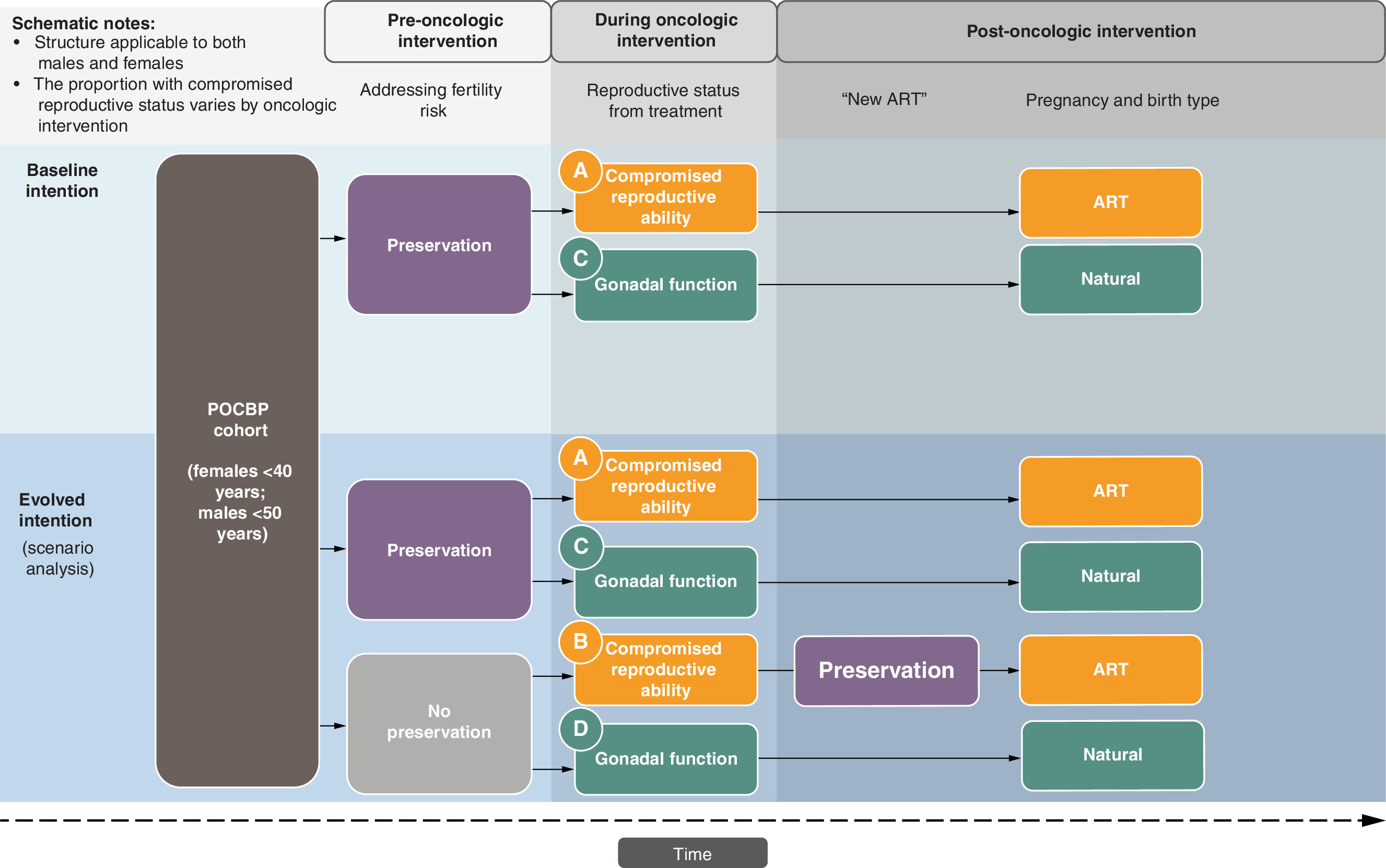
Figure 1. Model structure diagram.
ART: Assisted reproductive technology; POCBP: Patients of child-bearing potential.
The analysis was structured as a cohort model organized into three treatment phases of pre-oncologic intervention, during oncologic intervention and post-oncologic intervention.
•
Pre-oncologic intervention phase: A proportion of patients were assumed to receive fertility counselling and hematologist consultation to advise on how to address possible gonadal toxicity risk from frontline HL treatment. All patients who wanted to address their reproductive risk have preservation (groups A and C; Figure 1).
•
The group not wanting to address their fertility risk were only included within the analysis in a scenario.
•
Oncologic intervention phase: It was assumed that no patient would attempt to conceive through natural or ART methods based on clinical advice. The POCBP cohort received treatment with either BrECADD or eBEACOPP (or iPET ABVD in scenario analysis), which are associated with different gonadal toxicities and subsequent proportions of gonadal function recovery.
•
Post-oncologic intervention phase: Patients with compromised reproductive ability from oncologic treatment (groups A and B; Figure 1) were assumed to become pregnant only through ART, and those with gonadal function (groups C and D; Figure 1) were assumed to have pregnancies by natural conception only. The proportion of people with gonadal function recovery over time was specific to the oncologic intervention received.
The analysis included costs of ART and natural pregnancies up until birth. No costs associated with birth or those in the post-natal period were accounted for. People with successful births were removed from the analysis, whereas those experiencing an abortion, miscarriage or still birth returned to the eligible cohort in the next cycle and were assumed to be able to become pregnant again. Therefore, the end point of the model was at the point of first birth. This simplifying assumption reduced additional complexities associated with modelling further births, such as identifying data on the proportion of people attempting subsequent pregnancy. In addition, criteria associated with publicly funded ART around only those with no children meeting eligibility means affordability is also an implicit criterion in those requiring ART.
The analysis included two different approaches to the included population based on whether patients addressed their fertility risk pre-oncologic intervention and the intention for family building in the future.
The base-case population, referred to as ‘baseline intention’, included only people who had undergone preservation of reproductive material prior to oncologic intervention (groups A and C; Figure 1). It was assumed that people with the intention of future childbearing would have had gamete preservation prior to initiating oncologic therapy upon entering the HD21 trial (i.e., at ‘baseline’). Those that did not receive fertility preservation were removed from the analysis.
A scenario analysis was undertaken to reflect the ‘evolved intention’ for childbearing over time for people who either chose not to, or were not able to, receive fertility preservation prior to initiating oncologic therapy (groups B and D; Figure 1), for example, those needing immediate therapy. The ‘baseline intention’ population is also included in the scenario analysis such that the entire POCBP cohort is used. Therefore, people who did not undergo fertility preservation procedures prior to oncologic treatment were also included within the analysis and were able to have children in the future if their intention for childbearing changed. Those that experienced compromised reproductive ability but who did not previously preserve gametes before initiating oncologic therapy (but intention for childbearing had now changed) were able to commence ‘new ART’ (group B in Figure 1).
Costs included across the phases of care include expert counselling and consultation, testing, preservation and preservation complications, gonadotropin-releasing hormone prescriptions, gamete storage, ART, pregnancy complications, menopause care and optional societal costs.
A summary of the key assumptions of the evaluation is presented in Supplementary Table 7. The primary outcomes from the analysis were total health system cost, and number of pregnancies and births for the total population. Results are reported in Euros, with the analysis for Denmark conducted using Danish Krone (DKK), and converted to Euros (€) using a 0.13 conversion rate for presentational purposes [36].
Secondary outcomes of cost per pregnancy and cost per live birth (CPLB) are also included (per treatment, and incrementally between treatments) to validate outcomes with clinicians.
Data collection methods
Consultation with experts to define the compromised fertility composite outcome
A focus group comprised of five clinicians was consulted to identify what would be the most appropriate outcome for measuring compromised reproductive ability, given there is little consistency on the measures and thresholds used in oncology fertility analyses [21–24].
To inform discussions with the focus group, a targeted literature review was undertaken to identify the outcome data on fertility in patients with HL, including for ABVD which was not included within the HD21 trial. See Supplementary Table 11 for a summary of fertility data collected from published literature. Data on FSH, AMH and testosterone were reported, as well as a variety of other measures of fertility; however, there was a large variation in whether thresholds to represent fertility recovery post-treatment were reported, and if so, a lack of consistency in what those thresholds were. Where no thresholds were reported, information such as mean levels of AMH or testosterone were not sufficient to use as proxies to calculate what proportion of patients had compromised fertility without patient level data. Comparing mean levels to those at baseline was one possibility, however this has limitations, as clinician input identified that recovery to baseline was not a good measure, especially in males, as testosterone levels at baseline may already be lower than normal due to lymphoma. The focus group concluded that compromised reproductive ability should be defined as a composite hormonal outcome with sex-specific criteria. For females, compromised reproductive ability was defined as levels of AMH (<1 ng/ml), FSH (>10 IU/l) and E2 (>75 pg/ml assessed at day 3 of the menstrual cycle). For males, compromised reproductive ability was defined as total testosterone (≤10 nmol/l) and FSH (≤0.9 or >7 IU/l). People would be considered to have recovered their reproductive ability only if none of the sex-specific criteria were met. Therefore, this analysis compared the treatment arms from the HD21 trial applying these composite end points to available patient level data (Supplementary Table 9). A scenario analysis was conducted using FSH recovery levels alone (Supplementary Table 10), where compromised reproductive ability was defined as FSH levels >25 U/l for women and >15 U/l for men, consistent with the thresholds used in the HD21 fertility recovery analysis [24].
Model data
POCBP cohort data from HD21 and local epidemiological data for each country was used to inform population characteristics, preservation rates and births resulting from pregnancies as well as treatment-specific PFS and compromised reproductive ability data for BrECADD and eBEACOPP. Compromised reproductive ability data was based on a composite of AMH/FSH/ E2 for females and testosterone/FSH for males.
Costs data in the Danish and Italian settings were obtained from publicly available literature and clinical interviews. A micro-costing approach was used where possible in both the Danish and Italian models; however, in the Danish analysis a diagnosis-related group (DRG) costing approach based on group-level public tariff data was used for preservation and publicly funded ART costs, given how costing is determined in Denmark.
A summary of the key data used in the analysis is presented in Supplementary Table 8. [37–66]
Sensitivity analysis
Scenario analyses were conducted for each of the Danish and Italian settings:
•
The ‘evolved intention’ population scenario was used to explore how the changing preferences for childbearing overtime may impact birth and cost outcomes.
•
Scenario analyses using compromised reproductive ability based specifically on FSH (‘FSH only’) were conducted to allow for the inclusion and comparison of iPET ABVD (hereafter ABVD) with the two HD21 treatments (Supplementary Table 10). This comparison was included given ABVD is considered an aHL standard-of-care in geographies such as Italy [67] and for patients that cannot tolerate intensive regimens [28]. PFS and gonadal function recovery for ABVD was taken from the RATHL study [68]. The definition of patients with FSH recovery (concentration of ≤25 IU/l) was aligned to HD21. No data for ABVD FSH recovery for males were identified, therefore male ABVD gonadal function recovery based on FSH was assumed to be equivalent to male BrECADD data from HD21.
•
Finally, a scenario was conducted for the baseline intention population (using composite compromised reproductive ability data) with a societal perspective including costs associated with productivity loss due to patient absenteeism, stress and attendance of reproductive care appointments (Supplementary Table 6).
Results
Base-case results
Base-case results are presented for the baseline intention population using composite compromised reproductive ability data (Table 1) and results of the scenario analyses are presented in the supplement. Costs results are presented in Euros (€) over 5- and 10-year time horizons in both the Danish and Italian settings, using a hypothetical cohort of n = 1000 patients.
| BrECADD vs eBEACOPP | 5-year time horizon | 10-year time horizon | |||||
|---|---|---|---|---|---|---|---|
| BrECADD | eBEACOP | Incremental (BrECADD vs eBEACOPP) | BrECADD | eBEAC | Incremental (BrECADD vs eBEACOPP) | ||
| Denmark† | Total cost | €1,981,173 | €2,482,597 | -€501,424 | €2,230,451 | €3,067,351 | -€836,900 |
| Total pregnancies‡ | 270 | 257 | 13 | 485 | 469 | 16 | |
| Total births‡ | 222 | 212 | 10 | 399 | 386 | 13 | |
| Italy | Total cost | €1,268,334 | €1,399,435 | -€131,101 | €1,396,288 | €1,624,058 | -€227,769 |
| Total pregnancies‡ | 221 | 219 | 2 | 396 | 396 | 0 | |
| Total births‡ | 182 | 180 | 1 | 326 | 326 | 0 | |
†
Analysis for Denmark conducted using Danish Krone (DKK), and converted to Euros (€) using a 0.13 conversion rate for presentational purposes [36].
‡
HD21 POCBP cohort and local epidemiological data for each country was used to estimate preservation, pregnancy and births resulting from pregnancies over the designated time horizon.
BrECADD: Brentuximab vedotin, etoposide, cyclophosphamide, doxorubicin, dacarbazine and dexamethasone; eBEACOPP: Escalated bleomycin sulphate, etoposide phosphate, doxorubicin hydrochloride, cyclophosphamide, vincristine sulphate, procarbazine hydrochloride and prednisone.
Denmark
In Denmark, for a hypothetical cohort of 1000 patients, BrECADD is associated with total cost savings of €501,424 compared with eBEACOPP, and an additional 13 pregnancies and 10 births over a 5-year time horizon. Total cost savings increase to €836,900 over a 10-year period, with 16 additional pregnancies and 13 births respectively. Cost savings predominantly come from the reduced use of ART following treatment with BrECADD (Supplementary Table 1).
Italy
In Italy, for a hypothetical cohort of 1000 patients, BrECADD is associated with total cost savings of €131,101 compared with eBEACOPP, and an additional two pregnancies and one births over a 5-year time horizon. Total cost savings increase to €227,769 over a 10-year period, with similar numbers of pregnancies and births between treatments. Cost savings predominantly come from the reduced use of ART following treatment with BrECADD. Healthcare costs were significantly lower in Italy compared with Denmark, hence the incremental costs being lower in the Italian analysis (Supplementary Table 2).
Scenario results
Evolved intention population scenario analyses
In a Danish setting, scenario analysis using the evolved intention population with composite compromised reproductive ability data showed that BrECADD is associated with cost savings of €1307,807 and €1733,783 versus eBEACOPP over 5- and 10-year time horizons, respectively (Supplementary Table 4), and an increase in births and pregnancies. In line with the baseline intention population base-case analysis, cost savings are mainly driven by the reduced use of ART following treatment with BrECADD.
The evolved intention population scenario in an Italian setting showed that BrECADD is associated with savings in cost savings of €368,420 and €504,125 versus eBEACOPP over 5- and 10-year time horizons, respectively (Supplementary Table 4), and an increase in births and pregnancies. These cost savings are due to lower post-oncologic gamete preservation and ART use with BrECADD.
FSH only scenario analyses
As with the composite outcome, BrECADD is associated with cost savings compared with eBEACOPP across 5- and 10- year time horizons in both Denmark and Italy based on FSH compromised reproductive ability data (Supplementary Table 5). There are however country-specific differences in outcomes, with BrECADD having a higher number of pregnancies and births than eBEACOPP in the Danish analysis, but fewer pregnancies and births in the Italian analysis at both timepoints.
When compared with ABVD, BrECADD has generally marginally higher total costs, and marginally higher outcomes at 5 years, and at 10 years BrECADD has again marginally higher costs but slightly lower outcomes than ABVD. This is due to ABVD having slightly higher proportions of female patients with reproductive ability from year two onwards compared with BrECADD (male data is assumed to be equivalent). Patient cohort size and reproductive recovery drive these results, but overall differences are small between treatments relative to the total costs.
Societal perspective scenario analyses
When a societal perspective is used the cost savings associated with BrECADD compared with eBEACOPP increase in both the Danish and Italian settings, due to lower productivity loss from patient absenteeism, stress and attendance of reproductive care appointments for patients treated with BrECADD (Supplementary Table 6).
Discussion
Reproductive outcomes across Europe are increasingly relevant, given the declining birth rates in recent decades. The total fertility rate across the EU reached a historic low in 2023 of 1.38 live births per woman [69]. These trends are characterized by these historically low fertility rates and an increasing average age of mothers at first childbirth [69,70]. Notably, Italy has the highest average age of women at first birth among EU countries, at 31.8 years. This underscores the relevance of this analysis in estimating reproductive burden in POCBP with aHL and the importance of access to treatment with reduced gonadotoxicity.
Across both the Italian and Danish model outputs, BrECADD is consistently associated with lower pregnancy- and childbirth-related costs compared with eBEACOPP, largely due to better preservation of gonadal function, and reduced reliance on ART [24,71]. These differences align with findings from the HD21 trial, which demonstrated lower gonadotoxicity with BrECADD. This correlated to a higher proportion of patients having the option of conceiving naturally overtime [24,71]. Regimens that better preserve gonadal function are likely to reduce reliance on ART, which is a major cost driver due to expenses for consultations, hormonal stimulation, procedures and storage of cryopreserved material. Therefore, any reduction in ART use is likely to have a direct impact on overall economic burden. It is important to note that the main driver of results is gonadal function recovery in males more so than females, as there are larger differences in recovery rates from the data between treatments in males compared with females. Faster and more complete recovery of gonadal function not only improves clinical outcomes but also mitigates downstream costs, making these two elements central to the projections of the analysis across both payer and societal perspectives. Costs associated with reproductive outcomes are substantially higher in the Danish setting compared with Italy, driven by higher preservation and ART procedure costs in Denmark where gross domestic product per capita and living costs are higher [72].
The inclusion of societal costs increases the costs savings associated with BrECADD in both the Danish and Italian settings, as BrECADD was observed to require less ART and therefore treated patients incur fewer costs associated with productivity loss due to patient absenteeism, stress and attendance of reproductive care appointments when compared with patients treated with eBEACOPP.
Extending the analytical time horizon substantially influences the estimated CPLB. Over longer periods, patients treated with BrECADD are more likely to achieve live births compared with those receiving eBEACOPP, due to better preservation of gonadal function and superior PFS [24,71]. This increase in the number of live births for BrECADD expands the denominator in CPLB calculations, thereby reducing the per-birth cost. In contrast, the corresponding increase for eBEACOPP remains limited due to prolonged gonadal impairment and lower PFS, resulting in a comparatively higher CPLB. Consequently, the economic advantage of BrECADD becomes increasingly pronounced with time.
The evolved intention population scenarios represented an increase in total costs savings in both the Danish and Italian settings driven by higher demand for ART in individuals treated with eBEACOPP compared with BrECADD. The evolved intention group may include some of the more severely affected patients who were unable, due to the severity of the disease and requirement for immediate treatment, to undergo fertility preservation procedures before initiating oncologic therapy.
Results for both the composite end point and the FSH-only end point were directionally consistent in terms of costs, with BrECADD associated with lower pregnancy- and childbirth-related costs compared with eBEACOPP. This alignment across end points reinforces the robustness of the model's findings. Results for BrECADD were similar to ABVD, which is expected based on similar rates of female gonadal function recovery based on FSH between the two treatments (male recovery was assumed equal to BrECADD due to paucity of data).
The lower pregnancy and birth outcomes for BrECADD versus eBEACOPP in the Italian FSH-only scenario analyses is because the probability of a natural pregnancy using Italian data [73] is lower than that of Danish data [74]. As eBEACOPP has a far lower recovery rates, there are a higher number of people using ART, and the pregnancies and births resulting from ART (which are equivalent between each country) overtake that of the natural pregnancies and births when using BrECADD in the Italian setting using the FSH-only end point. This leads to a somewhat contradictory result of treatment with worse gonadotoxicity outcomes leading to overall slightly more pregnancies and births. This is potentially a phenomenon of the structure of the model, where people remain within the model until they have their first birth, which may differ in reality.
Beyond the economic implications, it is important to consider the broader consequences of treatment-related gonadal dysfunction, including psychological distress and long-term reproductive concerns. These impacts highlight the value of regimens such as BrECADD, which offer improved preservation of reproductive potential compared with more gonadotoxic alternatives [15].
Research indicates that infertility negatively affects QoL for both men and women, albeit in different ways: women often experience greater emotional and physical burden, while men report more relational distress [75]. Given that BrECADD is associated with reduced impairment of reproductive ability compared with more gonadotoxic regimens, this benefit is likely to translate into improved QoL outcomes alongside economic advantages [24,76].
This analysis is, to the authors’ knowledge, the first reproductive outcomes cost-consequence analysis in the clinical context of HL. A more comprehensive and conventional economic analysis was not developed due to reproductive outcomes being a supplementary outcome to the primary survival benefits of BrECADD and given the variation in reproductive data collected in clinical trials (Supplementary Table 11). The analysis was conducted using data from the HD21 trial, providing a reliable and clinically relevant foundation for its predictive capabilities. The approach and inputs have been extensively reviewed and assessed by key opinion leaders supporting the credibility, clinical plausibility and potential utility of the analysis.
Given the scope of the analysis using secondary outcomes, treatment acquisition costs were not included, and additional outcomes such as overall survival and QoL impacts were not captured. While this may limit the comprehensiveness of the assessment, the cost-consequence analysis approach provides valuable insights into the economic implications of fertility-related outcomes, which are not typically addressed in conventional cost-effectiveness or budget impact analyses.
The assumptions around compromised fertility and recovery only account for the chemotherapy-specific impact on reproductive function. It does not incorporate structural causes of infertility (e.g., ovarian, endometrial, or anatomical factors) and therefore assumes no other underlying infertility complications. However, as the model’s primary intention is to identify costs associated with chemotherapy-specific treatment in HL, this scope was considered appropriate for the analysis. Furthermore, it is expected that other structural causes of infertility would be evenly distributed between the treatment groups. Additional simplifying assumptions were made in attempt to streamline the analysis, such as assuming that the analysis would stop at first birth and those with unsuccessful pregnancies/births would attempt further reproduction.
The availability of data to inform the analysis was a key determinant in the research methodology. Alternative modelling approaches, such as a formal Markov model or individual patient-level simulation, could have been considered. These methods allow for more granular tracking of patient trajectories over time and across treatment cycles, enabling more precise assignment of costs and outcomes. However, such approaches have substantially greater data requirements to model such transitions over time, increasing methodological complexity and uncertainty.
There is no consistent approach taken across aHL trials to assess chemotherapy patients’ reproductive ability or ‘compromised reproductive ability’ (Supplementary Table 11), and individual assessments can potentially lack sensitivity as markers of the recovery of reproductive ability [77]. The model did not incorporate semen analysis data, considered a key investigational procedure to assess male fertility [78], as this was not consistently reported in HD21 [24]. Inhibin B was collected for males in the POCBP cohort but was not included in the analysis. This was based on expert opinion that the marker is not widely used by oncologists and is becoming less relevant as a measure of reproductive ability for fertility experts. Instead, the definition of compromised reproductive ability was based on discussion with a focus group of lymphoma and fertility clinical experts, resulting in gender-specific composite outcomes using multiple individual markers of reproductive ability (FSH, AMH and testosterone). Additionally in a scenario analysis, compromised reproductive ability was assumed to be represented by FSH levels alone.
The use of DRG-based costing in the Danish model may limit the accuracy of cost estimates, particularly for complex or individualized care pathways where DRG tariffs may not fully capture variation in resource use or real-world clinical practice. However, DRG-based costing remains a widely accepted approach in Danish health economic analyses and provides a consistent framework for estimating healthcare resource use.
Across both the Italian and Danish settings, BrECADD is consistently associated with lower pregnancy- and childbirth-related costs compared with eBEACOPP in POCBP treated for aHL with frontline therapy. This is largely due to better preservation of gonadal function and reduced reliance on ART. BrECADD is associated with similar reproductive burden costs when compared with ABVD, which has comparable impacts on the reproductive ability of POCBP. This analysis highlights that treatments which can reduce the reproductive burden in POCBP have additional benefits beyond those of treating the disease itself.
Summary points
•
Fertility preservation is a prominent emerging concern for patients with newly diagnosed Hodgkin lymphoma (HL), particularly given the highest incidence of HL is during reproductive years; components of some current preferred chemotherapy regimens (notably procarbazine) pose significant risk of infertility and premature ovarian failure, and there is an inherent gonadal dysfunction in male patients prior to diagnosis, suggestibly connected to their lymphoma.
•
Reduced gonadotoxicity associated with BrECADD compared with the use of eBEACAOPP is likely to result in more natural pregnancies thereby inciting a reduced need for assisted reproductive technology (ART) in POCBP, which in turn is likely to result in a reduction in costs associated with pregnancy and childbirth in this population.
•
Improved natural childbirth rates and resultant cost savings (from reduced use of ART) associated with newly diagnosed, advanced-stage classic HL in POCBP are expected when patients are treated with BrECADD (compared with eBEACOPP).
•
In the HD21 trial, BrECADD demonstrated superior efficacy and safety, including recovered gonadal function (laboratory markers related to gonadal and related pituitary function), pregnancy rates, and natural birth rates in comparison to eBEACOPP.
•
Using outcomes from the HD21 trial and clinical expert opinion, a de-novo cost calculator was developed to analyze the impacts of reduced gonadotoxicity associated with BrECADD compared with eBEACOPP over 5- and 10-year time horizons.
•
Across both the Italian and Danish settings, BrECADD is consistently associated with lower pregnancy- and childbirth-related costs compared with eBEACOPP in POCBP treated for aHL with frontline therapy. This is largely due to better preservation of gonadal function, and reduced reliance on ART. BrECADD is associated with similar reproductive burden costs when compared with ABVD, which has comparable impacts on the reproductive ability of POCBP. This analysis highlights that treatments which can reduce the reproductive burden in POCBP have additional benefits beyond those of treating the disease itself.
Author contributions
A Molinari, V Paly, N Brighton, M Petrou and V Stache were responsible for study conception and design. All listed authors were responsible for the acquisition, analysis and interpretation of data based on either the full scope or their country-specific analysis. All authors were responsible for drafting the manuscript, and all authors were responsible for critically revising/reviewing the manuscript and for providing final approval. All named authors meet the International Committee of Medical Journal Editors (ICMJE) criteria for authorship for this article, take responsibility for the integrity of the work, and have given their approval for this version to be published.
Acknowledgments
The project authors acknowledge Ethan Maughan at Source Health Economics for their medical writing and editorial support.
Financial disclosure
This work was funded by Takeda Pharmaceuticals America Inc. (MA, USA).
Competing interests disclosure
N Brighton and M Petrou are employees of Source Health Economics. Source Health Economics receives consultancy fees from major pharmaceutical companies, including Takeda Pharmaceuticals. A Molinari, V Stache, A Dydensborg and V Paly are salaried employees of Takeda Pharmaceuticals. The authors have no other relevant affiliations or financial involvement with any organization or entity with a financial interest in or financial conflict with the subject matter or materials discussed in the manuscript apart from those disclosed.
Writing disclosure
Medical writing and editorial support were provided by Ethan Maughan of Source Health Economics and were funded by Takeda Pharmaceuticals.
Ethical conduct of research
This article is based on previously conducted studies and does not involve any new studies of human or animal subjects performed by any of the authors.
Data sharing statement
The authors certify that this manuscript reports the secondary analysis of clinical trial data that have been shared with them, and that the use of this shared data is in accordance with the terms (if any) agreed upon their receipt. The datasets generated during and/or analyzed during the current study are available from the corresponding author upon reasonable request.
Open access
This work is licensed under the Creative Commons Attribution 4.0 International License (CC-BY 4.0). To view a copy of this license, visit https://creativecommons.org/licenses/by/4.0/.
Supplementary Material
File (supplementary materials.docx)
References
Papers of special note have been highlighted as: • of interest; •• of considerable interest
1.
World Health Organization. Global cancer observatory. Hodgkin lymphoma. (2022). https://gco.Iarc.Who.Int/media/globocan/factsheets/cancers/33-hodgkin-lymphoma-fact-sheet
2.
Heneghan M, Renfro L, Wu Y et al. Age-related differences in presentation among pediatric, adolescent, and young adults with mixed cellularity vs. Nodular sclerosis histology Hodgkin lymphoma on children's oncology group treatment and registry trials. Blood 146(Suppl. 1), 1849 (2025).
3.
Huang J, Pang WS, Lok V et al. Incidence, mortality, risk factors, and trends for Hodgkin lymphoma: a global data analysis. J. Hematol. Oncol. 15(1), 57 (2022).
4.
Ansell S. Hodgkin lymphoma: a 2020 update on diagnosis, risk-stratification, and management. Am. J. Hematol. 95(8), 978–989 (2020).
5.
Kaseb H, Babiker H. Hodgkin lymphoma. StatPearls (2023).
6.
Kahn JM, Kelly KM. Adolescent and young adult Hodgkin lymphoma: raising the bar through collaborative science and multidisciplinary care. Pediatr. Blood Cancer 65(7), e27033 (2018).
7.
Ward E, DeSantis C, Robbins A, Kohler B, Jemal A. Childhood and adolescent cancer statistics, 2014. CA Cancer J. Clin. 64(2), 83–103 (2014).
8.
Flerlage JE, Metzger ML, Bhakta N. The management of Hodgkin lymphoma in adolescents and young adults: burden of disease or burden of choice? Blood 132(4), 376–384 (2018).
9.
German Hodgkin Study Group. Disease stages and risk factors. https://en.GHSG.Org/disease-stages
10.
Cheson BD, Fisher RI, Barrington SF et al. Recommendations for initial evaluation, staging, and response assessment of Hodgkin and non-Hodgkin lymphoma: the Lugano classification. J. Clin. Oncol. 32(27), 3059–3068 (2014).
11.
Bachanova V, Connors JM. The management of Hodgkin lymphoma during pregnancy. In: Hodgkin Lymphoma: A Comprehensive Overview. Engert A, Younes A (Eds). Springer International Publishing, Switzerland, 325–334 (2020).
12.
Bhurani D, Nair R, Rajappa S et al. Real-world outcomes of Hodgkin lymphoma: a multi-centric registry from India. Front. Oncol. 11, 799948 (2022).
13.
Powis M, Hack S, Fazelzad R, Hodgson D, Kukreti V. Survivorship care for patients curatively treated for Hodgkin's and non-Hodgkin's lymphoma: a scoping review. J. Cancer Surviv. 19(2), 685–700 (2025).
14.
Wang L, Li J, Lu T et al. Perspectives and clinical practices on fertility preservation for young hematologic patients: a qualitative study of healthcare providers across multiple hospitals in China. J. Assist. Reprod. Genet. 42(5), 1415–1423 (2025).
15.
Machet A, Poudou C, Tomowiak C et al. Hodgkin lymphoma and female fertility: a multicenter study in women treated with doxorubicin, bleomycin, vinblastine, and dacarbazine. Blood Adv. 7(15), 3978–3983 (2023).
16.
Letourneau JM, Ebbel EE, Katz PP et al. Pretreatment fertility counseling and fertility preservation improve quality of life in reproductive age women with cancer. Cancer 118(6), 1710–1717 (2012).
17.
Spinner MA, Advani RH. Management of classic Hodgkin lymphoma in pregnancy. Hematol. Oncol. Clin. North Am. 40(2), 231–245 (2026).
18.
Takeda. Data on file. HD21 trial; analysis of patients of child-bearing potential (POCBP). Database lock: 1 October 2025 (2025).
19.
Dewailly D, Robin G, Peigne M, Decanter C, Pigny P, Catteau-Jonard S. Interactions between androgens, FSH, anti-müllerian hormone and estradiol during folliculogenesis in the human normal and polycystic ovary. Hum. Reprod. 22(6), 709–724 (2016).
• Describes the physiological interplay between AMH, FSH and estradiol during folliculogenesis, supporting the biological rationale for the composite fertility endpoints applied in the model.
20.
American Society for Reproductive Medicine. Testing and interpreting measures of ovarian reserve: a committee opinion. (2020). https://www.ASRM.Org/practice-guidance/practice-committee-documents/testing-and-interpreting-measures-of-ovarian-reserve-a-committee-opinion-2020/#
21.
Ciccarone M, Cavaceppi P, Tesei C et al. Effects of ABVD chemotherapy on ovarian function: epidemiology, hormonal dosages and ultrasound morphologic analyses in 270 patients with Hodgkin's disease. Front. Oncol. 13, 1059393 (2023).
22.
Decanter C, Delepine J, Behal H et al. Longitudinal study of AMH variations in 122 adolescents and young adults (AYA) and non-AYA lymphoma patients to evaluate the chemo-induced ovarian toxicity to further personalise fertility preservation counselling. Hum. Reprod. 36(10), 2743–2752 (2021).
23.
Demeestere I, Racape J, Dechene J et al. Gonadal function recovery in patients with advanced Hodgkin lymphoma treated with a PET-adapted regimen: prospective analysis of a randomized Phase III trial (AHL2011). J. Clin. Oncol. 39(29), 3251–3260 (2021).
• Provides important evidence on the use of hormonal biomarkers, including FSH and AMH, to assess gonadal recovery following Hodgkin lymphoma treatment and informed interpretation of fertility-related outcomes in this analysis.
24.
Ferdinandus J, Schneider G, Moccia A et al. Fertility in patients with advanced-stage classic Hodgkin lymphoma treated with BrECADD versus eBEACOPP: a secondary analysis of the multicentre, randomised, parallel, open-label, Phase III HD21 trial. Lancet Oncol. 26(8), 1081–1090 (2025).
•• This pivotal HD21 secondary analysis demonstrates superior gonadal function recovery and improved fertility outcomes with BrECADD versus eBEACOPP, providing the principal clinical evidence underpinning the current economic evaluation.
25.
Amant F, Maggen C, Dierickx D et al. 1069PD – obstetric and maternal outcome of 134 patients with Hodgkin lymphoma diagnosed during pregnancy: results from the INCIP registry. Ann. Oncol. 30, v436 (2019).
26.
Jankowska K, Suszczewicz N, Rabijewski M, Dudek P, Zgliczyński W, Maksym RB. Inhibin-B and FSH are good indicators of spermatogenesis but not the best indicators of fertility. Life (Basel) 12(4), 511 (2022).
27.
Ansell SM. Hodgkin lymphoma: 2025 update on diagnosis, risk-stratification, and management. Am. J. Hematol. 99(12), 2367–2378 (2024).
28.
Diehl V, Sieber M, Rüffer U et al. BEACOPP: an intensified chemotherapy regimen in advanced Hodgkin's disease. Ann. Oncol. 8(2), 143–148 (1997).
29.
Stephanie H, Christophe F, Catherine P. Management of fertility in patients treated for Hodgkin's lymphoma. Haematologica 96(11), 1692–1699 (2011).
30.
Roth-Hochreutener M, Karakitsiou M, Vidal Gutierrez AM et al. P-384 Hodgkin lymphoma – the effect of chemotherapy on gonadal function and fertility is strongly related to the treatment regimen: a systematic review and meta-analysis. Hum. Reprod. 40(Suppl. 1), P–384 (2025).
31.
Viviani S, Caccavari V, Gerardi C et al. Male and female fertility: prevention and monitoring Hodgkin’ lymphoma and diffuse large B-cell lymphoma adult survivors. A systematic review by the Fondazione Italiana Linfomi. Cancers (Basel) 13(12), 2881 (2021).
32.
Ministry of Finance Denmark. Ministry of finance of denmark. 2021. Documentation note – the socio-economic discount rate. Machine translated by Google. See table1 on p. 2, row labeled “real discount rate”. (2021). (Accessed August 2026). https://fm.Dk/media/eywl4qvh/dokumentationsnotat-for-den-samfundsoekonomiske-diskonteringsrente_7-januar-2021.Pdf
33.
Williams AO, Rojanasarot S, McGovern AM, Kumar A. A systematic review of discounting in national health economic evaluation guidelines: healthcare value implications. J. Comp. Eff. Res. 12(2), e220167 (2023).
34.
Italian Medicines Agency. For the preparation of the dossier supporting the application for the reimbursement and pricing of a medicinal product pursuant to the ministerial decree of 2 august 2019. Machine translated by google. See section named “tasso di sconto”. (2020). (Accessed August 2026). https://www.Aifa.Gov.It/documents/20142/1307543/2021.01.22_estratto_linee_guida_sezione_e.pdf
35.
Borchmann P, Moccia A, Greil R et al. BrECADD is non-inferior to eBEACOPP in patients with advanced stage classical Hodgkin lymphoma: efficacy results of the GHSG Phase III HD21 trial. Hematol. Oncol. 41, 881–882 (2023).
36.
Xe.Com 1 DKK to EUR – convert Danish Kroner to Euros=0.13: xe currency converter. (2025). (Accessed 14 January 2025). https://www.Xe.Com/en-gb/currencyconverter/convert/?Amount=1&from=dkk&to=eur
37.
Takeda. Data on file. HD21 trial patients of child-bearing potential (POCBP) publication. Publication data TBC. (2025).
38.
Fabbri R, Vicenti R, Magnani V et al. Ovarian tissue cryopreservation and transplantation: 20 years' experience in Bologna University. Front. Endocrinol. (Lausanne) 13, 1035109 (2022).
39.
Bodri D, Guillén JJ, Polo A, Trullenque M, Esteve C, Coll O. Complications related to ovarian stimulation and oocyte retrieval in 4052 oocyte donor cycles. Reprod. Biomed. Online 17(2), 237–243 (2008).
40.
Mourad S, Brown J, Farquhar C. Interventions for the prevention of OHSS in ART cycles: an overview of Cochrane reviews. Cochrane Database Syst. Rev. 1(1), CD012103 (2017).
41.
Ferdinandus J, Schneider G, Moccia A et al. Gonadal function recovery and fertility in the Phase III German Hodgkin Study Group HD21 trial. Abstract: S228. (2024). https://library.Ehaweb.Org/eha/2024/eha2024-congress/document?C_id=422332&cm_id=437164&type=document437164
42.
Jølving LR, Erb K, Nørgård BM, Fedder J, Larsen MD. The Danish national register of assisted reproductive technology: content and research potentials. Eur. J. Epidemiol. 36(4), 445–452 (2021).
43.
Jewett A, Warner L, Kawwass JF et al. Assisted reproductive technology cycles involving male factor infertility in the United States, 2017–2018: Data from the National Assisted Reproductive Technology Surveillance System. F&S Reports 3(2), 124–130 (2022).
44.
Vigiliano V, Scaravelli G, Spoletini R et al. Medically-assisted reproduction in Italy, 2021 data from the Italian MAR Registry. Minerva Obstet. Gynecol. 78(1), 33–42 (2026).
45.
National Health Service. IVF guidance. (2025). https://www.NHS.UK/tests-and-treatments/ivf/
46.
Data.gov.uk. NHS Kent and Medway ICB expenditure for (April) 2023. (2023). https://www.Data.Gov.Uk/dataset/b7dfbc92-e1c8-427c-845b-205c2317cd53/nhs-kent-and-medway-icb-expenditure-for-april-2023
47.
Italian Ministry of Economics and Finance. Relazione metodologica per la definizione delle tariffe dell'assistenza specialistica ambulatoriale e protesica. https://www.Quotidianosanita.It/allegati/allegato1730970975.pdf
48.
Luke B, Brown MB, Wantman E et al. Cumulative birth rates with linked assisted reproductive technology cycles. N. Engl. J. Med. 366(26), 2483–2491 (2012).
49.
Zhu L, Zhang Y, Liu Y et al. Maternal and live-birth outcomes of pregnancies following assisted reproductive technology: a retrospective cohort study. Sci. Rep. 6(1), 35141 (2016).
50.
Wisborg K, Ingerslev HJ, Henriksen TB. IVF and stillbirth: a prospective follow-up study. Hum. Reprod. 25(5), 1312–1316 (2010).
51.
Chelsom Vogt E, Gómez Real F, Husebye ES et al. Premature menopause and autoimmune primary ovarian insufficiency in two international multi-center cohorts. Endocr. Connect. 11(5), e220024 (2022).
52.
National Health Service inform. Early and premature menopause. (2025). https://www.Nhsinform.Scot/healthy-living/womens-health/later-years-around-50-years-and-over/menopause-and-post-menopause-health/early-and-premature-menopause/
53.
Meschia M, Pansini F, Modena AB et al. Determinants of age at menopause in Italy: results from a large cross-sectional study. Maturitas 15(2), 119–125 (2000).
54.
Sundhedsdata-Styrelsen. DRG tariff. (2026). https://casemix360.Solutions.Iqvia.Com/interactiveprod
55.
Il Ministro Della Salute. Tariffario ambulatoriale dpcm. (2017). https://www.Fioto.It/uploads/blog/allegati/6p1dagcfpf0ogg0488.pdf
56.
Righospitalet. Analysepriser i afdeling for vækst og reproduktion. (2025). https://www.Rigshospitalet.Dk/afdelinger-og-klinikker/julianemarie/vaekst-og-reproduktion/analyser/sider/analysepriser.aspx
57.
Aleric fertility. IVF behandling priser. https://aleris-fertility.Dk/da/priser/ivf-behandling-priser/
58.
IVI fertility. Prices. (Accessed January 2026). https://ivi-fertility.Com/ivf-invitro-price/
59.
Altamedica PMA. Costi pma. (Accessed January 2025). https://www.Altamedicapma.It/costi-pma/
60.
Vercellini P, Bandini V, Buggio L et al. Mitigating the economic burden of GnRH agonist therapy for progestogen-resistant endometriosis: why not? Hum. Reprod. 2023(2), hoad008 (2023).
61.
Medico e Leggi. Teriffe delle prestazioni di assistenza ospedaliera per acuti per tipo di ricovero. (2013). https://www.Medicoeleggi.Com/archivio/405022-1.pdf
62.
Frusca T, Gervasi MT, Paolini D, Dionisi M, Ferre F, Cetin I. Budget impact analysis of SFLT-1/PLGF ratio as prediction test in Italian women with suspected preeclampsia. J. Matern. Fetal Neonatal Med. 30(18), 2166–2173 (2017).
63.
Studio Bonaccorso. Menopause and bioidentical hormones: how much does it really cost? The truth about benefits and myths. (2025). https://studiobonaccorso.It/menopausa-e-ormoni-bioidentici-quanto-costa-davvero
64.
Istituto Nazionale di Statistica. Gross hourly wage per hour paid of employee jobs in euro (average). https://esploradati.Istat.It/databrowser/
65.
Tal R, Botchan A, Hauser R, Yogev L, Paz G, Yavetz H. Follow-up of sperm concentration and motility in patients with lymphoma. Hum. Reprod. 15(9), 1985–1988 (2000).
66.
Sieniawski M, Reineke T, Nogova L et al. Fertility in male patients with advanced Hodgkin lymphoma treated with BEACOPP: a report of the German Hodgkin study group (GHSG). Blood 111(1), 71–76 (2008).
67.
Avigdor A, Trinchese F, Gavini F et al. First-line treatment of Stage IIb to Stage IV classical Hodgkin lymphoma in Italy, Israel, and Spain: patient characteristics, treatment patterns, and clinical outcomes. EJHaem. 3(2), 415–425 (2022).
68.
Anderson RA, Remedios R, Kirkwood AA et al. Determinants of ovarian function after response-adapted therapy in patients with advanced Hodgkin's lymphoma (RATHL): a secondary analysis of a randomised Phase III trial. Lancet Oncol. 19(10), 1328–1337 (2018).
69.
Eurostat. Fertility statistics. (Accessed November 2025). https://ec.Europa.Eu/eurostat/statistics-explained/index.Php?Title=fertility_statistics#data_sources
70.
Council of Europe Commissioner for Human Rights. Sexual and reproductive health and rights in Europe: progress and challenges. (2024). https://rm.Coe.Int/follow-up-report-on-the-2017-ip-on-srhr-sexual-and-reproductice-health/1680aea9b4
71.
Borchmann P, Ferdinandus J, Schneider G et al. Assessing the efficacy and tolerability of PET-guided BrECADD versus eBEACOPP in advanced-stage, classical Hodgkin lymphoma (HD21): a randomised, multicentre, parallel, open-label, Phase III trial. Lancet 404(10450), 341–352 (2024).
• This pivotal Phase III HD21 publication demonstrated improved tolerability and progression-free survival with BrECADD while maintaining high efficacy, establishing BrECADD as a clinically important alternative to eBEACOPP and providing the foundation for subsequent fertility-focused analyses.
72.
World data. Comparison of worldwide cost of living. (2026). (Accessed 26 January 2026). https://www.Worlddata.Info/cost-of-living.php
73.
Rothman KJ, Wise LA, Sørensen HT, Riis AH, Mikkelsen EM, EE H. Volitional determinants and age-related decline in fecundability: a general population prospective cohort study in Denmark. Fertil. Steril. 99(7), 1958–1964 (2013).
74.
Reproductive Medicine Associates. My chances of getting pregnant explained: odds of pregnancy by age chart. (2025). https://rmanetwork.Com/blog/what-are-my-odds-of-getting-pregnant-at-any-age/#what-if-i-cant-get-pregnant-naturally-will-ivf-help
75.
Celda-Belinchón L, Saus-Ortega C, Palop-Muñoz J, Rubio Rubio JM, Ferrandis ED. Quality of life in women and men with infertility: a cross-sectional study. Eur. J. Obstet. Gynecol. Reprod. Biol. 313, 114649 (2025).
76.
Ferdinandus J. Pregnancies and childbirth following advanced-stage HL treatment with BrECADD or eBEACOPP in the GHSG randomized Phase III HD21 trial. ASH. (2023). https://www.Postersessiononline.Eu/173580348_eu/congresos/ash2023/aula/-mon_4437_ash2023.pdf
77.
Barraud-Lange V, Bourdon M, Cavalieri M, Decanter C, Chevillon F. BrECADD and fertility: an ongoing concern. Lancet Oncol. 26(10), e519 (2025).
78.
Minhas S, Boeri L, Capogrosso P et al. European Association of Urology guidelines on male sexual and reproductive health: 2025 update on male infertility. Eur. Urol. 87(5), 601–616 (2025).
Information & Authors
Information
Published In
Copyright
© 2026 Takeda Pharmaceuticals. This work is licensed under the Attribution-NonCommercial-NoDerivatives 4.0 Unported License
History
Received: 21 May 2026
Accepted: 6 October 2026
Published online: 13 November 2026
Keywords:
Topics
Authors
Metrics & Citations
Metrics
Article Usage
Article usage data only available from February 2023. Historical article usage data, showing the number of article downloads, is available upon request.
Citations
How to Cite
Cost implications of reproductive outcomes in adult patients with advanced Hodgkin lymphoma in the European Union: evaluated from the Danish and Italian healthcare and societal perspectives. (2026) Journal of Comparative Effectiveness Research. DOI: 10.57264/cer-2026-0105
Export citation
Select the citation format you wish to export for this article or chapter.