

Mortality risk estimation for autistic older adults: comparing novel machine-learning derived weights versus standard weights for the Charlson Comorbidity Index
Publication: Journal of Comparative Effectiveness Research
Abstract
Aim: We aimed to compare Quan and colleagues (2011) established weights for the Charlson Comorbidity Index (CCI) conditions to autism-specific weights for predicting mortality risk in autistic older adults. Materials & methods: We used inpatient healthcare claims from autistic older adults (aged 65+; n = 2829) using the Medicare Standard Analytic Files from 2021 to 2023. We used a machine learning technique called stochastic hill climbing to assign weights to the 12 CCI conditions to maximize predictive ability for 30-day and 1-year mortality. We then compared the resulting area under the curve (AUC) against the established weights. Results: The established weights had poor predictive ability for 30-day (AUC: 0.68; 95% CI: 0.62–0.74) and 1-year mortality (AUC: 0.67; 95% CI: 0.63–0.72). The autism-specific weights also had poor predictive ability for 30-day (AUC: 0.67; 95% CI: 0.61–0.73) and 1-year mortality (AUC: 0.67; 95% CI: 0.62–0.71). Conclusion: The established and autism-specific CCI weights performed similarly in predicting mortality among autistic older adults. Findings may suggest adjusting CCI weights alone is insufficient to accurately predict mortality risk in autistic older adults, and additional health conditions not currently captured by the CCI may need to be added to better predict mortality in this population. Future studies on developing an autism-specific mortality risk index are warranted.
Plain language summary
What is this article about?
Researchers often use tools like the Charlson Comorbidity Index (CCI) to estimate a person's risk of death. The CCI estimates risk of death based on whether they have 12 health conditions like heart failure, lung disease, dementia, cancer and others. Each of these health conditions is assigned a ‘weight’ for how much it increases a person’s risk of death, based on data from the general population. But autistic older adults tend to have different patterns of health conditions than the general population. Therefore, the usual CCI may not accurately estimate risk of death for autistic older adults. We created new weights for the 12 health conditions in the CCI using data from autistic older adults. We expected that these new autism-specific weights would predict risk of death within 30-days and 1-year more accurately for autistic older adults.
What were the results?
The usual CCI and the new autism-specific version we made poorly predicted risk of death within 30-days and 1-year in autistic older adults. Both versions performed about the same.
What do the results of the study mean?
These findings suggest that changing the weights for the 12 health conditions in the CCI did not help better predict risk of death in autistic older adults. Important health factors that influence risk of death in this group may not be included in the CCI at all. Future research should focus on developing a new tool that includes additional relevant health conditions to better predict risk of death in autistic older adults.
Over the past few decades, improvements in autism awareness and diagnosis have resulted in an increasing number of individuals with autism diagnoses in older adulthood, with 1 in 45 adults having an autism diagnosis in the US [1,2]. Yet despite this demographic shift, we know very little about aging in autistic people, particularly regarding long-term health outcomes like mortality risk. Prospective longitudinal studies are essential for uncovering mechanistic pathways and providing in-depth clinical insights, but it is often cost prohibitive to obtain large, nationally representative samples. In contrast, administrative claims data offer a valuable opportunity to study aging in autism at a population-level, enabling efficient analyses of co-occurring condition patterns and mortality outcomes. While claims data cannot replace the depth of prospective studies, they provide a powerful tool for identifying population-level risks and informing future targeted research.
Previous research shows that autistic older adults have a higher rate and risk of mortality than their nonautistic counterparts [3,4]. This may be attributable to the unique health risks and co-occurring condition patterns seen in autistic older adults. For example, autistic individuals have higher rates of diabetes, dementia, and cardiovascular conditions, which may contribute to mortality differently among autistic individuals compared with the general population [5,6]. Consequently, researchers may underestimate the mortality risk for autistic older adults if they rely on tools developed for the general population.
A commonly used tool in observational claims data research to predict mortality is the Charlson Comorbidity Index (CCI). The CCI was developed in 1987 to predict one-year mortality of breast cancer patients based on 19 weighted conditions, providing a valuable tool for assessing patient risk in clinical and research settings [7]. Researchers developed a weighted index to account for the number and seriousness of co-occurring conditions. The weighted sum of these conditions contributes to the CCI score, which can be utilized in regression models to control for mortality risk. The CCI has been updated over the years, including accommodating changes in coding systems, such as the International Classification of Disease (ICD) from the 9th and 10th editions (ICD-9, ICD-10), and improving predictive accuracy [8,9]. In 2011, Quan and colleagues used administrative records from inpatient hospitalizations to update and validate the CCI; this resulted in 12 weighted conditions with strong predictive ability for 30-day (area under the curve [AUC] = 0.88) and 1-year (AUC: 0.90) mortality for the general population [9]. The CCI provides important foundational work for the healthcare field by offering a standardized method to quantify the burden of co-occurring conditions and predict mortality risk [7]. Its widespread use across clinical research and health services has enabled comparisons of patient outcomes, informed risk adjustment in large datasets, and guided resource allocation [10].
Researchers widely use existing mortality risk indices such as the CCI to predict mortality risk and quantify co-occurring conditions in the general adult population [4,11–13]. However, because autistic older adults experience distinct co-occurring condition patterns, the general population weights may not adequately capture their mortality risk [6,14]. To address this gap, we aimed to develop autism-specific weights for the 12 CCI conditions from Quan et al. [9] to better quantify the 30-day mortality and 1-year mortality risk for autistic older adults. We hypothesized that the novel autism-specific weights for the CCI would have greater predictive ability than the established CCI weights developed by Quan et al. [9] for the general population.
Materials & methods
Data source
Data used in this study were derived from 2021 through 2023 Medicare Standard Analytical Files (SAF), which include limited dataset (LDS) information on 100% of Medicare beneficiaries for these years. SAF includes beneficiary-level healthcare claims data from inpatient, outpatient and skilled nursing facility records. Outpatient files contain all encounters with an institutional-outpatient facility such as hospital outpatient departments, rural health clinics, renal dialysis facilities, outpatient rehabilitation facilities, federally qualified health centers and community mental health centers. They do not include free-standing facilities (e.g., independent clinical laboratories, ambulance providers, free-standing ambulatory surgical centers and free-standing radiology centers).
Study population
Autistic older adults were included in this study if they were aged 65 years or older; were enrolled in Medicare Part A and Part B for 12 months consecutively between 2021 and 2023; had at least one inpatient hospitalization in 2022 to serve as an index hospitalization to anchor extraction of co-occurring conditions and mortality, aligned with the methods of Quan et al. [9]; and had at least one inpatient or two outpatient encounter with a diagnosis code for autism during 1 January 2021 through 31 December 2023. For those with more than one hospitalization in 2022, we used the last observed hospitalization as the index hospitalization, consistent with Quan et al. [9]. Autism diagnoses were identified using ICD-10 codes F84.0, F84.1, F84.5 or F84.9. Those enrolled in Medicare Advantage Plans were excluded from this study.
Measures
Our dependent variables were all-cause 30-day and 1-year mortality after the index hospitalization. Because Medicare receives beneficiary death dates nightly from the United States Social Security Administration, the date of death in the LDS SAF denominator file is up to date as of the day the files were created and only contains dates of death that have been independently validated using the LDS SAF standard procedures. Therefore, we assumed beneficiaries who had recorded no date of death during 2021–2023 were still alive at the end of the observational period. Our independent variables were the established CCI and a novel risk index we constructed as the weighted sum of the 12 CCI conditions using autism-specific weights. Consistent with Quan et al. [9], we used the year prior to index hospitalization as a look-back period to identify the 12 CCI conditions based on diagnosis codes in inpatient healthcare claims: congestive heart failure, dementia, chronic pulmonary disease, rheumatologic disease, liver disease (mild or severe), diabetes with complications, hemiplegia or paraplegia, renal disease, malignancy, metastatic solid tumor and acquired autoimmune deficiency syndrome/human immunodeficiency virus. Supplementary Table 1 provides the ICD-10 codes used to identify these conditions [9,15].
Demographic characteristics, including sex, race/ethnicity, age and US region of residence, were extracted from the Master Beneficiary Summary File as of the date of the index hospitalization. Rurality was determined based on the 2023 USDA Rural-Urban Continuum Code of ‘large metro area – urban population of greater than 1000,000’, ‘small metro area – urban population of less than 1000,000’, ‘metro area adjacent’, ‘non-metro area – urban population of greater than 2500’ and ‘rural area – urban population of less than 2500’ [16].
Data analysis
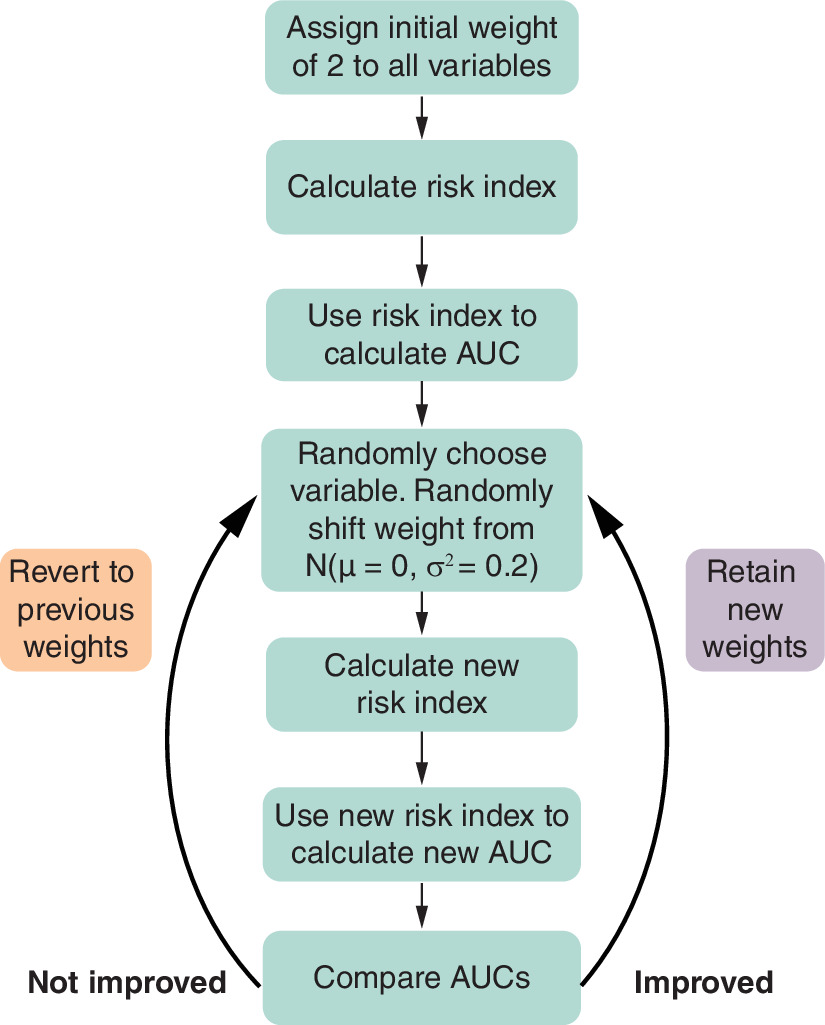
We randomly divided our dataset into two mutually exclusive groups: a 75% training cohort used to build the model, and a 25% validation cohort used to test the model performance. We applied a machine learning method known as stochastic hill climbing (see Figure 1) to iteratively adjust the weights for each condition in the CCI [17]. The algorithm began by assigning an initial weight of 2 to all conditions and computing a mortality risk score for each individual as a weighted sum of binary indicators (presence/absence of each condition). The risk score was then used as the sole predictor in a logistic model for mortality, and model performance was evaluated using the AUC, a standard measure of predictive ability. At each iteration, one condition was randomly selected, and its weight was adjusted by a small random value drawn from a normal (0, 0.2) distribution. The updated weights were retained only if they improved the AUC; otherwise, the previous weights were preserved. To identify an appropriate number of iterations, two preliminary runs with 10,000 iterations were conducted, and convergence in AUC was observed at approximately 1000 iterations, which was used for the final analysis. The stochastic hill climbing algorithm was repeated 50-times to ensure stability, and the final weights were derived from the median of the weights across these 50 runs. We applied the autism-specific and established weights in the validation cohort using logistic regression to predict 30-day and 1-year mortality, controlling for sex and age. We compared the AUC of the models based on the established and autism-specific weights. AUC is interpreted such that 0.5–0.6 was fail, 0.6–0.7 was poor, 0.7–0.8 was fair, 0.8–0.9 was considerable and 0.9–1.0 was excellent predictive ability. We used SAS v9.4 statistical software for all analyses.
Results
The sample included n = 2829 autistic older adults, n = 2122 in the training cohort and n = 707 in the validation cohort (Table 1). Patient characteristics were well-balanced between the training and validation cohorts. Most of the sample was male (68.8%), white (87.6%), and had a median age of 70 years (interquartile range [IQR]: 67–75). The median established CCI score was 2 (IQR: 0–3), and the median autism-specific CCI score was 2.01 (IQR: 0–3.99). The plurality of the sample had diabetes with chronic complications (n = 852, 30.1%), renal disease (n = 701, 24.8%), dementia (n = 699, 24.7%), congestive heart failure (n = 690, 24.4%) and chronic pulmonary disease (n = 566, 20.0%). Observed 30-day and 1-year mortality prevalence were 13.6% and 25.9%, respectively. The portion of patients who died after 30-days or after 1-year were comparable among patients in the training and validation cohorts.
| Characteristic | Training cohort (n = 2122) | Validation cohort (n = 707) | Total sample (n = 2829) |
|---|---|---|---|
| Demographics | |||
| Age at index, years, median (IQR†) | 70 (67, 75) | 71 (67, 75) | 70 (67, 75) |
| Male, n (%) | 1478 (69.7%) | 469 (66.3%) | 1947 (68.8%) |
| Race and ethnicity, n (%) | |||
| White, non-Hispanic | 1849 (87.1%) | 629 (89.0%) | 2478 (87.6%) |
| Black, non-Hispanic | 167 (7.9%) | 46 (6.5%) | 213 (7.5%) |
| Hispanic | 14 (0.7%) | §§ | §§ |
| Other | 90 (4.2%) | 30 (4.2%) | 120 (4.2%) |
| US region, n (%) | |||
| Midwest | 477 (22.5%) | 154 (21.8%) | 631 (22.3%) |
| Northeast | 659 (31.1%) | 221 (31.3%) | 880 (31.1%) |
| South | 610 (28.7%) | 199 (28.1%) | 809 (28.6%) |
| West | 374 (17.6%) | 133 (18.8%) | 507 (17.9%) |
| Rurality‡, n (%) | |||
| Large metro area (>1000,000) | 1134 (53.4%) | 372 (52.6%) | 1506 (53.2%) |
| Small metro area (<1000,000) | 706 (33.3%) | 227 (32.1%) | 933 (33.0%) |
| Metro area adjacent | 177 (8.3%) | 69 (9.8%) | 246 (8.7%) |
| Nonmetro area (>2500) | 84 (4.0%) | 29 (4.1%) | 113 (4.0%) |
| Rural area (<2500) | 19 (0.9%) | §§ | §§ |
| Estimated household income§, median (IQR) | 61.1 (51.0, 75.9) | 61.2 (51.7, 74.9) | 61.1 (51.1, 75.6) |
| Individual CCI conditions | |||
| AIDS¶, n (%) | §§ | §§ | §§ |
| CHF#, n (%) | 512 (24.1%) | 178 (25.2%) | 690 (24.4%) |
| CPD††, n (%) | 433 (20.4%) | 133 (18.8%) | 566 (20.0%) |
| Dementia, n (%) | 530 (25.0%) | 169 (23.9%) | 699 (24.7%) |
| DCC‡‡, n (%) | 654 (30.8%) | 198 (28.0%) | 852 (30.1%) |
| Any malignancy, n (%) | 166 (7.8%) | 57 (8.1%) | 223 (7.9%) |
| Mild liver disease, n (%) | 93 (4.4%) | 29 (4.1%) | 122 (4.3%) |
| Severe liver disease, n (%) | §§ | §§ | 20 (0.7%) |
| Hemiplegia or paraplegia, n (%) | 84 (4%) | 35 (5%) | 119 (4.2%) |
| Renal disease, n (%) | 543 (25.6%) | 158 (22.3%) | 701 (24.8%) |
| Rheumatologic disease, n (%) | §§ | §§ | 49 (1.7%) |
| Metastatic solid tumor, n (%) | 58 (2.7%) | 17 (2.4%) | 75 (2.7%) |
| Outcomes | |||
| 30-day mortality, n (%) | 274 (12.9%) | 111 (15.7%) | 385 (13.6%) |
| 1-year mortality, n (%) | 535 (25.2%) | 197 (27.9%) | 732 (25.9%) |
| Charlson Comorbidity Indices (CCI) | |||
| Established CCI, median (IQR) | 2 (0, 3) | 2 (0, 3) | 2 (0, 3) |
| Autism-specific CCI, median (IQR) | 2.14 (0.00, 3.98) | 2.00 (0.00, 4.01) | 2.01 (0.00, 3.99) |
†
Interquartile range.
‡
To determine rurality, we used the beneficiary's county of residence to create categories of rurality based on USDA rural-urban continuum codes.
§
Estimated annual household income is reported in tens of thousands and was estimated based on county, year, and U.S. Census Bureau information.
¶
Acquired immune deficiency syndrome.
#
Congestive heart failure.
††
Chronic pulmonary disease.
‡‡
Diabetes with chronic complications.
§§
Cell sizes <11 are censored per terms of data use agreement.
CCI: Charlson Comorbidity Index.
The established and autism-specific weights were similar for congestive heart failure, any malignancy, and hemiplegia or paraplegia (Table 2). The autism-specific weights were higher for chronic pulmonary disease, dementia, diabetes with chronic complications, renal disease, and rheumatologic disease (Table 2). The autism-specific weights were lower for acquired immune deficiency syndrome (AIDS), mild liver disease, moderate or severe liver disease and metastatic solid tumor, some of which may have been driven by low prevalence (Table 2). Indeed, AIDS prevalence was too low in this sample to derive a nonzero autism-specific weight.
| Variable | Established weights (Quan et al. [9]) | Autism-specific weights |
|---|---|---|
| AIDS† | 4 | 0 |
| CHF‡ | 2 | 2.00 |
| CPD§ | 1 | 1.76 |
| Dementia | 2 | 2.14 |
| DCC¶ | 1 | 1.72 |
| Any malignancy, including leukemia and lymphoma | 2 | 2.01 |
| Mild liver disease | 2 | 1.81 |
| Moderate or severe liver disease | 4 | 2.48 |
| Hemiplegia or paraplegia | 2 | 2.00 |
| Renal disease | 1 | 1.98 |
| Rheumatologic disease | 1 | 2.01 |
| Metastatic solid tumor | 6 | 3.26 |
†
Acquired immune deficiency syndrome.
‡
Congestive heart failure.
§
Chronic pulmonary disease.
¶
Diabetes with chronic complications.
The established weights had poor predictive ability for 30-day (AUC: 0.66; 95% CI: 0.60–0.72) and 1-year mortality (AUC: 0.65; 95% CI: 0.61–0.70) (Table 3). The autism-specific weights also had poor predictive ability for 30-day (AUC: 0.66; 95% CI: 0.60–0.72) and 1-year mortality (AUC: 0.66; 95% CI: 0.61–0.70) (Table 3). The AUC results were consistent in the training and validation cohorts (Table 3). Furthermore, the similarities in predictive ability are highlighted in the receiver operating characteristic curves for 30-day and 1-year mortality (Figures 2 & 3).
| Mortality | Training Cohort (n = 2122) | Validation Cohort (n = 707) | ||
|---|---|---|---|---|
| Established CCI AUC (95% CI) | Autism-specific CCI AUC (95% CI) | Established CCI AUC (95% CI) | Autism-specific CCI AUC (95% CI) | |
| 30-day | 0.66 (0.62, 0.69) | 0.65 (0.61, 0.68) | 0.68 (0.62, 0.74) | 0.67 (0.61, 0.73) |
| 1-year | 0.67 (0.65, 0.70) | 0.66 (0.63, 0.69) | 0.67 (0.63, 0.72) | 0.67 (0.62, 0.71) |
AUC is interpreted such that 0.5–0.6 = fail predictive ability, 0.6–0.7 = poor, 0.7–0.8 = fair, 0.8–0.9 = considerable, 0.9–1.0 = excellent.
Independent variables included age, sex, and individual co-occurring condition score. The dependent variable was mortality.
AUC: Area under the curve; CCI: Charlson Comorbidity Index.
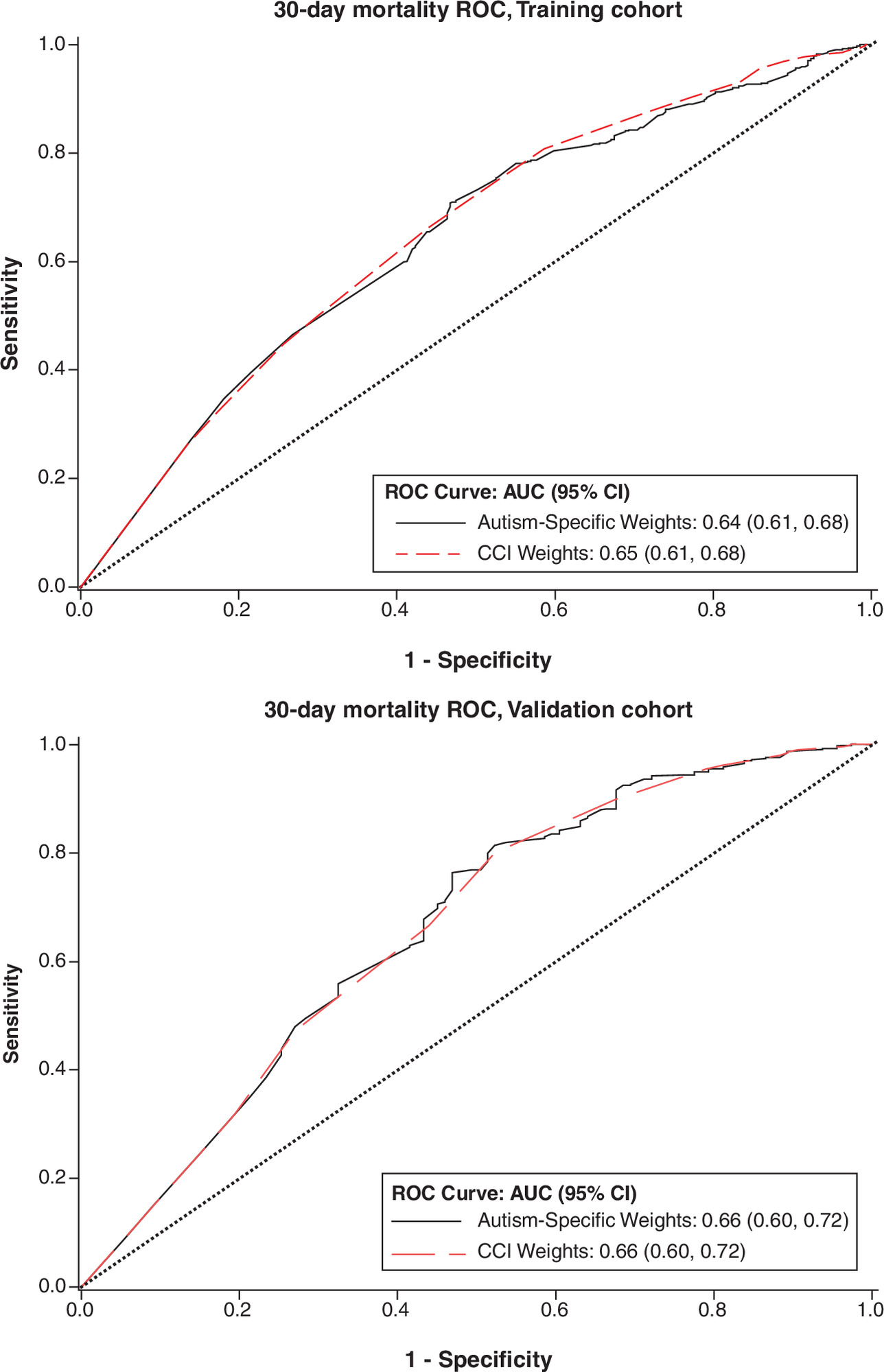
Figure 2. Area under the curve for 30-day mortality in autism-specific weights versus Charlson Comorbidity weights for the training and validation cohorts.
AUC: Area under the curve; CI: Confidence interval; ROC: Receiver operating characteristic.
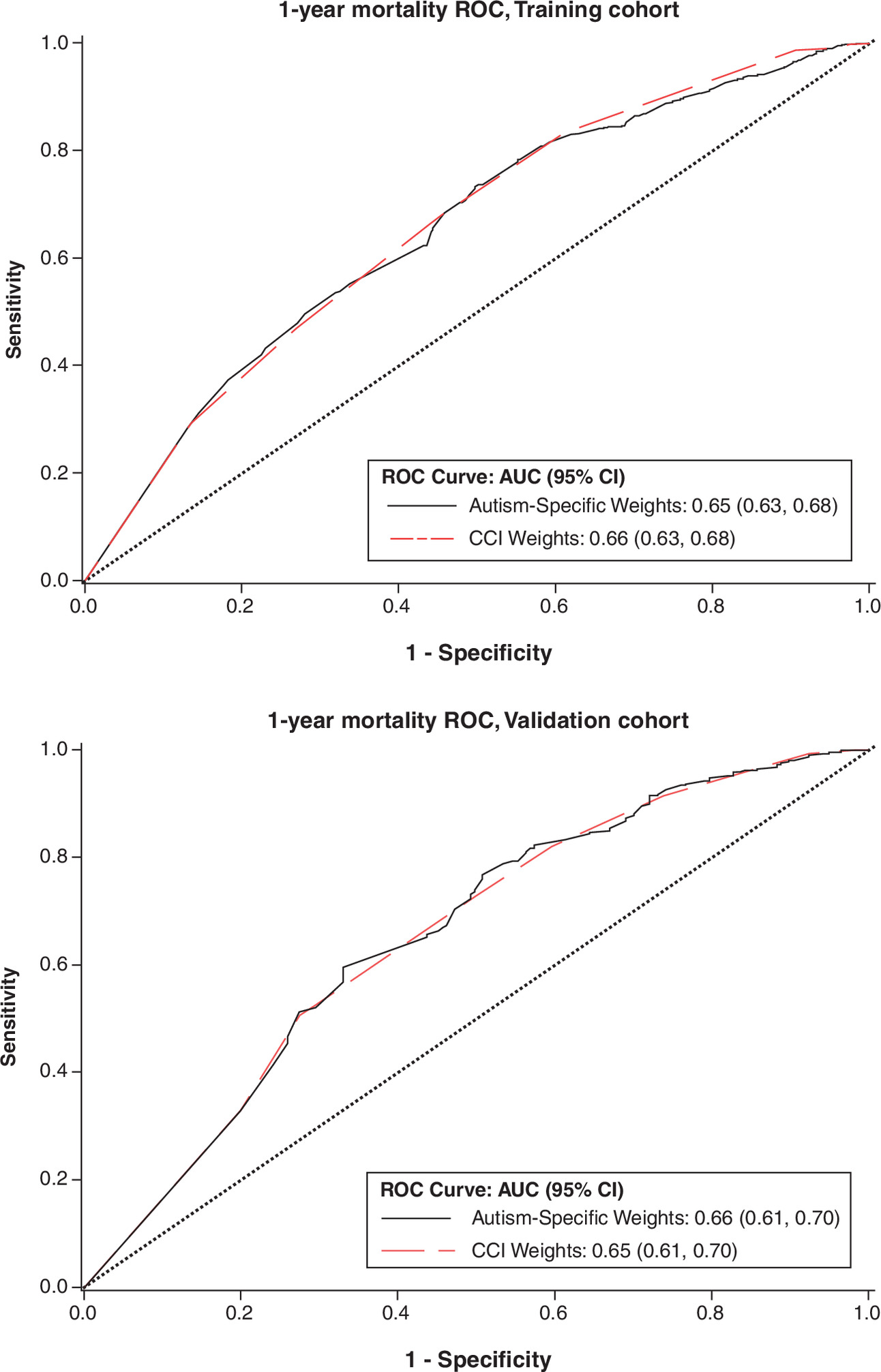
Figure 3. Area under the curve for 1-year mortality in autism-specific weights versus Charlson Comorbidity weights for the training and validation cohorts.
AUC: Area under the curve; CI: Confidence interval; ROC: Receiver operating characteristic.
Discussion
Mortality risk indices play a central role in clinical decision-making and health policy by helping clinicians estimate prognosis, guide screening decisions and determine the appropriateness of hospitalization, intensive treatment or palliative care [10,18–20]. Clinical guidelines increasingly recommend incorporating mortality risk into decisions about preventive screening, chronic disease management and hospice eligibility [18,21–23]. Mortality risk indices can meaningfully influence care prioritization, resource allocation and shared decision-making.
Prior literature demonstrates the CCI (using established weights) has high predictive ability for 30-day (AUC: 0.88) and 1-year (0.90) mortality in the general population [9], underscoring the utility of this index. Yet, our findings indicate that both the established and autism-specific weights had low predictive ability for 30-day and 1-year mortality in autistic older adults. These findings have important implications for clinical risk evaluation and future mortality risk development for the aging autistic population.
The low predictive ability of the established CCI demonstrates the limitations of the traditional risk tools when applied to autistic older adults. The CCI was originally developed and validated in predominantly non-autistic populations and was not intended to account for the distinct health patterns that autistic older adults experience [7,9]. For example, existing indices do not consider factors such as epilepsy [24], gastrointestinal disorders [5], and co-occurring psychiatric diagnoses [5], which are more common in the autistic adult population and may significantly influence health outcomes.
The low predictive ability of the autism-specific weights underscores the complexity of predicting mortality risk in autistic older adults. Our results suggest that the CCI’s set of co-occurring conditions does not fully reflect the health profiles most relevant to mortality in the autistic older adult population. Additionally, autistic adults are highly heterogeneous, with mortality risk potentially shaped by co-occurring intellectual disability, psychiatric conditions, and functional support needs, factors that are common in autism but largely absent from traditional comorbidity indices [5,25]. This heterogeneity likely contributed to the limited predictive performance; because these autism-specific risk factors are not represented in the CCI, adjusting its existing weights alone is unlikely to improve predictive ability. Our results highlight the need for a mortality risk index that incorporates conditions and contextual factors uniquely relevant to autistic adults. Ultimately, this may provide more accurate prognostic information tailored to the health profiles of autistic older adults, resulting in improved screening decisions, hospitalization planning, and long-term care strategies.
Methodologic considerations & future directions
Several methodologic considerations should be acknowledged when interpreting the results of this study. First, because we aimed to derive autism-specific weights that could be compared as directly as possible to the established weights from Quan et al. [9], we made a number of methodologic decisions based on their precedent. This included using only data from inpatient hospitalizations to identify comorbidities, using a 1-year look-back period, using only the last-observed inpatient hospitalization during 2022, and restricting our predictors to the 12 CCI conditions, age and sex. Future studies aiming to further improve the predictive ability of the CCI could consider including both inpatient and outpatient data to identify comorbidities, extending the look-back period beyond 1-year, and including multiple hospitalizations. Additionally, demographic factors and social determinants of health such as sex, race, location, and income may have significant predictive value in comorbidity indices [26,27]. Incorporating these variables into future models may enhance their applicability and predictive ability. Second, the use of administrative claims data introduces potential biases related to unmeasured clinical and social factors, under coded or miscoding of co-occurring conditions, and possible misclassification of diagnoses, all of which may affect the accuracy of mortality risk estimation [28,29]. Third, our findings are based on autistic adults aged 65 and older enrolled in Medicare, which limits generalizability to younger autistic individuals, those with private insurance, and populations with different healthcare access or utilization patterns. Fourth, we applied only stochastic hill climbing to derive autism-specific weights. There are many other machine learning methods available. Other studies seeking to improve the predictive accuracy of the CCI for autistic older adults or other clinical populations may wish to compare different types of machine learning methods. Finally, the autism-specific weights require validation in independent datasets and across more diverse autistic populations to determine their broader applicability. Continued research is needed to refine and validate mortality risk prediction tools tailored to the unique health profiles of autistic individuals.
Conclusion
While developing autism-specific weights for the CCI was a promising step toward tailoring health risk assessments for older autistic adults, the low predictive ability highlights critical gaps in our current measurement of mortality risk in the autistic older adult population. The results suggest a need for further research into mortality risk factors specific to autistic older adults, and the development of new models of mortality prediction. A specialized mortality risk index for autistic older adults would enable clinicians and researchers to make more accurate mortality risk assessments for the autistic older adult population [30,31]. As the autistic adult population ages, creating accurate risk assessment tools will be important for guiding clinical decision-making, research priorities, health system planning and policy development aimed at promoting healthy aging for the autistic older adult population.
Summary points
•
The Charlson Comorbidity Index (CCI) is a commonly used tool in observational studies using real-world claims data to predict mortality risk in the general population.
•
Yet, established mortality risk indices like the CCI may be inadequate to predict mortality risk in autistic older adults, who have distinct health profiles.
•
The researchers analyzed a sample of 2829 autistic Medicare beneficiaries aged 65 and older who had at least one inpatient hospitalization in 2022.
•
The researchers used a machine learning technique called stochastic hill climbing to derive autism-specific weights for the 12 conditions found in the CCI, attempting to better reflect the health risks of this population.
•
The derived autism-specific weights were higher for conditions like renal disease and chronic pulmonary disease, but lower for metastatic tumors compared with established weights.
•
Both the established and autism-specific weights for the CCI showed poor predictive ability for 30-day and 1-year mortality in autistic older adults.
•
While the CCI is highly accurate for the general population, its poor predictive ability in this study suggests it does not capture the distinct health profiles of autistic adults.
•
Because adjusting existing weights for mortality risk tools did not improve predictive ability, there is a need for new mortality risk tools tailored to autistic adults’ unique health profiles.
Author contributions
Author M Blake was responsible for data analysis, drafting and revision of the manuscript; authors BN Hand, JM Hyer and BJ Wolf were responsible for study conception and design; authors BN Hand and L Bishop were responsible for acquisition of data; author M Nikahd was responsible for supervising data analysis, and creation of the study cohort. Author BW Patterson was responsible for clinical guidance and revision of the manuscript. All authors were responsible for the revision of the manuscript.
Financial disclosure
Research reported in this publication was supported by the National Institutes on Aging of the NIH (MD, USA) under award no. R01AG082873. The content is solely the responsibility of the authors and does not necessarily represent the official views of the NIH.
Advisory board
The authors acknowledge the incredibly valuable contributions of our advisory board members: Nancy Alar; Scott Allen; Gyasi Burks-Abbott; Amy Hwa Frechette, BA; Cindy Molloy; Ace Patrick Unruh; Stephanie Primm; Sal Silinonte, Consulting Autistic.
Competing interests disclosure
The authors have no competing interests or relevant affiliations with any organization or entity with the subject matter or materials discussed in the manuscript. This includes employment, consultancies, honoraria, stock ownership or options, expert testimony, grants or patents received or pending, or royalties.
Writing disclosure
No funded writing assistance was utilized in the production of this manuscript.
Ethical conduct of research
The authors state that the study received an exemption from the institutional review board for approval due to the secondary data nature of the study.
Data sharing statement
The data used in this study are not publicly available due to restrictions under our data use agreement (DUA). However, the analytic code will be submitted to a public repository (Dryad DOI: 10.5061/dryad.tdz08kqdh) within 1 year of publication, and investigators with their own Centers for Medicare & Medicaid Services DUAs will be able to reproduce the analytical dataset.
Open access
This work is licensed under the Attribution-NonCommercial-NoDerivatives 4.0 Unported License. To view a copy of this license, visit https://creativecommons.org/licenses/by-nc-nd/4.0/
Supplementary Material
File (supplementary data.docx)
References
Papers of special note have been highlighted as: • of interest
1.
Dietz PM, Rose CE, McArthur D, Maenner M. National and State estimates of adults with autism spectrum disorder. J. Autism Dev Disord. 50, 4258–4266 (2020).
2.
Grosvenor LP, Croen LA, Lynch FL et al. Autism diagnosis among US Children and Adults, 2011–2022. JAMA Netw. Open 7, e2442218 (2024).
3.
Forsyth L, McSorley M, Rydzewska E. All-cause and cause-specific mortality in people with autism spectrum disorder: a systematic review. Res. Autism Spectr. Disord. 105, 102165 (2023).
4.
Krantz M, Dalmacy D, Bishop L, Hyer JM, Hand BN. Mortality rate and age of death among Medicare-enrolled autistic older adults. Res. Autism Spectr. Disord. 100, 102077 (2023).
• Highlights that autistic older adults have higher mortality rates compared with nonautistic counterparts.
5.
Croen LA, Zerbo O, Qian Y et al. The health status of adults on the autism spectrum. Autism Int. J. Res. Pract. 19, 814–823 (2015).
6.
Hand BN, Angell AM, Harris L, Carpenter LA. Prevalence of physical and mental health conditions in Medicare-enrolled, autistic older adults. Autism 24, 755–764 (2024).
• Highlights the physical and mental co-occurring conditions that may disproportionately impact autistic older adults compared with nonautistic peers.
7.
Charlson ME, Pompei P, Ales KL, MacKenzie CR. A new method of classifying prognostic comorbidity in longitudinal studies: development and validation. J. Chronic Dis. 40, 373–383 (1987).
• This is the original Charlson Comorbidity Index (CCI) that was created to classify 1-year mortality risk based on weighted co-occurring conditions.
8.
Quan H, Sundararajan V, Halfon P et al. Coding algorithms for defining comorbidities in ICD-9-CM and ICD-10 administrative data. Med. Care 43, 1130–1139 (2005).
9.
Quan H, Li B, Couris CM et al. Updating and validating the Charlson Comorbidity Index and score for risk adjustment in hospital discharge abstracts using data from 6 countries. Am. J. Epidemiol. 173, 676–682 (2011).
• This study updates and validates new weights for the CCI. This is the most updated and most used version of the CCI in administrative claims studies.
10.
Charlson ME, Carrozzino D, Guidi J, Patierno C. Charlson Comorbidity index: a critical review of clinimetric properties. Psychother. Psychosom. 91, 8–35 (2022).
• Evaluates the clinical usefulness of the CCI and shows that it is useful in providing a valid assessment of a patient’s clinical situation and in determining major diagnostic and prognostic differences among various groups of patients.
11.
Dhakal P, Shostrom V, Al-Kadhimi ZS, Maness LJ, Gundabolu K, Bhatt VR. Usefulness of Charlson Comorbidity Index to predict early mortality and overall survival in older patients with acute myeloid leukemia. Clin. Lymphoma Myeloma Leuk. 20, 804–812 (2020).
12.
Newhouse D, Rangavajla G, Dhande M et al. Abstract 15930: using Charlson Comorbidity Index to predict 1-year all-cause mortality in ICD recipients. Circulation 148, A15930 (2023).
13.
Zhang N, Lin Q, Jiang H, Zhu H. Age-adjusted Charlson Comorbidity Index as effective predictor for in-hospital mortality of patients with cardiac arrest: a retrospective study. BMC Emerg. Med. 23, 7 (2023).
14.
Gilmore D, Harris L, Longo A, Hand BN. Health status of Medicare-enrolled autistic older adults with and without co-occurring intellectual disability: an analysis of inpatient and institutional outpatient medical claims. Autism Int. J. Res. Pract. 25, 266–274 (2021).
15.
Glasheen WP, Cordier T, Gumpina R, Haugh G, Davis J, Renda A. Charlson Comorbidity Index: ICD-9 update and ICD-10 translation. Am. Health Drug Benefits 12, 188–197 (2019).
16.
U.S. Department of Agriculture Economic Research Service. Rural-urban continuum codes. Economic Research Service. (2023). https://www.ers.usda.gov/data-products/rural-urban-continuum-codes
17.
Russell SJ, Norvig P. Artificial Intelligence: A Modern Approach. 4th Edition. ISBN-13: 978-0134610993, Pearson, (2021).
• This is a book that describes hill climbing and stochastic machine learning methods.
18.
Lee SJ, Lindquist K, Segal MR, Covinsky KE. Development and validation of a prognostic index for 4-year mortality in older adults. JAMA 295, 801–808 (2006).
19.
Porock D, Parker-Oliver D, Petroski GF, Rantz M. The MDS mortality risk index: the evolution of a method for predicting 6-month mortality in nursing home residents. BMC Res. Notes 3, 200 (2010).
20.
Schonberg MA, Davis RB, McCarthy EP, Marcantonio ER. Index to predict 5-year mortality of community-dwelling adults aged 65 and older using data from the National Health Interview Survey. J. Gen. Intern. Med. 24, 1115–1122 (2009).
21.
American Geriatrics Society Expert Panel on the Care of Older Adults with Multimorbidity. Guiding principles for the care of older adults with multimorbidity. J. Am. Geriatr. Soc. 60, E1–E25 (2012).
22.
Ferrell BR, Twaddle ML, Melnick A, Meier DE. National Consensus Project clinical practice guidelines for quality palliative care, 4th Edition. J. Palliat. Med. 21, 1684–1689 (2018).
23.
Yourman LC, Lee SJ, Schonberg MA, Widera EW, Smith AK. Prognostic indices for older adults: a systematic review. JAMA 307, 182–192 (2012).
24.
Liu X, Sun X, Sun C et al. Prevalence of epilepsy in autism spectrum disorders: a systematic review and meta-analysis. Autism Int. J. Res. Pract. 26, 33–50 (2022).
25.
Masi A, DeMayo MM, Glozier N, Guastella AJ. An overview of autism spectrum disorder, heterogeneity and treatment options. Neurosci. Bull. 33, 183–193 (2017).
26.
Kunnath AJ, Sack DE, Wilkins CH. Relative predictive value of sociodemographic factors for chronic diseases among All of Us participants: a descriptive analysis. BMC Public Health 24, 405 (2024).
27.
Zhuang Y, Zhao X, Tang S et al. Independent associations of social determinants of health with mortality and added predictive value beyond life's essential 8. J. Health Popul. Nutr. 44, 286 (2025).
28.
Iezzoni LI. Assessing quality using administrative data. Ann. Intern. Med. 127, 666–674 (1997).
29.
Johnson EK, Nelson CP. Utility and pitfalls in the use of administrative databases for outcomes assessment. J. Urol. 190, 17–18 (2013).
30.
Parikh RB, Ferrell WJ, Girard A et al. The impact of machine learning mortality risk prediction on clinician prognostic accuracy and decision support: a randomized vignette study. Med. Decis. Making 45, 690–702 (2025).
• This study underscores that machine learning-based assessments can improve prognostic accuracy and impact clinician decision making.
31.
Riley RD, Collins GS, Kirton L et al. Uncertainty of risk estimates from clinical prediction models: rationale, challenges, and approaches. Br. Med. J. 388, e080749 (2025).
Information & Authors
Information
Published In
Copyright
© 2026 The authors. This work is licensed under the Attribution-NonCommercial-NoDerivatives 4.0 Unported License
History
Received: 23 March 2026
Accepted: 1 July 2026
Published online: 29 July 2026
Keywords:
Topics
Authors
Metrics & Citations
Metrics
Article Usage
Article usage data only available from February 2023. Historical article usage data, showing the number of article downloads, is available upon request.
Citations
How to Cite
Mortality risk estimation for autistic older adults: comparing novel machine-learning derived weights versus standard weights for the Charlson Comorbidity Index. (2026) Journal of Comparative Effectiveness Research. DOI: 10.57264/cer-2026-0053
Export citation
Select the citation format you wish to export for this article or chapter.