

Validity of HINT-8 in evaluating health-related quality of life among cervical cancer patients
Publication: Journal of Comparative Effectiveness Research
Abstract
Aim: Cervical cancer, caused primarily by human papillomavirus infection, affects patients' health-related quality of life (HRQoL). Despite research on quality of life in cancer patients, studies using the HINT-8 instrument, especially for cervical cancer, are scarce. This study evaluates the validity of HINT-8 in measuring HRQoL among Korean cervical cancer patients by comparing it with EQ-5D-5L. Materials & methods: Demographic and clinical characteristics were analyzed. Mean, median and standard deviations for each domain of both instruments were calculated. Spearman and Pearson correlation coefficients assessed relationships between HINT-8 and EQ-5D-5L indices and domains. Results: Increased problem intensity in HINT-8 domains (e.g., stair climbing, pain and vitality) was correlated with decreased EQ-5D-5L index, indicating a higher response level in HINT-8 aligns with lower EQ-5D-5L scores. Significant variables were consistent across tools, showing no substantial functional difference. A strong correlation between HINT-8 and EQ-5D-5L indices (r = 0.771, p < 0.01) supports HINT-8’s effectiveness in evaluating HRQoL for cervical cancer patients. Conclusion: The HINT-8 demonstrated a strong correlation with the EQ-5D-5L index and a substantially lower ceiling effect, suggesting that it can capture subtle differences in HRQoL among cervical cancer patients. Furthermore, the HINT-8 may provide complementary information beyond the EQ-5D-5L by capturing distinct dimensions such as memory, sleep and happiness, which are not explicitly represented in the EQ-5D-5L descriptive system. These findings support the validity of the HINT-8 as a complementary instrument for assessing HRQoL in Korean cervical cancer patients.
Plain language summary: How well does the HINT-8 questionnaire measure quality of life in people with cervical cancer?
What is this article about?
Cervical cancer and its treatments can greatly affect how patients feel and function in daily life. To understand patients’ overall well-being, healthcare teams often ask them to complete questionnaires about their quality of life (QoL). This study looked at whether a Korean questionnaire called HINT-8 can accurately measure QoL in people with cervical cancer. The results from HINT-8 were compared with those from EQ-5D-5L, a widely used international tool.
What were the results?
People who reported more difficulties on the HINT-8 – such as pain, tiredness, trouble climbing stairs, sleep problems or low mood – also showed lower scores on the EQ-5D-5L. This means both tools reflected patients’ health in a similar way. The two tools showed a strong overall correlation. However, HINT-8 detected fewer ‘perfect health’ responses than EQ-5D-5L, meaning it was better at picking up differences among patients.
What do the results mean? Why is this important?
The findings show that HINT-8 is a useful and reliable tool for understanding the QoL of cervical cancer patients in Korea. Because it captures more subtle differences in patients’ experiences, it can help healthcare teams better monitor patients’ well-being and plan supportive care. This study is the first to confirm the usefulness of HINT-8 specifically for cervical cancer.
Cervical cancer, a malignant tumor of the cervix, is primarily caused by infection with the human papillomavirus. Cervical cancer typically has a longer precancerous stage compared with the other cancer forms. Additionally, progressing cervical cancer invades neighboring organs, such as the kidneys, bladder and rectum, either directly or through lymphatic vessels, rapidly spreading to other organs [1]. In 2023, the Korean Central Cancer Registry reported that among the 277,523 cancer cases recorded in South Korea in 2021, cervical cancer, excluding carcinoma in situ, accounted for 3173 cases, representing 1.1% of the total, and was the 11th most common cancer in women [2]. The crude incidence was 12.3 cases per 100,000 people [2]. Surgery, radiation therapy and chemotherapy are common treatments for cervical cancer, but they often cause side effects such as fatigue, pain and depression [3,4]. These side effects can affect a patient’s everyday life and overall health-related quality of life (HRQoL).
With advancements in medical technology, cancer patients’ survival rates have improved, making patient-reported outcome measures increasingly important [5]. Consequently, subjective patient-reported outcomes, such as HRQoL, and social, emotional and physical functioning are now used as key indicators to measure health outcomes in clinical trials [6]. Particularly, HRQoL is a widely used indicator of a patient’s overall health status, with various tools developed to measure it [7].
HRQoL instruments can be broadly classified into cancer-specific and generic instruments. Cancer-specific instruments are designed to capture symptoms, treatment-related adverse effects and functional concerns that are particularly relevant to cancer patients. In contrast, generic HRQoL instruments allow comparisons across different diseases and with the general population, and some preference-based generic instruments can generate utility values for economic evaluation. Therefore, generic instruments are particularly useful when HRQoL outcomes need to be interpreted in a broader clinical or policy context [8–10].
Generic instruments for measuring QoL are universally applicable to both patients and non-patients. EuroQol 5-Dimension (EQ-5D), used broadly as a generic instrument for both patients and the general public, has the advantage of converting QoL into a value between 0 and 1, simplifying and collectively representing the patient's condition. Additionally, the EQ-5D index is used for economic evaluations, increasing attention to public healthcare policy. Furthermore, HRQoL can vary significantly depending on the socio-cultural and healthcare system of a country [11], making it highly valuable to measure and study QoL across various nations.
HINT-8 is a Korean preference-based generic HRQoL instrument developed in 2014 to reflect health concepts and cultural characteristics relevant to the Korean population [12]. Compared with the EQ-5D-5L, the HINT-8 includes additional domains such as memory, sleep, vitality and happiness, which may capture cognitive, restorative, energy-related and positive psychological aspects of HRQoL. These features may be particularly relevant for cervical cancer patients, who often experience multidimensional health burdens related to cancer and its treatment [13].
Cervical cancer patients may experience multidimensional HRQoL impairment related to treatment, including pain, fatigue, depressive symptoms, sleep disturbance, cognitive concerns and reduced overall well-being [13]. Although the EQ-5D-5L is widely used and useful for generating utility values, its five-domain structure may not directly capture some of these aspects, particularly memory, sleep, vitality and happiness. Therefore, evaluating the HINT-8 in these patients may provide evidence on whether it offers added value beyond the EQ-5D-5L in detecting subtle differences in HRQoL. However, studies investigating the validity of the HINT-8 specifically for cervical cancer patients have not yet been reported. Therefore, this study aimed to evaluate the validity of the HINT-8 instrument for measuring HRQoL among Korean cervical cancer patients by comparing it with the EuroQol 5-Dimension 5-Level (EQ-5D-5L).
Materials & methods
Research participants & data collection
This study was conducted between August 2023 and February 2024 across 12 hospitals to assess the HRQoL in cervical cancer patients. The final analysis included 250 respondents who completed the HINT-8 and EQ-5D-5L questionnaires without missing data.
The Institutional Review Board (IRB) of the Kongju National University, as well as IRBs of the 12 participating hospitals (Supplementary Table 1), approved this study (KNU_IRB_2023-49). Only patients who provided written informed consent were included. The HINT-8 and EQ-5D-5L questionnaires, along with demographic information, were self-administered by the patients. When clarification was needed, trained clinical staff provided standardized explanations without influencing patients' responses. In contrast, clinical and disease-related factors were collected by clinical practitioners at each hospital through a comprehensive review of medical records.
Measurement items
The survey collected data on participants' general characteristics such as sex, age, education level, marital status, income level, household members, employment status and religion. Income level was classified based on 5000,000 Korean Won (KRW), which is close to the average monthly household income of 5023,719 KRW in the fourth quarter of 2023. Disease-related characteristics were also collected such as treatment status, the duration since diagnosis, the most recent treatment date, and the types of treatment received (surgery, radiation therapy, chemotherapy, immunotherapy or targeted therapy).
HRQoL was assessed using the HINT-8 and EQ-5D-5L tools. The HINT-8 was developed in Korea to more accurately measure HRQoL tailored to the characteristics of Koreans [14,15]. The HINT-8 consists of eight domains: climbing stairs, pain, vitality, working, depression, memory, sleep and happiness, which can express 65,000 different health states [7]. The diverse health state expressions of the HINT-8 can reflect an individual’s specific health condition, which significantly aids in patient-centered health management [16]. The HINT-8 allows for the calculation of health utility indexes for different health states, ranging from an index value of 1 for perfect health (11111111) to 0.13 for the worst possible health state (44444444) [7]. The HINT-8 value set was developed from a Korean valuation study in which Korean adults evaluated selected HINT-8 health states using visual analogue scale and standard gamble methods [12]. The valuation sample was designed to reflect the Korean general adult population, and the resulting scoring algorithm was used to convert HINT-8 response profiles into utility values [17]. The HINT-8 index ranges from 1 for full health to 0.132 for the worst health state.
The EQ-5D, developed by the EuroQol group, is a standardized questionnaire intended for measuring HRQoL [18]. The EQ-5D-5L includes five dimensions: mobility, self-care, usual activities, pain/discomfort and anxiety/depression. Each domain is divided into five levels, allowing for detailed representation of various health states. Health utility values for different conditions can be calculated using the EQ-5D-5L, with a range from 1 for optimal health (11111) to -0.224 for the poorest health state (55555) [19]. In this study, the EQ-5D-5L index was calculated using the EQ-5D-5L QoL weighting formula [19]. The recall periods differed between the two instruments. The EQ-5D-5L asked participants to report their health status on the day of survey completion, whereas the HINT-8 asked participants to report their health status during the past week.
Data analysis
Index values were calculated for eight HINT-8 domains and five EQ-5D-5L domains to validate and compare the HRQoL tools. Frequency analysis of participants’ demographic and clinical characteristics was performed. Descriptive statistics was calculated, including the mean, median and standard deviation for each domain and scale in both instruments. The ceiling effects of each instrument were assessed by comparing the number and percentage of respondents who reported the optimal state (11111 for EQ-5D-5L and 11111111 for the HINT-8).
Correlations between EQ-5D-5L and HINT-8 domains were analyzed using Spearman correlation coefficients. Pearson correlation coefficients were used to evaluate the relationship between the EQ-5D-5L index and the HINT-8 index. Correlation coefficient values from ±0.1 to ±0.3 indicate a low correlation, those from ±0.3 to ±0.5 represent a moderate correlation, and values above ±0.5 signify a high correlation [20]. Cronbach's alpha was calculated as a supplementary indicator of response consistency across items. However, because both the EQ-5D-5L and HINT-8 are multidimensional HRQoL instruments designed to assess distinct domains rather than a single latent construct, Cronbach’s alpha should be interpreted with caution. The intraclass correlation coefficient (ICC) was used to assess inter-instrument agreement between the EQ-5D-5L and HINT-8 index scores, rather than test-retest reliability. Cronbach’s alpha values exceeding 0.7 indicate high reliability [21], while ICC values under 0.50 represent low agreement, those between 0.50 and 0.75 represent moderate agreement, values of 0.75–0.9 represent good agreement, and those over 0.90 represent excellent agreement [22]. Therefore, reliability and validity were evaluated comprehensively using domain-level correlations, index-level agreement, known-groups comparisons and ceiling effects. Data were analyzed using IBM SPSS Statistics 27.0, SAS 9.4.
Results
General & disease-related characteristics of the study participants
The average participant's age was 52.6 years, with 30.8% of them aged ≥60 years. Regarding education, 81.2% of participants completed high school or higher. Most participants were married or cohabitating (63.3%). Regarding income, 59.6% of participants earned <5 million KRW per month. Additionally, 81.2% of participants had two or more household members. Employment status revealed that 32.8% of participants were working, and 45.2% of participants reported having a religion (Table 1).
| Characteristics | Categories | n | Percentage |
|---|---|---|---|
| Sex | Female | 250 | 100.0 |
| Age, years | ≤39 | 33 | 13.2 |
| 40–49 | 64 | 25.6 | |
| 50–59 | 76 | 30.4 | |
| ≥60 | 77 | 30.8 | |
| Education | Middle school or lower | 46 | 18.4 |
| High school | 114 | 45.6 | |
| College or more | 89 | 35.6 | |
| Marital status | Single | 88 | 35.2 |
| Married or cohabitating | 159 | 63.6 | |
| Income | <5 million Korean Won† | 149 | 59.6 |
| >5 million Korean won | 99 | 39.6 | |
| Household member | One person | 47 | 18.8 |
| More than one person | 203 | 81.2 | |
| Employment status | Worker/business | 82 | 32.8 |
| Housewife | 126 | 50.4 | |
| Unemployed | 40 | 16.0 | |
| Religion | Yes | 113 | 45.2 |
| No | 136 | 54.4 | |
| Treatment status | Undergoing treatment within 6 months | 185 | 74.0 |
| Follow-up‡ | 65 | 26.0 | |
| Duration since diagnosis | <1 year | 126 | 50.4 |
| ≥1 year | 124 | 49.6 | |
| Most recent treatment date | <1 year | 177 | 70.8 |
| ≥1 year | 73 | 29.2 | |
| Surgery | No | 100 | 40.0 |
| ≤39 | 150 | 60.0 | |
| Radiation therapy | Yes | 109 | 43.6 |
| No | 141 | 56.4 | |
| Chemotherapy | Yes | 131 | 52.4 |
| No | 119 | 47.6 | |
| Immunotherapy | Yes | 20 | 8.0 |
| No | 230 | 92.0 | |
| Targeted therapy | Yes | 16 | 6.4 |
| No | 234 | 93.6 |
Variables for which the sum of percentages does not reach 100% indicate missing values.
Surgery or any other treatment includes patients who are >1 year and <2 years after diagnosis or those who have been >1 year since diagnosis and have not experienced recurrence or metastasis.
†
One million Korean Won (KRW) equals approximately 769.23 dollars (USD).
‡
Follow-up was defined as routine clinical surveillance or survivorship care after completion of active cancer treatment.
Regarding disease-related characteristics, 74.0% of participants were undergoing treatment, 49.6% of participants had been diagnosed for more than a year and 70.8% of participants had their most recent treatment within the past year. Treatment types included surgery (40.0%), radiation therapy (43.6%), chemotherapy (52.4%), immunotherapy (8.0%) and targeted therapy (6.4%) (Table 1).
Health-related QoL
In the HINT-8 tool, ‘problems’ were defined as responses at levels 2–4 out of the four response levels across the eight domains. Issues were reported by approximately ≥50% of participants in the following domains: difficulty climbing stairs (48.0%), pain (53.6%), low vitality (71.2%), difficulty with work (53.2%), depression (52.8%), memory issues (50.4%), sleep difficulties (59.2%) and problems with happiness (74.0%).
The comparison between eight HINT-8 domains and the EQ-5D-5L index showed that as the degree of issues in climbing stairs, pain, vitality, work, memory, sleep and happiness increased, the EQ-5D-5L index decreased. Thus, increased problem severity in HINT-8 typically decreases the EQ-5D-5L index. Additionally, 6.4% of respondents reported no problems in any HINT-8 domain, while 31.6% of participants reported no problems in any EQ-5D-5L domain (Table 2).
| HINT-8 Item | Categories | n | Percentage | EQ-5D-5L index, Mean ± SD |
|---|---|---|---|---|
| Climbing stair | 1 | 130 | 52.0 | 0.92 ± 0.09 |
| 2 | 88 | 35.2 | 0.80 ± 0.12 | |
| 3 | 28 | 11.2 | 0.69 ± 0.16 | |
| 4 | 4 | 1.6 | 0.60 ± 0.19 | |
| Pain | 1 | 116 | 46.4 | 0.94 ± 0.08 |
| 2 | 105 | 42.0 | 0.80 ± 0.10 | |
| 3 | 25 | 10.0 | 0.68 ± 0.13 | |
| 4 | 4 | 1.6 | 0.51 ± 0.25 | |
| Vitality | 1 | 72 | 28.8 | 0.93 ± 0.08 |
| 2 | 91 | 36.4 | 0.86 ± 0.11 | |
| 3 | 83 | 33.2 | 0.77 ± 0.16 | |
| 4 | 4 | 1.6 | 0.71 ± 0.20 | |
| Working | 1 | 117 | 46.8 | 0.94 ± 0.08 |
| 2 | 95 | 38.0 | 0.82 ± 0.09 | |
| 3 | 25 | 10.0 | 0.70 ± 0.11 | |
| 4 | 13 | 5.2 | 0.59 ± 0.20 | |
| Depression | 1 | 118 | 47.2 | 0.92 ± 0.12 |
| 2 | 112 | 44.8 | 0.81 ± 0.11 | |
| 3 | 18 | 7.2 | 0.68 ± 0.16 | |
| 4 | 2 | 0.8 | 0.77 ± 0.07 | |
| Memory | 1 | 124 | 49.6 | 0.89 ± 0.13 |
| 2 | 117 | 46.8 | 0.81 ± 0.13 | |
| 3 | 9 | 3.6 | 0.71 ± 0.16 | |
| 4 | 0 | 0.0 | 0.00 | |
| Sleep | 1 | 102 | 40.8 | 0.91 ± 0.11 |
| 2 | 111 | 44.4 | 0.83 ± 0.12 | |
| 3 | 35 | 14.0 | 0.76 ± 0.18 | |
| 4 | 2 | 0.8 | 0.64 ± 0.16 | |
| Happiness | 1 | 65 | 26.0 | 0.92 ± 0.13 |
| 2 | 101 | 40.4 | 0.88 ± 0.11 | |
| 3 | 74 | 29.6 | 0.77 ± 0.13 | |
| 4 | 10 | 4.0 | 0.72 ± 0.16 | |
| HINT-8 best state (11111111) | 16 | 6.4 | ||
| EQ-5D-5L best state (11111) | 79 | 31.6 | ||
| HINT-8 Index, M ± SD | 0.78 ± 0.13 | |||
| EQ-5D-5L Index, M ± SD | 0.85 ± 0.14 | |||
M: Mean; SD: Standard deviation.
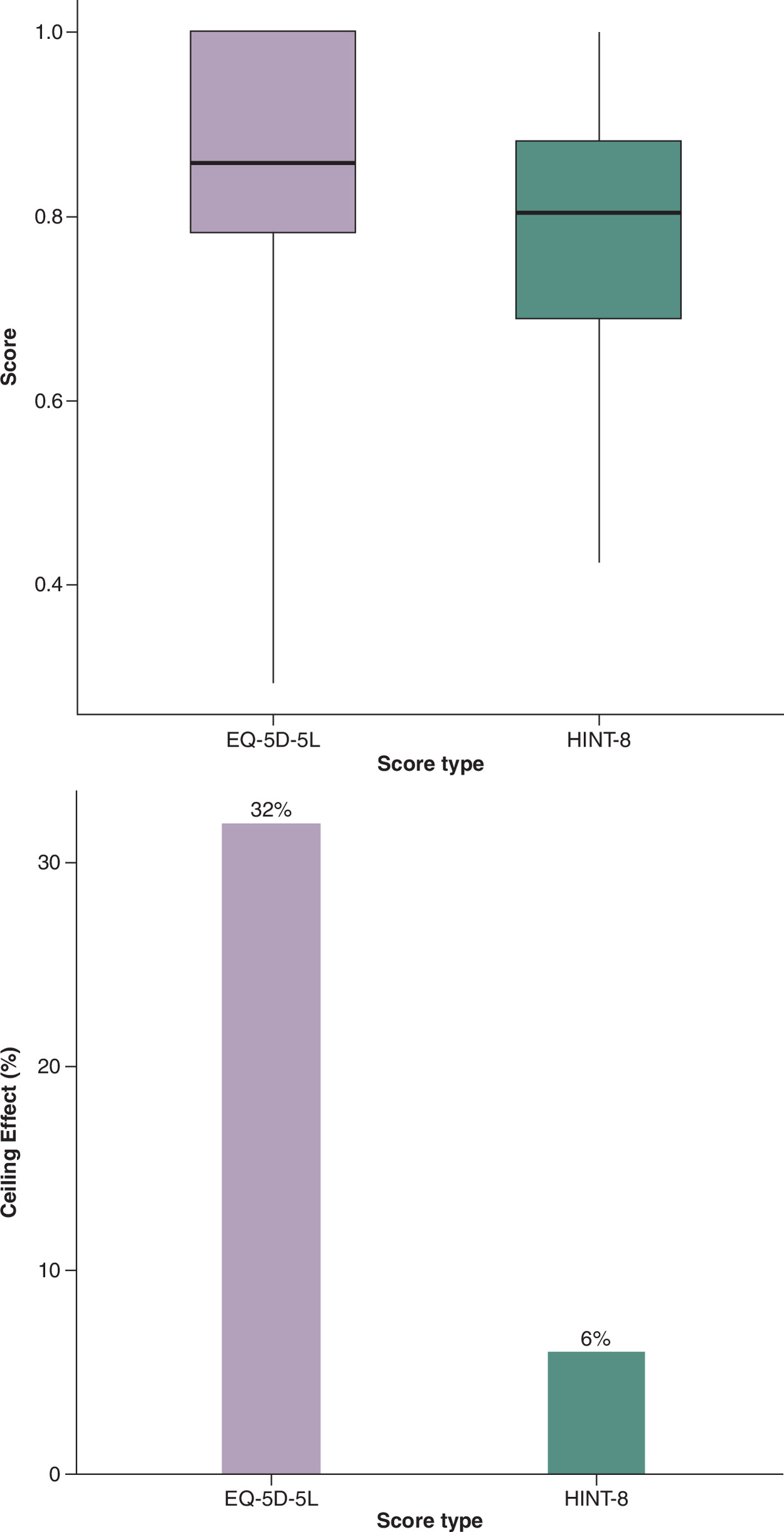
Figure 1 shows a boxplot representing the distribution of EQ-5D-5L and HINT-8 index scores. Additionally, Figure 1 demonstrates a bar graph illustrating the ceiling effect of EQ-5D-5L and HINT-8. The median for the EQ-5D-5L index was roughly between 0.85 and 0.9, whereas the median for the HINT-8 index was about 0.8. Both indices were generally close to the maximum score of 1, but the HINT-8 index showed a marginally lower overall score distribution. The ceiling effect for EQ-5D-5L was 32%; hence, 32% of respondents answered 1, the best possible QoL state, in all five domains. In contrast, HINT-8 had a ceiling effect of 6%, meaning that only 6% of respondents rated all eight domains as the best possible QoL state, which is 1. The EQ-5D-5L showed a high ceiling effect, making it difficult to distinguish differences among respondents. In contrast, HINT-8 had a lower ceiling effect, indicating higher discriminative ability.
Comparison of HINT-8 & EQ-5D-5L indices based on participants' characteristics
Analysis of HINT-8 and EQ-5D-5L indices according to the participants' general and disease-related characteristics revealed consistent statistically significant differences across most variables for both tools. The HINT-8 index showed significant differences in marital status, employment status, treatment status, radiation therapy, chemotherapy, immunotherapy and targeted therapy (p < 0.05). Similarly, the EQ-5D-5L index displayed significant differences in marital status, household members, employment status, treatment status, the most recent treatment date, chemotherapy, immunotherapy and targeted therapy (p < 0.05) (Table 3).
| Characteristics | Categories | HINT-8 | EQ-5D-5L | ||||
|---|---|---|---|---|---|---|---|
| M ± SD | t or F | p-value | M ± SD | t or F | p-value | ||
| Age, years | ≤39 | 0.76 ± 0.13 | 0.56 | 0.644 | 0.82 ± 0.16 | 0.89 | 0.449 |
| 40–49 | 0.79 ± 0.11 | 0.84 ± 0.14 | |||||
| 50–59 | 0.80 ± 0.13 | 0.85 ± 0.14 | |||||
| ≥60 | 0.78 ± 0.13 | 0.87 ± 0.13 | |||||
| Education | Middle school or lower | 0.81 ± 0.14 | 0.39 | 0.678 | 0.89 ± 0.14 | 1.73 | 0.180 |
| High school | 0.78 ± 0.11 | 0.86 ± 0.12 | |||||
| College or more | 0.78 ± 0.14 | 0.83 ± 0.15 | |||||
| Marital status | Single | 0.76 ± 0.13 | 7.69 | 0.006 | 0.82 ± 0.14 | 7.15 | 0.008 |
| Married or cohabitating | 0.80 ± 0.12 | 0.87 ± 0.14 | |||||
| Income | <5 million won | 0.78 ± 0.12 | 1.30 | 0.256 | 0.84 ± 0.13 | 0.91 | 0.342 |
| >5 million won | 0.79 ± 0.13 | 0.86 ± 0.15 | |||||
| Household member | One person | 0.77 ± 0.14 | 2.68 | 0.103 | 0.81 ± 0.16 | 6.61 | 0.010 |
| Other | 0.79 ± 0.12 | 0.86 ± 0.13 | |||||
| Employment status | Worker/business | 0.81 ± 0.12 | 4.79 | 0.009 | 0.88 ± 0.12 | 5.24 | 0.005 |
| Housewife | 0.78 ± 0.12 | 0.85 ± 0.14 | |||||
| Unemployed | 0.73 ± 0.13 | 0.78 ± 0.14 | |||||
| Religion | Yes | 0.77 ± 0.13 | 1.10 | 0.334 | 0.83 ± 0.15 | 2.14 | 0.120 |
| No | 0.80 ± 0.12 | 0.87 ± 0.13 | |||||
| Treatment status | Undergoing treatment within 6 months | 0.77 ± 0.13 | 6.04 | 0.015 | 0.83 ± 0.14 | 14.64 | 0.000 |
| Follow-up | 0.82 ± 0.11 | 0.91 ± 0.10 | |||||
| Duration since diagnosis | <1 year | 0.79 ± 0.12 | 0.59 | 0.445 | 0.84 ± 0.13 | 0.96 | 0.327 |
| ≥1 year | 0.78 ± 0.13 | 0.86 ± 0.15 | |||||
| Most recent treatment date | <1 year | 0.78 ± 0.13 | 1.97 | 0.161 | 0.83 ± 0.14 | 9.75 | 0.002 |
| ≥1 year | 0.81 ± 0.11 | 0.90 ± 0.11 | |||||
| Surgery | Yes | 0.79 ± 0.12 | 0.02 | 0.877 | 0.84 ± 0.12 | 0.39 | 0.530 |
| No | 0.79 ± 0.13 | 0.85 ± 0.15 | |||||
| Radiation therapy | Yes | 0.77 ± 0.12 | 1.27 | 0.260 | 0.82 ± 0.13 | 4.48 | 0.035 |
| No | 0.80 ± 0.13 | 0.87 ± 0.14 | |||||
| Chemotherapy | Yes | 0.76 ± 0.13 | 8.22 | 0.005 | 0.81 ± 0.15 | 21.89 | <0.000 |
| No | 0.81 ± 0.11 | 0.90 ± 0.11 | |||||
| Immunotherapy | Yes | 0.70 ± 0.14 | 10.71 | 0.001 | 0.75 ± 0.18 | 11.21 | 0.000 |
| No | 0.79 ± 0.12 | 0.86 ± 0.13 | |||||
| Targeted therapy | Yes | 0.68 ± 0.12 | 12.92 | 0.000 | 0.72 ± 0.19 | 11.68 | 0.000 |
| No | 0.79 ± 0.12 | 0.86 ± 0.13 | |||||
Values of p were derived using independent t-tests for two-group comparisons and one-way analysis of variance (ANOVA) for comparisons involving three or more groups.
M: Mean; SD: Standard deviation.
Correlation analysis of domains & indexes between HINT-8 & EQ-5D-5L
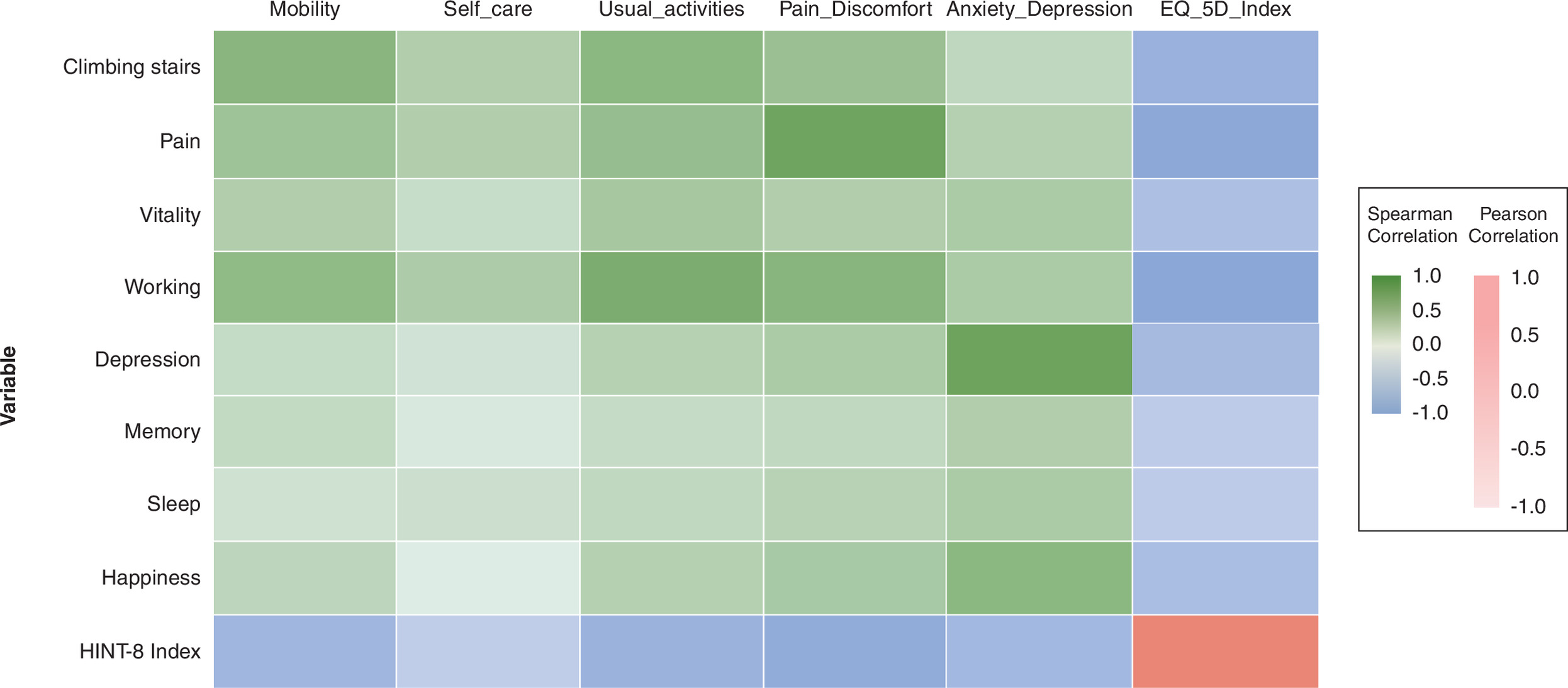
The correlation analysis between HINT-8 and EQ-5D-5L domains and indexes revealed strong correlations between similar domains of the two tools. The stair climbing domain of the HINT-8 was strongly correlated with the mobility domain of the EQ-5D-5L (r = 0.61, p < 0.01). The pain domain of the HINT-8 showed a significant correlation with the pain/discomfort domain of the EQ-5D-5L (r = 0.76, p < 0.01). Additionally, the depression domain of the HINT-8 showed a high correlation with the anxiety/depression item of the EQ-5D-5L (r = 0.77, p < 0.01).
However, memory and sleep domains of the HINT-8, which are unique to this tool, showed lower correlations with other EQ-5D-5L domains compared with other areas. Additionally, no correlation between the happiness domain of the HINT-8 and the self-care domain of the EQ-5D-5L was identified. The correlation coefficient between HINT-8 and EQ-5D-5L indices was 0.772 (p < 0.01) (Table 4).
| EQ-5D-5L | Mobility | Self-care | Usual activities | Pain/discomfort | Anxiety/depression | EQ-5D Index |
|---|---|---|---|---|---|---|
| HINT-8 | r | r | r | r | r | r† |
| Climbing stair | 0.61§ | 0.38§ | 0.60§ | 0.51§ | 0.30§ | -0.636§ |
| Pain | 0.48§ | 0.38§ | 0.53§ | 0.76§ | 0.36§ | -0.724§ |
| Vitality | 0.38§ | 0.25§ | 0.44§ | 0.38§ | 0.41§ | -0.500§ |
| Working | 0.57§ | 0.40§ | 0.68§ | 0.62§ | 0.41§ | -0.729§ |
| Depression | 0.27§ | 0.19‡ | 0.35§ | 0.41§ | 0.77§ | -0.556§ |
| Memory | 0.28§ | 0.15‡ | 0.26§ | 0.29§ | 0.38§ | -0.382§ |
| Sleep | 0.21‡ | 0.22‡ | 0.29§ | 0.33§ | 0.41§ | -0.382§ |
| Happiness | 0.31§ | 0.11 | 0.36§ | 0.42§ | 0.60§ | -0.517§ |
| HINT-8 Index | -0.584§ | -0.377§ | -0.624§ | -0.683§ | -0.572§ | 0.772§ |
†
Pearson correlation coefficient for the correlation between the HINT-8 index and EQ-5D-5L index.
‡
p < 0.05.
§
p < 0.01.
r: Spearman correlation coefficient for domain-level correlations.
Figure 2 shows a heatmap of the correlation coefficients between HINT-8 and EQ-5D-5L domains and indices. The green colors indicate positive correlations, with more intense shades representing correlation coefficients nearer to 1, denoting a strong positive relationship. Blue tones represent negative correlations, with deeper blues showing coefficients nearer to -1, indicating a strong negative correlation. The red colors on the heatmap denote Pearson correlation coefficients, with more intense red shades representing coefficients closer to 1, indicating a strong positive correlation.
Internal validity of the EQ-5D-5L & HINT-8
Table 5 demonstrates the results of Cronbach's alpha analysis for the internal validity of the two tools. The Cronbach's alpha (α) was evaluated with a cutoff of 0.7, with the table displaying alpha values for each item and their 95% CIs. The HINT-8 Cronbach’s alpha values ranged from 0.79 to 0.83, indicating high internal validity. Each item generated very consistent responses, making the tool reliable for assessment. The EQ-5D-5L Cronbach’s alpha values ranged from 0.72 to 0.83, reflecting high internal validity as well. Specifically, the items related to self-care and anxiety/depression had high validity. Since the tool generated consistent responses across items, it provided reliable assessments. The inter-instrument agreement between the EQ-5D-5L and HINT-8 indices revealed an ICC value of 0.78, reflecting a high degree of agreement, with a 95% CI from 0.73 to 0.83. Hence, both tools consistently measure the same construct. Therefore, using both tools can produce highly reliable results, with both showing high consistency in evaluating the HRQoL.
| Item | Cronbach alpha (95% CI) |
|---|---|
| HINT-8 Item | |
| Climbing stair | 0.82 (0.80–0.84) |
| Pain | 0.82 (0.80–0.84) |
| Vitality | 0.81 (0.79–0.83) |
| Working | 0.79 (0.77–0.81) |
| Depression | 0.81 (0.79–0.83) |
| Memory | 0.83 (0.81–0.85) |
| Sleep | 0.83 (0.81–0.85) |
| Happiness | 0.82 (0.80–0.84) |
| EQ-5D-5L Item | |
| Mobility | 0.74 (0.71–0.77) |
| Self-care | 0.80 (0.77–0.83) |
| Usual activities | 0.72 (0.69–0.75) |
| Pain/discomfort | 0.76 (0.73–0.79) |
| Anxiety/depression | 0.83 (0.80–0.86) |
| EQ-5D-5L Index & HINT-8 Index ICC | 0.78 (0.73–0.83) |
Discussion
This study assessed the validity of the HINT-8, an HRQoL tool developed in Korea, by comparing it with the globally used EQ-5D-5L in cervical cancer patients. Increased problem intensity in HINT-8 domains, such as stair climbing, pain, vitality, work, memory, sleep and happiness, was correlated with decreased EQ-5D-5L index. Thus, a higher response level for most HINT-8 domains corresponds with a lower EQ-5D-5L index. Additionally, the comparison of HINT-8 and EQ-5D-5L indices based on participants’ characteristics showed that most statistically significant variables were consistent between the two tools, indicating no substantial functional difference between them. The strong correlation between HINT-8 and EQ-5D-5L indices (r = 0.771, p < 0.01) supports the effectiveness of HINT-8 in evaluating HRQoL in cervical cancer patients. These findings also provide evidence supporting the known-groups validity of the HINT-8. The HINT-8 index showed statistically significant differences across clinically meaningful subgroups, including treatment status and treatment modalities such as radiation therapy, chemotherapy, immunotherapy and targeted therapy. Patients receiving active or more intensive treatments may experience greater symptom burden, fatigue, functional limitations and psychological distress than those in standard follow-up or survivorship care [23,24]. Therefore, the lower HINT-8 scores observed in these groups suggest that the HINT-8 can discriminate between patient groups expected to differ in HRQoL.
Conversely, some differences in HRQoL results for cervical cancer patients were identified when using HINT-8 and EQ-5D-5L. Although conceptually similar domains between the two instruments were highly correlated, the memory, sleep, and happiness domains of the HINT-8 showed relatively lower correlations with the EQ-5D-5L domains. These lower correlations should not necessarily be interpreted as a lack of relationship or poor validity. Rather, they may indicate that the HINT-8 captures distinct dimensions of health that are not directly represented in the EQ-5D-5L [25,26]. In particular, memory, sleep and happiness reflect cognitive, restorative and positive psychological aspects of HRQoL, which may be highly relevant to cervical cancer patients but are not explicitly included in the EQ-5D-5L descriptive system. Therefore, the HINT-8 may provide complementary information beyond the EQ-5D-5L, especially in detecting subtle differences in patient well-being.
The lower ceiling effect of the HINT-8 may be partly explained by the inclusion of these additional domains that are frequently affected in cervical cancer patients. In this study, the highest proportions of reported problems in the HINT-8 were observed for happiness (74.0%), vitality (71.2%) and sleep (59.2%). These domains are not explicitly represented in the EQ-5D-5L descriptive system, and their inclusion may have reduced the proportion of respondents classified as being in full health. Therefore, the lower ceiling effect of the HINT-8 is not merely a consequence of having more items but may also reflect its ability to capture psychosocial, energy-related, and restorative aspects of HRQoL that are relevant to cervical cancer patients. Previous research extensively measured the HRQoL in cervical cancer patients, often using cancer-specific tools. A systematic review by Tax (2017) indicated that while most previous studies used cancer-specific tools, about 30% of them used generic tools, such as EQ-5D [27]. The EQ-5D is widely used for estimating the HRQoL and is crucial in calculating QALYs for the economic evaluation of healthcare interventions [10].
Although prior validation studies of the EQ-5D specifically among Korean cervical cancer patients are limited, the EQ-5D-5L has a Korean value set and has been widely used as a generic preference-based HRQoL instrument in Korean health outcome studies [28,29]. In Korea, the EQ-5D has also been used to evaluate HRQoL among cancer patients, supporting its relevance as a comparator instrument in Korean clinical populations [29]. Therefore, comparing the HINT-8 with the EQ-5D-5L provides a practical basis for evaluating the validity and potential added value of the HINT-8 in Korean cervical cancer patients.
International studies have also reported the use of EQ-5D instruments in cervical cancer populations. For instance, Jyani [30] reported an EQ-5D-5L index of 0.76 among 159 cervical cancer patients in India, with significant QoL differences noted only in income level [31]. The percentage of respondents reporting no issues across all EQ-5D-5L items was 15.7%, which is lower than the 31.6% observed in our study. Similarly, an Indonesian study measuring HRQoL using the EQ-5D-3L across different stages of cervical cancer reported index values ranging from 0.71 to 0.85, depending on the disease stage [31]. However, to our knowledge, no previous studies have compared HRQoL measured by HINT-8 and EQ-5D in cervical cancer patients.
The small sample size of 250 participants in this study represents a limitation. However, the study aimed to enhance the representativeness of findings by involving 12 hospitals nationwide, thereby including a diverse group of patients from different regions. Furthermore, the inclusion of various demographic and disease-related variables from both the survey and medical record review strengthens the study, allowing for a comprehensive examination of HRQoL differences. Finally, this study did not assess test-retest reliability because the HINT-8 and EQ-5D-5L were administered only once in a cross-sectional survey. Therefore, the temporal stability of the HINT-8 index in cervical cancer patients could not be evaluated. Future studies should include repeated measurements over an appropriate interval to examine the test-retest reliability of the HINT-8 in this population.
This study is the first to assess the validity of the HINT-8 QoL instrument in cervical cancer patients. The findings suggest that the HINT-8 can be useful for monitoring and evaluating HRQoL among Korean cervical cancer patients, particularly because it demonstrated a strong correlation with the EQ-5D-5L, lower ceiling effects and an ability to capture additional domains such as memory, sleep and happiness. However, because the HINT-8 was developed to reflect the health and cultural characteristics of the Korean population, the findings should be interpreted within this cultural context. Although this multicenter study included 12 hospitals, further cross-cultural validation studies are needed to determine whether the utility of the HINT-8 extends to non-Korean populations with cervical cancer. Such research would help establish the global relevance and applicability of the HINT-8 in diverse clinical and cultural settings.
Summary points
•
Cervical cancer and its treatments significantly affect patients' daily functioning and overall quality of life.
•
This study evaluated the validity of the HINT-8, a Korean-developed health-related quality of life instrument, in cervical cancer patients.
•
Results from HINT-8 were compared with those from the widely used EQ-5D-5L to assess consistency and performance.
•
Higher problem severity across HINT-8 domains was correlated with lower EQ-5D-5L index scores.
•
A strong correlation between the HINT-8 and EQ-5D-5L indices supports the validity of HINT-8 for this population.
•
HINT-8 demonstrated a much lower ceiling effect than EQ-5D-5L, indicating greater sensitivity in detecting differences in patient health status.
•
Memory, sleep, and happiness domains – unique to HINT-8 – captured additional aspects of patient well-being not reflected in EQ-5D-5L.
•
Demographic and clinical subgroup comparisons showed consistent patterns across both tools, supporting robust measurement across populations.
•
Both instruments showed high internal validity, with Cronbach’s alpha values above acceptable thresholds.
•
This study is the first to validate HINT-8 specifically for cervical cancer patients, supporting its future clinical and research use.
Author contributions
A-Y Lee: Conceptualization, Data curation, Formal analysis, Writing – original draft. SH Lee: Writing – review & editing. M-J Kim, J-E An, G-U Hong, W-J Sim: Data curation, Project administration. H Lim, T-W Kong, B Su Kwon, ST Park, KA So, W Moo Lee, J-Y Lee, DH Jeong, MC Choi, YJ Choi, J-K Lee: Resources, Investigation. K-J Min: Writing – review and editing, Supervision, Resources, Investigation. S-Y Yu: Writing – review and editing, Supervision, Funding acquisition, Resources.
Acknowledgments
The authors would like to thank all participating patients and clinical staffs at the 12 hospitals for their support and cooperation throughout the study period. The authors also acknowledge the researchers for their assistance with data collection and administrative processes.
Financial disclosure
This work was supported by the Korea Disease Control and Prevention Agency, Republic of Korea (grant no. 2023-10-012); the Patient-Centered Clinical Research Coordinating Center (PACEN), funded by the Ministry of Health and Welfare, Republic of Korea (grant no. RS-2025-02304176); and the National Research Foundation of Korea (NRF) and Commercialization Promotion Agency for R&D Outcomes (COMPA), funded by the Ministry of Science and ICT, Republic of Korea (grant no. RS-2025-02313127).
Competing interests disclosure
The authors have no competing interests or relevant affiliations with any organization or entity with the subject matter or materials discussed in the manuscript. This includes employment, consultancies, honoraria, stock ownership or options, expert testimony, grants or patents received or pending, or royalties.
Writing disclosure
AI-assisted technologies were used only for language editing and formatting support, and all content was verified and approved by the authors.
Ethical conduct of research
The Institutional Review Board (IRB) of Kongju National University, as well as IRBs of the 12 participating hospitals (Appendix 1), approved this study (KNU_IRB_2023-49). All participants provided written informed consent prior to participating in the survey and data collection procedures, in accordance with the Declaration of Helsinki.
Data sharing statement
The dataset used and analyzed during the current study contains clinical information and is therefore not publicly available due to privacy regulations and IRB restrictions.
Open access
This work is licensed under the Attribution-NonCommercial-NoDerivatives 4.0 Unported License. To view a copy of this license, visit https://creativecommons.org/licenses/by-nc-nd/4.0/
Supplementary Material
File (supplementary data.docx)
References
Papers of special note have been highlighted as: • of interest; •• of considerable interest
1.
National Cancer Information Center. An easy guide to early diagnosis and prevention of cervical cancer 2023. https://www.cancer.go.kr/lay1/bbs/S1T261C844/B/77/view.do?article_seq=37408&cpage=&rows=&condition=&keyword=&rn=10
2.
Korea Central Cancer Registry, National Cancer Center. Annual Report of Cancer Statistics in Korea in 2021: Ministry of Health and Welfare. (2023). https://www.mohw.go.kr/board.es?mid=a10411010100&bid=0019&act=view&list_no=1482495&tag=&nPage=1
3.
Cull A, Cowie VJ, Farquharson DI, Livingstone JR, Smart GE, Elton RA. Early stage cervical cancer: psychosocial and sexual outcomes of treatment. Br. J. Cancer 68(6), 1216–1220 (1993).
4.
Chun MS, Lee EH, Moon SM, Kang SH, Ryu HS. Medical-and-psychosocial factors influencing on the quality of life in patients with cervix cancer. Radiat. Oncol. J. 23(4), 201–210 (2005).
5.
Van Wilder L, Pype P, Mertens F et al. Living with a chronic disease: insights from patients with a low socioeconomic status. BMC Fam. Pract. 22(1), 1–11 (2021).
6.
Choi JS, Park YS, Kim JA, Park CS. International trends on patient-reported outcome measures for improving care quality and its implication for South Korea: focus on OECD PaRIS. Qual. Improv. Health Care 25(1), 11–28 (2019).
7.
Lee HJ, Jo MW, Choi SH, Kim YJ, Oh KW. Development and psychometric evaluation of measurement instrument for Korean health-related quality of life. Public Health Wkly Rep. 9(24), 447–454 (2016).
•• Describes the development and psychometric evaluation of the HINT-8, the primary instrument evaluated in the present study.
8.
European Organisation for Research and Treatment of Cancer. New commentary urges a rethink of quality of life metrics in cancer care economics in the context of EU HTA reform. (2025). https://www.eortc.org/blog/2025/05/19/new-commentary-quality-of-life-metrics-in-cancer-care-economics/
9.
Lorgelly PK, Doble B, Rowen D, Brazier J. Condition-specific or generic preference-based measures in oncology? A comparison of the EORTC-8D and the EQ-5D-3L. Qual. Life Res. 26(5), 1163–1176 (2017).
10.
Drummond MF, Sculpher MJ, Claxton K, Stoddart GL, Torrance GW. Methods for the Economic Evaluation of Health Care Programmes. Oxford University Press, Oxford, UK (2015).
11.
Kim EC, Hong CS, Lee JK, Park YS. Factors influencing health and quality of life among allergy and asthma patients: with specific focus on self-efficacy, social support and health management. Korean Psychologic. J. Culture Social Iss. 11(2), 143–181 (2005).
12.
Lee H, Jo M, Choi S, Kim Y, Oh K. Development and psychometric evaluation of measurement instrument for Korean health-related quality of life. Public Health Wkly Rep. 9(24), 447–454 (2016).
13.
Zhang L, Wang J, Chen T, Tian M, Zhou Q, Ren J. Symptom clusters and quality of life in cervical cancer patients receiving concurrent chemoradiotherapy: the mediating role of illness perceptions. Front. Psych. 12, 807974 (2022).
14.
Lee J, Ahn J. A study on deriving a conversion formula using mapping between EQ-5D and HINT-8 instruments. Korean J. Health Econ. Policy 25(1), 77–103 (2019).
15.
Kim SY, Shim JY, Won WJ, Sun WS, Park HK, Lee JK. The development of Korean Health Related Quality of Life Scale (KQUOLS): testing reliability and validity. J. Korean Acad. Fam. Med. 21(3), 382–394 (2000).
16.
Kim SH, Kim M. Validity of the health-related quality of life instrument with 8 items (HINT-8) in the Korean elderly: a cross-sectional study. J. Korean Gerontol. Nurs. 24(3), 248–256 (2022).
• Provides prior evidence on the validity of the HINT-8 in a Korean population.
17.
Jo MW. Valuation of Korean Health-related Quality of Life Instrument with 8 Items (HINT-8). Korean Centers for Disease Control and Prevention. Report No.: 11-1352159-000695-01. (2017).
18.
EuroQol Group. EuroQol–a new facility for the measurement of health-related quality of life. Health Policy (New York) 16(3), 199–208 (1990).
19.
Jo MW, Ahn JH, Kim SH et al. The valuation of EQ-5D-5L health states in Korea. In: Research Report, 1–122 (2012).
•• Provides the Korean EQ-5D-5L valuation set used to calculate EQ-5D-5L utility values.
20.
Cohen J. A power primer. In: Methodological Issues and Strategies in Clinical Research. 4th Edition. Kazdin AE (Ed.). American Psychological Association, DC, USA, 279–284 (2016).
21.
Tavakol M, Dennick R. Making sense of Cronbach's alpha. Int. J. Med. Educ. 2, 53–55 (2011).
22.
Koo TK, Li MY. A guideline of selecting and reporting intraclass correlation coefficients for reliability research. J. Chiropr. Med. 15(2), 155–163 (2016).
23.
He Y, Pang Y, Su Z et al. Symptom burden, psychological distress, and symptom management status in hospitalized patients with advanced cancer: a multicenter study in China. ESMO Open 7(6), 100595 (2022).
24.
Burucu R, Cantekin I. Psychological resilience, symptom burden, and supportive care needs in chemotherapy patients: a path analysis. Brain Behavior 15(11), e70851 (2025).
25.
Hong G-U, Koo BS, Kim M-J et al. Validation of the health-related quality of life instrument with 8 items for assessing health-related quality of life in patients with oropharyngeal cancer: a comparison with the EQ-5D-5L. Health Qual. Life Outcomes 23(1), 104 (2025).
26.
Lee T-K, Lee S-Y, Cho E. Psychometric properties of the health-related quality of life instrument with 8 items: a systematic review and meta-analysis. Health Qual. Life Outcomes 24(1), 47 (2026).
27.
Tax C, Steenbergen ME, Zusterzeel PL, Bekkers RL, Rovers MM. Measuring health-related quality of life in cervical cancer patients: a systematic review of the most used questionnaires and their validity. BMC Med. Res. Methodol. 17(1), 1–9 (2017).
• Summarizes commonly used health-related quality of life instruments and their validity in cervical cancer patients.
28.
Park J, Kim Y, Kim J et al. Health-Related Quality of Life of patients with Cervical Cancer according to the duration of treatment and Cancer progression. Asian Pac. J. Cancer Prev. 23(6), 1945 (2022).
29.
Kim SH, Hwang JS, Kim TW, Hong YS, Jo M-W. Validity and reliability of the EQ-5D for cancer patients in Korea. Support. Care Cancer 20(12), 3155–3160 (2012).
30.
Jyani G, Chauhan AS, Rai B, Ghoshal S, Srinivasan R, Prinja S. Health-related quality of life among cervical cancer patients in India. Int. J. Gynecol. Cancer 30(12), 1887–1892 (2020).
31.
Endarti D, Riewpaiboon A, Thavorncharoensap M, Praditsitthikorn N, Hutubessy R, Kristina SA. Evaluation of health-related quality of life among patients with cervical cancer in Indonesia. Asian Pac. J. Cancer Prev. 16(8), 3345–3350 (2015).
Information & Authors
Information
Published In
Copyright
© 2026 The authors. This work is licensed under the Attribution-NonCommercial-NoDerivatives 4.0 Unported License
History
Received: 2 December 2025
Accepted: 1 July 2026
Published online: 24 July 2026
Keywords:
Topics
Authors
Metrics & Citations
Metrics
Article Usage
Article usage data only available from February 2023. Historical article usage data, showing the number of article downloads, is available upon request.
Citations
How to Cite
Validity of HINT-8 in evaluating health-related quality of life among cervical cancer patients. (2026) Journal of Comparative Effectiveness Research. DOI: 10.57264/cer-2025-0194
Export citation
Select the citation format you wish to export for this article or chapter.