

Stakeholder engagement in research: a scoping review of current evaluation methods
Publication: Journal of Comparative Effectiveness Research
Abstract
Aim: Evaluating stakeholder engagement can capture what meaningful engagement in research entails, how it develops, and how it is experienced by all collaborators. We conducted a scoping review of recent approaches for evaluating engagement in research and present a descriptive overview of our findings. Methods: We searched peer-reviewed journal articles published worldwide in English between January 2013 and June 2018. Results: Our final sample consisted of 17 articles. Various approaches for evaluating stakeholder engagement were identified including qualitative approaches, surveys and engagement logs. Discussion & conclusion: We identified evaluation approaches that varied in quality, detail and methods. Valid, systematic and inclusive approaches that are developed with research partners and are inclusive of diverse perspectives are an important area for future research.
Translating research findings into clinical practice can improve treatment options for patients, drive healthcare innovation and inform policy development. Despite the benefits of implementing effective evidence in practice, previous literature has documented long-standing delays and barriers such as a troubling 17-year gap in this process [1] and a diminished likelihood of patient access to recommended services [2]. Stakeholder engagement is one strategy for reducing the gap between research, practice and policy [3–8]. Engaged stakeholders may include health systems, industry, purchasers, payers, policy makers, researchers, practitioners, patients or caregivers who are impacted by study findings [9,10]. Stakeholder perspectives can guide the development of a research question and subsequent study implementation, data analysis and dissemination of study findings. Thus, study results are more likely to be rapidly actionable, feasible, trustworthy and valued by the public [10]. Within a research project, stakeholders may participate from conception to dissemination and perform roles beyond those of research participants (e.g., consultants, collaborators, co-investigators) [9].
As funders prioritize stakeholder engagement, there is a need for consensus on what meaningful stakeholder-engaged research entails, how it develops over time and how it is experienced by all collaborators. Previous studies investigating published characterizations of stakeholder engagement identified inconsistent reporting of stakeholder engagement in research (e.g., concepts, terminology, extent, impact) and a need to demonstrate its impact on studies [7,8,11–14]. As a growing number of funders embrace stakeholder-engaged research, investigators must be prepared to report on their collaborations with nonresearcher partners using a common framework and systematically evaluate the quality and impact of stakeholder contributions [9,11,15].
Strong communication, access to resources, transparency, shared governance and equalizing power hierarchies have been documented as best practices for stakeholder-engaged research [6,7,11,16,17]. Ongoing evaluation of how stakeholders, including patients and caregivers, experience engagement in research is one strategy for monitoring equity, meaningfulness and ability of non-researchers to influence decision-making. Still, patient and caregiver voices in study-specific evaluations of stakeholder engagement are limited and inclusion of diverse populations lacking. For example, there is a gap in knowledge about engaging stakeholders with limited research knowledge and those from populations likely to experience healthcare disparities or distrust (e.g., limited English proficiency or health literacy, low socioeconomic status) [18]. Valid and inclusive evaluations of engagement have the potential to identify the impact of the partnership on the study, pinpoint areas for improvement and describe how the collaboration develops over time from the perspective of each stakeholder.
As a first step to understanding contemporary practices for evaluating research partnerships, we conducted a scoping review of recent stakeholder-engaged research studies. Our purpose was to describe approaches for evaluation of stakeholder engagement rather than appraise evaluation rigor or the engagement methods used. In this paper, we present a descriptive overview of our findings and identify areas for future research toward inclusive and systematic evaluations of stakeholder engagement.
Methods
We conducted a scoping review using an established methodological framework developed by Arksey and O’Malley to ensure rigor and reproducibility [19]. The use of a scoping review allowed us to address a broader topic and review evidence generated by a range of study designs and quality [19]. Additionally, it supported our goal of describing the range of evidence available on the evaluation of stakeholder engagement and identifying gaps in this knowledge base for future investigation.
Guiding question
The following question guided this scoping review: How has the evaluation of stakeholder engagement in research been reported in recent studies? Our guiding question responds to previous calls to investigate stakeholder engagement as a research practice and document its impact through evaluation [13,14]. For this scoping review, we defined ‘evaluation of stakeholder engagement’ as any approach used by researchers to capture the perspectives of collaborators regarding their participation in scientific inquiry. We identified ‘stakeholders' as any individual or group impacted by research findings, including, but not limited to patients/healthcare consumers, caregivers, healthcare providers, policymakers and researchers, as outlined by PCORI's definition of stakeholders [10].
Data sources & search strategy
We developed a comprehensive search strategy in collaboration with a research librarian. Our search combined the following major terms: stakeholder engagement, research, measurement, patient engagement, community engagement, patient-centered outcomes research, comparative effectiveness research, evaluation, outcomes and measurement (Table 1). The search was conducted in June 2018 in multiple databases, including PubMed, ProQuest Social Sciences and CINAHL. We also conducted a hand search of the ‘PCORI in the Literature’ database [20] and scanned the reference lists of identified reviews for relevant studies.
| Search terms | Search string |
|---|---|
| Stakeholder engagement | ‘stakeholder engagement’ OR stakeholder OR ‘patient engagement’ OR ‘public involvement’ OR ‘community engagement’ OR ‘community engaged research’ |
| Research | ‘scientific research’ OR PCOR OR ‘patient-centered outcomes research’ OR ‘comparative effectiveness research’ |
| Measurement | ‘measurement’ OR ‘evaluation’ OR ‘outcomes’ OR ‘assessment’ OR ‘measures of engagement’ |
PCOR: Patient-centered outcomes research.
Peer-reviewed journal articles published worldwide in English between January 2013 and June 2018 were included. These date parameters build upon previous articles that analyzed evidence published before our selected time frame [6,8] and capture the most recent developments in stakeholder-engaged research driven by discussions about patient-centered care along with the initial publications of PCORI-funded investigations [15]. We excluded conference abstracts and letters to the editor due to the limited detail they provided regarding approaches for measuring stakeholder engagement.
Selection, screening & analysis
Search results were screened at multiple levels (e.g., title, abstract) for their fit to study inclusion criteria. We screened articles for descriptions of measuring stakeholder engagement in the context of a research collaboration. We selected studies in which stakeholders actively engaged with the research team as part of the scientific process (e.g., study planning, conduct, dissemination of results) and directly influenced study decisions as partners, as opposed to serving as research participants. Our decision is consistent with the concept of ‘collaborative’ stakeholder engagement, which denotes an ongoing partnership and shared control [21].
Abstracts were compiled and duplicates were eliminated. Next, two authors (JM, CW) independently reviewed the titles and then abstracts of retrieved publications for possible inclusion. The full-texts of the remaining articles were reviewed independently by the same two reviewers, with 90% concordance (JM, CW). Any disagreement was addressed by discussion and deliberation, which included a third reviewer for adjudication (NEL).
Two members of the research team (JM, CW) completed the data extraction and analysis. This process involved extracting a description of the approach used to evaluate stakeholder engagement. For each approach, we extracted information about: how stakeholder engagement data were collected and by whom; what stakeholder groups represented; the frequency at which engagement was evaluated throughout a given study and domains of stakeholder engagement. Finally, the abstracted data were reviewed by all authors, including stakeholder partners (DCB, BLP) to ensure the inclusion and accurate representation of stakeholder perspectives in our analysis.
Results
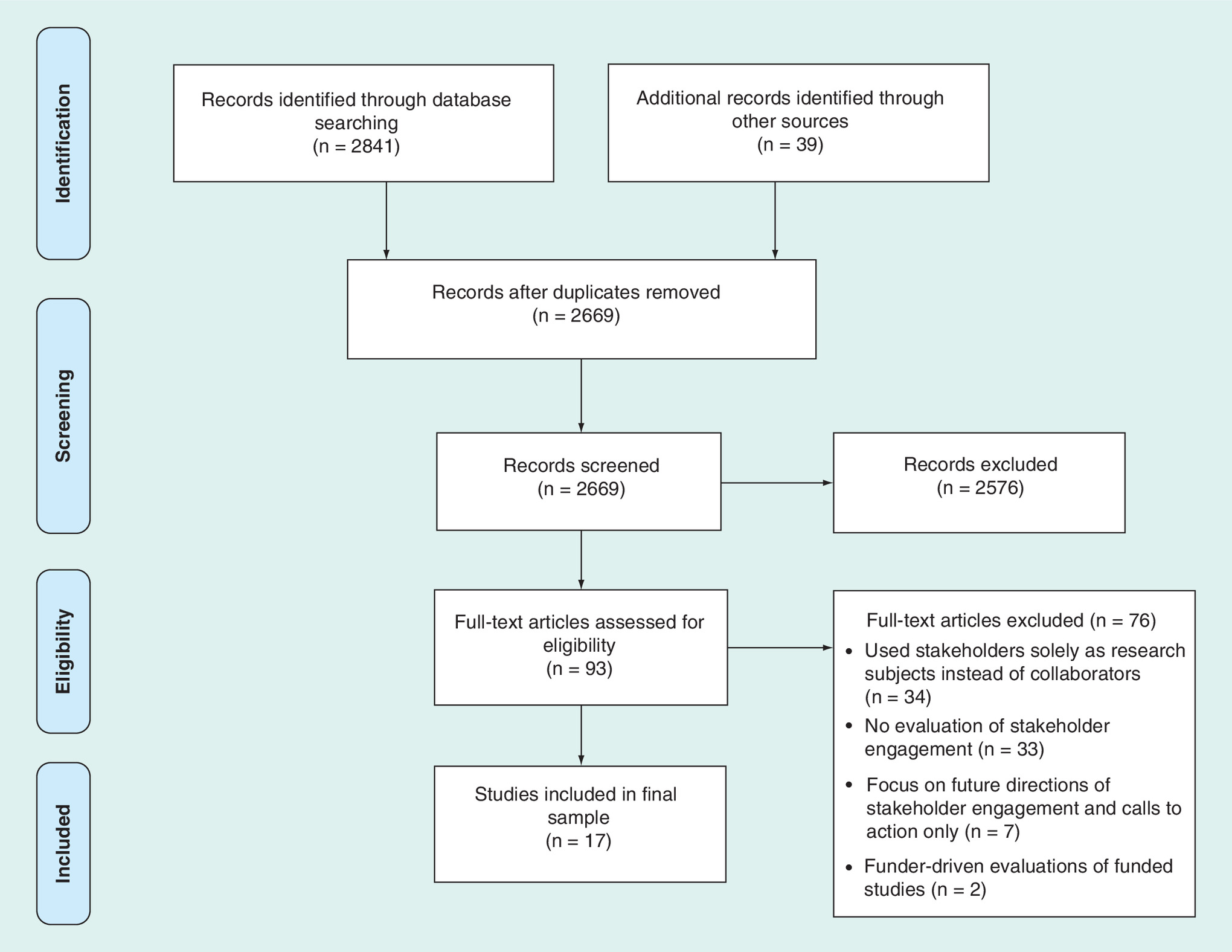
The search yielded 2880 articles, which were screened and selected for analysis as summarized in Figure 1 [22]. A total of 93 articles were reviewed at the full-text phase; 76 of those articles were excluded as documented in Figure 1. The final sample for analysis consisted of 17 articles (Table 2), of which 16 had been conducted in the USA and 1 in Hong Kong.
| Study (year) | Type (e.g., interviews, survey) and mode (e.g., in-person, phone) of data collection | Frequency of data collection | Who collected data | Description of engagement assessment | Topics of engagement covered in evaluation |
|---|---|---|---|---|---|
| Bindels et al. (2014) | • Interviews • Mode not specified | • One-time interviews • Timing of the one-time interview was not specified | External evaluator | A topic list was created by the external evaluator in consultation with the academic researchers | The experiences of older adults as part of research collaboration |
| • Other-reflection meetings • Mode not specified | Two reflection meetings held at months 6 and 12 of the study | • First meeting was led by the academic researchers • Second meeting was co-led by the co-researchers and the academic researchers | Open dialogue and reflection on collaboration between the academic researchers and co-researchers | • Reflections on the collaboration to date • What issues should be addressed • How to enhance the collaboration • Evaluate the changes implemented | |
| • Engagement log • Mode not specified | • Field notes taken regularly by all participants on their collaboration and track the time they spent on study activities • After 6 months, maintaining field notes was noted to be a barrier to participation. Thus, the three older adult co-researchers were asked to log their experiences conducting participant interviews | Field notes kept by the participants (i.e., three older adult co-researchers and the main academic researcher) during the first 6 months, and only the co-researchers thereafter | Journaling | • Collaboration between the co-researchers and academic researchers • Personal perspective on the collaboration • Time spent on study activities • Experience conducting participant interviews | |
| Brodt et al. (2015) | • Interviews • Mode not specified | Not specified | Not specified | Not specified | • Stakeholder partners’ experience with research collaboration • Perceived contribution to research process and study outcomes |
| Brookman-Frazee et al. (2016) | • Survey • Web-based | • Electronic survey was sent once • Timing of the electronic survey was not specified | • Not specified • Online software program was used to create and distribute survey | • 25 items • Multiple choice and open-ended items | • Project characteristics • Collaborative process between research and community partners • Benefits and challenges of collaboration |
| Chu et al. (2017) | • Focus groups • In person | Single evaluation administered after project implementation | Not specified | • Four groups were held • Five to seven participants each • Groups lasted for approximately 90 min • Prompts and guidelines were used | • Experience of stakeholders on various stages of the project • Overall impact of the project at individual and community levels • Recommendations for improvement |
| • Interviews • In person | • One-time • Following the project consolidation stage | Not specified | • Interviews lasted for approximately 60 min • Prompts and guidelines were used | • Experience of stakeholders on various stages of the project • Overall impact of the project at individual and community levels • Recommendations for improvement | |
| Gesell et al. (2017) | • Engagement log • Using REDCap online database | Activity log will be maintained throughout study | Researchers | Database where any engagement activities can be collected and tracked | • When stakeholder engagement was requested • When stakeholders were involved • When their input was incorporated |
| • Survey • Mode not specified | • Quarterly check-ins are described as a future component of the study • Timing of quarterly check-ins is not specified | Researchers | Not specified | • If stakeholders feel their perspectives are valued • Stakeholder satisfaction with their level of engagement • Involvement in the activities they want to be involved in • If the study team is meeting stakeholder communication preferences | |
| Gibbons et al. (2016) | • Focus groups • In person | One-time | Not specified | • Three focus groups were offered • Held in community venues | Stakeholders’ attitudes, beliefs, perspectives regarding the impact of and satisfaction with the engagement process |
| • Interviews • In person | One-time | Ten data collectors from the community were trained to conduct interviews in pairs | Interviews held in community venues | • Gain further insight regarding feedback from focus groups • Reconcile differences in perspectives from community and university partners | |
| • Survey • Web-based | • One-time • Timing of web-based survey was not specified | Not specified | Ten open-ended questions and three yes/no questions | • Perceptions of impact • Strengths and weaknesses of engagement process • How to increase project awareness • Ideas for future community needs to address | |
| Goodman et al. (2017) | • Survey testing and development • Web-based | • Survey was completed approximately 6 weeks apart during development • Biannual administration of the survey recommended for future studies using this measure | Researchers | • Ninety-six total questions on a 5-point Likert scale • Questions grouped across 11 community-engaged research principles | • Stakeholder perspective of study relevance • Acknowledgement of community • Dissemination, engagement of community partners • Fostering co-learning and co-benefit for all partners • Building on strengths and resources within community • Facilitating collaborative and equitable partnerships • Planning for long-term process and commitments |
| Greene et al. (2018) | • Survey • Mode not specified | • Semiannually at in-person meetings • Timing of semiannual meetings is not specified | Not specified | Not specified | • Assessing communication • Inclusion, comprehension • Durability of partnership • Impact to study |
| Kelly et al. (2017) | • Interviews • In person | • One-time • One year after project started | Research associate | • In-depth interviews lasted 60–90 min • Used a semistructured interview guide • Occurred over a meal or coffee | • Member motivations for participating in study • Expectations of the project and advisory committee • Extent to which goals had been met • Perspectives on engagement structure and dynamics • Personal areas of interest for future research |
| Kim et al. (2018) | • Engagement log • Mode not specified | Throughout study | Not specified | Participant logins to an online platform for discussion | Quantitative assessment of participation metrics |
| • Other follow-up email • Web-based | Following each meeting | Not specified | Not specified | Solicited stakeholder recommendations for improving conduct of the meetings | |
| • Survey • Web-based | At the completion of each online platform discussion | Not specified | Questionnaire using a 7-point scale | Stakeholder perspective of online discussions and online platform | |
| Mackie et al. (2017) | • Interviews • Semistructured individual interviews or group telephone interviews | One-time | Researcher | • Interviews lasted 30–90 min • Close and open-ended questions • Before the interview, participants were emailed an information sheet on four PCOR principles | • Perspective on each PCOR principle (i.e., reciprocal relationships, co-learning, partnership, and trust, transparency and honesty) • What structure or process would prevent or facilitate attainment of each principle |
| Morain et al. (2017) | • Interview • In person | Once following completion of study | Group facilitators for stakeholder panel discussions designed to assess their views on a policy issue | One-on-one exit interviews lasting 15 min were done after the final group and follow-up survey | • Stakeholder's perspectives and feedback on their experience • Reflections on their participation • Ease of participation • Assess their understanding of study |
| Morton et al. (2017) | • Survey • Web-based | • One-time • Timing of web-based survey was not specified | Researchers | Participants were invited to provide formal free-text comments at the end of a Delphi survey on an unrelated topic | • Stakeholder's experience being involved in the study • Survey ease of use • Reflections on study summaries previously sent out |
| Nowell et al. (2018) | • Survey • Mode not specified | Administered before and after patient involvement in an in-person orientation | Not specified | Twelve item pre-assessment and post-assessment using a 6-point scale | • The measure was created by referencing elements of the PCORI Engagement Rubric • Patient perceptions of their engagement in governance |
| • Interview • Via phone | Six months after the initial survey | Patient network chair | • Semistructured phone interview • Include open-ended questions • Asked to answer questions using a 1–10 point scale | • Perceptions about their participation in governance • The progress of the network toward conducting research • The support they receive from staff • The support they have received and given other patients in the network | |
| Ray et al. (2017) | • Engagement log • Mode not specified | Meetings occurred once every 3–4 months via telephone or video conference | Researchers | A research team member logged all stakeholder comments and recommendations made during study meetings, including any additional feedback provided via email or one-on-one meetings | Stakeholder's comments and recommendations regarding: • Research objectives • Methods • Interview guides • Data analysis • Preliminary results • Dissemination opportunities and future directions |
| • Survey • Mode not specified | Survey completed after the first year | Researchers | Not specified | • Stakeholder's perspectives on balanced composition • Clear roles/expectations • Appropriate frequency of engagement • Representativeness • Co-learning, valuing stakeholder contributions • Transparency and impact of engagement on methods • Interpretation • Stakeholder satisfaction | |
| Saunders et al. (2016) | • Survey • Via phone | • One-time • Completed at months 22–23 of the study | Researchers | • Brief quantitative survey • Included 5-point scale ratings | • Stakeholder's comfort level with the engagement process • Perceived contribution and impact to the study |
| • Interview • Via phone | • One-time • Completed at months 22–23 of the study | Researchers | Semistructured phone interview | • Stakeholder's perspectives on the overall experience • Process of engagement, research topics and methods • Logistics of engagement • Impact and outcomes | |
| Warren et al. (2018) | • Engagement log • Mode not specified | Not specified | Research network leadership | Not specified | • Number or organizations involved in research • Logging involvement of stakeholder workgroups in research activities (e.g., participation in research proposals and projects) |
| • Engagement log • Mode not specified | Not specified | Research network leadership | Not specified | • Stakeholder attendance • Number of co-investigators | |
| • Survey • Mode not specified | • Quarterly • The timing of quarterly check-ins is not specified | Not specified | Not specified | • Solicit patient testimonials on the value of stakeholder engagement • Identification of barriers and recommendations to enhance their roles in the collaboration • Descriptions of how patient guidance has impacted projects throughout the research cycle |
PCORI: Patient-centered outcomes research institute.
In accordance with previous evidence, we encountered inconsistent reports of who stakeholders are and what constitutes engagement in research [7,8,14]. For example, many articles in our initial sample (n = 2880) that reported collaborating with stakeholders included community members as study participants only, a role that is inconsistent with ongoing partnership and shared decision-making. The 17 articles in our final sample described a collaboration with stakeholders and evaluated their engagement within an existing study. Further, although stakeholder groups to consider for engagement have been previously described [10,23], there is no common framework for reporting the type of stakeholders engaged and what perspectives contributed to the evaluation of engagement. In our final sample, 53% of studies provided detailed descriptions of the stakeholder groups who participated in the evaluation of engagement. The remaining 47% of studies did not describe the stakeholder groups who participated in the evaluation of engagement or named partners as a collective (e.g., advisory board, stakeholder panel, research network, etc.).
In response to our guiding question, we identified four approaches to evaluating stakeholder engagement: ‘qualitative approaches, surveys, engagement logs and other data collection approaches’. These four approaches were not mutually exclusive. Across our final sample of 17 articles, 7 studies described using one approach to evaluate stakeholder engagement [13,24–29], 6 discussed using two [14,30–34] and 4 studies used three approaches for measuring engagement [35–38]. We discuss each of the four approaches in detail below.
Qualitative approaches
‘Qualitative approaches’ refer to the collection of non-numerical data on stakeholder engagement through one-on-one interviews and focus groups. Nine studies conducted one-on-one qualitative interviews [24,26,27,30,32,33,35–37] and varied in facilitators, participants, length, frequency, mode of communication and topics covered. Of those, two studies [30,36] also used focus groups in addition to qualitative interviews.
One-on-one qualitative interviews were led by members of the research team [26,32,37], trained community partners [27,33] or an external evaluator [35]. Not all studies specified who led the qualitative interviews [24]. Interviewees included stakeholders such as researchers, co-researchers (i.e., participants who are situated as joint contributors and investigators in research), advisory or steering committee members and patient network or community members.
The qualitative interviews occurred during the study [30,32,33,37] or following its completion [27]. Interviews lasted anywhere from 15 to 90 min [26,27,30,37] and were conducted in person [27,30,36,37] or by phone [26,32,33]. In some studies, interviews were conducted once [26,27,30,32,33,35–37]; however, several studies did not report the frequency of the interviews [24], when they occurred [24,26,35,36], their length [24,32,33,35,36] or mode of communication [24,35]. Topics addressed in qualitative interviews included the personal experiences of stakeholder partners as part of the research collaboration, perceived role and impact of contribution, satisfaction and suggestions for enhancing the engagement process.
Descriptions of the focus groups in the studies that used them also varied. Focus groups in one study were facilitated by a member of the research team [30]; the second study did not specify the background of the facilitator [36]. Focus group participants included all project interveners [30] or community members [36]. In both studies that used focus groups, stakeholders participated in only one session, yet multiple in-person groups were offered to ensure interviewee convenience [30,36]. The first study conducted 90-min focus groups [30] while the second did not describe the duration of the sessions [36]. The topics covered in both focus groups mirrored those covered in the previously described qualitative interviews.
Surveys
Surveys describe the collection of data through questionnaires on stakeholder engagement. Eleven studies [13,14,25,28,29,31–34,36,38] used surveys to capture stakeholder engagement and varied in facilitators, respondents, frequency, timing relative to the ongoing study, mode of administration, format and topics covered.
Surveys were conducted by members of the research team in five studies [13,14,28,31,32]; the remaining six studies did not specify who conducted their surveys [25,29,33,34,36,38]. Survey respondents for all 11 studies included stakeholders such as researchers, co-researchers (i.e., participants who are situated as joint contributors and investigators in research), advisory or steering committee members and patient network or community members.
For all surveys, administration frequency and timing relative to the ongoing study varied. One study surveyed participants on a quarterly basis but did not describe when these check-ins occurred [34]. Six studies described one-time surveys [14,25,28,32,36]. Of these, evaluations were completed during 22–23 months of the study [32] or after 1 year [14]. Three studies administered the survey following a discussion or meeting [29,33,38]. More specifically, surveys were administered at semiannual in-person meetings [29], after participating in an online moderated discussion board to prioritize research topics [38], and as pre- and post-assessments of an in-person study planning meeting to build relationships between study stakeholders and reach agreement on governance issues [33]. The remaining study administered a survey with the goal of developing a quantitative community engagement measure and recommends administering the resulting tool at biannual intervals as the minimum time between assessments [13].
Survey mode of administration and structure varied across the 11 studies that used surveys. Five surveys were conducted online [13,25,28,36,38] and one via telephone [32]; the remaining five studies did not specify the mode of survey administration [14,29,31,33,34]. Survey formats included multiple choice [25], open-ended or free response [25,28,36], yes or no items [36], and scaling using a 5- to 7-point scales [13,32,33,38]. Four studies did not provide additional details on survey design [14,29,31,34].
Broadly speaking, surveys gathered stakeholder perspectives on their collaboration with the research team and their impressions on the impact that engaging stakeholders had on the study. A more detailed categorization of the topics covered across the 11 surveys identified are listed in Table 3. Although most studies did not describe how their surveys were developed, one study [13] indicated that their survey was developed following a review of literature on the principles of community-engaged research, while a second study [33] described drawing from their study funder's stakeholder engagement rubric.
| Study (year) | Project characteristics and incorporation of stakeholder engagement in study design | Stakeholder communities represented | Stakeholder perspectives on the collaboration between researchers and community partners | Impact of stakeholder engagement on study | Stakeholder perspectives and participation in dissemination activities |
|---|---|---|---|---|---|
| Brookman-Frazee et al. (2016) | X | X | |||
| Gesell et al. (2016) | X | ||||
| Gibbons et al. (2016) | X | X | X | ||
| Goodman et al. (2017) | X | X | X | X | |
| Greene et al. (2018) | X | X | |||
| Kim et al. (2018) | X | ||||
| Morton et al. (2017) | X | ||||
| Nowell et al. (2018) | X | ||||
| Ray et al. (2017) | X | ||||
| Saunders et al. (2016) | X | X | |||
| Warren et al. (2018) | X | X |
Engagement logs
Engagement logs refer to tracking research-related engagement activities, such as tallying participation recorded in meeting minutes, tracking logins to an online communication platform or logging stakeholder comments and recommendations. Five studies [14,31,34,35,38] used engagement logs to capture stakeholder engagement and varied in format, respondents and topics covered.
One study asked academic researchers and stakeholder co-researchers to complete personal field notes on their reflections on the researcher–stakeholder participation throughout the study [35]. These logs captured personal perspectives on collaborations within the research team, time spent on study activities, and co-researcher reflections on their role as qualitative interviewers [35].
The remaining four studies used engagement logs to track what stakeholders were engaged and how they participated [14,31,34,38]. One study captured comments and recommendations made by stakeholders during and between study meetings [14] and a second tracked logins to an online discussion platform [38]. A third study [34] maintained two logs: the first log tracked meeting attendance and the second captured the number of participating community organizations in their research network and how many community members served as co-investigators. The last study [31] had not yet used the engagement logs and instead described plans for an online database that would capture when stakeholder input is obtained and incorporated, as well as when communication with stakeholders occurs. Engagement logs were maintained by researchers [14,31] or research network leadership [34]. One study did not provide additional details regarding the log [38].
Other data collection approaches
Other data collection approaches describe the collection of data on stakeholder engagement via approaches that were not captured by our previous categories (i.e., qualitative approaches, surveys, engagement logs). Given their unique approaches to the evaluation of stakeholder engagement, we describe the two studies [35,38] in more detail below.
One study [35] used two meetings, scheduled at 6 and 12 months, wherein stakeholder co-researchers and academic investigators engaged in open dialogue and reflection on their collaboration. The first meeting was initiated by the academic researchers, but the results of the conversation demonstrated that the co-researchers desired more involvement in the study. Thus, the co-researchers and academic investigators instituted changes to their collaboration and jointly organized, prepared and analyzed the outcomes of the second meeting. During the second meeting, attendees reflected on the changes implemented to the collaboration and used their findings to further enhance their partnership. The second study in this category [38] used follow-up emails to stakeholder partners following each advisory board meeting to solicit feedback on strengths, weaknesses and areas of improvement for meetings. However, no additional details regarding this process were reported.
Discussion
This scoping review described multiple approaches for evaluating stakeholder engagement in research. All studies collected data from a range of stakeholders, such as researchers, advisory or steering committee members and community members. Evaluation approaches most frequently sought to capture the perspective of stakeholders on their involvement as research collaborators. We did not evaluate the quality of each evaluation approach or of the stakeholder engagement partnership itself.
In accordance with the concept of collaborative stakeholder engagement [21], our final sample of articles described a partnership with stakeholders and evaluated engagement within an existing study. One of the articles in our final sample also sought to develop a community engagement measure from the data collected given the lack of evidence-based approaches or existing guidance for valid and reliable measurements of stakeholder engagement [13]. No systematic reviews met the inclusion criteria.
A key finding of our descriptive scoping review study was that approaches for capturing stakeholder engagement varied widely and their descriptions were often inconsistent or incomplete. Evaluation details and depth of description differed between studies or was missing for topics including: evaluation facilitators, how it was conducted (e.g., in-person or online), when and how frequently it was administered, and the content addressed. What specific stakeholder groups participated in the evaluation process (e.g., caregivers, healthcare providers, policy-makers, etc.) were not always specified. Additionally, the evaluation approaches (and combinations of approaches) used were different for each study. In our final sample (n = 17), nine studies used one evaluation approach, five used two approaches and three used a combination of three approaches. Surveys were by far the most common approach for evaluating stakeholder engagement and were used in 11 studies. Most articles did not describe how their evaluations were developed, and what role if any, community partners had in their design. Exceptions included Goodman and colleagues who indicated that their survey was developed following a review of literature on the principles of community-engaged research, and Nowell et al. who drew from their study funders’ stakeholder engagement rubric [13,33].
The purpose of capturing stakeholder engagement and its fit with the content addressed by each evaluation approach was not clearly stated for each study. Some evaluation approaches directly engaged stakeholders as respondents (e.g., surveys, interviews), others interacted with project data to characterize engagement (e.g., meeting minutes, tracking log-ins to an online service), and some also described plans for evaluation in a future study (e.g., creating activity logs). We identified the most common topics addressed through evaluation approaches which included: stakeholders’ personal perspective on the collaboration; stakeholders’ perceived impact on the research process and study outcomes; the barriers and facilitators stakeholders encountered to engagement; stakeholder satisfaction with the collaboration and feelings of being valued by the study team and recommendations for improving future collaborations.
We found limited information on evaluation design, accessibility, and the role that stakeholders themselves have had in evaluation conceptualization, dissemination and analysis of results. Given the need for collaborative practices in stakeholder-engaged research and a focus on equity and trustworthiness, partnering with stakeholders to design and implement inclusive evaluation approaches is an important area of future research.
Recent literature supports a continued interest in stakeholder engagement practices. For example, recent articles describe research team member-led reflections of engagement and a focus on enrollment or retention as indicators of the impact of engagement [39,40]. Reports of funder-led evaluations of stakeholder engagement of funded projects have also been published [9,41]. However, there is still a need to address evaluation approaches from a variety of perspectives. Existing evaluation approaches may prioritize researcher or organizational experiences instead of diverse stakeholder partners and may not account for power hierarchies and other factors (e.g., familiarity with research, socioeconomic status, access to resources, educational level, language proficiency).
We identified that the results of stakeholder engagement evaluations were limited or absent, as was a description of how the research team utilized or responded to evaluation findings. This gap in reporting further compromises transparency, equitable partnerships, and the potential for future research to produce findings that improve the health and healthcare of vulnerable populations. There is an urgent need for common practices for evaluating stakeholder engagement and systematic tools for doing so that capture the plurality of stakeholder backgrounds and perspectives.
Challenges to measuring stakeholder engagement include the lack of: a unifying conceptual model of stakeholder-engaged research; consensus on how to define meaningful engagement; a common understanding of who stakeholders are and what groups they may represent and unifying definition of what constitutes an engaged stakeholder [8,14]. Moreover, study results and evidence for impact of stakeholder engagement may not be available at the time of manuscript preparation, or authors may be limited by space limitations in publications [14]. However, previous literature has begun to address the need for assessment, recommendations, and models to capture stakeholder engagement [7,9,13,14,41]. Future work refining and appraising evaluation approaches, as well as investigations into other ways to capture stakeholder engagement is necessary to advance research methodologies on the topic.
Clear guidelines for identifying stakeholders and reporting data in future publications can add to our knowledge of current strategies for engagement and its evaluation. As a result, investigators of stakeholder-engaged studies may be better able to incorporate regular and valid evaluations of engagement in their initial study designs, demonstrate the impact that stakeholders have on research, and systematically document their results in research reports. Through such high quality evaluations of engagement, investigators may be better equipped to develop inclusive partnerships with stakeholders from all backgrounds, respond to power hierarchies or other factors impacting collaborative engagement (e.g., familiarity with research, socioeconomic status), and increase representation from vulnerable populations experiencing healthcare disparities.
Limitations
There are multiple limitations to our study. Since we conducted a scoping review, we did not evaluate the quality or the methodology of the included studies. As the volume of evidence examining stakeholder engagement methods evolves, future systematic reviews on the topic will need to critically appraise the quality of the methods. We included studies published between January 2013 and June 2018, which would have excluded more recent publications. In addition, relevant literature may have been inaccurately excluded during the title and abstract screening phase. Thus, there may be additional citations that could have resulted from utilizing other databases or alternative search terms. Our search also utilized terms common to stakeholder-engaged research. Given the lack of consensus on terminology, it is possible that relevant studies where stakeholder engagement occurred but was termed something else could have been excluded. Finally, given the recent and emergent evidence on this topic, a systematic review is not appropriate at this time.
Conclusion
As a growing number of studies employ stakeholder-engaged research, investigators must be prepared to collaborate with nonresearcher partners, describe how this occurred throughout the study and discuss a systematic evaluation approach that addresses stakeholder contributions and experiences [9,11]. Although the importance of engaging stakeholders and end-users of research in the scientific process is widely supported [42,43], evaluation approaches and reports of methods, results or response to evaluation findings varied widely. As a result, the extent of stakeholder engagement, its role in the study, and the perspectives of stakeholder partners were often unclear. As the number of projects engaging stakeholders and their publication grows, our findings highlight the urgent need to use validated tools at regular intervals that use a common language, framework or criteria for engagement to reflect the priorities of end-users but also meet funders’ reporting requirements. Findings from these evaluation approaches can help more clearly articulate the value and role of stakeholder engagement in the research investigation and describe effective strategies for collaborating with the public. As a result, common strategies that embed meaningful partnerships with stakeholders in the scientific process and research findings that enhance health outcomes for vulnerable populations can be facilitated.
Future perspective
Given the increased interest in stakeholder engagement in research and its prioritization by funders, it is important to identify the role that stakeholders play, how they are engaged in a study and capture their perspective research partners using valid and reliable methods. To do so, a rigorous plan for ongoing evaluation of stakeholder engagement at regular intervals is a key component of stakeholder-engaged research that can address this gap in knowledge. To support future investigators leading stakeholder-engaged research, a consensus on stakeholder engagement practices, its goals and guidance for evaluating engagement is needed and represents an important area of future investigation.
Background
•
Stakeholder engagement has been identified as a key component of high-quality studies that investigate relevant and timely healthcare topics in order to better understand how research can contribute to reducing the gap between research, practice and policy.
•
Our purpose was to describe approaches for evaluation of stakeholder engagement rather than appraise evaluation rigor or the engagement methods used.
Methods
•
We conducted a scoping review with the guiding question: How has the evaluation of stakeholder engagement in research been reported in recent studies?
•
We sought peer-reviewed journal articles in multiple databases where stakeholder partners collaborated in study planning, research activities or dissemination of results instead of taking on the role of study participants.
Results
•
After reviewing articles with inclusion and exclusion criteria, we identified a final sample of 17 articles.
•
We identified four approaches for measuring stakeholder engagement in research: qualitative approaches, surveys, engagement logs and other data collection approaches.
Discussion
•
Our findings illustrated a variety of approaches and data reported regarding the evaluation of stakeholder engagement.
•
Valid and systematic evaluation approaches that capture the diversity of stakeholder perspectives and backgrounds are essential for collaborative stakeholder engagement in research.
•
Challenges to measure stakeholder engagement include a lack of a unifying conceptual model of stakeholder-engaged research, the need for consensus on how to define meaningful engagement and a common language for what constitutes an engaged stakeholder.
Financial & competing interests disclosure
Research reported in this publication was funded through a Patient-Centered Outcomes Research Institute (PCORI) Award (IHS-1608-35732). The statements in this publication are solely the responsibility if the authors and no not necessarily represent the views of the PCORI, its Board of Governors or Methodology Committee. The authors have no other relevant affiliations or financial involvement with any organization or entity with a financial interest in or financial conflict with the subject matter or materials discussed in the manuscript apart from those disclosed.
No writing assistance was utilized in the production of this manuscript.
Author contributions
J Martinez, C Wong, and NE Leland conceived the presented idea and designed the study. J Martinez and C Wong preformed the scoping review with the guidance of NE Leland who was also available to resolve any questions about the inclusion of articles in the sample. J Martinez, C Wong, and NE Leland wrote the manuscript with support and review from all authors. DC Bieber and BL Perry provided a review of the manuscript to ensure that research stakeholders’ perspectives were represented. CV Piersol provided extensive writing support and mentorship for the article resubmission.
Acknowledgments
We thank K Saric for assistance with formulating and implementing our search strategy, as well as L Terhorst for support with technical editing of the manuscript.
Financial & competing interests disclosure
Research reported in this publication was funded through a Patient-Centered Outcomes Research institute (PCORI) Award (IHS-1608-35732). The statements in this publication are solely the responsibility if the authors and do not necessarily represent the views of the Patient-Centered Outcomes Research Institute (PCORI), its Board of Governors or Methodology Committee. The authors have no other relevant affiliations or financial involvement with any organization or entity with a financial interest in or financial conflict with the subject matter or materials discussed in the manuscript apart from those disclosed.
No writing assistance was utilized in the production of this manuscript.
References
Papers of special note have been highlighted as: • of interest; •• of considerable interest
1.
Morris ZS, Wooding S, Grant J. The answer is 17 years, what is the question: understanding time lags in translational research. J. Royal Soc. Med. 104(12), 510–520 (2011).
2.
McGlynn EA, Asch SM, Adams J et al. The quality of health care delivered to adults in the United States. N. Engl. J. Med. 348(26), 2635–2645 (2003).
3.
Boaz A, Hanney S, Borst R et al. How to engage stakeholders in research: design principles to support improvement. Health Res. Policy Syst. 16(60), 1–9 (2018).
4.
Forsythe LP, Frank L, Tafari T et al. Unique review criteria and patient and stakeholder reviewers: analysis of PCORI's approach to research funding. Value Health 21(10), 1152–1160 (2018).
5.
Forsythe LP, Frank LB, Workman TA et al. Patient, caregiver and clinician views on engagement in comparative effectiveness research. J. Comp. Eff. Res. 6(3), 231–244 (2017).
• Prior study indicating stakeholders’ perspective on the importance of stakeholder engagement in research.
6.
Esmail L, Moore E, Rein A. Evaluating patient and stakeholder engagement in research: moving from theory to practice. J. Comp. Eff. Res. 4(2), 133–145 (2015).
•• Provides a systematic review that identifies the knowledge gap in methods to engage stakeholders in research.
7.
Concannon TW, Fuster M, Saunders T et al. A systematic review of stakeholder engagement in comparative effectiveness and patient-centered outcomes research. J. Gen. Intern. Med. 29(12), 1692–1701 (2014).
•• Systematic review that identified the variability in how stakeholder engagement is reported.
8.
Bowen DJ, Hyams T, Goodman M et al. Systematic review of quantitative measures of stakeholder engagement. Clin. Transl. Sci. 10(5), 314–336 (2017).
9.
Forsythe LP, Ellis LE, Edmundson L et al. Patient and stakeholder engagement in the PCORI pilot projects: description and lessons learned. J. Gen. Intern. Med. 31(1), 13–21 (2016).
• Provides a description of stakeholder engagement in research.
10.
Patient-Centered Outcomes Research Institute. PCORI's stakeholders (2018). https://www.pcori.org/about-us/our-programs/engagement/pcoris-stakeholders
11.
Sheridan S, Schrandt S, Forsythe L et al. The PCORI Engagement Rubric: promising practices for partnering in research. Ann. Fam. Med. 15(2), 165–170 (2017).
12.
Lavallee DC, Williams CJ, Tambor ES et al. Stakeholder engagement in comparative effectiveness research: how will we measure success? J. Comp. Eff. Res. 1(5), 397–407 (2012).
13.
Goodman MS, Sanders Thompson VL, Arroyo Johnson C et al. Evaluating community engagement in research: quantitative measure development. J. Commun. Psychol. 45(1), 17–32 (2017).
•• Previous study that emphasized the need for investigating stakeholder engagement as a research practice and document its impact through evaluation.
14.
Ray KN, Miller E. Strengthening stakeholder-engaged research and research on stakeholder engagement. J. Comp. Eff. Res. 6(4), 375–389 (2017).
•• Previous study that identifies a lack of consensus on standards to report stakeholder engagement activities.
15.
Patient-Centered Outcomes Research Institute. Our story (2017). https://www.pcori.org/about-us/our-story
16.
Boivin A, Richards T, Forsythe L et al. Evaluating patient and public involvement in research. Br. Med. J. 363, k5147 (2018).
17.
Kimminau KS, Jernigan C, LeMaster J et al. Patient vs community engagement: emerging issues. Med. Care 56(Suppl. 1), S53–S57 (2018).
18.
DeCamp LR, Polk S, Camacho Chrismer M et al. Health care engagement of limited English proficient Latino families: lessons learned from advisory board development. Prog. Community Health Partnersh. 9(4), 521–530 (2015).
19.
Arksey H, O’Malley L. Scoping studies: towards a methodological framework. Int. J. Social Res. Methodol. 8(1), 19–32 (2005).
20.
Patient-Centered Outcomes Research Institute. PCORI in the literature (2017). https://www.pcori.org/literature/research-articles
21.
Ellis LE, Kass NE. How are PCORI-funded researchers engaging patients in research and what are the ethical implications? AJOB Empir. Bioeth. 8(1), 1–10 (2017).
22.
Moher D, Liberati A, Tetzlaff J et al. Preferred reporting items for systematic reviews and meta-analyses: the PRISMA statement. PLoS Med. 6(7), e1000097 (2009).
23.
Concannon TW, Meissner P, Grunbaum JA et al. A new taxonomy for stakeholder engagement in patient-centered outcomes research. J. Gen. Intern. Med. 27(8), 985–991 (2012).
24.
Brodt A, Norton CK, Kratchman A. So much more than a “pair of brown shoes”: triumphs of patient and other stakeholder engagement in patient-centered outcomes research. Patient Exp. J. 2(1), 43–49 (2015).
25.
Brookman-Frazee L, Stahmer A, Stadnick N et al. Characterizing the use of research-community partnerships in studies of evidence-based interventions in children's community services. Adm. Policy Ment. Health 43(1), 93–104 (2016).
26.
Mackie TI, Sheldrick RC, de Ferranti SD et al. Stakeholders’ perspectives on Stakeholder-Engaged Research (SER): strategies to operationalize patient-centered outcomes research principles for SER. Med. Care 55(1), 19–30 (2017).
27.
Morain SR, Whicher DM, Kass NE et al. Deliberative engagement methods for patient-centered outcomes research. Patient 10(5), 545–552 (2017).
28.
Morton KL, Atkin AJ, Corder K et al. Engaging stakeholders and target groups in prioritising a public health intervention: the Creating Active School Environments (CASE) online Delphi study. BMJ Open 7(1), e013340 (2017).
29.
Greene SM, Brandzel S, Wernli KJ. From principles to practice: real-world patient and stakeholder engagement in breast cancer research. Perm. J. 22, 17–232 (2018).
30.
Chu JT, Chan SS, Stewart SM et al. Exploring community stakeholders’ perceptions of the enhancing family well-being project in Hong Kong: a qualitative study. Front. Public Health 5, 106 (2017).
31.
Gesell SB, Potvin Klein K, Halladay J et al. Methods guiding stakeholder engagement in planning a pragmatic study on changing stroke systems of care. J. Clin. Transl. Sci. 1(2), 121–128 (2017).
32.
Saunders T, Mackie TI, Shah S et al. Young adult and parent stakeholder perspectives on participation in patient-centered comparative effectiveness research. J. Comp. Eff. Res. 5(5), 487–497 (2016).
33.
Nowell WB, Curtis JR, Crow-Hercher R. Patient governance in a patient-powered research network for adult rheumatologic conditions. Med. Care 56, S16–S21 (2018).
34.
Warren NT, Gaudino JA, Likumahuwa-Ackman S et al. Building meaningful patient engagement in research: case study from ADVANCE clinical data research network. Med. Care 56, S58–S63 (2018).
35.
Bindels J, Baur V, Cox K et al. Older people as co-researchers: a collaborative journey. Ageing Soc. 34(6), 951–973 (2014).
36.
Gibbons MC, Illangasekare SL, Smith E et al. A community health initiative: evaluation and early lessons learned. Prog. Community Health Partnersh. 10(1), 89–101 (2016).
37.
Kelly G, Wang S, Lucas G et al. Facilitating meaningful engagement on community advisory committees in patient-centered outcome research. Prog. Comm. Health Partnersh. 11(3), 243–251 (2017).
38.
Kim KK, Knodyakov D, Marie K et al. A novel stakeholder engagement approach for patient-centered outcomes research. Med. Care 56, S41–S47 (2018).
39.
Forsythe LP, Carman KL, Szydlowski V et al. Patient engagement in research: early findings from the Patient-Centered Outcomes Research Institute. Health Aff. 38(3), 359–367 (2019).
40.
Crocker JC, Ricci-Cabello I, Parker A et al. Impact of patient and public involvement on enrolment and retention in clinical trials: systematic review and meta-analysis. Br. Med. J. 363, k4738 (2018).
41.
Forsythe L, Heckert A, Margolis MK et al. Methods and impact of engagement in research, from theory to practice and back again: early findings from the Patient-Centered Outcomes Research Institute. Qual. Life Res. 27(1), 17–31 (2018).
• Previous study that initially addresses the need for assessment and models to capture stakeholder engagement.
42.
Brett J, Staniszewska S, Mockford C et al. A systematic review of the impact of patient and public involvement on service users, researchers and communities. Patient 7(4), 387–395 (2014).
43.
Cottrell E, Whitlock E, Kato E et al. Defining the benefits and challenges of stakeholder engagement in systematic reviews. Agency for Healthcare Research and Quality, MD, USA, AHRQ Report No.: 14-EHC006-EF (2014).
Information & Authors
Information
Published In
Pages: 1327 - 1341
PubMed: 31736341
Copyright
© 2019 Future Medicine Ltd.
History
Received: 8 April 2019
Accepted: 23 September 2019
Published online: 18 November 2019
Keywords:
Topics
Authors
Metrics & Citations
Metrics
Article Usage
Article usage data only available from February 2023. Historical article usage data, showing the number of article downloads, is available upon request.
Citations
How to Cite
Stakeholder engagement in research: a scoping review of current evaluation methods. (2019) Journal of Comparative Effectiveness Research. DOI: 10.2217/cer-2019-0047
Export citation
Select the citation format you wish to export for this article or chapter.
Citing Literature
- Waleed Abdulmotalib Mazi, Muhammad Abdulrahman Halwani, Evaluation of the Saudi national prevention model for reduction of central-line-associated bloodstream infections: A single-center qualitative study, Journal of Infection Prevention, 10.1177/17571774261493285, (2026).
- Dominic Ledinger, Alex Todhunter-Brown, Maureen Smith, Ursula Griebler, Danielle Pollock, Rebecca Rees, Andrea C. Tricco, Shoba Dawson, Biljana Macura, Sophie Staniszewska, Kate Boddy, Gerald Gartlehner, Barbara Nussbaumer-Streit, Top 20 research priorities on methods of co–production in evidence synthesis, Journal of Clinical Epidemiology, 10.1016/j.jclinepi.2026.112286, 195, (112286), (2026).
- Léa Obrecht, Femke van Abswoude, Katrijn Klingels, Bert Steenbergen, Advancing knowledge translation processes in motor rehabilitation for children with cerebral palsy and developmental coordination disorder: insights from a scoping review, BMC Health Services Research, 10.1186/s12913-026-14488-0, 26, 1, (2026).
- Shauntey Kalweit, Carly Marten, Odia Kane, Kalei Glozier, David Andres, Melissa Creary, Maile M. Taualii, Joon‐Ho Yu, Megan Doerr, Cultivating Authentic Partnership: Cooperative Development of a Toolkit to Mitigate Group Harm in Biorepository‐Enabled Research, Health Expectations, 10.1111/hex.70635, 29, 2, (2026).
- Alex Todhunter‐Brown, Jennifer Petkovic, Christine Chang, Ursula Griebler, Ailish Hannigan, Jennifer Hilgart, Basharat Hussain, Janet Jull, Christina Koscher‐Kien, Dominic Ledinger, Barbara Nussbaumer‐Streit, Oyekola Oloyede, Eve Tomlinson, Shoba Dawson, Omar Dewidar, Sean Grant, Lyubov Lytvyn, Thomas W. Concannon, Leonila Dans, Denny John, Zoe Jordan, Evan Mayo‐Wilson, Chris McCutcheon, Francesco Nonino, Danielle Pollock, Karine Toupin April, Pauline Campbell, Joanne Khabsa, Olivia Magwood, Vivian Welch, Peter Tugwell, Methods of Engaging Interest‐Holders in Healthcare Evidence Syntheses: A Scoping Review, Cochrane Evidence Synthesis and Methods, 10.1002/cesm.70066, 4, 1, (2026).
- Meena Khatwa, Vanessa Bennett, Rachael C. Edwards, Lisa Richardson, Phuong Tu Nguyen, Sajid Saleem, Sylvia Chaires, Alison O'Mara‐Eves, Dylan Kneale, A Co‐production Evaluation Tool Informed by Co‐production Workshops for Use in Evidence Synthesis Contexts, Cochrane Evidence Synthesis and Methods, 10.1002/cesm.70065, 4, 1, (2026).
- Carol Davy, Alice Windle, Gillian Harvey, Stakeholder engagement: supporting innovation in aged care, JBI Evidence Implementation, 10.1097/XEB.0000000000000524, 23, 4, (525-544), (2025).
- Sarah Cecilie Tscherning, Annesofie Lunde Jensen, Hilary Louise Bekker, Tina Wang Vedelø, Jeanette Finderup, Gitte Susanne Rasmussen, Jakob Appel Østergaard, Flemming Otto Jensen, Lotte Ørneborg Rodkjaer, How are patient partners involved in health service research? A scoping review of reviews, Research Involvement and Engagement, 10.1186/s40900-025-00755-7, 11, 1, (2025).
- Pamela Haverkamp, Atul Anantheswar, Marcel May, Gabriele Wadlig, Juliana Hildebrandt, Kira Amelie Thiessat, Ines Wollny, Marzia Traverso, Sabine Müller-Mall, Michael Kaliske, Dirk Habich, Wolfgang Lehner, Digital Twin Road: value and implications involving data and application, Discover Applied Sciences, 10.1007/s42452-025-07018-w, 7, 6, (2025).
- Hamidreza Khankeh, Shima Shirozhan, Ulrich Dirnagl, Challenges and Facilitators to Patient and Public Involvement In Stroke Research: Protocol for a Qualitative Study, Health Expectations, 10.1111/hex.70231, 28, 2, (2025).
- See more