

Disease perception, quality of life and mental health among Chinese patients with transplant-eligible newly diagnosed multiple myeloma following treatment: a cross-sectional survey study
Abstract
Aim: This study evaluated disease perception, health-related quality of life (HRQoL) and mental health among Chinese patients with transplant-eligible newly diagnosed multiple myeloma (NDMM) after treatment in Chinese tertiary hospital settings. Materials & methods: This cross-sectional survey enrolled patients after the treatments for NDMM in two Chinese tertiary hospitals between January and June 2025. This survey study collected disease perception, HRQoL assessment using the EuroQol 5-Dimension 5-Level (EQ-5D-5L) instrument and psychological assessment using the 9-item Patient Health Questionnaire (PHQ-9) for depression and the 7-item Generalized Anxiety Disorder scale (GAD-7) for anxiety. Patients were categorized according to treatment pathway (autologous stem cell transplantation [ASCT] vs non-ASCT) for exploratory descriptive comparisons. Multivariable regression analyses were used to explore any factors associated with HRQoL and psychological outcomes. Results: The cohort had a mean age of 57.2 years; 39.6% were male. Pathological fractures (54.7%) and hypertension (35.8%) were common in these surveyed patients. Knowledge gaps existed regarding the negative impact of MM on renal impairment and anemia. The mean EQ-5D utility score was 0.849; anemia was negatively associated with EQ-5D utility score (coefficient, -0.253; 95% CI: -0.444 to -0.062; p = 0.011). Regarding psychological outcomes, the mean GAD-7 anxiety score and PHQ-9 depression score were 4.7 and 3.1, respectively. Progressive disease was significantly associated with higher anxiety (GAD-7: coefficient, 7.963; 95% CI: 3.804 to 12.122; p < 0.001) and depression (PHQ-9: coefficient, 3.358; 95% CI: 1.091 to 5.624; p = 0.005). Conclusion: HRQoL was generally preserved in treated Chinese patients with NDMM, but anemia was linked to poorer HRQoL and progressive disease to greater anxiety and depression, supporting targeted education and psychosocial care.
Plain language summary: Understanding quality of life & emotional well-being in Chinese patients newly diagnosed with multiple myeloma after treatment
What is this article about?
Multiple myeloma (MM) is a type of blood cancer that can affect patients' daily lives, physical health and emotional well-being. This study explored how Chinese patients with newly diagnosed MM experienced their disease after treatment. We looked at their understanding of the disease, their quality of life and whether they experienced anxiety or depression.
What were the results?
Overall, the surveyed patients reported relatively preserved quality of life after treatment. However, many did not know that MM can cause kidney problems and low red blood cell counts (anemia). Patients who did have anemia reported a lower quality of life. Furthermore, patients whose cancer had worsened (progressed) experienced significantly more anxiety and depression.
What do the results mean?
These findings highlight the importance of providing patients with better disease education and emotional support during MM care. Identifying and managing treatment-related health problems and psychological distress may help improve the overall well-being of patients living with MM.
Multiple myeloma (MM) is a malignant plasma cell disorder characterized by clonal plasma-cell proliferation and a chronic relapsing course, often complicated by anemia, bone disease, renal impairment, infection risk and impaired physical functioning [1]. In China, the clinical burden of MM has continued to increase with population aging and improved diagnostic recognition, creating substantial treatment, psychological and economic challenges for patients and healthcare systems [2].
The treatment landscape for transplant-eligible newly diagnosed MM (NDMM) in China has evolved rapidly. Proteasome inhibitor- and immunomodulatory drug-based induction regimens, followed by high-dose therapy with autologous stem cell transplantation (ASCT) and post-transplant maintenance, remain central to standard care for eligible patients [3–6]. More recently, anti-CD38 monoclonal antibody-based combinations have further improved depth of response and disease control, although real-world access, affordability, regional resource availability and patient preference continue to influence treatment selection [7,8]. Consequently, some transplant-eligible patients do not proceed to ASCT despite guideline-supported recommendations.
Beyond survival and response outcomes, MM and its treatments can substantially affect patients' disease perception, health-related quality of life (HRQoL) and psychological well-being. Symptoms such as anemia, skeletal complications, treatment toxicity and fear of progression may contribute to anxiety, depression and reduced daily functioning [9–12]. However, patient-reported outcomes (PROs) among transplant-eligible Chinese patients with NDMM remain insufficiently characterized, particularly in relation to ASCT receipt.
Therefore, this cross-sectional study assessed disease perception, HRQoL, anxiety and depression among transplant-eligible Chinese patients with NDMM after treatment in tertiary hospital settings. By comparing patients who received ASCT with those who did not and identifying factors associated with HRQoL and psychological distress, this study aimed to inform more patient-centered supportive care and treatment decision-making.
Materials & methods
This cross-sectional survey study was conducted between January and June 2025 at two tertiary hospitals in China. This study received ethical clearance from the ethics committee of the study hospital, and all participants provided written informed consent prior to enrollment. The research was performed in strict accordance with the ethical principles outlined in the Declaration of Helsinki and complied with all relevant national guidelines for clinical research involving human subjects. This study was reported following the Strengthening the Reporting of Observational Studies in Epidemiology (STROBE) reporting guideline for observational studies.
Study patients
This cross-sectional survey was conducted among patients who met the eligibility criteria during the predefined study period. Eligible patients were consecutively invited to participate and completed a face-to-face questionnaire at a single assessment during the study period. Baseline demographic, clinical and treatment-related information, including ASCT status, was supplemented and verified using electronic medical records. Inclusion criteria were defined as a confirmed diagnosis of MM according to the 2022 Chinese Guidelines for the Diagnosis and Treatment of MM and meeting the clinical criteria for transplant eligibility at diagnosis, which included age of <75 years, an Eastern Cooperative Oncology Group performance status of 0–2, and adequate cardiac, pulmonary and hepatic function. Additionally, patients were required to have completed a standard induction therapy regimen and achieved at least a partial response, very good partial response or complete response. To evaluate the impact of different therapeutic trajectories, the study enrolled patients who had proceeded to receive post-diagnosis consolidation treatments, specifically categorized into those undergoing ASCT and those receiving non-ASCT-based therapies (e.g., continued novel agent-based consolidation or maintenance). For patients who had undergone ASCT, the interval between ASCT and questionnaire completion was required to be at least 1 year. Patients whose interval between ASCT and questionnaire completion was less than 1 year were excluded to reduce the influence of acute peri-transplant symptoms and to focus on relatively stable post-treatment outcomes. Patients were also excluded if they presented with severe cognitive, language or comprehension impairments that precluded the accurate completion of the survey instruments, or if they explicitly refused to participate. No prospective longitudinal follow-up or repeated PRO assessments were performed. Thus, the questionnaire captured patients’ disease perception, HRQoL and psychological status at a single cross-sectional assessment.
Data collection
Patient survey data were collected using a structured questionnaire designed to capture patient-reported disease perception, perceived treatment challenges, HRQoL and mental health status. The disease perception and treatment challenge sections comprised study-specific items developed by the investigators based on a literature review of MM-related guidelines and studies, consultation with MM specialists, and pilot testing in 10 patients before the formal survey. As no validated instrument specifically assessing disease perception and treatment challenges among Chinese transplant-eligible patients with NDMM was available, these study-specific items were developed to capture common clinical counseling topics and unmet patient needs encountered in routine practice. The instrument was not formally psychometrically validated before use in this study. The disease perception section assessed patients’ understanding of MM-related symptoms, organ damage and long-term disease consequences. Items covered awareness of early symptoms such as bone pain, fatigue, bleeding/anemia, infection risk and pathological fractures; recognition of organ involvement including bone, renal, hematologic, neurologic, hepatic and splenic complications; and perceived long-term consequences such as functional impairment, life-threatening complications and financial burden. The treatment challenge section assessed perceived barriers during treatment, including high treatment costs, limited insurance reimbursement, adverse effects or drug toxicity, limited treatment efficacy, complex disease management or limited access to care, poor long-term treatment adherence and absence of perceived challenges. These items were designed to describe patients’ perceived treatment challenges and treatment preferences and were not intended to identify determinants of treatment selection or reasons for undergoing or not undergoing ASCT. These items were structured as multiple-choice questions, and patients were allowed to select more than one response when applicable. Responses were summarized descriptively as counts and percentages; no composite disease perception or treatment challenge score was calculated. HRQoL was quantified using the EuroQol 5-Dimension 5-Level (EQ-5D-5L) instrument, a widely used preference-based measure of health status that has been validated in Chinese populations [13]. The EQ-5D-5L evaluates mobility, self-care, usual activities, pain/discomfort and anxiety/depression. Patients also self-rated their global health status using the EQ visual analogue scale (EQ-VAS), ranging from 0 (worst imaginable health) to 100 (best imaginable health). Mental health outcomes were measured using the 7-item Generalized Anxiety Disorder scale (GAD-7) [14] and the 9-item Patient Health Questionnaire (PHQ-9) [15], both of which have been validated and widely applied in Chinese populations for screening anxiety and depressive symptoms. GAD-7 scores were dichotomized into mild anxiety or lower (0–9) and moderate-to-severe anxiety (≥10), while PHQ-9 scores were categorized as minimal or none (0–4) versus mild or greater depressive symptoms (≥5). Questionnaires were self-administered whenever possible. For patients with physical limitations, neutral assistance was provided by trained study personnel or family members to facilitate completion without influencing responses.
In addition, electronic medical records were reviewed to collect clinical data, including disease duration, International Staging System (ISS) stage, disease progression status and MM-related complications such as anemia, pathological fractures and renal impairment. Disease progression status at the time of the survey was determined based on the available electronic medical records and clinical documentation. No additional prospective follow-up was conducted to ascertain subsequent disease progression. Progressive disease had been assessed and documented by the responsible treating clinicians according to the International Myeloma Working Group [16] response criteria. For the present analysis, patients documented as having progressive disease at the time corresponding to the questionnaire assessment were classified into the progression group, whereas those documented with other clearly defined response categories were classified into the non-progression group. Thus, ‘non-progression’ indicated that the patient was not classified as having progressive disease at the time of the assessment and did not imply the absence of disease progression throughout the disease course.
Statistical analyses
Descriptive statistics summarized cohort characteristics, with continuous variables presented as mean with standard deviation (SD) or median with interquartile range and categorical variables as counts and percentages. Normality and homogeneity of variance were assessed using the Shapiro–Wilk and Levene tests, respectively. Missing data were not imputed; available-case analyses were used, and denominators were reported when they differed from the total sample. Missing data, when present, were mainly attributable to incomplete medical records or incomplete questionnaire responses. Multivariable linear and logistic regression analyses were conducted to identify factors associated with EQ-5D utility scores, GAD-7 scores and PHQ-9 scores, adjusting for potential confounders. Candidate variables included age, sex, treatment pathway (ASCT vs non-ASCT), disease progression status and anemia status. These variables were selected a priori based on clinical relevance and previous literature. For multivariable linear regression models, multicollinearity among predictors was assessed using variance inflation factors (VIFs). Model assumptions for linear regression were evaluated using residual diagnostics, including residual-versus-fitted, normal Q–Q, scale-location, and residual-versus-leverage plots, and heteroscedasticity was assessed using the Breusch–Pagan test. Sensitivity analyses for linear regression models were performed by excluding observations identified as potentially influential based on Cook’s distance and refitting the models to evaluate the robustness of regression estimates. Exploratory multivariable logistic regression models were fitted for moderate-to-severe anxiety (GAD-7 ≥10) and mild-or-greater depressive symptoms (PHQ-9 ≥5). Given the small sample size and limited number of binary outcome events, these analyses were considered exploratory. Patients were also stratified by treatment pathway (ASCT vs non-ASCT) for subgroup comparisons of patient characteristics and PROs. Subgroup analyses used independent-samples t-tests for normally distributed continuous data, Wilcoxon rank-sum tests for non-normal distributions, and Fisher exact tests for categorical variables. Two-sided p-values < 0.05 were considered statistically significant.
Results
A total of 59 transplant-eligible patients with NDMM after induction therapy were initially screened for eligibility. After excluding two patients whose interval between ASCT and survey completion was less than 1 year, 57 eligible patients were invited to participate in the survey. Among them, four patients declined participation. Ultimately, 53 patients were included in the final analysis and constituted the study cohort. The detailed inclusion and exclusion flow is presented in Supplementary Figure 1.
Patient characteristics
The study population had a mean age of 57.2 years, a mean body mass index of 26.8 kg/m2, and was predominantly female (60.4%). The mean disease duration was 2.0 years, and 18.9% of patients were experiencing disease progression at the time of the survey. Clinical staging according to the ISS revealed that 40.4% and 36.5% of patients were in stage II and stage III, respectively. The most common disease-related complications were pathological fractures (54.7%), neurological impairment (35.8%) and immunosuppression (22.6%). Furthermore, comorbidity profiles showed that hypertension was the most prevalent condition (35.8%), followed by osteoporosis (28.3%), diabetes (15.1%) and coronary heart disease (13.2%). Detailed demographic and clinical characteristics are summarized in Table 1. Regarding missing data, initial ISS stage was unavailable for one patient (1/53, 1.9%) because records from the institution where the initial diagnosis was made were incomplete, whereas all other core study variables were complete. Available observations were used for descriptive analyses, and denominators were reported when they differed from the total sample size.
| Characteristic | Total (N = 53) |
|---|---|
| mean ± SD/% | |
| Demographics | |
| Age (years) | 57.2 ± 7.6 |
| Sex (male) | 39.6% |
| BMI (kg/m2) | 26.8 ± 2.9 |
| Socioeconomics | |
| Health insurance type | |
| Urban resident basic medical insurance | 71.7% |
| Urban employee basic medical insurance | 24.5% |
| Commercial health insurance | 3.8% |
| Disease characteristics | |
| Disease duration (years) | 2.0 ± 1.4 |
| Disease progression | 18.9% |
| ISS stage† | |
| Stage I (low risk) | 23.1% |
| Stage II (intermediate risk) | 40.4% |
| Stage III (high risk) | 36.5% |
| Comorbidities | |
| Hypertension | 35.8% |
| Osteoporosis | 28.3% |
| Diabetes mellitus | 15.1% |
| Coronary heart disease | 13.2% |
| Complications | |
| Pathological fracture | 54.7% |
| Neurological impairment | 35.8% |
| Immunosuppression | 22.6% |
| Anemia | 13.2% |
| Renal impairment | 11.3% |
†
N = 52.
BMI: body mass index; ISS: International Staging System; SD: Standard deviation.
Disease perception
Responses to individual disease-perception items varied across the cohort, with relatively greater awareness of symptomatic and visible manifestations and lower awareness of certain less apparent organ-related complications. Initial symptom recognition was highest for musculoskeletal and constitutional manifestations, with most patients identifying bone pain (90.6%) and fatigue (84.9%) as primary indicators of the disease. This was followed by an awareness of pathological fractures and increased infection risk (both 79.2%). However, awareness was lower regarding hematologic indicators, with only 67.9% of patients recognizing bleeding and anemia as early symptoms, while 3.8% remained entirely uncertain.
A similar disparity was observed regarding awareness of organ-related complications. Most patients recognized bone-specific damage, such as fractures and deformities (88.7%), as well as hematologic and neurological complications (both 77.4%), knowledge regarding other critical end-organ damage was markedly lower. Only 50.9% of the participants recognized the risk of renal impairment – a hallmark of MM – and awareness of potential liver and spleen involvement was even lower at 39.6%. Furthermore, 7.5% of the cohort reported no knowledge of any organ-related complications.
In terms of long-term disease consequences, most patients acknowledged the risk of bone destruction or pathological fractures (86.8%) and the resulting impairment of functional status, specifically the inability to work or perform daily activities (81.1%). While 73.6% recognized the potential for life-threatening or financially catastrophic complications, nearly one in ten patients (9.4%) remained uncertain about the long-term prognosis and risks of the disease. These findings are summarized in Supplementary Figure 2.
Health-related quality of life
The mean EQ-5D utility score of the study cohort was 0.849 ± 0.233, and the mean EQ-VAS score was 71.8 ± 19.7 (Table 2). In multivariable linear regression analysis of clinical and demographic factors (Figure 1A), anemia was significantly associated with lower HRQoL (coefficient: -0.253; 95% CI: -0.444 to -0.062; p = 0.011), whereas age, sex, treatment pathway and disease progression status were not significantly associated with EQ-5D utility scores.
| Outcomes | Total (N = 53) |
|---|---|
| mean ± SD/% | |
| HRQoL | |
| EQ-5D utility | 0.849 ± 0.233 |
| VAS | 71.8 ± 19.7 |
| Mental health | |
| GAD-7 total score | 4.7 ± 6.2 |
| No/mild anxiety (0–9) | 86.8% |
| Moderate/severe anxiety (≥10) | 13.2% |
| PHQ-9 total score | 3.1 ± 3.4 |
| No/minimal depression (0–4) | 77.4% |
| Mild or greater depression (≥5) | 22.6% |
EQ-5D: EuroQol 5-Dimension; GAD-7: Generalized Anxiety Disorder-7; HRQoL: Health-related quality of life; PHQ-9: Patient Health Questionnaire9; SD: Standard deviation; VAS: Visual analogue scale.
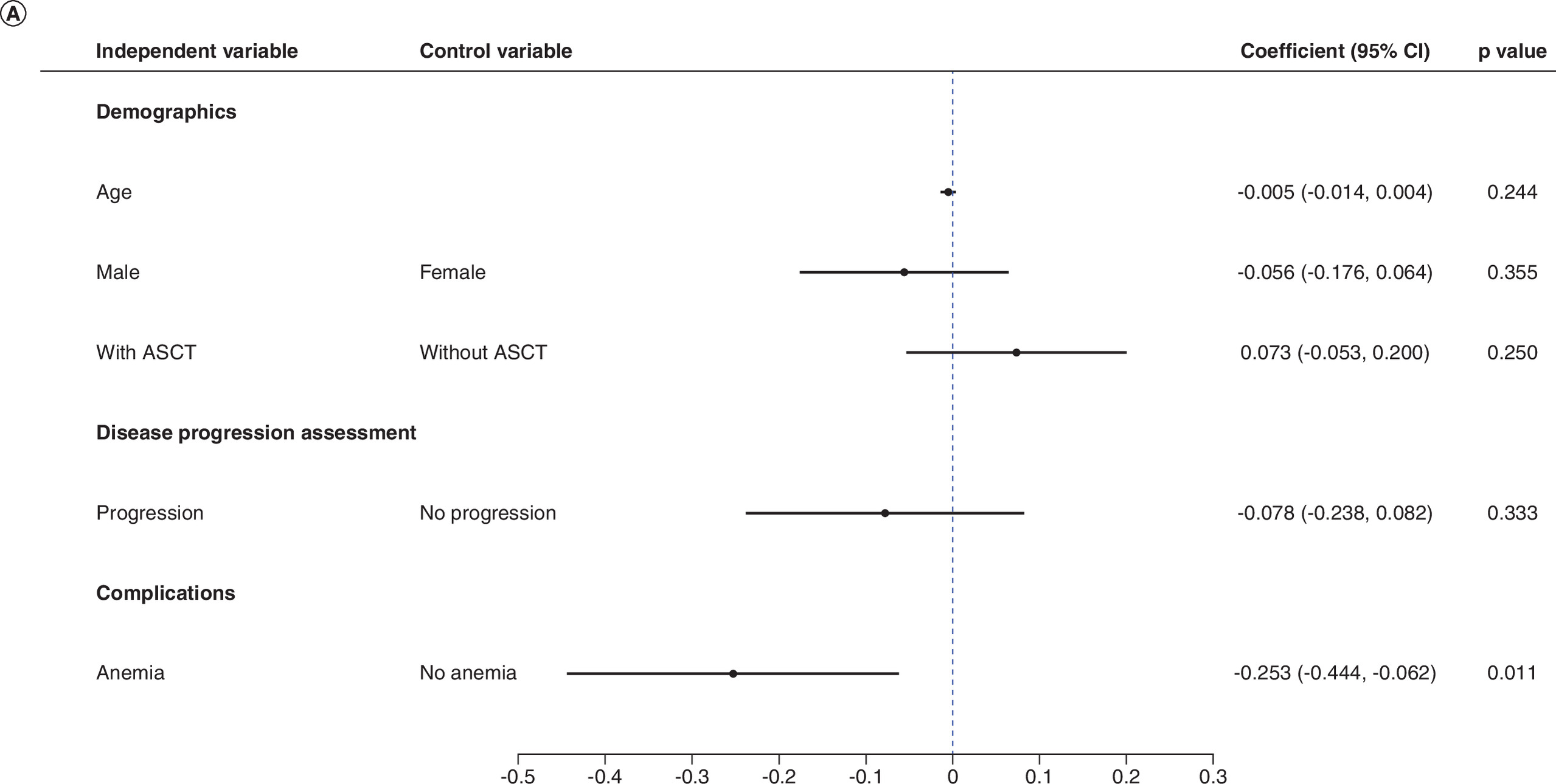
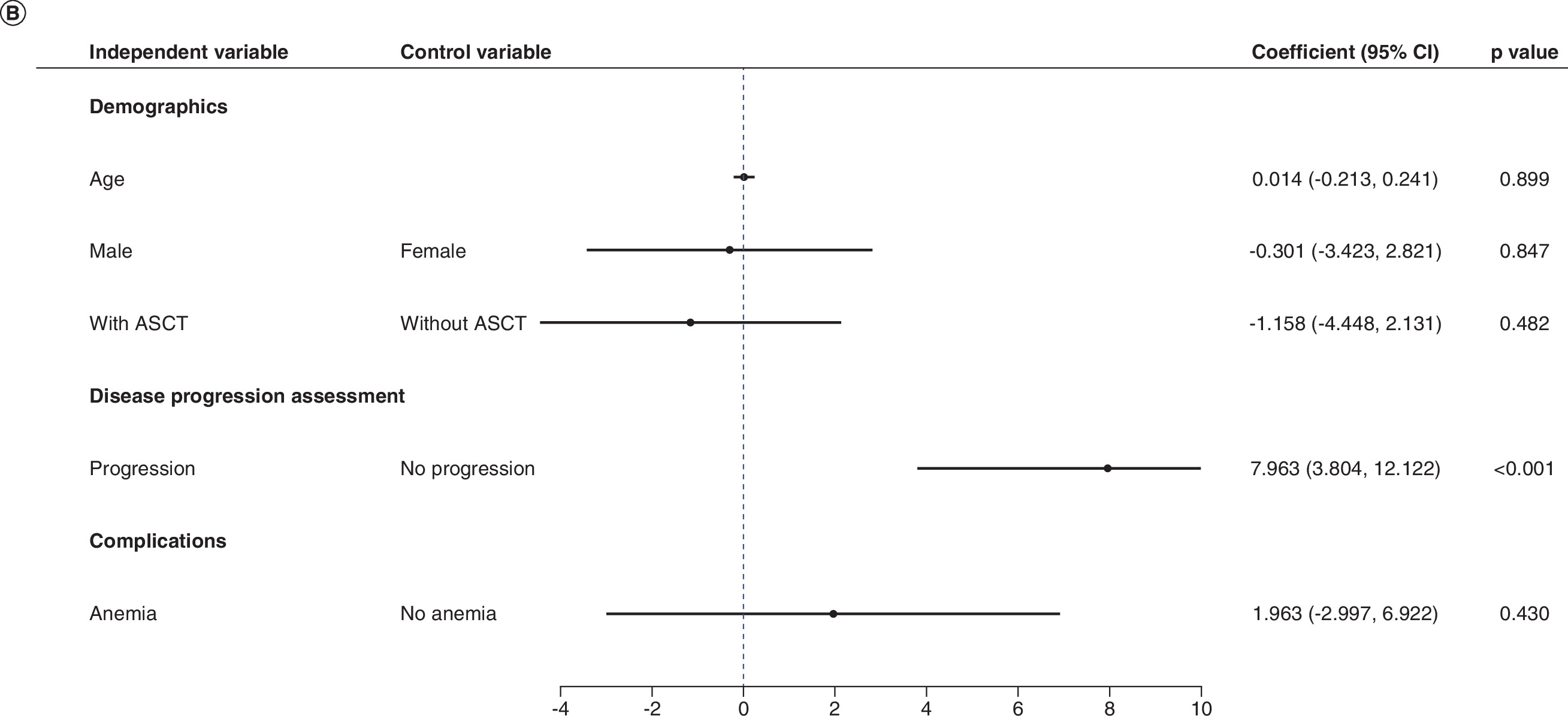
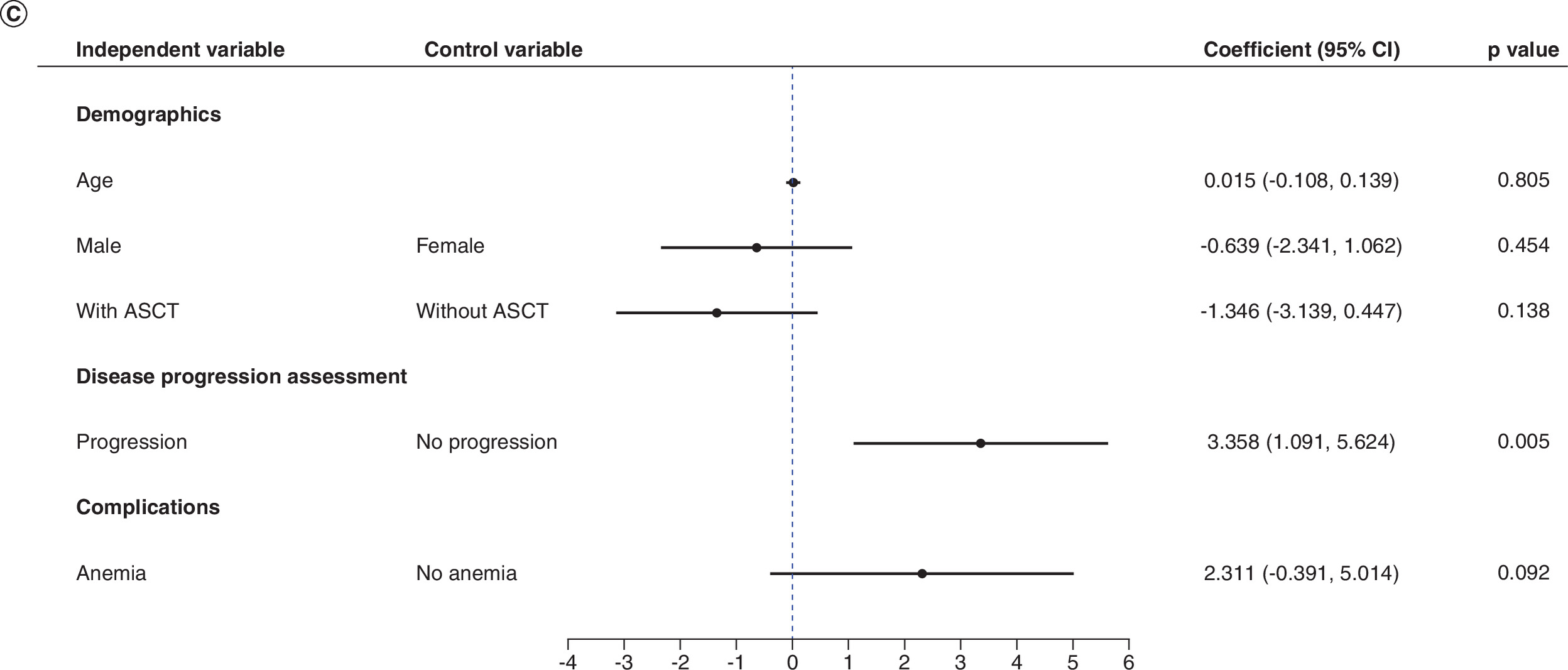
Figure 1. Multivariate linear regression analyses of health-related quality of life and mental health in autologous stem cell transplantation-eligible patients with newly diagnosed multiple myeloma.
(A) EQ-5D-5L utility scores. (B) GAD-7 scores. (C) PHQ-9 scores.
ASCT: Autologous stem cell transplantation; EQ-5D-5L: EuroQol 5-Dimension 5-Level; GAD-7: Generalized Anxiety Disorder-7; PHQ-9: Patient Health Questionnaire-9.
Psychological outcomes
Psychological assessment of the cohort revealed varying degrees of emotional distress. The mean GAD-7 score for anxiety was 4.7 ± 6.2, with 13.2% of patients meeting the criteria for moderate-to-severe anxiety. Regarding depressive symptoms, the mean PHQ-9 score was 3.1 ± 3.4, with 22.6% of patients exhibiting symptoms classified as mild or greater (Table 2). The multivariable linear regression analyses (Figure 1B & C) identified progressive disease as significantly associated with psychological distress, associated with marked increases in both GAD-7 (coefficient: 7.963; 95% CI: 3.804 to 12.122; p < 0.001) and PHQ-9 scores (coefficient: 3.358; 95% CI: 1.091 to 5.624; p = 0.005). These findings were further corroborated by logistic regression analysis (Supplementary Figure 3), which showed that progressive disease was significantly associated with clinically significant anxiety and depressive symptoms. Specifically, patients with progressive disease had higher odds of moderate-to-severe anxiety (odds ratio [OR]: 7.690; 95% CI: 1.017 to 64.944; p = 0.047) and mild-or-higher depression (OR: 9.860; 95% CI: 1.542 to 86.016; p = 0.020).
Diagnostic analyses of the three linear regression models indicated no obvious multicollinearity among predictors (VIF range: 1.070–1.325). Residual diagnostic plots, including residuals-versus-fitted, normal Q–Q, scale-location and residuals-versus-leverage plots, did not reveal substantial violations of linear regression assumptions. The residuals were generally randomly distributed around zero, with no clear evidence of non-linearity or markedly unequal variance, although minor deviations from normality were observed in the tails of the Q–Q plots. The Breusch–Pagan tests showed no evidence of heteroscedasticity in the EQ-5D, GAD-7 and PHQ-9 models (p = 0.306, 0.479 and 0.370, respectively). Sensitivity analyses were conducted by identifying potentially high-influence observations based on Cook’s distance, excluding these observations, and refitting the linear regression models. The results were generally consistent with the primary analyses, with the direction and statistical significance of the main associations retained. However, some parameter estimates varied after exclusion of high-influence observations, suggesting that certain estimates may have been influenced by these observations and should therefore be interpreted cautiously.
Subgroup analysis
Among the 53 transplant-eligible patients with NDMM after induction therapy, 19 had undergone ASCT and 34 had not. Subgroup comparisons were conducted descriptively to characterize differences between the two treatment pathway groups. The groups differed in several demographic and clinical characteristics. Patients in the ASCT group were younger than those in the non-ASCT group (53.7 vs 59.2 years, p = 0.008) and had a longer mean disease duration (3.3 vs 1.2 years, p < 0.001). Osteoporosis was more prevalent in the ASCT group than in the non-ASCT group (47.4% vs 17.6%, p = 0.021). In terms of health insurance coverage, the proportion of patients with urban resident basic medical insurance was lower in the ASCT group than in the non-ASCT group (52.6% vs 82.4%, p = 0.021). Regarding patient-reported treatment challenges and preferences, a higher proportion of patients in the ASCT group reported no notable treatment challenges than those in the non-ASCT group (26.3% vs 2.9%, p = 0.034). Financial and clinical treatment challenges were more frequently reported in the non-ASCT group, although these differences were not statistically significant. Specifically, 88.2% of non-ASCT patients reported high treatment costs compared with 68.4% of ASCT patients, while 70.6% reported limited medical insurance reimbursement compared with 47.4% of ASCT patients. Drug-related adverse effects and poor long-term treatment adherence were reported by 29.4% and 11.8% of non-ASCT patients, respectively. These findings describe patients' reported treatment experiences and preferences and were not intended to identify determinants of ASCT treatment selection. While the mean EQ-5D utility score was higher in the ASCT group (0.918 vs 0.811), psychological outcomes as measured by GAD-7 and PHQ-9 scores remained comparable between the two treatment pathways (Supplementary Table 1). Given the baseline differences between the groups, including age and disease duration, the heterogeneous clinical and treatment characteristics within the non-ASCT group, and the non-randomized nature of treatment allocation, these subgroup findings should be interpreted as exploratory and descriptive and should not be considered evidence of treatment effects.
Discussion
In this cross-sectional survey of transplant-eligible Chinese patients with NDMM after induction therapy, responses to individual disease-perception items varied, with notable knowledge gaps regarding less apparent complications. HRQoL was relatively preserved overall. Anemia was associated with lower EQ-5D utility, while progressive disease was associated with greater anxiety and depressive symptoms. Patients in the non-ASCT group also reported more financial and access-related treatment challenges. These findings highlight areas that may warrant greater attention in patient education, symptom management, psychological support and the assessment of treatment-related challenges.
The disease-perception results showed a clear contrast between greater recognition of symptomatic or visible manifestations and lower awareness of less apparent organ involvement. Most patients recognized bone pain, fatigue, pathological fractures, infection risk and long-term functional impairment, which is consistent with the high prevalence of pathological fractures in the cohort and with qualitative studies showing that patients with MM often focus on symptoms that directly disrupt daily life [11,17]. In contrast, only half of participants recognized renal impairment as a disease-related risk, despite renal dysfunction being a core component of MM-related end-organ damage. This pattern may differ from clinician-centered descriptions of MM because patients may base their understanding of the disease primarily on experienced symptoms rather than laboratory abnormalities or occult organ injury. These findings highlight the potential value of structured education that explicitly links less apparent complications, such as renal impairment and anemia, to disease management and treatment decisions.
The mean EQ-5D utility score of 0.849 and EQ-VAS score of 71.8 suggest better overall HRQoL than might be expected in broader real-world MM populations, but this difference is plausible given the study design. Unlike studies enrolling patients across disease stages, treatment lines, relapse states or frailer clinical profiles [10,11], this cohort was restricted to transplant-eligible patients who had completed induction therapy and achieved at least a partial response. Only patients who survived and were able to complete the survey were included in the final analysis. Patients surveyed during acute peri-transplant recovery were also excluded. These eligibility features may have resulted in selection toward patients with better performance status and more stable post-treatment functioning, potentially contributing to the relatively favorable HRQoL observed in this cohort. At the same time, anemia was the variable significantly associated with lower HRQoL in the multivariable analysis, which is consistent with prior work emphasizing the central role of anemia-related fatigue and physical limitation in MM-related quality of life [18]. This finding suggests that routine assessment of anemia-related symptom burden and appropriate management of hematologic abnormalities may warrant greater attention in clinical practice, particularly given the potential contribution of anemia to patients’ perceived health status. Whether timely correction of anemia can translate into meaningful improvements in HRQoL, however, remains to be determined in longitudinal or interventional studies. Differences from rehabilitation or survivorship studies may also reflect differences in instruments, timing of assessment, symptom burden and supportive-care exposure [19].
The mental health findings also require interpretation in relation to the cohort and measurement approach. The proportions of patients with moderate-to-severe anxiety and mild-or-greater depressive symptoms were clinically meaningful, but may appear lower than reports emphasizing the broad unmet psychological needs of people living with MM [12]. Several factors may explain this difference, including use of GAD-7 and PHQ-9 threshold-based classifications, assessment after induction rather than at diagnosis or relapse, tertiary-center follow-up and exclusion of patients in the acute post-ASCT period. Nevertheless, progressive disease was significantly associated with both anxiety and depressive symptoms in the multivariable analyses, which is consistent with literature linking fear of progression, fatigue, impaired functioning and poorer global quality of life among hematologic cancer survivors [20]. However, the logistic regression estimates were imprecise, as reflected by the wide confidence intervals for moderate-to-severe anxiety and mild-or-greater depressive symptoms. Given the small number of outcome events, these estimates should be regarded as exploratory rather than as robust estimates for clinical prediction. Nevertheless, the observed associations highlight the potential importance of psychological screening among patients experiencing disease progression, while requiring confirmation in larger prospective studies.
The ASCT and non-ASCT subgroup findings were exploratory and should be interpreted as patient-reported signals rather than causal effects of transplantation. ASCT recipients were younger, had longer disease duration, were less likely to be covered by Urban Resident Basic Medical Insurance, and were more likely to report no major treatment challenges. Non-ASCT patients more frequently reported high treatment costs, limited reimbursement, adverse effects or drug toxicity and poor long-term adherence. These findings describe differences in patient-reported treatment experiences and preferences between the two treatment pathways and should not be interpreted as evidence that these factors determined whether patients underwent ASCT. Although treatment pathway was included as a covariate in the multivariable regression models, the clinical and treatment heterogeneity within the non-ASCT group could not be fully accounted for given the small sample size. Published studies of ASCT often describe an early deterioration in HRQoL during transplantation followed by recovery over time [21]. In our study, patients surveyed within 1 year after ASCT were excluded, so the assessment likely captured a more stable survivorship phase. In addition, baseline differences between groups, together with the small sample size, limit the interpretability of between-group differences in PROs and preclude conclusions regarding treatment effects.
The financial findings also differ from many Western cost-effectiveness studies, in which ASCT is often evaluated as a clinically effective and economically favorable strategy over longer horizons [22,23]. In the present Chinese tertiary-care cohort, however, the patient-reported barrier was not only whether ASCT is cost-effective at a system level, but whether patients could afford upfront costs and whether insurance reimbursement was sufficient at the point of care. This distinction may provide context for understanding why some transplant-eligible patients did not proceed to ASCT despite guideline-supported treatment pathways and evidence that ASCT and maintenance strategies can extend disease control [24–26], although these patient-reported treatment challenges should not be interpreted as established determinants of treatment selection. The high frequency of reported financial burden among non-ASCT patients is also consistent with emerging evidence that financial toxicity affects outcomes in hematologic malignancies and may be modifiable through targeted financial-support interventions [27]. Taken together, these findings suggest that differences between this study and published PRO studies may reflect not only clinical status and assessment timing, but also health-system financing, reimbursement design and patient-level affordability.
The findings of this study carry several important implications for clinical practice in transplant-eligible patients with NDMM in China. First, structured patient education should be strengthened at the time of diagnosis and during post-induction treatment, with particular emphasis on silent but prognostically critical complications such as renal impairment. Improving patients' understanding of long-term organ damage and the potential benefits and limitations of ASCT may facilitate informed discussions and shared decision-making regarding treatment options. Second, routine assessment of anemia-related symptom burden and timely management of hematologic abnormalities may help improve HRQoL. This is particularly relevant because anemia was associated with worse patient-perceived health status in our cohort. Third, systematic psychological assessment using brief tools such as GAD-7 and PHQ-9 should be integrated into standard MM care, particularly for patients experiencing disease progression, who appear to be at markedly elevated risk for anxiety and depressive symptoms. These findings underscore the potential value of early psychological assessment and supportive care, which may help preserve treatment adherence and resilience during intensive therapy. Finally, given the substantial financial barriers identified among non-ASCT patients, multidisciplinary care models that incorporate social work consultation and financial counseling are warranted. At a broader level, these findings highlight the potential importance of insurance reimbursement and financial-support mechanisms in addressing patient-reported financial challenges and may warrant further evaluation as part of efforts to improve equitable access to guideline-recommended care.
This study has several limitations that should be considered when interpreting the results. First, the cross-sectional design precludes causal inference between clinical factors, such as disease progression or anemia, and observed quality of life and psychological outcomes. Although multivariable adjustment was performed, residual confounding cannot be excluded because relevant factors may not have been measured or adequately captured. Longitudinal studies are required to track how these perceptions and mental health states evolve throughout the treatment continuum. Second, the sample size was relatively small (N = 53) and limited to two tertiary hospitals in a single province, which may restrict generalizability to the broader Chinese population, particularly patients treated in lower-tier hospitals or rural areas with different access to care. Third, restricting the study population to patients who had achieved at least a partial response and survived to complete the survey may have introduced selection bias. This selection may have contributed to the relatively favorable HRQoL observed in our cohort compared with broader MM populations. In addition, excluding patients surveyed within 1 year after ASCT may have introduced survivor bias and time-related selection bias.This may have led to underestimation of the early adverse effects of ASCT on HRQoL and mental health and may have made the ASCT group appear more recovered. Moreover, the ASCT and non-ASCT groups differed in baseline characteristics, including age and disease duration, and treatment allocation was not randomized. Accordingly, these exploratory subgroup differences should be interpreted descriptively rather than as evidence of treatment effects. The non-ASCT group may also have comprised patients with diverse clinical and treatment characteristics. Although treatment pathway was included as a covariate in the multivariable regression models, the small sample size limited our ability to account more comprehensively for this within-group heterogeneity. Fourth, all PROs were based on self-administered questionnaires, which may introduce recall or social desirability bias. Disease-perception and treatment-challenge items were self-developed and not formally psychometrically validated, limiting comparability with validated disease-knowledge or financial-toxicity instruments. Fifth, the regression analyses should be interpreted cautiously given the relatively small sample size (N = 53) and limited number of outcome events, particularly for disease progression, moderate-to-severe anxiety and depressive symptoms. The low events-per-variable ratio in some logistic regression models may have increased the risk of overfitting and contributed to wide confidence intervals and uncertainty in effect estimates. Diagnostic analyses of the linear regression models did not indicate obvious violations of the assessed model assumptions, although some effect estimates varied in sensitivity analyses excluding potentially influential observations. Therefore, these regression findings should be considered exploratory and require validation in larger prospective cohorts. Missing data were minimal, with only one patient lacking initial ISS stage data, while all variables included in the regression models were complete; thus, missingness was unlikely to have materially influenced the regression estimates. Potentially unmeasured factors, including social support, caregiver availability, treatment regimen, coping style and objective financial toxicity, may therefore have contributed to residual confounding. Finally, although we identified perceived financial barriers, detailed objective cost, income, reimbursement and out-of-pocket expenditure data were not collected. Future research incorporating objective economic data alongside patient-reported financial toxicity would provide a stronger basis for health policy recommendations.
In conclusion, transplant-eligible patients with NDMM in China showed substantial awareness of symptomatic and visible disease manifestations, but important knowledge gaps regarding less apparent complications, such as renal impairment, persisted. Anemia was significantly associated with lower HRQoL, while progressive disease was associated with higher anxiety and depressive symptoms. Exploratory subgroup findings suggested that patients who did not undergo ASCT reported greater perceived financial burden and medical insurance limitations, but these findings should be interpreted with caution given baseline differences between groups, limited sample size and the subjective nature of patient-reported economic measures. These findings highlight the potential value of patient-centered care integrating psychological screening, targeted symptom management and structured disease education, while the effectiveness of specific interventions warrants further prospective evaluation.
Summary points
•
More than a third of Chinese patients with transplant-eligible newly diagnosed multiple myeloma (NDMM) had advanced clinical stages and pathological fractures and neurological impairment were the leading disease-related complications.
•
Patients who underwent autologous stem cell transplantation (ASCT) tended to be younger, had a longer disease duration, and experienced a higher prevalence of osteoporosis compared with those who did not receive transplantation.
•
Patients more frequently recognized bone pain and fatigue than less apparent disease complications, while important knowledge gaps remained regarding critical end-organ damage, particularly renal impairment.
•
Fewer patients recognized bleeding and anemia as early indicators of the disease than recognized physical symptoms such as bone pain and fatigue.
•
Chinese patients with NDMM after treatment reported a relatively preserved mean EQ-5D utility score, with anemia being the only variable significantly associated with lower health-related quality of life.
•
Depressive symptoms and anxiety were prevalent in Chinese patients with NDMM after treatment, while progressive disease was significantly associated with higher anxiety and depressive symptoms.
•
Chinese patients receiving nontransplant treatments faced greater financial hurdles by reporting high treatment costs and limited insurance reimbursement.
•
Despite the differences in clinical barriers, financial strain, and baseline characteristics between the ASCT and non-ASCT subgroups, their overall levels of anxiety and depression remained comparable regardless of which treatment pathway they followed.
Author contributions
J Meng, X Liu and W Chen formulated the study concept. Y Zhang, J You and C Chen developed the study protocol. Y Zhang, J You, Y Meng, Y Zhao, H Sun, J Wang and GS Sah conducted patient enrollment, collect patient consent, patient interview and data collection from medical records. C Chen conducted data analysis. Y Zhang and J You drafted the manuscript under the guidance of J Meng, X Liu and W Chen. All authors critically reviewed and revised the manuscript and approved the manuscript submission.
Acknowledgments
The authors thank all the patients who participated in this survey study for their valuable contributions. The authors also acknowledge the medical and nursing staff, as well as the research teams at the participating tertiary hospitals, for their support in facilitating participant recruitment and data collection.
Financial disclosure
This work was supported by a grant from the International Science and Technology Cooperation/Hong Kong–Macao–Taiwan Science and Technology Cooperation Program of the Hebei Provincial Department of Science and Technology (grant no. 25297702D).
Competing interests disclosure
The authors have no competing interests or relevant affiliations with any organization or entity with the subject matter or materials discussed in the manuscript. This includes employment, consultancies, honoraria, stock ownership or options, expert testimony, grants or patents received or pending, or royalties.
Writing disclosure
No funded writing assistance was utilized in the production of this manuscript.
Ethical conduct of research
The study received ethical clearance from the ethics committee of the study hospital, and all participants provided written informed consent prior to enrollment. The research was performed in strict accordance with the ethical principles outlined in the Declaration of Helsinki and complied with all relevant national guidelines for clinical research involving human subjects.
Data transparency statement
This manuscript reports the results of a cross-sectional survey study. The study protocol was not publicly registered. The datasets generated and/or analyzed during the current study are not publicly available due to ethical and privacy restrictions. The anonymized datasets, analytic methods, and study materials are available from the corresponding authors upon reasonable request.
Open access
This work is licensed under the Attribution-NonCommercial-NoDerivatives 4.0 Unported License. To view a copy of this license, visit https://creativecommons.org/licenses/by-nc-nd/4.0/
Supplementary Material
File (supplementary materials.docx)
References
Papers of special note have been highlighted as: •• of considerable interest
1.
Malard F, Neri P, Bahlis NJ et al. Multiple myeloma. Nat. Rev. Dis. Primer. 10(1), 45 (2024).
•• This comprehensive review summarizes the clinical characteristics, complications, treatment evolution and long-term disease burden of multiple myeloma (MM), providing important background for understanding the multidimensional impact of MM beyond survival outcomes.
2.
Dou X, Duan G, Zhong Y et al. The burden of multiple myeloma in China: trends from 1990 to 2021 and forecasts for 2050. Cancer Lett. 611, 217440 (2025).
3.
Dimopoulos MA, Moreau P, Terpos E et al. Multiple myeloma: EHA-ESMO clinical practice guidelines for diagnosis, treatment and follow-up. Ann. Oncol. Off. J. Eur. Soc. Med. Oncol. 32(3), 309–322 (2021).
4.
Nunnelee J, Cottini F, Zhao Q et al. Improvement in post-autologous stem cell transplant survival of multiple myeloma patients: a long-term institutional experience. Cancers 14(9), 2277 (2022).
5.
Ebraheem M, Kumar SK, Dispenzieri A et al. Deepening responses after upfront autologous stem cell transplantation in patients with newly diagnosed multiple myeloma in the era of novel agent induction therapy. Transplant. Cell. Ther. 28(11), 760.e1–760.e5 (2022).
6.
Pasvolsky O, Marcoux C, Dai J et al. Trends in outcomes after upfront autologous transplant for multiple myeloma over three decades. Transplant. Cell. Ther. 30(8), 772.e1–772.e11 (2024).
7.
Sorgiovanni I, Del Giudice ML, Galimberti S, Buda G. Monoclonal antibodies in relapsed-refractory multiple myeloma. Pharmaceuticals 18(2), 145 (2025).
8.
Atallah R, Shatnawi Y, Ayoobkhan MFS et al. Global access to multiple myeloma therapies. JCO Glob. Oncol. 11, e2400441 (2025).
9.
Fan H, Wang W, Zhang Y et al. Current treatment paradigm and survival outcomes among patients with newly diagnosed multiple myeloma in china: a retrospective multicenter study. Cancer Biol. Med. 20(1), 77–87 (2023).
10.
Li X, Liu J, Chen M et al. Health-related quality of life of patients with multiple myeloma: a real-world study in china. Cancer Med. 9(21), 7896–7913 (2020).
•• This real-world Chinese study characterized health-related quality of life (HRQoL) among patients with MM and identified clinical factors associated with impaired quality of life, supporting the importance of evaluating patient-reported outcomes in Chinese MM populations.
11.
Zaleta AK, Miller MF, Olson JS et al. Symptom burden, perceived control, and quality of life among patients living with multiple myeloma. J. Natl Compr. Canc. Netw. 18(8), 1087–1095 (2020).
•• Highlights the relationship between symptom burden, patients’ perceptions of disease control and quality of life, emphasizing the importance of incorporating patient experiences into MM management.
12.
Tuckey N, Iasiello M, Ali K et al. The unmet psychological needs of people living with multiple myeloma and smouldering myeloma: a review of current approaches and future directions. Clin. Lymphoma Myeloma Leuk. 25(12), e1145–e1159 (2025).
•• Summarizes the psychological challenges experienced by patients with MM and highlights the need for systematic psychological assessment and supportive interventions throughout the disease trajectory.
13.
Luo N, Liu G, Li M, Guan H, Jin X, Rand-Hendriksen K. Estimating an EQ-5D-5L value set for china. Value Health 20(4), 662–669 (2017).
14.
Tong X, An D, McGonigal A, Park S-P, Zhou D. Validation of the generalized anxiety disorder-7 (GAD-7) among chinese people with epilepsy. Epilepsy Res. 120, 31–36 (2016).
15.
Wang W, Bian Q, Zhao Y et al. Reliability and validity of the chinese version of the patient health questionnaire (PHQ-9) in the general population. Gen. Hosp. Psychiatry 36(5), 539–544 (2014).
16.
Rajkumar SV, Dimopoulos MA, Palumbo A et al. International Myeloma Working Group updated criteria for the diagnosis of multiple myeloma. Lancet Oncol. 15(12), e538–e548 (2014).
17.
Osborne TR, Ramsenthaler C, De Wolf-Linder S et al. Understanding what matters most to people with multiple myeloma: a qualitative study of views on quality of life. BMC Cancer 14(1), 496 (2014).
18.
Gascón P, Arranz R, Bargay J, Ramos F. Fatigue- and health-related quality-of-life in anemic patients with lymphoma or multiple myeloma. Support. Care Cancer 26(4), 1253–1264 (2018).
•• Demonstrates the negative impact of anemia-related symptoms on HRQoL in patients with hematological malignancies, supporting the current study’s finding that anemia is associated with poorer quality of life in MM.
19.
Nielsen LK, Larsen RF, Jarlbaek L, Möller S, Jespersen E. Health-related quality of life in patients with multiple myeloma participating in a multidisciplinary rehabilitation program. Ann. Hematol. 100(9), 2311–2323 (2021).
20.
Esser P, Götze H, Mehnert-Theuerkauf A, Knoop H, Kuba K. Fear of progression and its role in the relationship of cancer-related fatigue with physical functioning and global quality of life – a register-based study among hematological cancer survivors. J. Psychosom. Res. 127, 109844 (2019).
21.
Chakraborty R, Hamilton BK, Hashmi SK, Kumar SK, Majhail NS. Health-related quality of life after autologous stem cell transplantation for multiple myeloma. Biol. Blood Marrow Transplant. 24(8), 1546–1553 (2018).
•• Evaluates HRQoL changes following autologous stem cell transplantation in patients with MM and provides important context for interpreting patient-reported outcomes after different treatment pathways.
22.
Shah GL, Winn AN, Lin P-J et al. Cost-effectiveness of autologous hematopoietic stem cell transplantation for elderly patients with multiple myeloma using the surveillance, epidemiology, and end results–medicare database. Biol. Blood Marrow Transplant. 21(10), 1823–1829 (2015).
23.
Corso A, Mangiacavalli S, Cocito F et al. Long term evaluation of the impact of autologous peripheral blood stem cell transplantation in multiple myeloma: a cost-effectiveness analysis. PLoS ONE 8(9), e75047 (2013).
24.
Al Hamed R, Bazarbachi AH, Malard F, Harousseau J-L, Mohty M. Current status of autologous stem cell transplantation for multiple myeloma. Blood Cancer J. 9(4), 44 (2019).
25.
Martino M, Paviglianiti A, Memoli M, Martinelli G, Cerchione C. Multiple myeloma outpatient transplant program in the era of novel agents: state-of-the-art. Front. Oncol. 10, 592487 (2020).
26.
Uyl-de Groot CA, Ramsden R, Lee D, Boersma J, Zweegman S, Dhanasiri S. Lenalidomide as maintenance treatment for patients with multiple myeloma after autologous stem cell transplantation: a pharmaco-economic assessment. Eur. J. Haematol. 105(5), 635–645 (2020).
27.
Knight TG, Aguiar M, Robinson M et al. Financial toxicity intervention improves outcomes in patients with hematologic malignancy. JCO Oncol. Pract. 18(9), e1494–e1504 (2022).
Information & Authors
Information
Published In
Copyright
© 2026 The authors. This work is licensed under the Attribution-NonCommercial-NoDerivatives 4.0 Unported License
History
Received: 20 July 2026
Accepted: 5 October 2026
Published online: 11 November 2026
Keywords:
Topics
Authors
Metrics & Citations
Metrics
Article Usage
Article usage data only available from February 2023. Historical article usage data, showing the number of article downloads, is available upon request.
Citations
How to Cite
Disease perception, quality of life and mental health among Chinese patients with transplant-eligible newly diagnosed multiple myeloma following treatment: a cross-sectional survey study. (2026) Journal of Comparative Effectiveness Research. DOI: 10.57264/cer-2026-0155
Export citation
Select the citation format you wish to export for this article or chapter.