

The effects of exercises with a Pilates ball on balance, reaction time and dual-task performance of kindergarten children
Publication: Journal of Comparative Effectiveness Research
Abstract
Aim: This study investigated the effects of exercises conducted with a Pilates ball on the motor skills of preschool children. Methods: 62 preschool children were randomly divided into two groups: an intervention group (IG) (n = 30) and a control group (CG) (n = 32). Exercises with a Pilates ball were practiced in IG. The One Leg Standing test, Functional Reach test, Ruler Drop test and Timed-Up and Go test were the outcome measures. Results: Static balance performance and dual-task performance were found to be significantly improved in the intragroup and intergroup comparisons, favoring the IG (p < 0.05). Conclusion: The exercises carried out in this study were found to be effective on static balance and dual-task performance. The study can guide an exercise program for the preschool age group. Clinical Trial Registration: NCT04575441 (ClinicalTrials.gov)
A sedentary lifestyle causes many chronic conditions, one of which is obesity, the most commonly seen chronic condition in childhood. Intensive behavioral interventions might be a promising approach to prevent preschool obesity [1]. Participation in physical activities is an important way of managing obesity, and it is also important to increase socializing, reduce depressive symptoms and improve motor skills in childhood [2]. Additionally, physical activity in childhood is a determinant of physical activity in adulthood [3].
The preschool period is a time that is optimal for the maturation of the nervous system and the development of fundamental motor skills [4,5]. Therefore, physical activity in preschool children has become a parameter that needs to be studied further. Playing is an important physical activity and a basic need for children in the preschool period [6,7]. It is a fun, motivating and actively involved activity, as well as a preferred way to increase physical activity levels in preschool children [4,7].
Exercise, a type of physical activity, improves children’s health and results in positive biomechanical and physiological changes [8]. The WHO recommends physical fitness exercises starting from school age. According to the WHO guidelines for preschool children, at least 180 min of physical activity is recommended, and there is no specific exercise prescription. According to some other important documents published by the CDC and the American College of Sports Medicine, preschool children should be physically active throughout the day, but there is no specific exercise recommendation from these organizations either. Nevertheless, researchers have aimed to propose exercise methods and programs for preschool children, and various studies have investigated the effects of exercise in this age group [9]. These studies have focused on aerobic exercise, individual/team sports and exercises addressing fundamental motor skills. Moreover, most of this research has measured the effects of exercise on children’s BMI and blood pressure. Thus, there is no up-to-date exercise schedule for this population and outcome measures for basic and complex motor skills [9].
One aim of exercise in childhood is to support motor development [9]. Motor development refers to the development of motor skills, which are associated with goal-oriented activities or tasks that require the voluntary movement of one or more body parts [10,11]. Preschool children continue to develop fundamental motor skills, a specific set of skills that involve different body parts, such as the feet, legs, trunk, head, arms and hands. Fundamental motor skills can be categorized into three groups: body management skills, locomotor skills and object control skills. Rolling, balancing, running, jumping, hopping, dodging, skipping, bouncing, catching, kicking and striking are some examples for fundamental motor skills [10,11]. In addition to fundamental motor skills, some cognitive-motor tasks, termed dual tasks, may be used for preschool children to prepare them for involvement in complex motor activities [4].
Because exercise should be conducted according to a certain plan, it is important to find an exercise tool/environment that preschool children can love and associate with playing a game. Exercises with a Pilates ball can be used easily by preschool children, and a colorful ball can easily attract their attention [12]. Exercises with a Pilates ball can be used in a discipline to provide children with the experience of exercising and also improve their fundamental motor skills. Both stretching and strengthening exercises can be performed to develop motor skills in children [13]. A Pilates ball also allows exercises on a moving surface, which requires more muscular activity to support the spine and maintain overall body stability than exercises performed on a stable surface [12,13]. Exercises performed with the help of unstable surfaces such as a Pilates ball increases functional capacity because this type of exercise affects other aspects of physical fitness, such as balance and proprioception [14,15]. Thus, a Pilates ball allows the performance of almost all beneficial exercises mentioned in the literature for the preschool period.
This study was planned with the idea that children should be introduced and motivated to exercise from earlier ages when the foundations of their lifestyles are laid. Among many lifestyle interventions for preschool children, there is a limited number of papers on the benefits of exercise interventions on their motor skills [16]. Starting exercise early may provide the opportunity to gain the habit of living with exercise more easily, and motor development can be supported from early ages. The hypothesis of this study is that exercises with a Pilates ball would be beneficial for the balance, reaction time and dual-task performance of preschool children. Therefore, this study investigated the effects of a 6-week exercise program with a Pilates ball on the motor skills of preschool children.
Methods
Participants
The study was conducted in the city of Famagusta from May 2020 to October 2020. There were approximately 250 children aged 4 and 5 who continued to kindergartens in Famagusta. 62 of the children, attended a kindergarten for at least 6 months (and continued to attend full time), were included in our study. Children who had orthopedic injuries or impairments, any pain that could prevent them from doing exercise, visual and/or auditory impairments and any cognitive problem that would prevent them from understanding the instructions of the physiotherapist were excluded from the study.
Before the study, in line with the decision of the Scientific Research and Publication Ethics Committee of Eastern Mediterranean University dated 21 October 2019 (no. 2019/0211), the necessary approval was obtained from the Health Ethics Subcommittee. The ClinicalTrials.gov identifier of the study is NCT04575441.
A power analysis was performed using the G*Power 3.1.9.2 package program to determine the required sample size of the study before the study was conducted. The required sample size of the randomized controlled study was calculated with the analysis performed according to the Wilcoxon test at a significance level of 0.05 and a power of 0.8. The minimum required sample size was determined as 54 participants with these calculations. Considering data losses that could be experienced in the study, it was determined that 68 participants should be included by increasing the sample size by 25%.
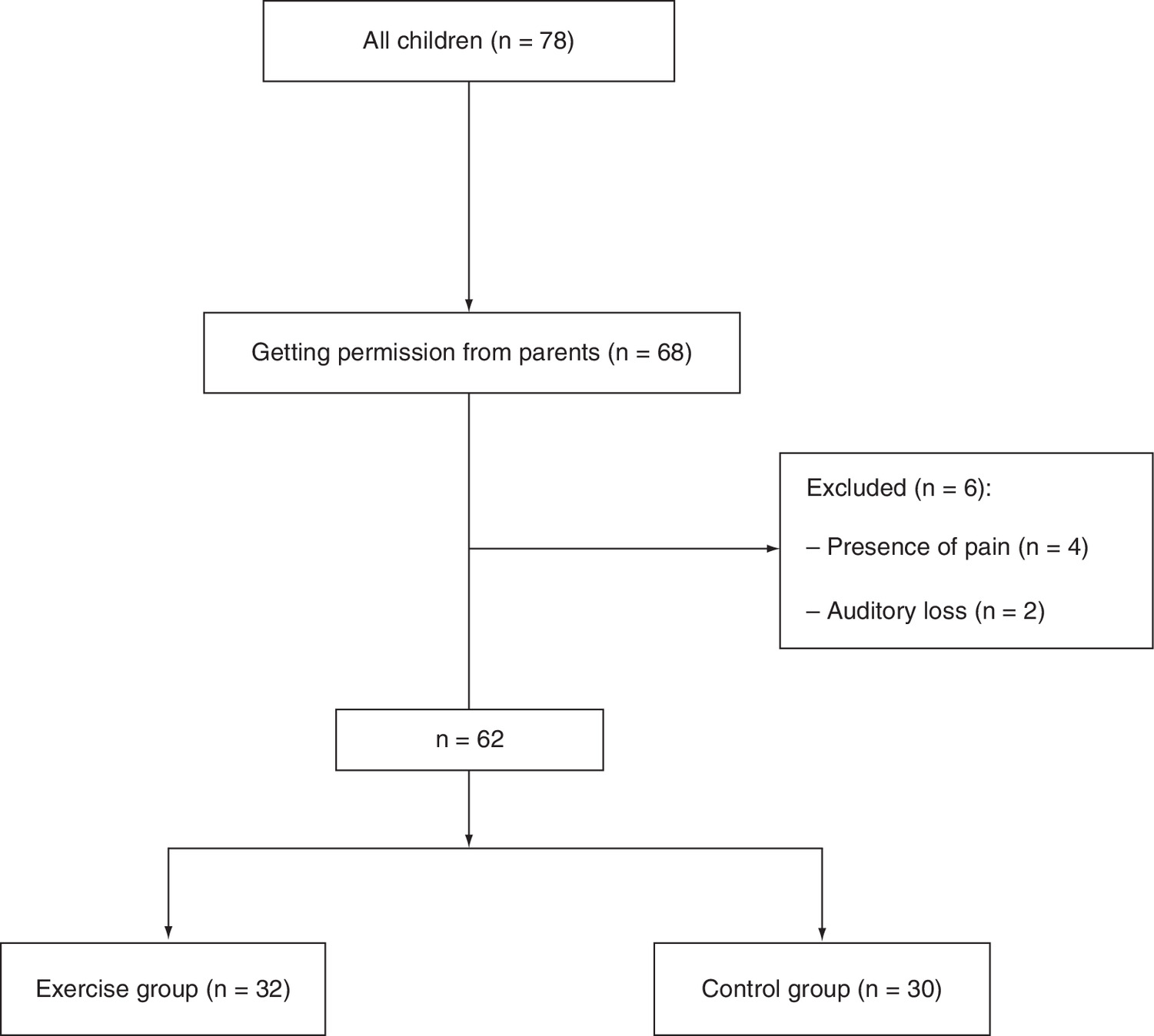
68 participants were included at the beginning of the study. Six children could not participate for personal reasons (Figure 1). The participants’ families and teachers were informed about the purpose of the study, the tests that would be applied before and after the intervention in the study and the exercises to be performed for the intervention group (IG). 62 individuals who agreed to participate in the study and complied with the inclusion criteria were considered; they signed the consent form and were randomly allocated to the IG or control group (CG).
Parents were asked about participants’ age, sex, height, weight, BMI, parents’ education levels and occupations, number of siblings, any athletic activity, use of medication, any surgery, onset of walking (month) and use of eyeglasses, and the data were recorded.
Outcome measures
The children were informed about all tests that were going to be performed by the same physiotherapist (T Obuz). Children’s balance, reaction time and dual-task performance were tested before and after the 6-week period.
Static balance
The One Leg Standing Test was used with both the eyes closed and eyes open methods [17]. The children were asked to have arms akimbo when they raised their preferred leg with a 90-degree knee flexion and a neutral hip position. The meaning of ‘preferred leg’ was explained to children as follows: “Think about your legs and decide which one is better to stand on”. When the other leg was raised from the floor, a stopwatch was started. When there was any change in the position of the lifted foot, any movement of the foot fixed on the floor or any change in the hand positions on the hips, the stopwatch was stopped. The test position was repeated with the eyes closed. The children were first asked to take the same position with their eyes open. When the children closed their eyes, the stopwatch was started, and when they opened their eyes or showed the other criteria mentioned above for the eyes-open test, the time was stopped. The children were barefoot in both tests, and both legs were tested. The test was conducted twice, and the longest duration was recorded and used for the analysis in both the eyes open and eyes closed conditions [17].
Dynamic balance
The Functional Reach Test (FRT) was used to measure the dynamic balance of the children in a barefoot condition [18]. The children were asked to stand next to the wall with their right side and extend their right arm with a 90-degree shoulder flexion. They were then asked to reach with their arm as far as possible without losing balance, taking a step or touching the wall. A vertical band was placed on the wall to inform the children to hold their fingers behind this band as a starting position. The children were asked to try to perform the movements in the instructions three times, and the average distance was recorded in centimeters [18].
Reaction time
The Ruler Drop Test was performed for this part of the testing process [19]. A 50-cm ruler was used in the test. The children were asked to sit on a chair with their mid-prone position and a 90° elbow flexion. The ruler was left with its zero point as a border for the fingers and then dropped between the two fingers. The children were asked to catch the ruler as quickly as possible, and the distance was recorded in centimeters. The test was repeated three times for both hands, and the average value of the three measurements was recorded. The reaction time was calculated as a function of distance with the formula in free fall under the influence of gravity (d = ½ gt2) [19].
Dual-task performance
The Timed Up and Go (TUG) test was used to investigate the motor skill of the children. While doing this task, the children performed a cognitive skill as the second task [20]. Counting animal names were used as the cognitive skill. Before starting to test dual-task performance, the teachers confirmed that the children knew multiple animal names, and the researchers also checked that all children who were included in the study knew animal names. For the Timed Up and Go test, a 3-meter pathway was marked with a red masking tape. The TUG test was administered using two standard chairs, and the children were asked to walk at a speed of their preference. At the same time, they were asked to say as many animal names as possible. They were then asked to say the names of four-legged animals to increase the challenge level in the dual-task measurement test. The time for the children to complete the test and the number of the animals they counted were recorded [20].
Intervention group
The exercise program was implemented individually so that every child could be included in the exercise under the supervision of the physiotherapist specializing in pediatric physiotherapy (T Obuz). The physiotherapist had experience with children both with and without disabilities. While planning the exercises for this age group, she visited kindergartens and tried to find the right exercise schedule with a suitable Pilates ball. All exercises were performed with the same blue Pilates ball. The size of the ball was chosen as a diameter of 22 inches, which is a commonly preferred size for children, according to the age range of the included children. This size allows children’s feet to touch the floor when they sit on the ball [12].
Before starting the exercise sessions, the children were informed about the exercises to be performed with the Pilates ball and the benefits of these exercises. Each session started with 5 min of warming up and ended with 5 min of cooling. Both warming and cooling involved stretching exercises for different muscles. In between, the exercise phase was applied for 30 min. Thus, the total duration of the session was 40 min. The children in the IG were involved in this 40-min program twice a week for 6 weeks.
Many motor skill measurement criteria, such as balance, coordination, speed and agility with some sensory input (e.g., proprioceptive, visual), were included in the exercise program in a planned schedule with specific number of repetitions. According to the child’s performance and motivation, the number of repetitions were 6–8 in the first weeks and 8–10 in the last weeks. While the children were doing the exercises, they were asked to count numbers, the names of their body parts and the colors or furniture items in the environment to motivate their active participation and integrate motor and cognitive tasks in a disciplined manner. The exercises applied in IG are shown in Table 1.
| Exercise program with Pilates ball | ||
|---|---|---|
| Warming and cooling exercises – Stretching of upper limb muscles on ball – Stretching of lower limb muscles on ball – Stretching the trunk muscles | ||
| 0–2 weeks – Range-of-motion exercises on ball – Sitting on ball and looking in different directions (up, back,down) – Functional activities on the ball – Bridge on the ball – Throwing the ball to each other – Rolling the ball on the wall – Walking while carrying ball | 3–4 weeks In addition to the first 2 weeks’ exercises: – Sit-ups on ball – Reaching objects while sitting on the ball – Bouncing the ball – Walking while carrying the ball in a figure 8 (using two chairs) – Tandem standing while holding the ball | 5–6 weeks In addition to the first 4 weeks exercises: – Squat with Pilates ball – Tandem walking while carrying ball – Catching the ball being thrown from different directions – Tandem standing while holding the ball with eyes closed |
Control group
The children in CG were not included in this exercise program, but they were included in the first and final tests.
The exercises and tests were carried out in the kindergartens of the included children. The children in both groups were able to engage in all routine game-playing and other activities in the kindergarten. At the end of the 6 weeks, all evaluations including the tests in the outcome measures were applied among all children again.
Statistical analysis
SPSS 25.0 program was used to analyze the data obtained from the children included in the IG and CG.
The distributions of the children in IG and CG according to their sociodemographic characteristics, sports activities and status of wearing glasses were determined by frequency analysis. Descriptive statistics such as mean, standard deviation, minimum and maximum values for the anthropometric measurements, One-Leg Static Balance, FRT, reaction time and dual-task scores of the children in the IG and CG and 95% CI values for the means are presented.
The normality of the distribution of the collected data was examined with Shapiro-Wilk test, and it was determined that the data did not fit normal distribution. For this reason, Wilcoxon test, which is a nonparametric test, was used in the intragroup comparisons of the first and last measurements, and Mann-Whitney U test was used for the intergroup comparisons.
Results
Sociodemographic characteristics of the children
No significant difference was found between the IG and CG based on their mean ages, which were 60 ± 6.69 months in IG and 58 ± 6.81 months in CG (p > 0.05). Mean BMI values of the children were 13.57 ± 2.18 kg/m2 in the IG and 13.20 ± 1.44 kg/m2 in the CG, which were not significantly different (p = 0.573 and p > 0.05). The sociodemographic characteristics of the children are shown in Table 2. The distributions of the children in both groups were similar in terms of their sex, onset of walking, duration of going to kindergarten and number of siblings (p > 0.05). The education statuses of the parents of the children were significantly different between the two groups (p < 0.05). Accordingly, the rates of those with a university-level degree for both the mother and the father were higher in the IG. As shown in Table 3, no children had athletic activity, a history of surgery or medication use. Three children in the IG and one child in the CG wore eyeglasses (Table 3).
| Variables | Intervention (n = 32) | Control (n = 30) | χ2 | p-value | ||
|---|---|---|---|---|---|---|
| Total n | % | n | % | |||
| Gender | ||||||
| Female | 16 | 50.00 | 16 | 53.33 | 0.069 | 0.793 |
| Male | 16 | 50.00 | 14 | 46.67 | ||
| Onset of walking (months) | ||||||
| ≤12 | 6 | 18.75 | 3 | 10.00 | ‡ | ‡ |
| 13–14 | 24 | 75.00 | 24 | 80.00 | ||
| ≥15 | 2 | 6.25 | 3 | 10.00 | ||
| Duration in kindergarten (months) | ||||||
| ≤12 | 9 | 28.13 | 11 | 36.67 | 2.628 | 0.269 |
| 13–35 | 16 | 50.00 | 9 | 30.00 | ||
| ≥36 | 7 | 21.88 | 10 | 33.33 | ||
| Mother education status | ||||||
| Secondary | 5 | 15.63 | 8 | 26.67 | 8.205 | 0.017† |
| High school | 12 | 37.50 | 18 | 60.00 | ||
| University | 15 | 46.88 | 4 | 13.33 | ||
| Father education status | ||||||
| Secondary | 6 | 18.75 | 4 | 13.33 | 12.584 | 0.002† |
| High school | 11 | 34.38 | 23 | 76.67 | ||
| University | 15 | 46.88 | 3 | 10.00 | ||
| Siblings (n) | ||||||
| 0 | 6 | 18.75 | 2 | 6.67 | ‡ | ‡ |
| 1 | 25 | 78.13 | 24 | 80.00 | ||
| 2 | 1 | 3.13 | 4 | 13.33 | ||
†
p < 0.05.
‡
The assumptions of the Chi-square test could not be met.
| Variables | Intervention (n = 32) | Control (n = 30) | χ2 | p-value | ||
|---|---|---|---|---|---|---|
| n | % | n | % | |||
| Athletic activity | ||||||
| None | 32 | 100.00 | 30 | 100.00 | ‡ | ‡ |
| Use of eyeglasses | ||||||
| Yes | 29 | 90.63 | 29 | 96.67 | – | 0.613† |
| No | 3 | 9.38 | 1 | 3.33 | ||
| Surgery | ||||||
| None | 32 | 100.00 | 30 | 100.00 | ‡ | ‡ |
| Use of regular medication | ||||||
| None | 32 | 100.00 | 30 | 100.00 | ‡ | ‡ |
p < 0.05.
†
Fisher exact test is used.
‡
The assumptions of the Chi-square test could not be met.
Dynamic and static balance
Table 4 shows the results of the children in the static and dynamic balance tests. The results of both balance tests were similar at the beginning of the study (p > 0.05). After 6 weeks, the static balance scores significantly improved within the groups in both the eyes closed and eyes open tests (p < 0.05). In the intergroup comparisons, the static balance scores in the IG improved significantly more than those in CG (p < 0.05). There was no significant change in the Functional Reach Test as a dynamic balance test (p > 0.05).
| Single leg standing | Group | Pre-test | p1 | Post-test | p2 | p3 | ||
|---|---|---|---|---|---|---|---|---|
| (95% CI) | min-max | (95% CI) | min–max | |||||
| Eyes open (R) | Intervention | 6.72 ± 5.42 (4.77–8.68) | 1.72–23.4 | 0.844 | 13.65 ± 7.17 (11.07–16.24) | 2.7–32.11 | 0.015† | 0.000† |
| Control | 6.43 ± 5.37 (4.43–8.44) | 1.01–23.45 | 11.14 ± 10.16 (7.35–14.94) | 2.88–36.42 | 0.000† | |||
| Eyes open (L) | Intervention | 5.31 ± 3.57 (4.03–6.6) | 1.5–13.98 | 0.757 | 11.12 ± 5.45 (9.15–13.08) | 2.57–23.3 | 0.014† | 0.000† |
| Control | 5.54 ± 4.67 (3.79–7.28) | 0.96–19.48 | 9.32 ± 8.89 (6–12.64) | 1.72–29.86 | 0.000† | |||
| Eyes close (R) | Intervention | 1.78 ± 1.28 (1.32–2.24) | 0.7–6.44 | 0.108 | 2.53 ± 1.77 (1.89–3.17) | 0.7–8.04 | 0.016† | 0.000† |
| Control | 1.35 ± 0.89 (1.01–1.68) | 0.5–4.01 | 1.66 ± 1.3 (1.17–2.14) | 0.63–5.72 | 0.001† | |||
| Eyes close (L) | Intervention | 1.39 ± 0.88 (1.08–1.71) | 0.3–3.28 | 0.402 | 2.01 ± 1.4 (1.51–2.51) | 0.59–7.72 | 0.028† | 0.000† |
| Control | 1.23 ± 0.92 (0.89–1.57) | 0.5–4.9 | 1.47 ± 1.14 (1.04–1.9) | 0.6–5.6 | 0.002† | |||
| Functional reach test (cm) | Intervention | 17.06 ± 1.7 (16.45–17.67) | 13.33–20 | 0.377 | 17.26 ± 1.67 (16.66–17.86) | 13.66–21 | 0.211 | 0.057 |
| Control | 16.99 ± 2.04 (16.22–17.75) | 14.33–25.33 | 17.04 ± 2 (16.29–17.79) | 14.33–25.33 | 0.433 | |||
†
p < 0.05.
L: Left; p1: First measurement, comparison between the groups; p2: Second measurement, comparison between the groups; p3: Comparison within the groups from first to second measurements; R: Right.
Reaction time and dual-task performance
Reaction time significantly improved in both groups after 6 weeks (p < 0.05), although the difference between the groups was not significant (p > 0.05; Table 5). Dual-task performance significantly improved in both groups after 6 weeks (p < 0.05), with a more significant improvement seen in the IG than the CG in the scores for both counting names of any animal and counting names of animals with four legs (p < 0.05; Table 6).
| Reaction time | Group | Pre-test | p1 | Post-test | p2 | p3 | ||
|---|---|---|---|---|---|---|---|---|
| (95% CI) | min-max | (95% CI) | min–max | |||||
| Right | Intervention | 32.21 ± 6.96 (29.7–34.72) | 22.33–44 | 0.778 | 28.87 ± 6.26 (26.62–31.13) | 17–42 | 0.978 | 0.002† |
| Control | 31.13 ± 5.26 (29.17–33.09) | 19–42 | 28.62 ± 5.78 (26.46–30.78) | 19–41 | 0.000† | |||
| Left | Intervention | 32.76 ± 6.45 (30.43–35.08) | 20.33–44 | 0.226 | 28.67 ± 5.82 (26.58–30.77) | 15–41.33 | 0.064 | 0.000† |
| Control | 34.89 ± 5.86 (32.7–37.07) | 19.33–46.66 | 31.5 ± 6.19 (29.18–33.81) | 17–43 | 0.000† | |||
†
p < 0.05.
p1: First measurement, comparison between the groups; p2: Second measurement, comparison between the groups; p3: Comparison within the groups from first to second measurements.
| Dual Task | Group | Pre-test | p1 | Post-test | p2 | p3 | ||
|---|---|---|---|---|---|---|---|---|
| (95% CI) | min-max | (95% CI) | min-max | |||||
| Aniamls counted (n) | Intervention | 3.69 ± 1.23 (3.24–4.13) | 2–7 | 0.879 | 4.78 ± 1.34 | 3–9 (4.3–5.26) | 0.043† | 0.000† |
| Control | 3.6 ± 0.86 (3.28–3.92) | 3–6 | 4.1 ± 0.92 (3.76–4.44) | 2–6 | 0.001† | |||
| Duration of counting animals | Intervention | 14.59 ± 3.16 (13.45–15.73) | 7.14–23.38 | 0.115 | 14.13 ± 2.7 (13.16–15.11) | 9.18–20.31 | 0.007† | 0.089† |
| Control | 13.59 ± 2.61 (12.62–14.57) | 9.21–19.16 | 12.25 ± 1.66 (11.63–12.87) | 9.17–15.13 | 0.004† | |||
| Animals who have four limbs counted (n) | Intervention | 3.31 ± 0.93 (2.98–3.65) | 2–5 | 0.167 | 4.59 ± 1.01 (4.23–4.96) | 3–7 | 0.006† | 0.000† |
| Control | 2.97 ± 0.96 (2.61–3.33) | 1–5 | 3.87 ± 1.01 (3.49–4.24) | 2–6 | 0.000† | |||
| Duration of counting animals who have four limbs counted | Intervention | 16.46 ± 3.29 (15.27–17.65) | 9.81–22.17 | 0.155 | 15.88 ± 2.74 (14.9–16.87) | 10.12–20.17 | 0.046† | 0.023† |
| Control | 15.17 ± 3.29 (13.94–16.39) | 9.56–20.03 | 14.38 ± 2.5 (13.44–15.31) | 10.21–17.63 | 0.022† | |||
†
p < 0.05.
p1: First measurement, comparison between the groups; p2: Second measurement, comparison between the groups; p3: Comparison within the groups from first to second measurements.
Discussion
The results of this study showed that a 6-week exercise program with a Pilates ball increased the static balance and dual-task performance of the preschool children who were included. Although there was progress in timing in the dynamic balance and reaction time tests in both groups, there was no significant difference between the two groups. Thus, our hypothesis was partially confirmed.
The exercise program implemented in this study aimed to produce positive results based on the involvement of a physiotherapist and the use of a Pilates ball. The intervention was 40 min per session, with two sessions per week for 6 weeks; it was planned and implemented based on the information reported in previous studies. In the literature, although there are reports of exercise or physical activity programs that were implemented for longer periods, 6-week programs have also been effective [9,21,22]. Considering the duration of every exercise session, preschool children may have difficulties adhering to longer programs. Given the exercise frequency of the program implemented in our study, it was at the lower limit based on the ideal recommendation of 3 days a week [9].
Although the scores of the children in our study in the One Leg Standing Test (both eyes open and eyes closed conditions) improved in both groups after 6 weeks, these results showed more improvement in the IG according to the intergroup comparisons. This indicates that exercises conducted with a Pilates ball had a positive effect on the static balance of the children. No study in the literature has shown the effects of a regular exercise program on the balance of preschool children [9]. Supporting our result, Pujianto et al. found that more physical activity improves static balance skills in early childhood [23]. Thus, it is possible that the children who were included in our study already engaged in physical activity when playing games, so their balance improved, and the individual exercises presented an opportunity to increase their physical activity levels.
It is known that static balance is an important parameter for fundamental motor skills, and reference values are determined for various age groups of children. By following these values, information about children’s motor skills is obtained. Higher levels of motor skills contribute to the physical, cognitive and social development of the child, and an active lifestyle is supported by participation in sports in later years [24–26].
There was no significant improvement in the dynamic balance results according to the Functional Reach Test. It was thought that various exercises performed on a ball or exercises for balance performed by carrying the ball and doing exercises on the ball could improve the dynamic balance of children. Similar to our study, Donath et al. [11] investigated the effectiveness of activity cards and exercise practice for preschool children in kindergartens. In their study, 107 children were in the intervention group, and 107 others were in the control group. This intervention was applied 15 min a day for 7 months, and the dynamic balance of the children did not improve. There was no comment by the authors on why no improvement was observed. It is known that exercises improve dynamic balance at older ages [27]. Therefore, the age factor may be the reason for differences between reports on adults and those on children, and exercise training for young children may be insufficient to affect their dynamic balance [27–29]. More studies with longer follow-up are needed.
In this study, there were significant improvements in the reaction time of the children in both the IG and the CG. However, there were no significant differences between the two groups. Studies have shown that reaction time is an interesting measurement because it shows the capabilities of the neuromuscular system [30,31]. In a previous study, significant improvements were observed in the reaction time of children aged 6–8 years who received aerobic gymnastics training 3 days a week for 8 weeks. Gymnastics movements are more complex than running or walking. These complex movements stimulate the brain to work harder because they require both hand coordination and hand–eye coordination [32].
Moreover, different types of exercise also shorten the duration of reaction time for different age groups [33,34]. In another study, researchers stated that preschool children who participated in an exercise program including various motor skills had a better ability to maintain attention than those who were physically inactive. Their findings highlighted that exercise requiring motor control is more likely to increase sustained attention for the next cognitive task because the prefrontal brain regions involved in sustained attention are activated after exercise [34].
Considering all this information, the intervention in this study was expected to affect reaction time. Although this is among the pioneering studies aimed at shortening the period for this age group, it may be that the training period of 6 weeks is too short or the frequency of the sessions per week was insufficient. Another reason may be that the age group included in this study was younger than those in the literature, and different age groups may be more resistant to exercise, contrary to what is expected. Therefore, more research is needed for this parameter.
The concept of social ambulation refers to the ability to adapt walking to environmental needs. Including obstacles in the walking path or adding cognitive skills to walking is more difficult, especially for preschool children [4]. The ability to control attention on the target and the ability to select information from sensory input enables children in the 5- to 6-year age group to perform two tasks simultaneously in their daily activities. Activities such as walking and carrying a tray at the same time are examples of dual tasks [35]. In another study, cognitive intervention and motor intervention simultaneously enabled better performance of a given task, but a lower level of alpha activity was found in the frontal brain areas during walking. This was indicative of increased cognitive load on the prefrontal cortex during dual-task walking [36].
In our study, counting as many animals as possible during the TUG test was applied as a part of the measurement of dual task performance. To make this measurement more challenging, the children were asked to count the names of four-legged animals. When the time taken for the children to complete the TUG test and the numbers of animals they counted were recorded, it was observed that the children in the intervention group had more successful results. McNeill et al. [37] stated that physical activity and cognitive development show parallelism in preschool children [37]. Similarly, exercise has been shown to have cognitive benefits, and these benefits were reported to be permanent [36]. Because there is no study in the literature to which the present results can be compared, the findings of this study related to dual-task performance will play a guiding role in the literature. An important result of our study was that the exercise program applied with a Pilates ball accompanied by a physiotherapist improved this complex gait in the preschool-age participants.
The children enjoyed the Pilates ball exercises in this study. The children’s teachers stated that the children showed their enjoyment in the sessions through various expressions. Although it was difficult at first to control them in some movements performed on the ball because they made sudden movements, the children’s postural reactions were good in terms of performing safe movements. Even though they occasionally fell off the ball, they thought it was a fun game, so they stood up again, laughing, and continued their exercises. The children had fun with these exercises, used their creativity and became physically active. To contribute to children’s development, we recommend that exercises with a Pilates ball be applied among kindergarten children.
A limitation of this study is that the assessments and interventions were conducted by the same physiotherapist. Thus, there was no blinding of the assessments. Another limitation was that children’s level of physical activity in the two groups may not have been similar due to the inclusion of different kindergartens and teachers, as well as the different schooling hours of the kindergartens in terms of activity schedules, such as evenings and weekends. Lastly, parents’ education level were different in the groups. These limitations may have affected our results.
Conclusion
There is a limited number of reports on a structured exercise program for preschool children in the literature. This study explored whether exercise awareness gained at a young age would be permanent. A healthier lifestyle in terms of exercise habits formed in earlier years will make an important contribution to the prevention of various diseases in both childhood and adulthood and support better motor skills and participation in sports. More randomized controlled studies with blinded assessors should focus on the effects of exercise programs in preschool children on their gains in future years.
•
Exercise is an important habit for all individuals to prevent chronic disease.
•
Study of lifestyle interventions, including exercise during the preschool period, are limited in the literature, and this study aimed to show the effects of an exercise intervention for this developmental period.
•
An exercise program with a Pilates ball is presented for preschool children.
•
The preschool children who participated in this study experienced exercise.
•
Some benefits of exercise on static balance and complex motor skills were shown.
•
More research including longer study periods is needed to understand further the effects of exercises on the motor skills of preschool children.
Author contributions
T Obuz: literature review, exercise sessions and assessments. Z Güçhan Topcu: literature review, ethical procedures and clinical trial registration, writing of the article.
Acknowledgments
The authors thank the administrators of the kindergartens who allowed data collection.
Financial & competing interests disclosure
The authors have no relevant affiliations or financial involvement with any organization or entity with a financial interest in or financial conflict with the subject matter or materials discussed in the manuscript. This includes employment, consultancies, honoraria, stock ownership or options, expert testimony, grants or patents received or pending, or royalties.
No writing assistance was utilized in the production of this manuscript.
Ethical conduct of research
Before the study, in line with the decision of the Scientific Research and Publication Ethics Committee of Eastern Mediterranean University dated 21 October 2019 (no. 2019/0211), the necessary approval was obtained from the Health Ethics Subcommittee. The ClinicalTrials.gov identifier of the study is NCT04575441.
Data sharing statement
The datasets collected during and/or analyzed during the current study are available from the corresponding author upon reasonable request.
References
1.
Routen A. Measuring physical activity, sedentary behaviour and obesity through childhood. In: Researching Difference in Sport and Physical Activity. 99–113 London, UK (2018).
2.
Janssen I, LeBlanc AG. Systematic review of the health benefits of physical activity and fitness in school-aged children and youth. Int. J. Behav. Nutr. Phys. Act. 7(1), 1–16 (2010).
3.
Louie L, Chan L. The use of pedometry to evaluate the physical activity levels among preschool children in Hong Kong. Early Child. Dev. Care 173(1), 97–107 (2003).
4.
Latorre-Román PÁ, Consuegra González PJ, Martínez-Redondo M et al. Complex gait in preschool children in a dual-task paradigm is related to sex and cognitive functioning: a cross-sectional study providing an innovative test and reference values. Mind Brain Educ. 14(4), 351–360 (2020).
5.
Figueroa R, An R. Motor skill competence and physical activity in preschoolers: a review. Matern. Child Health J. 21(1), 136–146 (2017).
6.
Şahin İK, Tortop HS. Gelişimsel oyun terapisinin okul öncesi dönemdeki çocukların dil ve sosyal gelişim düzeylerine etkisinin incelenmesi. J. Gift Educ. Creativity 6(2), 65–73 (2019).
7.
Yogman M, Garner A, Hutchinson J et al. Committee on psychosocial aspects of child and family health. The power of play: a pediatric role in enhancing development in young children. Pediatrics 142(3), 132–133 (2018).
8.
Logan SW, Webster EK, Robinson LE et al. The relationship between motor competence and physical activity engagement during childhood: a systematic review. Kinesiol. Rev. 4(4), 416–426 (2015).
9.
García-Hermoso A, Alonso-Martinez AM, Ramírez-Vélez R, Izquierdo M. Effects of exercise intervention on health-related physical fitness and blood pressure in preschool children: a systematic review and meta-analysis of randomized controlled trials. Sports Med. 50(1), 187–203 (2020).
10.
Foulkes JD. Fundamental movement skills, physical activity and obesity from early to late childhood. John Moores University, Liverpool, UK (2017).
11.
Donath L, Imhof K, Roth R, Zahner L. Motor skill improvement in preschoolers: How effective are activity cards?. Sports 2(4), 140–151 (2014).
12.
Hypes B. Facilitating development and sensorimotor function: treatment with the ball. PDP Press, PA, USA (1991).
13.
Shahanawaz SD, Palekar TJ, Shah N. Effect of Swiss ball on balance in children with spastic diplegia: a case study. J. Paediatr. 1(1), 8–11 (2015).
14.
Garber CE, Blissmer B, Deschenes MR et al. Quantity and quality of exercise for developing and maintaining cardiorespiratory, musculoskeletal, and neuromotor fitness in apparently healthy adults: guidance for prescribing exercise. Med. Sci. Sports Exerc. 43(7), 1334–1359 (2011).
15.
Mori A. Electromyographic activity of selected trunk muscles during stabilization exercises using a gym ball. Electromyogr. Clin. Neurophysiol. 44(1), 57–64 (2004).
16.
Ling J, Robbins LB, Wen F, Zhang N. Lifestyle interventions in preschool children: a meta-analysis of effectiveness. Am. J. Prev. Med. 53(1), 102–112 (2017).
17.
Atwater SW, Crowe TK, Deitz JC, Richardson PK. Interrater and test-retest reliability of two pediatric balance tests. Phys. Ther. 70(2), 79–87 (1990).
18.
Norris RA, Wilder E, Norton J. The functional reach test in 3- to 5-year-old children without disabilities. Pediatr. Phys. Ther. 20(1), 47–52 (2008).
19.
Ángel Latorre-Roman P, Robles-Fuentes A, García-Pinillos F, Salas-Sánchez J. Reaction times of preschool children on the ruler drop test: a cross-sectional study with reference values. Percept. Motor Skills 125(5), 866–878 (2018).
20.
Goh LY, Tan IO, Yang LC, Ng SS. Effects of cognitive and motor tasks on the walking speed of individuals with chronic stroke. Medicine 96(9), 1-6 (2017).
21.
Chang YK, Tsai YJ, Chen TT, Hung TM. The impacts of coordinative exercise on executive function in kindergarten children: an ERP study. Exp. Brain Res. 225(2), 187–196 (2013).
22.
Rajović R, Berić D, Bratić M et al. Effects of an ‘NTC’ exercise program on the development of motor skills in preschool children. Facta Universitatis Ser. Phys. Educ. Sport 14(3), 315–329 (2017).
23.
Pujianto D. Physical activity and static balance on early childhood. ACTIVE: J. Phys. Educ. Sport Health Recreat. 7(2), 68–72 (2018).
24.
Geldhof E, Cardon G, De Bourdeaudhuij I et al. Static and dynamic standing balance: test-retest reliability and reference values in 9 to 10 year old children. Eur. J. Pediatr. 165(11), 779–786 (2006).
25.
Hatzitaki V, Zlsi V, Kollias I, Kioumourtzoglou E. Perceptual-motor contributions to static and dynamic balance control in children. J. Mot. Behav. 34(2), 161–170 (2002).
26.
Latorre Román PÁ, Mora López D, Robles Fuentes A, García Pinillos F. Reference values of static balance in Spanish preschool children. Percept. Mot. Skills 124(4), 740–753 (2017).
27.
Lau PW, Wong DP, Ngo JK et al. Effects of high-intensity intermittent running exercise in overweight children. Eur. J. Sport Sci. 15(2), 182–190 (2015).
28.
Habib Z, Westcott S, Valvano J. Assessment of balance abilities in Pakistani children: a cultural perspective. Pediatr. Phys. Ther. 11(2), 73–82 (1999).
29.
Williams EN, Carroll SG, Reddihough DS et al. Investigation of the timed ‘up & go’ test in children. Dev. Med. Child Neurol. 47(8), 518–524 (2005).
30.
Ruiz LM, Mata E, Jiménez F. Percepción visual y problemas evolutivos de coordinación motriz en la edad escolar. Arch. Med. Deporte 21, 429–434 (2005).
31.
Raynor AJ. Fractionated reflex and reaction times in children with developmental coordination disorder. Motor Control 2(2), 114–124 (1998).
32.
Fediani Y, Santoso B, Kadir MR, Dewi MR. The recommended aerobic gymnastics has better effects on improving cognitive and motoric ability in children. Biosci. Med. J. Biomed. Transl. Res. 2(3), 25–34 (2018).
33.
Coe DP, Pivarnik JM, Womack CJ et al. Effect of physical education and activity levels on academic achievement in children. Med. Sci. Sports Exerc. 38(8), 1515 (2006).
34.
Miyaguchi K, Demura S, Sugiura H et al. Development of various reaction abilities and their relationships with favorite play activities in preschool children. J. Strength Cond. Res. 27(10), 2791–2799 (2013).
35.
Rothbart MK, Posner MI. The developing brain in a multitasking world. Dev. Rev. 35, 42–63 (2015).
36.
Beurskens R, Steinberg F, Antoniewicz F et al. Neural correlates of dual-task walking: effects of cognitive versus motor interference in young adults. Neural. Plast. 2016, 1–9 (2016).
37.
McNeill J, Howard SJ, Vella SA et al. Physical activity and modified organized sport among preschool children: associations with cognitive and psychosocial health. Ment. Health Phys. Act. 15, 45–52 (2018).
Information & Authors
Information
Published In
Pages: 583 - 593
PubMed: 35514277
Copyright
© 2022 Future Medicine Ltd.
History
Received: 26 November 2021
Accepted: 12 April 2022
Published online: 6 May 2022
Keywords:
Topics
Authors
Metrics & Citations
Metrics
Article Usage
Article usage data only available from February 2023. Historical article usage data, showing the number of article downloads, is available upon request.
Citations
How to Cite
The effects of exercises with a Pilates ball on balance, reaction time and dual-task performance of kindergarten children. (2022) Journal of Comparative Effectiveness Research. DOI: 10.2217/cer-2021-0293
Export citation
Select the citation format you wish to export for this article or chapter.
Citing Literature
- Marina Potašová, Peter Kutiš, Lenka Ondrušková, Silvia Borová, Prevalence of postural disorders in children aged 5–6 and their primary prevention in kindergartens, SHS Web of Conferences, 10.1051/shsconf/202623801003, 238, (01003), (2026).
- Beibei Luo, Yujie Xu, Yunya Zhang, Rongda Wang, Meifeng Gu, Jingjing Wang, Yanmei Shi, Zhibei Zhou, Rui Li, Xuting Zhu, Effects of a 10-Week Wushu Program on Static, Dynamic, and Dual-Task Balance and Physical Fitness in Preschool Children, Sports, 10.3390/sports14070286, 14, 7, (286), (2026).
- Rabeb Laatar, Mohamed Achraf Harrabi, Ahmad Touil, Rihab Borji, Haithem Rebai, Sonia Sahli, Cognitive–motor training promotes dual-task skills and executive functions in preschool children: a randomized controlled trial, Sport Sciences for Health, 10.1007/s11332-026-01838-y, 22, 3, (2026).
- Elżbieta Cimochowska, Idzi Siatkowski, Małgorzata Wójcik, Evaluation of the effect of postural muscle strengthening exercises on static and dynamic balance in preschool children, Fizjoterapia Polska, 10.56984/8ZG7D19XLJS, 25, 2, (92-96), (2025).