

Indirect treatment comparison of lanadelumab and a C1-esterase inhibitor in pediatric patients with hereditary angioedema
Publication: Journal of Comparative Effectiveness Research
Abstract
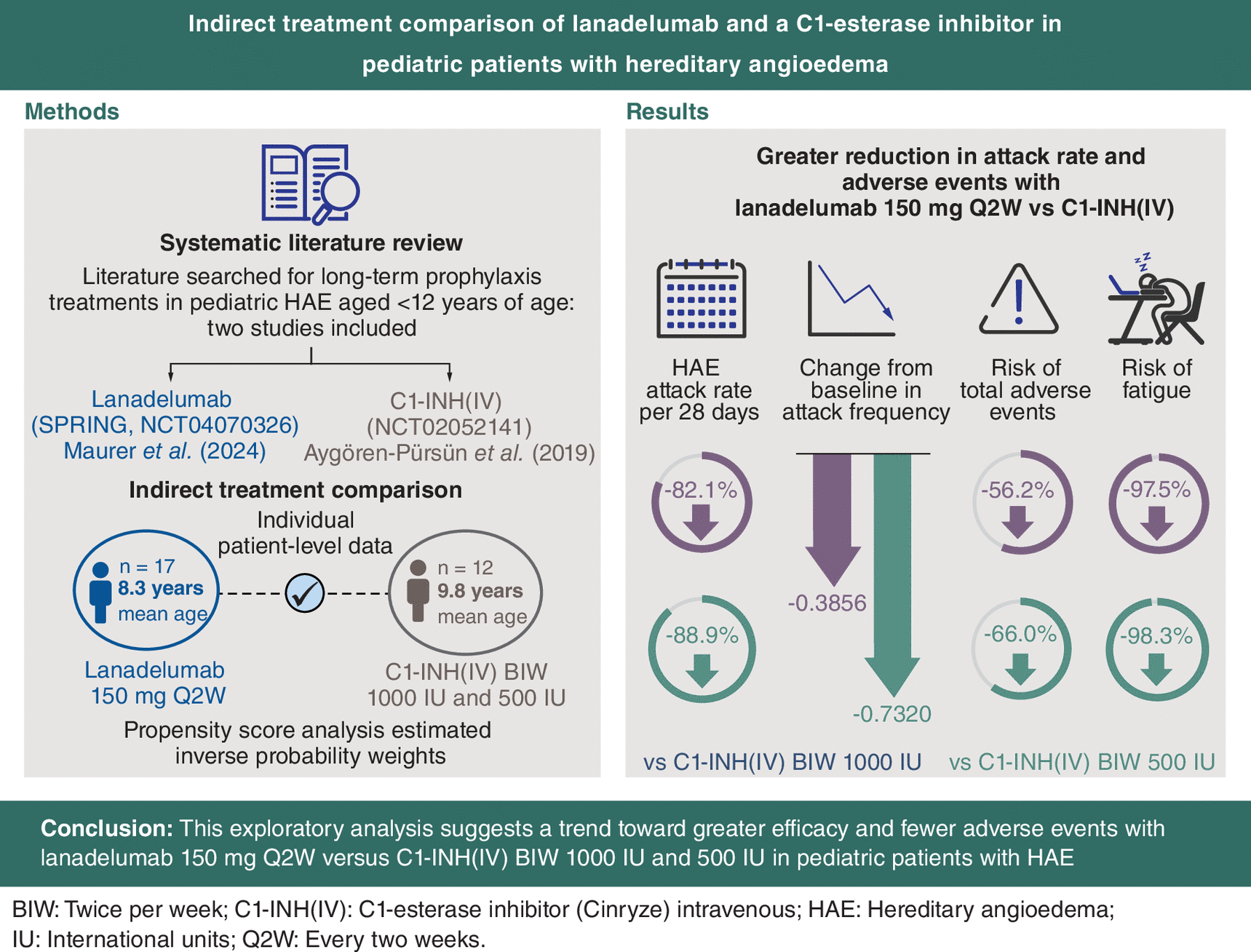
Aim: To compare the efficacy and safety of lanadelumab versus other approved long-term prophylaxis (LTP) treatments in patients with pediatric hereditary angioedema (HAE) aged <12 years. Materials & methods: A systematic literature review was conducted to identify studies of LTP in patients with HAE aged <12 years. Two studies met the inclusion criteria in an indirect treatment comparison of efficacy and safety data in pediatric HAE patients. These were for lanadelumab (SPRING, NCT04070326) and intravenous-C1-esterase inhibitor (C1-INH[IV], NCT02052141). A propensity score analysis used individual patient-level data from both studies in a logistic regression model to estimate inverse probability weights. To avoid convergence issues and an underpowered analysis due to the small sample size (n = 29), the base case was defined as Poisson regression analyses on monthly attack rate adjusting for one covariate (baseline attack rate). Model selection among unadjusted, adjusted and weighted regression models was conducted through the Akaike and Bayesian Information Criteria. Results: Lanadelumab 150 mg every 2 weeks (Q2W) reduced the monthly HAE attack rate by 82.1% versus C1-INH(IV) 1000 IU twice weekly (every 3–4 days [BIW]; rate ratio [RR], 0.1792 [95% CI: 0.0296–1.0853]) and by 88.9% versus C1-INH(IV) 500 IU BIW (RR: 0.1107 [95% CI: 0.0234–0.5239]). Treatment with lanadelumab Q2W reduced the risk of total adverse events by 56.2% versus C1-INH(IV) 1000 IU BIW (RR:0.4377 [95% CI: 0.1536–1.2469]) and by 66.0% versus C1-INH(IV) 500 IU BIW (RR: 0.3401 [95% CI: 0.1234–0.9371]). Conclusion: This exploratory analysis suggested a trend toward greater efficacy and fewer adverse events with lanadelumab 150 mg Q2W compared with C1-INH(IV) BIW 1000 IU and 500 IU in pediatric patients with HAE. Future studies could potentially assess larger samples over longer periods of time for the long-term preventative efficacy, safety and tolerability of lanadelumab and C1-INH(IV).
Graphical abstract
Supplementary Material
File (supplementary materials.docx)
References
Papers of special note have been highlighted as: • of interest; •• of considerable interest
1.
Wilkerson RG, Moellman JJ. Hereditary angioedema. Immunol. Allergy Clin. North Am. 43(3), 533–552 (2023).
2.
Bernstein JA. Severity of hereditary angioedema, prevalence, and diagnostic considerations. Am. J. Manag. Care 24(Suppl. 14), S292–S298 (2018).
3.
Busse PJ, Christiansen SC. Hereditary angioedema. N. Engl. J. Med. 382(12), 1136–1148 (2020).
4.
Maurer M, Magerl M, Betschel S et al. The international WAO/EAACI guideline for the management of hereditary angioedema—the 2021 revision and update. Allergy 77(7), 1961–1990 (2022).
• The most recent international guidelines on the management of hereditary angioedema.
5.
Magerl M, Schiffhorst G, Fanter L et al. Patient-level indirect treatment comparison of lanadelumab versus pdC1-INH i.v. in hereditary angioedema patients: PATCH study. Allergy 79(1), 215–224 (2024).
6.
Farkas H. Pediatric hereditary angioedema due to C1-inhibitor deficiency. Allergy Asthma Clin. Immunol. 6(1), 18 (2010).
7.
Farkas H, Kőhalmi KV, Veszeli N, Varga L. Safety of plasma-derived C1-inhibitor treatment in pediatric patients with hereditary angioedema due to C1-inhibitor deficiency – a long-term survey [abstract]. J. Allergy Clin. Immunol Pract. 139(2), AB236 (2017).
8.
Lumry WR. Overview of epidemiology, pathophysiology, and disease progression in hereditary angioedema. Am. J. Manag. Care 19(Suppl. 7), S103–S110 (2013).
9.
Farkas H, Martinez-Saguer I, Bork K et al. International consensus on the diagnosis and management of pediatric patients with hereditary angioedema with C1 inhibitor deficiency. Allergy 72(2), 300–313 (2017).
10.
Christiansen SC, Davis DK, Castaldo AJ, Zuraw BL. Pediatric hereditary angioedema: onset, diagnostic delay, and disease severity. Clin. Pediatr. (Phila.) 55(10), 935–942 (2016).
11.
Schöffl C, Wiednig M, Koch L et al. Hereditary angioedema in Austria: prevalence and regional peculiarities. J. Dtsch Dermatol. Ges. 17(4), 416–423 (2019).
12.
Zuraw BL. The pathophysiology of hereditary angioedema. World Allergy Organ J. 3(Suppl. 9), S25–S28 (2010).
13.
Betschel S, Badiou J, Binkley K et al. The international/Canadian hereditary angioedema guideline. Allergy Asthma Clin. Immunol. 15, 72 (2019).
14.
TAKHZYRO® (lanadelumab-flyo) injection, for subcutaneous use. Prescribing information. (2018) (Accessed March 2024). https://www.accessdata.fda.gov/drugsatfda_docs/label/2023/761090s010lbl.pdf
15.
TAKHZYRO 300 mg solution for injection, lanadelumab. Summary of product characteristics. (2018) (Accessed March 2024). https://www.ema.europa.eu/en/documents/product-information/takhzyro-epar-product-information_en.pdf
16.
CINRYZE (C1 Esterase Inhibitor [Human]). Summary of product characteristics. (2008) (Accessed March 2024). https://www.ema.europa.eu/en/documents/product-information/cinryze-epar-product-information_en.pdf
17.
CINRYZE (C1 Esterase Inhibitor [Human]). Prescribing information. (2008) (Accessed March 2024). https://pi.shirecontent.com/PI/PDFs/Cinryze_USA_ENG.pdf
18.
HAEGARDA® (C1 Esterase Inhibitor Subcutaneous [Human]). Prescribing information. (2017). (Accessed March 2024). https://labeling.cslbehring.com/PI/US/HAEGARDA/EN/HAEGARDA-Prescribing-Information.pdf
19.
Berinert 2000 / 3000 Summary of product characteristics. (2021) (Accessed November 2024). https://labeling.cslbehring.com/SMPC/EU/Berinert/EN/Berinert-2000-3000-SPC.pdf
20.
Johnston DT, Smith RC. Hereditary angioedema: special considerations in children. Allergy Asthma Proc. 41(Suppl. 1), S43–S46 (2020).
21.
Aygören-Pürsün E, Soteres DF, Nieto-Martinez SA et al. A randomized trial of human C1 inhibitor prophylaxis in children with hereditary angioedema. Pediatr. Allergy Immunol. 30(5), 553–561 (2019).
•• Reports results of the randomized, single-blind, phase III trial of C1-INH(IV) prophylaxis in hereditary angioedema patients aged 2 to <12 years.
22.
Craig T, Zuraw B, Longhurst H et al. Long-term outcomes with subcutaneous C1-inhibitor replacement therapy for prevention of hereditary angioedema attacks. J. Allergy Clin. Immunol. Pract. 7(6), 1793–1802.e2 (2019).
•• Reports results from the long-term, open-label extension of the COMPACT phase III trial of C1NH(SC).
23.
Maurer M, Lumry WR, Li HH et al. Lanadelumab in patients 2 to less than 12 years old with hereditary angioedema: results from the phase III SPRING study. J. Allergy Clin. Immunol. Pract. 12(1), 201–211.e6 (2024).
•• Reports results of the phase III, open-label, multicenter SPRING study of lanadelumab in hereditary angioedema patients aged 2 to <12 years.
24.
Centre for Reviews and Dissemination, University of York. CRD's guidance for undertaking reviews in healthcare. (2009) (Accessed March 2024). https://www.york.ac.uk/media/crd/Systematic_Reviews.pdf
25.
Higgins JP, Green S. The Cochrane Handbook for Systematic Reviews of Interventions Version 5.1.02011.
26.
Hutton B, Salanti G, Caldwell DM et al. The PRISMA extension statement for reporting of systematic reviews incorporating network meta-analyses of health care interventions: checklist and explanations. Ann. Intern. Med. 162(11), 777–784 (2015).
27.
National Institute for Health and Care Excellence (NICE). Guide to the methods of technology appraisal: NICE process and methods. (2013) (Accessed March 2024). https://www.nice.org.uk/process/pmg9/chapter/foreword
28.
Busse P, Tachdjian R, Longhurst H, Lu P, Nurse C, Anderson J. Long-term efficacy and safety of lanadelumab for prophylactic treatment in adolescent patients with hereditary angioedema (HAE) [abstract 129]. J. Allergy Clin. Immunol. 143(Suppl. 2), AB103 (2020).
29.
Araújo-Simões J, Boanova AGP, Constantino-Silva RN et al. The challenges in the follow-up and treatment of Brazilian children with hereditary angioedema. Int. Arch. Allergy Immunol. 182(7), 585–591 (2021).
30.
Martinez Saguer I, Escuriola Ettingshausen C, Gutowski Z, Linde R. The need for individually tailored prophylaxis with C1-INH concentrate in pediatric patients with hereditary angioedema (HAE) – real life data [abstract TP1459]. Allergy 74(Suppl. 106), 753 (2019).
31.
Martinez Saguer I, Escuriola Ettingshausen C, Gutowski Z, Linde R. Individually tailored prophylaxis with C1-INH concentrate in four pediatric patients with hereditary angioedema (HAE): real life data [abstract 1434]. Allergy 73(Suppl. 105), 725–726 (2018).
32.
Desai B, Bernstein J, Johnston DT, Aggarwal K, Tomita D, Reshef A. Berotralstat demonstrates consistently low attack rates in adolescent patients: subgroup analysis from apeX-S [abstract 336]. Allergy 76(Suppl. 110), 621 (2021).
33.
Martinez-Saguer I, Baker JW, Busse PJ. Pediatric use of a C1 esterase inhibitor concentrate for hereditary angioedema: findings from the international Berinert (C1-INH) registry. J. Allergy Clin. Immunol. 137(Suppl. 2), AB244 (2016).
34.
Farkas H, Reshef A, Aberer W et al. Treatment effect and safety of icatibant in pediatric patients with hereditary angioedema. J. Allergy Clin. Immunol. Pract. 5(6), 1671–1678.e2 (2017).
35.
Kessel A, Farkas H, Reshef A et al. Rapid and sustainable effect of icatibant across recurrent hereditary angioedema attacks in adolescent patients [abstract PD0376]. Allergy 74(106), 213–214 (2019).
36.
Farkas H, Kőhalmi KV, Visy B, Veszeli N, Varga L. Clinical characteristics and safety of plasma-derived C1-inhibitor therapy in children and adolescents with hereditary angioedema—a long-term survey. J. Allergy Clin. Immunol. Pract. 8(7), 2379–2383 (2020).
37.
Andresen I, Longhurst H, Aberer W et al. Icatibant treatment of acute attacks in pediatric patients with hereditary angioedema: findings from the Icatibant Outcome Survey [abstract 127]. J. Allergy Clin. Immunol. 143(2), AB43 (2019).
38.
Kreuz W, Rusicke E, Martinez-Saguer I, Aygören-Pürsün E, Heller C, Klingebiel T. Home therapy with intravenous human C1-inhibitor in children and adolescents with hereditary angioedema. Transfusion 52(1), 100–107 (2012).
39.
Reshef A, Grivcheva-Panovska V, Kessel A et al. Recombinant human C1 esterase inhibitor treatment for hereditary angioedema attacks in children. Pediatr. Allergy Immunol. 30(5), 562–568 (2019).
40.
Maurer M, Lumry W, Li H et al. Efficacy and safety of lanadelumab in paediatric patients aged 2 to <12 years with hereditary angioedema: results from the open-label, multicentre phase III SPRING study. Allergy 78(Suppl. 111), 3–716 (2023).
41.
Majluf-Cruz A, Nieto-Martínez S. Long-term follow up analysis of nadroparin for hereditary angioedema. A preliminary report. Int. Immunopharmacol. 11(8), 1127–1132 (2011).
42.
Ocak M, Nain E, Şahiner ÜM et al. Recurrent angioedema in childhood: hereditary angioedema or histaminergic angioedema? Pediatr. Dermatol. 38(1), 143–148 (2021).
43.
Banerji A, Manning ME, Martinez-Saguer I et al. Subgroup analyses from the phase III HELP study of lanadelumab for the prevention of hereditary angioedema attacks. J. Allergy Clin. Immunol. 143(Suppl. 2), AB42 (2019).
44.
Levy D, Caballero T, Hussain I et al. Long-term efficacy of subcutaneous C1 inhibitor in pediatric patients with hereditary angioedema. Pediatr. Allergy Immunol. Pulmonol. 33(3), 136–141 (2020).
45.
Zanichelli A, Magerl M, Longhurst HJ et al. Improvement in diagnostic delays over time in patients with hereditary angioedema: findings from the Icatibant Outcome Survey. Clin. Transl. Allergy 8, 42 (2018).
46.
Prenzel F, Abraham S, Hirche C et al. Epidemiology and treatment of children with hereditary angioedema in Germany: a retrospective database study. Clin. Transl. Allergy 13(11), e12313 (2023).
47.
Read N, Lim E, Tarzi MD, Hildick-Smith P, Burns S, Fidler KJ. Paediatric hereditary angioedema: a survey of UK service provision and patient experience. Clin. Exp. Immunol. 178(3), 483–488 (2014).
48.
Lumry W, Manning ME, Hurewitz DS et al. Nanofiltered C1-esterase inhibitor for the acute management and prevention of hereditary angioedema attacks due to C1-inhibitor deficiency in children. J. Pediatr. 162(5), 1017–1022.e2 (2013).
49.
Zuraw BL, Banerji A, Bernstein JA et al. US Hereditary Angioedema Association Medical Advisory Board 2013 recommendations for the management of hereditary angioedema due to C1 inhibitor deficiency. J. Allergy Clin. Immunol. Pract. 1(5), 458–467 (2013).
50.
MacGinnitie AJ. Pediatric hereditary angioedema. Pediatr. Allergy Immunol. 25(5), 420–427 (2014).
51.
Riley RD, Lambert PC, Staessen JA et al. Meta-analysis of continuous outcomes combining individual patient data and aggregate data. Stat. Med. 27(11), 1870–1893 (2008).
52.
Saramago P, Sutton AJ, Cooper NJ, Manca A. Mixed treatment comparisons using aggregate and individual participant level data. Stat. Med. 31(28), 3516–3536 (2012).
53.
Mendivil J, Malmenäs M, Haeussler K, Hunger M, Jain G, Devercelli G. Indirect comparison of lanadelumab and intravenous C1-INH using data from the HELP and Change studies: bayesian and frequentist analyses. Drugs R. D. 21(1), 113–121 (2021).
•• Reports indirect treatment comparison between lanadelumab and C1-INH(IV) for the long-term prophylaxis of hereditary angioedema attacks.
54.
Banerji A, Riedl MA, Bernstein JA et al. Effect of lanadelumab compared with placebo on prevention of hereditary angioedema attacks: a randomized clinical trial. JAMA 320(20), 2108–2121 (2018).
• The primary manuscript reporting results from the HELP study.
55.
Zuraw BL, Busse PJ, White M et al. Nanofiltered C1 inhibitor concentrate for treatment of hereditary angioedema. N. Engl. J. Med. 363(6), 513–522 (2010).
56.
Zuraw BL, Cicardi M, Longhurst HJ et al. Phase II study results of a replacement therapy for hereditary angioedema with subcutaneous C1-inhibitor concentrate. Allergy 70(10), 1319–1328 (2015).
Information & Authors
Information
Published In
Copyright
© 2024 Takeda. This work is licensed under the Creative Commons Attribution 4.0 License
History
Received: 4 July 2024
Accepted: 25 November 2024
Published online: 21 January 2025
Keywords:
Topics
Authors
Metrics & Citations
Metrics
Article Usage
Article usage data only available from February 2023. Historical article usage data, showing the number of article downloads, is available upon request.
Citations
How to Cite
Indirect treatment comparison of lanadelumab and a C1-esterase inhibitor in pediatric patients with hereditary angioedema. (2025) Journal of Comparative Effectiveness Research. DOI: 10.57264/cer-2024-0110
Export citation
Select the citation format you wish to export for this article or chapter.
Citing Literature
- Elena A. Tarshina, Alexander N. Pampura, Elena A. Latysheva, Long-term prevention of hereditary angioedema in young children, Russian Journal of Allergy, 10.36691/RJA17086, (2026).