

Evaluation of hypercholesterolemia management in at-risk patients by cardiologists in France: a case vignette-based study
Publication: Journal of Comparative Effectiveness Research
Abstract
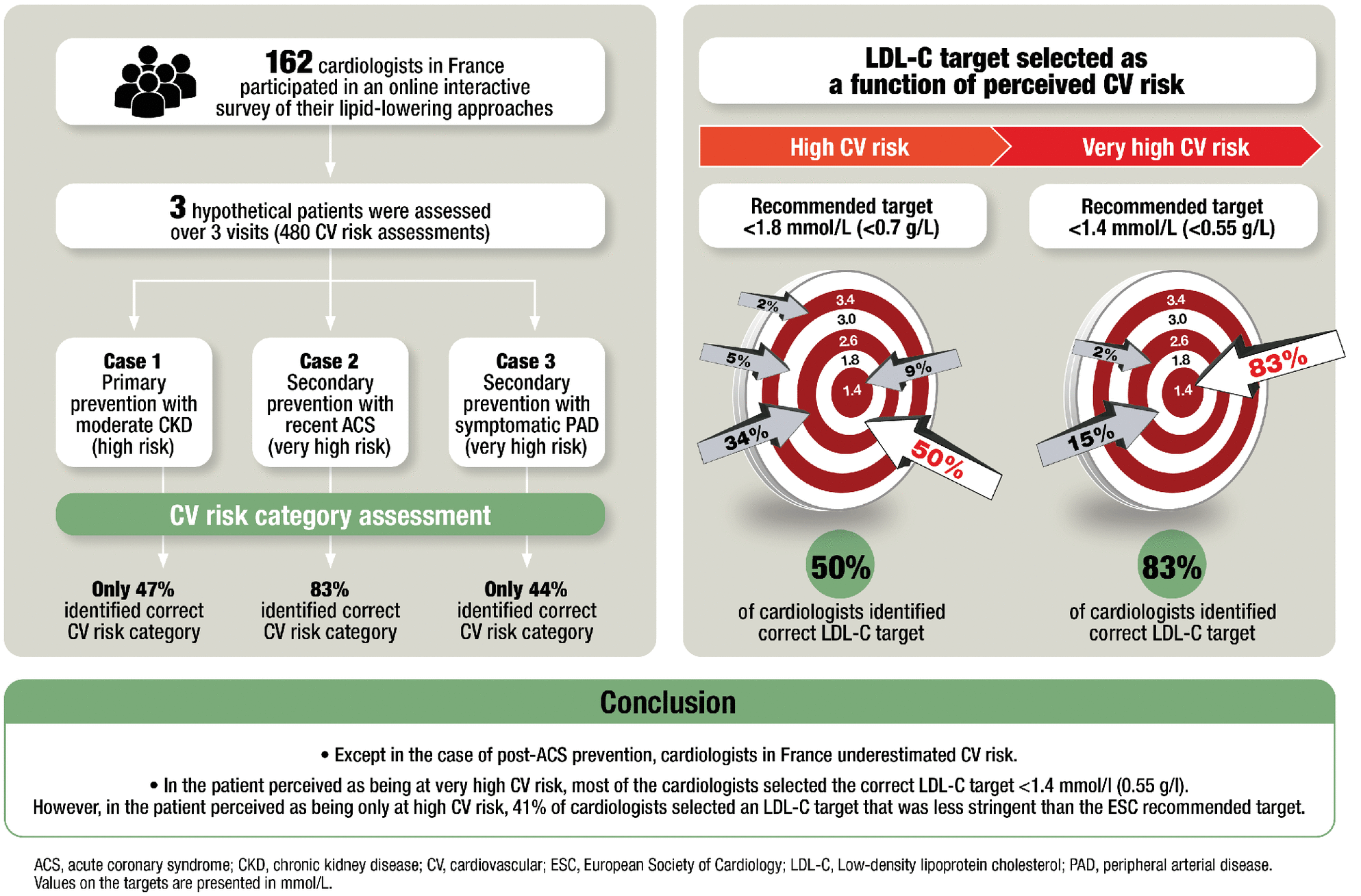
Aim: This online interactive survey investigated lipid-lowering approaches of French cardiologists in high- and very high-cardiovascular risk patients with hypercholesterolemia. Materials & methods: Physicians assessed three hypothetical patients at three clinic visits, and selected the patients’ cardiovascular risk category, target low-density lipoprotein cholesterol (LDL-C) and treatment. Results: A total of 162 physicians completed 480 risk assessments; 58% of assessments correctly categorized the hypothetical patients. Most physicians chose the correct LDL-C target for one of the very high-risk patients, but higher-than-recommended targets were selected for the other very high-risk patient and the high-risk patient. Statins were the most commonly chosen treatment. Conclusion: French cardiologists often underestimate cardiovascular risk in patients with hypercholesterolemia, select a higher-than-recommended LDL-C target and prescribe less intensive treatment than that recommended by guidelines.
Tweetable abstract
Based on case vignette analysis, French cardiologists underestimate cardiovascular risk in patients with hypercholesterolemia, resulting in suboptimal treatment #hypercholesterolemia #LDL-C target #lipid-lowering therapy
Graphical abstract
Plain language summary
What is this article about?
Cardiovascular disease is the main cause of death in Europe. High blood cholesterol (or hypercholesterolemia) is one of the major risk factors for cardiovascular disease, but it can be controlled by proper treatment. Studies have shown that patients in France with hypercholesterolemia generally receive suboptimal treatment.
What were the results?
We surveyed 162 French cardiologists to understand their approach to lowering of low-density lipoprotein cholesterol (LDL-C) levels. Using an online interactive survey, the physicians communicated with three virtual patients presenting hypothetical clinical scenarios. We found that many of the French cardiologists incorrectly judged the cardiovascular risk in patients with hypercholesterolemia, lacked knowledge about the correct LDL-C targets, and prescribed less intensive treatment than that recommended by guidelines.
What do the results of the study mean?
In order to decrease the proportion of patients receiving suboptimal treatment, continued physician education in assessing cardiovascular risk and increasing familiarity with correct LDL-C targets are required.
Supplementary Material
File (supplementary material.docx)
References
Papers of special note have been highlighted as: • of interest; •• of considerable interest
1.
Townsend N, Nichols M, Scarborough P, Rayner M. Cardiovascular disease in Europe–epidemiological update 2015. Eur. Heart J. 36(40), 2696–2705 (2015).
2.
Timmis A, Townsend N, Gale CP et al. European Society of Cardiology: cardiovascular disease statistics 2019. Eur. Heart J. 41(1), 12–85 (2020).
3.
Tuppin P, Rivière S, Rigault A et al. Prevalence and economic burden of cardiovascular diseases in France in 2013 according to the national health insurance scheme database. Arch. Cardiovasc. Dis. 109(6–7), 399–411 (2016).
4.
Ference BA, Ginsberg HN, Graham I et al. Low-density lipoproteins cause atherosclerotic cardiovascular disease. Evidence from genetic, epidemiologic, and clinical studies. A consensus statement from the European Atherosclerosis Society consensus panel. Eur. Heart J. 38(32), 2459–2472 (2017).
• Consensus statement from the European Atherosclerosis Society (EAS) summarizing the genetic and clinical evidence supporting a causal relationship between low-density lipoproteins and atherosclerotic cardiovascular disease.
5.
Domanski MJ, Tian X, Wu CO et al. Time course of LDL cholesterol exposure and cardiovascular disease event risk. J. Am. Coll. Cardiol. 76(13), 1507–1516 (2020).
6.
Mach F, Baigent C, Catapano AL et al. 2019 ESC/EAS Guidelines for the management of dyslipidaemias: lipid modification to reduce cardiovascular risk. Eur. Heart J. 41(1), 111–188 (2020).
•• These European Society of Cardiology (ESC) and EAS guidelines propose novel low-density lipoprotein cholesterol goals and provide advice on cardiovascular risk stratification and patient management.
7.
Olie V, Grave C, Gabet A. Impact of lowering low-density lipoprotein cholesterol thresholds on the proportion of adults requiring an intervention: application of the 2019 ESC/EAS guidelines for the management of dyslipidaemia to the French population. Arch. Cardiovasc. Dis. 115(2), 106–108 (2022).
8.
Blacher J, Gabet A, Vallee A et al. Prevalence and management of hypercholesterolemia in France, the Esteban observational study. Medicine (Baltimore) 99(50), e23445 (2020).
9.
Beliard S, Boccara F, Cariou B et al. High burden of recurrent cardiovascular events in heterozygous familial hypercholesterolemia: the French Familial Hypercholesterolemia Registry. Atherosclerosis 277, 334–340 (2018).
10.
Berard E, Bongard V, Haas B et al. Prevalence and treatment of familial hypercholesterolemia in France. Can. J. Cardiol. 35(6), 744–752 (2019).
11.
Ferrieres J, Banks V, Pillas D et al. Screening and treatment of familial hypercholesterolemia in a French sample of ambulatory care patients: a retrospective longitudinal cohort study. PLoS ONE 16(8), e0255345 (2021).
12.
Ferrieres J, Rouyer MV, Lautsch D et al. Suboptimal achievement of low-density lipoprotein cholesterol targets in French patients with coronary heart disease. Contemporary data from the DYSIS II ACS/CHD study. Arch. Cardiovasc. Dis. 110(3), 167–178 (2017).
13.
Kousignian I, Sautereau A, Vigouroux C et al. Diagnosis, risk factors and management of diabetes mellitus in HIV-infected persons in France: a real-life setting study. PLoS ONE 16(5), e0250676 (2021).
14.
Allen JD, Curtiss FR, Fairman KA. Nonadherence, clinical inertia, or therapeutic inertia? J. Manag. Care Pharm. 15(8), 690–695 (2009).
15.
Rizos CV, Barkas F, Elisaf MS. Reaching low density lipoprotein cholesterol targets. Curr. Med. Res. Opin. 30(10), 1967–1969 (2014).
16.
Peabody JW, Luck J, Glassman P et al. Measuring the quality of physician practice by using clinical vignettes: a prospective validation study. Ann. Intern. Med. 141(10), 771–780 (2004).
17.
Bruckert E, Bonnelye G, Thomas-Delecourt F, André L, Delaage PH. Assessment of cardiovascular risk in primary care patients in France. Arch. Cardiovasc. Dis. 104(6–7), 381–387 (2011).
18.
Liew SM, Lee WK, Khoo EM et al. Can doctors and patients correctly estimate cardiovascular risk? A cross-sectional study in primary care. BMJ Open 8(2), e017711 (2018).
19.
Hobbs FD, Jukema JW, Da Silva PM, Mccormack T, Catapano AL. Barriers to cardiovascular disease risk scoring and primary prevention in Europe. QJM 103(10), 727–739 (2010).
20.
Graham IM, Stewart M, Hertog MG. Cardiovascular Round Table Task Force. Factors impeding the implementation of cardiovascular prevention guidelines: findings from a survey conducted by the European Society of Cardiology. Eur. J. Cardiovasc. Prev. Rehabil. 13(5), 839–845 (2006).
21.
Nasir K, Bittencourt MS, Blaha MJ et al. Implications of coronary artery calcium testing among statin candidates according to American College of Cardiology/American Heart Association cholesterol management guidelines: MESA (Multi-Ethnic Study of Atherosclerosis). J. Am. Coll. Cardiol. 66(15), 1657–1668 (2015).
22.
Mcclelland RL, Chung H, Detrano R, Post W, Kronmal RA. Distribution of coronary artery calcium by race, gender, and age: results from the Multi-Ethnic Study of Atherosclerosis (MESA). Circulation 113(1), 30–37 (2006).
23.
Mitchell JD, Fergestrom N, Gage BF et al. Impact of statins on cardiovascular outcomes following coronary artery calcium scoring. J. Am. Coll. Cardiol. 72(25), 3233–3242 (2018).
24.
Visseren FLJ, Mach F, Smulders YM et al. 2021 ESC Guidelines on cardiovascular disease prevention in clinical practice. Eur. Heart J. 42(34), 3227–3337 (2021).
•• Guidelines from the ESC proposing novel approaches to tailored treatment intensification and summarizing recent evidence on the efficacy of antithrombotic treatment regimens in atherosclerotic cardiovascular disease.
25.
Averna M, Banach M, Bruckert E et al. Practical guidance for combination lipid-modifying therapy in high- and very-high-risk patients: a statement from a European Atherosclerosis Society task force. Atherosclerosis 325, 99–109 (2021).
•• This guideline provides evidence based practical advice for the use of combination lipid-modifying therapy to treat elevated low-density lipoprotein cholesterol/or triglycerides in high-risk and very-high-risk patients to prevent atherosclerotic cardiovascular disease events.
26.
Diaz Rodriguez A, Murga N, Camafort-Babkowski M et al. Therapeutic inertia in hypercholesterolaemia is associated with ischaemic events in primary care patients. a case-control study. Int. J. Clin. Pract. 68(8), 1001–1009 (2014).
27.
Ferrieres J, Roubille F, Farnier M et al. Control of low-density lipoprotein cholesterol in secondary prevention of coronary artery disease in real-life practice: the DAUSSET study in French cardiologists. J. Clin. Med. 10(24), 5938 (2021).
• A national, multicenter, non interventional study describing real-life clinical practices for low-density lipoprotein cholesterol control as secondary prevention of coronary heart disease.
28.
Mert KU, Basaran O, Mert GO et al. Management of LDL-cholesterol levels in patients with diabetes mellitus in cardiology practice: real-life evidence of under-treatment from the EPHESUS registry. Eur. J. Clin. Invest. 51(7), e13528 (2021).
29.
Ray KK, Molemans B, Schoonen WM et al. EU-wide cross-sectional observational study of lipid-modifying therapy use in secondary and primary care: the DA VINCI study. Eur. J. Prev. Cardiol. 28(11), 1279–1289 (2021).
30.
Ferrieres J, Gorcyca K, Iorga SR, Ansell D, Steen DL. Lipid-lowering therapy and goal achievement in high-risk patients from French general practice. Clin. Ther. 40(9), 1484–1495 e1422 (2018).
• This retrospective database study summarizes the patterns of lipid-lowering therapy use and its role in achieving guideline-identified lipid goals in a French general practice cohort with atherosclerotic cardiovascular disease/or diabetes mellitus.
31.
Mammen AL. Statin-associated myalgias and muscle injury-recognizing and managing both while still lowering the low-density lipoprotein. Med. Clin. North Am. 105(2), 263–272 (2021).
32.
Parker BA, Capizzi JA, Grimaldi AS et al. Effect of statins on skeletal muscle function. Circulation 127(1), 96–103 (2013).
33.
Bytyçi I, Penson PE, Mikhailidis DP et al. Prevalence of statin intolerance: a Meta-Analysis. Eur. Heart J. 43(34), 3213–3223 (2022).
34.
Peabody JW, Luck J, Glassman P, Dresselhaus TR, Lee M. Comparison of vignettes, standardized patients, and chart abstraction: a prospective validation study of 3 methods for measuring quality. JAMA 283(13), 1715–1722 (2000).
•• A prospective validation study assessing the suitability of clinical vignettes as a means for measuring physician competence and quality of practice.
35.
Bachmann LM, Muhleisen A, Bock A, Ter Riet G, Held U, Kessels AG. Vignette studies of medical choice and judgement to study caregivers' medical decision behaviour: systematic review. BMC Med. Res. Methodol. 8, 50 (2008).
Information & Authors
Information
Published In
Copyright
© 2023 Jean Ferrières. This work is licensed under the Attribution-NonCommercial-NoDerivatives 4.0 Unported License
History
Received: 17 October 2022
Accepted: 6 February 2023
Published online: 8 March 2023
Keywords:
Topics
Authors
Funding Information
Metrics & Citations
Metrics
Article Usage
Article usage data only available from February 2023. Historical article usage data, showing the number of article downloads, is available upon request.
Citations
How to Cite
Evaluation of hypercholesterolemia management in at-risk patients by cardiologists in France: a case vignette-based study. (2023) Journal of Comparative Effectiveness Research. DOI: 10.57264/cer-2022-0181
Export citation
Select the citation format you wish to export for this article or chapter.