

ISPOR 2026 – Inside the third plenary: Can global markets adapt to the ripple effects of US pricing policy?

Extending the discussion beyond individual healthcare systems, attention at ISPOR 2026, the annual meeting of ISPOR—the Professional Society for Health Economics and Outcomes Research, turned to the global implications of recent policy shifts. As US pricing reforms, trade dynamics, and reference pricing approaches continue to evolve, their effects are increasingly felt across international markets.
The third plenary, “Innovation Under Pressure: How Will US Drug Policy Reshape Innovation, Evidence, and Access Globally?” examined how these developments were reshaping the global access landscape. The discussions examined how evolving US pharmaceutical policy may reshape innovation, evidence generation, and access not only domestically, but globally. Moderated by Indranil Bagchi (GSK US), the panel brought together Lotte Steuten (Office of Health Economics), Darius Lakdawalla (University of Southern California), Jens Grueger (Boston Consulting Group), and Lizheng Shi (Tulane University School of Public Health and Tropical Medicine) to discuss a rapidly changing policy landscape shaped by Medicare drug price negotiations, Most-Favored-Nation (MFN) pricing proposals, international reference pricing, health technology assessment (HTA) evolution, and growing geopolitical tensions.
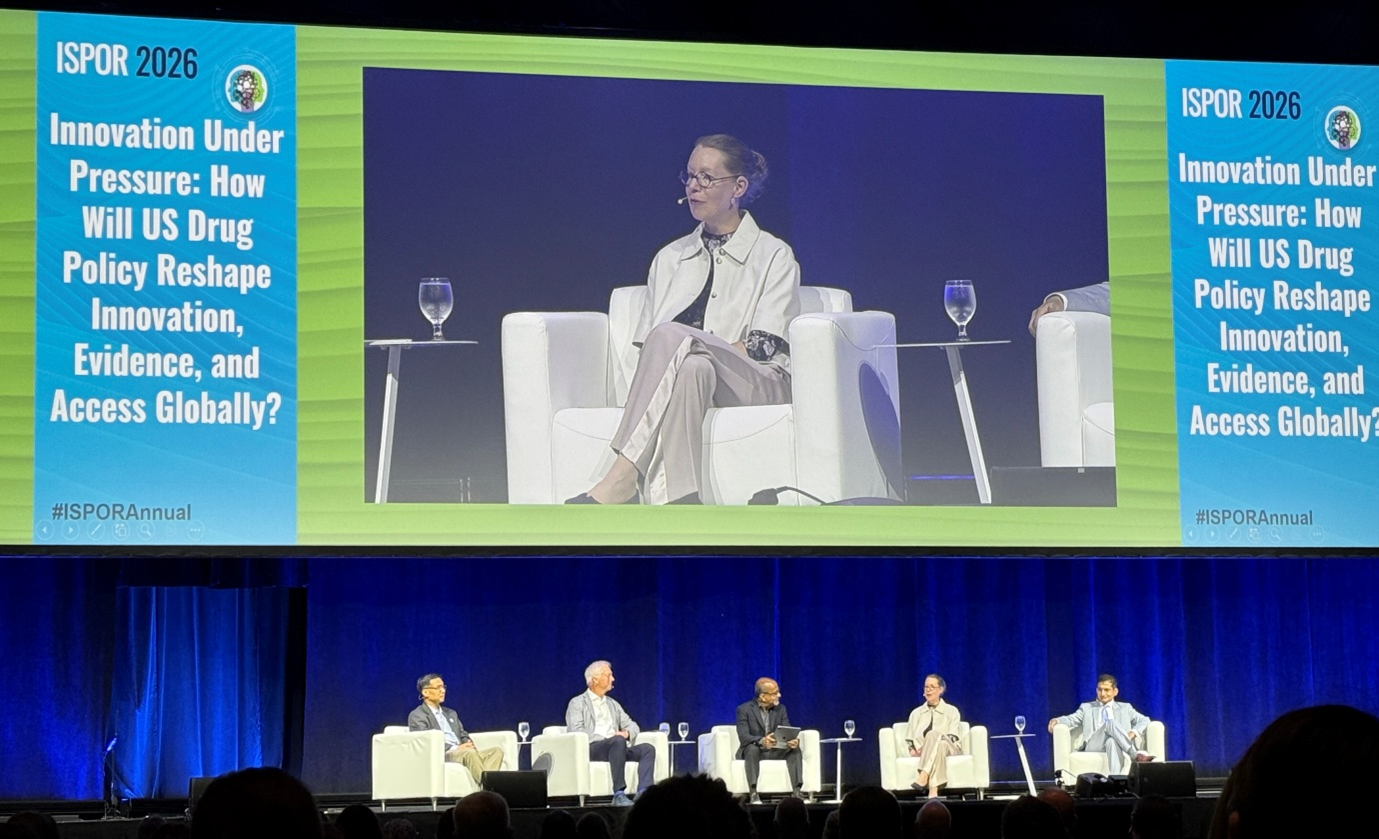
Opening the session, Bagchi framed the central challenge: how healthcare systems can preserve incentives for pharmaceutical innovation while maintaining affordability and access. He highlighted the growing influence of US policy decisions on global evidence generation, launch sequencing, reimbursement strategies, and investment decisions.
Discussion 1 – From US policy to global impact: where is pharmaceutical pricing headed?
Bagchi opened by asking whether the global policy environment is fundamentally changing, pointing to developments including the Inflation Reduction Act (IRA), MFN pricing proposals, Joint Clinical Assessment (JCA), external reference pricing, and increasing geopolitical tensions.
Lakdawalla argued that uncertainty remains one of the defining features of the current US environment.
“The status quo in the US is almost designed to maximize uncertainty,” he suggested, arguing that a more structured American-style HTA framework could potentially allow pricing decisions to better reflect the preferences and priorities of American patients while preserving incentives for innovation.
Grueger highlighted the potential disruption associated with efforts to align US pharmaceutical pricing more closely with global markets. Drawing on European experience, he noted that international reference pricing systems can create unintended consequences, including delayed launches and reduced access to innovative medicines.
“A lot of innovation” risks “going to waste,” he cautioned, suggesting that broader adoption of MFN-style approaches could exacerbate these challenges further.
Shi offered an international perspective, highlighting China’s transition from being viewed primarily as a manufacturing center toward becoming an innovation center. He emphasized that China’s HEOR community will increasingly shape pricing and reimbursement decisions for products developed and launched within China. At the same time, Shi acknowledged challenges surrounding access to innovative therapies and the need for evidence ecosystems capable of supporting increasingly complex healthcare decisions.
Steuten offered a European HTA perspective, suggesting many European systems may be relatively well positioned to absorb emerging pricing pressures.
She anticipated increased use of confidential discounts alongside outcomes-based payment arrangements that allow pricing to evolve over time as evidence accumulates, while emphasizing that broader dimensions of value must continue to be incorporated into decision making.
Discussion 2 – How global markets and access are already changing
The second section shifted focus toward how policy shifts are already influencing global access and market behavior.
Grueger highlighted industry experience with international reference pricing in Europe, arguing that pricing frameworks can unintentionally discourage innovation when manufacturers face difficult trade-offs around launch timing and pricing strategies.
The discussion reinforced that healthcare systems are increasingly interconnected. Decisions made in one market influence launch sequencing, evidence generation strategies, reimbursement negotiations, and ultimately patient access elsewhere. Speakers repeatedly returned to concerns around uncertainty – not only regarding pricing policy itself, but uncertainty surrounding how healthcare systems globally may respond.
A recurring theme throughout the discussion was the challenge of balancing affordability with maintaining strong incentives for continued innovation.
Panelists emphasized that HEOR researchers will play an increasingly important role in helping healthcare systems understand downstream consequences of policy decisions and navigate increasingly interconnected global healthcare environments.
Discussion 3 – What does this mean for innovation?
As discussion broadened beyond pricing policy itself, panelists reflected on the evolving role of HEOR in shaping future healthcare systems.
Steuten closed with a call to action focused not only on protecting healthcare value, but protecting scientific integrity itself.
“This is the best thing that we, as an HEOR community, can do for patients, for citizens, for society, but also for science ... We are all here because we care about the science of value, but to make sure that we have value equations that are important and respectful in future, we really now need to protect the value of science.”
Overall, in considering whether global markets can adapt to the ripple effects of US pricing policy, the panel’s answer appeared to be yes; but not without change. Adaptation will require healthcare systems to become more flexible, evidence frameworks to evolve, and policymakers to balance affordability with incentives for innovation. As healthcare systems become increasingly interconnected, the HEOR community will play a central role in ensuring policy decisions strengthen – rather than undermine – equitable access, sustainable innovation, and the science that underpins them both.
| Register for free today to become a member of The Evidence Base and receive the latest news straight to your inbox. |