

Cost standard set program: moving forward to standardization of cost assessment based on clinical condition
Publication: Journal of Comparative Effectiveness Research
Abstract
This communication piece is reporting the launching of the International Cost Standard set program, aiming to introduce standardized frameworks to measure costs for specific clinical conditions worldwide. A scientific committee including 16 international healthcare cost assessment experts from several countries, and International Consortium for Health Outcomes Measurement was formed to introduce the program. The committee got together in Lisbon for a first scientific meeting, followed by an international conference where time-driven activity-based costing applied studies were shared with the community. The cost standard set program start to offer instruments for people to measure with real-world data, the financial impact of having access to health technologies, improving the ability to evaluate inequity. Those advances might represent a paradigm shift in our ability to generate cost information on an individual level.
Adoption of value-based healthcare (VBHC) principles offers a promising opportunity for reducing the financial burden on healthcare systems along with improved patient outcomes and access. VBHC implementation requires measuring clinical outcomes and costs at the level of the patient’s clinical condition [1]. During the past 10 years, the International Consortium for Health Outcomes Measurement (ICHOM) has performed a significant amount of work on standardizing clinical and patient-reported outcomes measures for a specific clinical condition. ICHOM disseminates the program, creates solutions for practical application and develops international benchmark references. But managers and clinicians also need an accurate and reliable method for measuring patient level costs over the patient’s complete cycle of care, from diagnosis to cure or health status monitoring and maintenance. Until now, no standard setting body had emerged for this purpose.
Responding to this gap, the time-driven activity-based costing (TDABC) in healthcare consortium was formed in 2019 with the aim of connecting healthcare managers and scientists around the globe to share best practices for implementation of TDABC, a robust methodology healthcare costing [2–4].
Since the launch of the consortium, peers from all continents have joined as members, and several methodological and applied papers were published by the founders of this initiatives, such as the analysis performed for the stroke care pathway in Brazil [5] and the studies focused on surgical care pathways in the US [6]. Additional examples can be accessed on www.tdabcconsortium.com/publications. Following the precedent steps already established by ICHOM, the TDABC consortium recently started the International Cost Standard set program, with the goal to introduce standardized frameworks to measure costs for specific clinical conditions worldwide.
What was done?
In May 2022, the consortium brought together, in Lisbon and virtually, a scientific committee formed by 16 international healthcare cost-assessment experts, including representatives from Brazil, USA, UK, The Netherlands, Ireland, Austria, Portugal and ICHOM to define a methodological approach to be followed in a pilot version of a cost standard set. Individuals were selected based on their previous experience and publications on TDABC application in healthcare, and by recommendations of other members.
The committee members agreed on the need to define pilot projects to structure a cost standard set methodology, identify infrastructure for running applied validation projects in different countries, and achieve a consensus on the main objectives of creating cost standard sets.
In the month before the meeting, the participants were invited to propose clinical conditions that could be considered for the pilot projects. These included hip and knee replacement surgery, pregnancy and childbirth, heart failure, breast cancer, prostate cancer, lung cancer, stroke, coronary artery disease, cataract surgery and diabetes. Based on these suggestions, the group decided to choose one chronic disease and one surgical pathway for pilot projects. Selection criteria included the condition’s volume, complexity and social impact. Before the meeting, Ana Paula Etges (APE), Carisi Polanczyk (CP) and Anne Geubelle (AG) categorized the alternatives using a binary classification to suggest if the clinical condition had a positive or negative performance for each criterion (Figure 1).
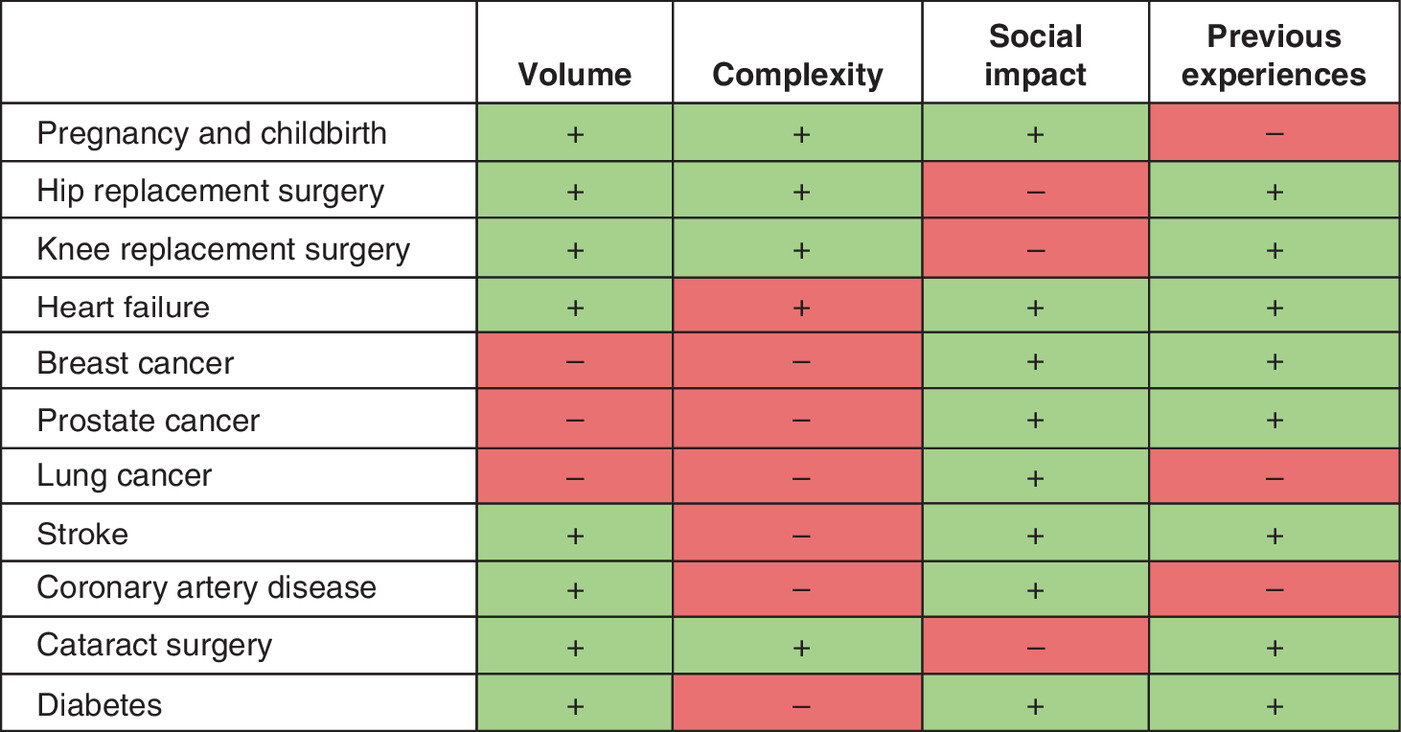
On the meeting day, all participants had the opportunity to share previous experiences and expectations for the new program. The leaders of the American College of Surgeon's VBHC project, named ‘THRIVE’, inspired the group by talking about their involvement in applying the TDABC framework to measure the costs of surgical conditions in the USA. In sequence, APE and CAP presented the previous multicriteria analysis to the whole group (Figure 1). At this time, the list was narrowed down to chronic and surgical care pathways, respectively: heart failure, stroke and diabetes; pregnancy and childbirth, hip/knee replacement and cataract surgery. All participants agreed with the categorization previously performed and started a discussion to achieve a final consensus about the clinical conditions to be used in the pilot projects.
After an open discussion, each participant individually voted for one of the chronic diseases and one surgical condition, finally defining heart failure and hip/knee replacement surgery as the clinical conditions for the pilot cost standard set program.
A final discussion was then conducted to summarize the Cost Standard Set program planning, with the following objectives:
•
Provide instruments to enable measuring accurate costs per clinical condition.
•
Guide how to perform national and international variability analyses.
•
Generate accurate information to redesign reimbursement strategies and control manage reimbursement strategies with transparency.
•
Guide the identification of benchmarks of care delivery for specific clinical conditions by crossing outcomes and cost results, using these to identify hospitals as examples of the achievement of better outcomes at a global and populational health level.
•
Provide instruments for people to measure with real-world data the financial impact of having access to health technologies, improving the ability to evaluate inequity in healthcare systems.
TDABC Conference
In addition to the scientific meeting, the committee organized a 1-day conference to promote and disseminate experiences in applied cost-assessment projects in healthcare. More than 100 people attended the conference in person or virtually. The following topics were reviewed: fundamentals of TDABC and VBHC; innovations in digital solutions for cost analyses; practical examples of TDABC and care pathways for surgical patients; experiences from the ICHOM Program for health outcomes measurements. We summarize the content of these sessions below and the entire meeting schedule is described on (Table 1).
| Session | Speaker (country) |
|---|---|
| Welcome from the TDABC consortium, Nova University and VBHC Center Europe | Carisi Polanczyk (Brazil) |
| Richard Urman (USA) | |
| Ana Paula Etges (Brazil) | |
| José Fragata (Portugal) | |
| Why TDABC is the gold standard for VBHC and what are the challenges? | Robert Kaplan (USA) |
| Advances in digital solutions and scalability of TDABC | Anne Geubelle (Portugal) |
| Derek Haas (USA) | |
| TDABC in surgical care pathways | Richard Urman (USA) |
| Cost assessment and new reimbursement strategies | Denizar Vianna (Brazil) |
| Integrating health outcomes and costs standard sets ICHOM | Neo Tapela (UK) |
| TDABC in oncological studies | Fernando Maia (Brazil) |
| Birth care in The Netherlands | Kees Ahaus (The Netherlands) |
| Implementing TDABC for NHS Wales, practical reflections from local and national projects | Mark Bowling (UK) |
| IATS session: prostate cancer care pathway in Brazil | Carisi Polanczyk (Brazil) |
| TDABC in cardiovascular cases | Miriam Zago (Brazil) |
| The stroke case from Brazil | Ana Paula Etges (Brazil) |
| VBHC and TDABC, how do we reach the end goal of sustainability | Ahmed Abdulla (UK) |
| ROCHE – session: The importance of the co-creation on the implementation of a cost measurement culture | Nayara Carlos (Brazil) |
| João Marques (Portugal) | |
| Ana Paula Etges (Brazil) | |
| TDABC in surgical reports | Erica Roos (Brazil) Naye Balzan (Brazil) |
| Case-studies from value for health CoLAB | Ana Londral (Portugal) |
| Salomé Azevedo (Portugal) | |
| Advanced technology-enabled cost accounting in high value musculoskeletal care | Prakash Jayakumar (USA) |
| Prologica – session: business Intelligence solution using TDABC to outpatient surgeries | Anne Geubelle (Portugal) |
| Talk to the experts | All the speakers |
IATS: Institute for Health Technology Assessment; ICHOM: International Consortium for Health Outcomes Measurement; TDABC: Time-driven activity-based costing; VBHC: Value-based health care.
Fundamentals of TDABC & VBHC
In this session, the explanation about why the TDABC is the best strategy to measure costs in healthcare was presented, using several international examples as evidence of successful implementations of this methodology. The opportunity to understand the processes of care of one individual, measuring resource consumption and not hospital charges, was used to demonstrate the value of the TDABC. Another discussion revolved around the relevance of the cost standard sets specific to each clinical condition, especially that it will be a pivotal turn in measuring variability in care and identifying the benchmarks of care worldwide.
Innovations in digital solutions for cost analyses
Once there was a consensus that TDABC is a useful method to measure costs in healthcare, providing technology that can automate calculations and make scalability feasible was the focus of the following session. Two chief executive officers from European and North American companies demonstrated how they are developing strategies to automate individual cost data collection and analyses following the principles of the TDABC. While many US companies are advanced in their ability to link cost analyses per care pathway with the reimbursement systems, the European companies are in the advanced stage of systems integration and, consequently, automation of resource consumption data collection at the patient level. Both executives used real-time examples of their solutions that are in use in different hospitals and care pathways. The sessions demonstrated that it is possible to implement the automatization of TDABC in the healthcare field.
Practical examples of TDABC & care pathways for surgical patients
This session brought to the audience several practical examples of TDABC executed at the Brigham Women’s Hospital in MA, USA. Some of the TDABC efforts were related to the Enhanced Recovery After Surgery program. Examples of the use of the TDABC to design and compare care pathways of the same surgery within and between hospitals were demonstrated. The message for the audience was that the TDABC can contribute to the costing measure because it can be used as a strategic tool to guide decisions associated with the design of more effective care pathways in the surgical field.
Experiences from ICHOM Program for health outcomes measurements
The ICHOM program has achieved great results for the clinical and patient reported outcomes measure capability. Because of that, its methods to create standard sets is serving as an inspiration for the costs program. At this session, the method used by the ICHOM to create the standard set was presented in detail. The techniques used along with the standard set development, such as Delphi process with experts, the participants discussed the successes and constraints factors and provided recommendations to be considered in the definition of the cost standard set program. The participants also confirmed the contribution of the cost program to the ICHOM initiative, suggesting that the integration of both approaches allows closing the cycle of measuring value for specific clinical conditions worldwide.
During the afternoon sessions of the conference, post-graduate students and researchers presented data on studies applying TDABC worldwide, particularly concerning cardiovascular, oncology and surgical pathways.
What are the next steps?
As the next steps for the program, members of the scientific committee are involved in working on pilot projects for heart failure and knee/hip replacements and establishing program governance. Participants outlined a list of goals for the first year which will guide committee activities:
•
Definition of a list of clinicians, experts in heart failure and knee/hip replacements, from the US, Europe and Latin America to invite for contributing on the development of each standard set.
•
Schedule the first meeting with the experts for each clinical condition to design the general care pathways according to the local healthcare setting and technology available in each country.
•
To identify centers in Latin America, the US and Europe to conduct pilot projects for clinical conditions and monitor the project’s execution.
•
Search for funding from private entities, foundations and academic funders to sustain the program’s execution.
•
Validate the final care pathway for each clinical condition with the committee.
•
Agree upon the format for data collection and analysis (off the shelf or a proprietary tool).
•
Develop tools and glossary to guide standardized cost data collection.
•
Develop tools to guide standardized cost data analyses.
•
Consolidate and share the guide, glossary, tools and templates for each clinical condition.
•
Evaluate the results achieved on the pilot projects, consolidate cost measures and variability analyses and demonstrate the value of the cost standard set used by publishing scientific articles.
•
Prepare and promote the second conference on the cost standard set program, where the results of the pilot projects will be shared with the scientific community and audience for the first time.
The purpose of the cost standard set program is to understand how it can help promote a more sustainable healthcare delivery. In particular, there is an opportunity to use consistent measures to identify locations where more efficient processes of care are being provided. The cost standard set is an organic way to reduce budgetary silos and consequently contribute to more effective healthcare delivery.
After the results that the standardized measure of clinical and patient reported outcomes is promoting become available, the cost standard set program might represent a paradigm shift in our ability to generate accurate individual cost information, which is fundamental to driving more precise health policies and management practices.
•
This report is launching the International Cost Standard set program, with the goal of introducing standardized frameworks to measure costs for specific clinical conditions worldwide.
•
The cost standard set is an organic way to reduce budgetary silos and consequently contribute to more effective healthcare delivery.
•
The first standard sets will be designed for heart failure and hip/knee replacement surgeries, and 1-year schedule was planned, aiming to present to the global community the standard sets in during the followed year.
•
The cost standard set program might represent a paradigm shift in our ability to generate cost information in an individual level.
Author contributions
Concept and design: APB da Silva Etges, A Geubelle and CA Polanczyk. Analysis and interpretation: APB da Silva Etges, RD Urman, R Kaplan, A Geubelle and CA Polanczyk. Drafting of the manuscript: APB da Silva Etges and CA Polanczyk. Critical revision of the paper for important intellectual content: APB da Silva Etges, RD Urman, R Kaplan, A Geubelle and CA Polanczyk. Supervision: R Kaplan and CA Polanczyk.
Acknowledgments
The authors would like to thank M Mimozo, F Gill, A Menezes and A Zanotto, for enthusiastic support and help to organize the meeting and to acknowledge all the participants, in addition to the authors, of the meeting on 28 May (Nova University, Lisbon) listed here: A Abdulla (UK); AR Londral (Portugal); A Zuckermann (Austria); A Dayal (USA); C Aguilar (Switzerland); D Hoyt (USA); D Haas (USA); G Doyle (Ireland); JS de Souza (Brazil); J Nabi (USA); K Ahaus (The Netherlands); M Bowling (UK); N Tapela (UK); P Jayakumar (USA); RD Urman (USA); S Azevedo (Portugal).
Financial & competing interests disclosure
The invited attendees were supported by Roche Inc., Prologica, National Institute for Health Technology Assessment (IATS/CNPq/FAPERGS, Brazil) and Way2Value. The authors have no other relevant affiliations or financial involvement with any organization or entity with a financial interest in or financial conflict with the subject matter or materials discussed in the manuscript apart from those disclosed.
No writing assistance was utilized in the production of this manuscript.
Ethical conduct of research
The authors state that they have followed the principles outlined in the Declaration of Helsinki for all human or animal experimental investigations and as this is a Conference Proceeding Report, it is not required a submission to the IRB.
References
1.
Porter ME. What is value in health care. N. Engl. J. Med. 363(26), 2477–2481 (2010).
2.
Kaplan RS. Improving value with TDABC. Healthc. Financ. Manage. 68(6), 76–84 (2014).
3.
da Silva Etges APB, Ruschel KB, Polanczyk CA, Urman RD. Advances in value-based healthcare by the application of time-driven activity-based costing for inpatient management: a systematic review. Value Health 23(6), 812–823 (2020).
4.
da Silva Etges APB, Polanczyk CA, Urman RD. A standardized framework to evaluate the quality of studies using TDABC in healthcare: the TDABC in Healthcare Consortium Consensus Statement. BMC Health Serv. Res. 20(1), 1107 (2020).
5.
da Silva Etges APB, Nabi J, Geubelle A, Martins SO, Polanczyk CA. Analytical solutions to support value-based health care: the ischemic stroke care pathway case. NEJM Catal. Innov. Care Deliv. 3(1), (2022).
6.
Martin JA, Mayhew CR, Morris AJ, Bader AM, Tsai MH, Urman RD. Using time-driven activity-based costing as a key component of the value platform: a pilot analysis of colonoscopy, aortic valve replacement and carpal tunnel release procedures. J. Clin. Med. Res. 10(4), 314–320 (2018).
Information & Authors
Information
Published In
Pages: 1219 - 1223
PubMed: 36251500
Copyright
© 2022 Future Medicine Ltd.
History
Received: 22 September 2022
Accepted: 26 September 2022
Published online: 17 October 2022
Keywords:
Topics
Authors
Funding Information
Metrics & Citations
Metrics
Article Usage
Article usage data only available from February 2023. Historical article usage data, showing the number of article downloads, is available upon request.
Citations
How to Cite
Cost standard set program: moving forward to standardization of cost assessment based on clinical condition. (2022) Journal of Comparative Effectiveness Research. DOI: 10.2217/cer-2022-0169
Export citation
Select the citation format you wish to export for this article or chapter.
Citing Literature
- Jens Grueger, Etienne Lainé, Francisco Nuno-Rocha Goncalves, Hans Middelhoven, William V. Padula, Ana Paula Etges, Lotte Steuten, Kelly Lenahan, Giovanni Monti, Luca Pani, Elizabeth Teisberg, Joanne Yoong, Applying Health Economics and Outcomes Research Methods in Value-Based Healthcare Implementation: An ISPOR Special Task Force Report, Value in Health, 10.1016/j.jval.2026.02.014, 29, 7, (1141-1150), (2026).
- Donna Kucharski, Perioperative Management of the Surgical Service Line, The Anesthesiologist as Perioperative Leader, 10.1007/978-3-032-18058-2_8, (99-113), (2026).
- Pedro Gabriel Melo de Barros e Silva, Valter Furlan, Renato D. Lopes, André Volschan, Paulo Cesar Pereira de Souza, Carisi Anne Polanczyk, Value-Based Healthcare in Cardiology: How to Integrate a more Comprehensive View into Medical Decision-Making?, Arquivos Brasileiros de Cardiologia, 10.36660/abc.20240668i, 122, 2, (2025).
- Pedro Gabriel Melo de Barros e Silva, Valter Furlan, Renato D. Lopes, André Volschan, Paulo Cesar Pereira de Souza, Carisi Anne Polanczyk, Cuidado em Saúde Baseado em Valor na Cardiologia: Como Integrar uma Visão mais Abrangente na Decisão Médica?, Arquivos Brasileiros de Cardiologia, 10.36660/abc.20240668, 122, 2, (2025).