

Can real-world evidence save pharma US$1 billion per year? A framework for an integrated evidence generation strategy
Publication: Journal of Comparative Effectiveness Research
Evidence generation by the pharma industry is typically sequential and siloed. While this one-size-fits-all approach was previously adequate for regulatory decision-makers, it is no longer fit for purpose. External factors, such as increasing regulatory requirements for real-world data (RWD), the growing role of payer- and patient-relevant end points in reimbursement decisions and rising constraints on healthcare budgets, require a new and integrated approach. This article builds on the previous ‘call to action’ to transform the mindset of the pharmaceutical industry in utilizing real-world evidence (RWE) [1] by presenting an evidence-powered operating framework (EPOF) for applying an integrated evidence generation strategy within a pharma organization.
Improved & earlier use of RWE requires an integrated approach
In a 2018 benchmarking survey within pharma, executive leadership teams stated that the importance of RWE as part of their organization's strategy will increase dramatically in the next 2 years [2]. This is reflected in 90% of companies making major RWE investments across the entire product life cycle in the hope of potentially achieving cost savings and efficiencies [2]. Indeed, a shift in focus for application of RWE to optimize trial design and execution, value-based contracts and support regulatory submissions/label expansions is expected (in addition to common current uses, for example, evidence of burden of disease, patient safety and treatment effects in subpopulations). These trends are challenging pharma's traditional operating model to drive earlier use of RWE in the product life cycle. This is justified by the fact that seven in ten clinical trials are hit by enrollment snags, and every additional week spent getting to market accounts for a loss of US$300,000 in sales [3]. Furthermore, in response to increasing regulatory interest in, and use of, RWE for decision-making by the US FDA [4,5], EMA [6,7] and China's Center for Drug Evaluation [8], some companies have made large investments as part of their strategy to access RWD and to generate RWE. For instance, in 2015, Novartis initiated a feasibility assessment to gauge interest from leading rheumatology experts in cocreating a European research collaboration network to collect patient data on spondyloarthritides (SpA). The EuroSpA research collaboration network of 16 independent registries from across 16 countries was subsequently formed [9]. Through a coordinating center that leads and oversees the research and collaborative efforts, researchers are able to share data and technical and clinical expertise, thus creating the infrastructure to conduct studies on a large population of approximately 63,000 patients (as of the end of 2017) who are receiving disease-modifying antirheumatic drugs and biologics [10]. This collaboration thereby enables deeper clinical insights to be provided and enhances patient research capabilities in the real-world setting. In addition, Novartis is a contributor to the Innovative Medicines Initiative's Electronic Health Data in a European Network project, which aims to make large-scale analysis of health data from approximately 100 million EU citizens a reality by building a federated data network of 22 partners from across 12 countries [11].
In a previous publication [1], I outlined a strategy for an integrated approach to evidence generation, utilizing RWE to support activities across the product life cycle and among multiple internal functions in order to satisfy the myriad of external stakeholder needs more effectively. Several individual concepts that can be informed by RWE when establishing an integrated evidence strategy were proposed, including end point strategy, Phase III population identification, randomized controlled trial recruitment, patient-reported outcomes, outcome agreements and effectiveness prediction. While concepts can often be interesting and compelling, they can be difficult to put into action without concrete direction and context. What is needed is a framework, EPOF, for applying an evidence generation strategy that is developed in a truly integrated way within a pharma organization.
EPOF consists of seven pillars
EPOF aims to close the gap that typically exists between research, clinical development, market access and commercial insights (Figure 1). For example, while RWE is commonly applied to ascertain patient insights (e.g., to validate and to inform patient-centric end points/outcomes) and to inform commercial strategies (e.g., to secure market access), its applications can be expanded to preclinical and clinical research (e.g., to enhance productivity though precise target and patient cohort identification), and optimization of trial design and execution (e.g., by identifying potential patients and study sites). Each of these pillars is associated with a natural organizational function to ensure excellence in evidence delivery across the entirety of a product's life cycle. Application of the framework across these pillars will help to ensure that evidence strategy and decision-making are optimized through use of RWE, patients are put first in evidence planning, activities are evidence-based and resource-efficient, and a competitive edge over other products is identified.

EPOF may be associated with significant efficiency savings for pharma
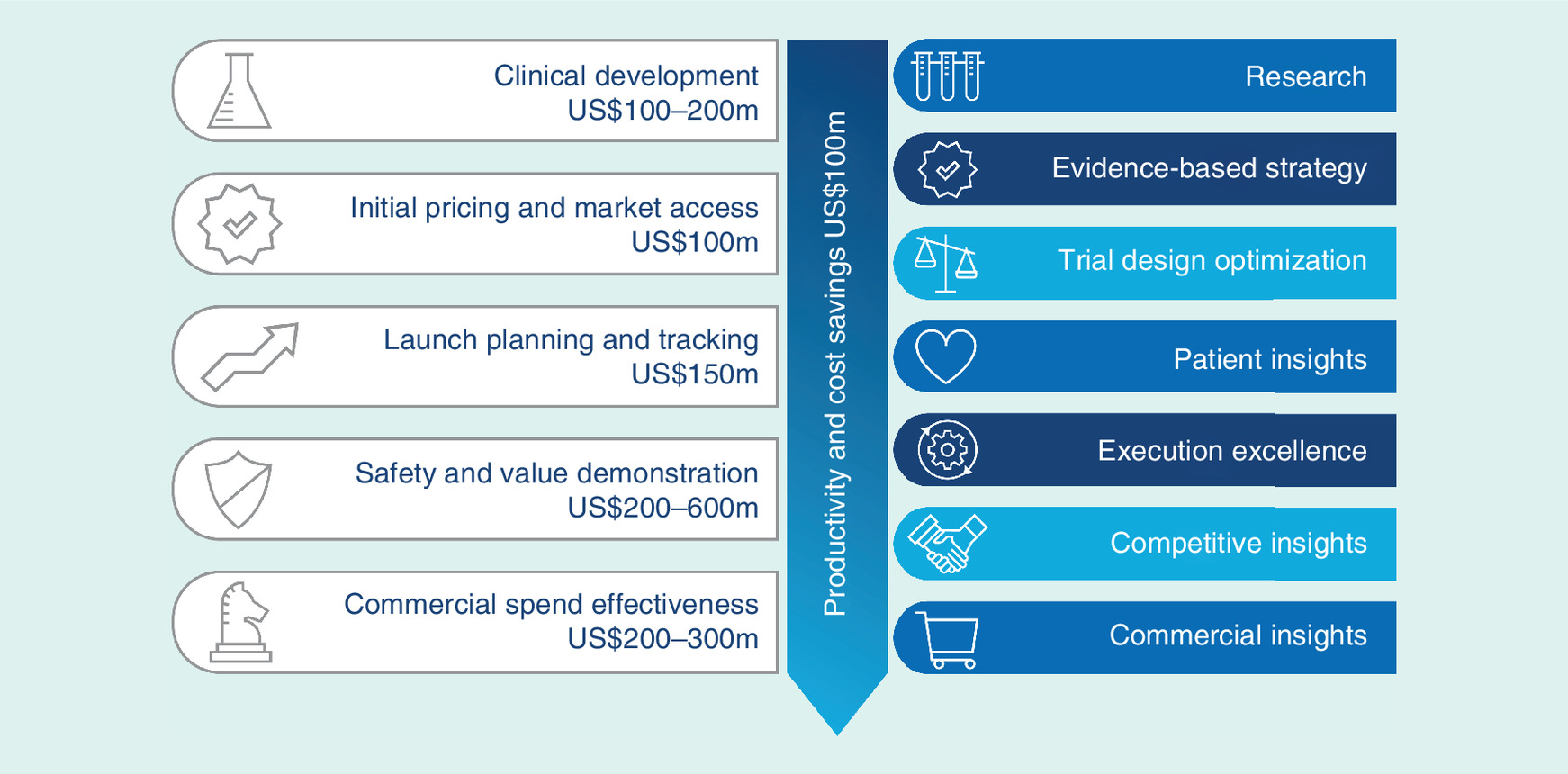
There is vast scope for cost savings associated with increasing the efficiency of the pharma development and commercialization pathway; a report in 2016 estimated that pharma companies could save US$1 billion per year through the use of RWE [12]. The most successful companies have used RWE platforms to realize substantial value across the product life cycle. For this reason, a framework such as EPOF could help to realize these cost savings because many of the projected cost measures map onto the proposed EPOF pillars (Figure 2); indeed, there are examples of companies realizing and maintaining substantial value across the product life cycle through using integrated evidence-generation frameworks such as EPOF [12]. Several examples from Novartis demonstrate an attempt to streamline an operation that spends more than US$5 billion per year on developing new drugs [3]. For example, through a partnership with TriNetX (a global health research network), Novartis has been able to utilize a cloud-based platform to conduct state-of-the-art analytics on RWD obtained from contract research organizations, healthcare organizations and data partners to conduct early feasibility analyses on over 150 clinical trial protocols across multiple disease areas since 2018 [13]. These feasibility analyses are likely to lead to increased probabilities of trial success, shorter recruitment times and higher relevance of trial populations from a regulatory and access perspective. Additionally, through observing how aviation and power companies use technology-based ‘crisis centers’ to prevent failures and blackouts, Novartis developed a global surveillance hub to map and to monitor its network of 500 clinical trials across 70 countries, to predict and to rectify potential problems on a minute-by-minute basis. With this approach, Novartis plans to reduce time to enrollment by as much as 15% [3]. Finally, there are several examples where RWE has been pivotal to successful regulatory decisions on initial authorization or indication extension (i.e., beyond traditional safety signal evaluation, risk management and benefit–risk evaluation) [7]. In one such example for Kymriah®, RWE was used to confirm and contextualize the response rate observed in a single-arm trial of adults with relapsed or refractory diffuse large B-cell lymphoma [7]. RWE was considered acceptable and sufficient in this case because diffuse large B-cell lymphoma is a rare disease, the unmet need for patients was significant, and an randomized controlled trial was not feasible [7].
Recommendations & insights
Significant savings can be realized through the strategic use of RWE through, for example, early identification of target populations and end points/outcomes, feasibility studies to refine trial criteria to increase their probability of success, strategic selection of sites that can deliver successful patient enrollment, innovative trial designs (e.g., cluster randomization, use of external controls and bridging studies) and securing optimal reimbursement conditions. Although this requires an upfront investment in data and infrastructure that will mean the initial net savings will admittedly be reduced, strategic use of RWE will ultimately allow us to make better decisions and ignoring the full range of opportunities that applying RWE provides is a strategic disadvantage. To take full advantage of the RWE opportunities for efficiency gains and informed decision-making, a framework such as EPOF is needed. Successful implementation of such frameworks will require close collaboration between multiple functions and strong leadership, which together will help to drive a change in mindset toward integrating RWE into the internal life cycle.
Conclusion
Never have external pressures been so high for the pharma industry to continue to innovate without increasing drug prices. The tendency for pharma to respond by continuing to cut costs is a self-limiting approach; the real goal is to improve efficiency and productivity, with RWE as an enabler. While large upfront investments may be of concern to some pharma executive leadership teams, they are indeed needed to remain ahead of the curve in an increasingly demanding healthcare system, to generate meaningful evidence that meets stakeholder needs and to realize efficiency savings. These savings may be difficult to quantify and might not reach the predicted US$1 billion per year but are likely to be substantial enough to warrant action. Pharma companies must invest and implement new operating models and frameworks, such as EPOF, to drive an integrated approach to evidence generation across the entire product life cycle. This approach is a complete shift in the mindset of how evidence should be generated and is the new way of doing business.
Financial & competing interests disclosure
Development of this editorial was funded by Novartis Pharma AG. M Olson is an employee of Novartis Pharma AG. The author has no other relevant affiliations or financial involvement with any organization or entity with a financial interest in or financial conflict with the subject matter or materials discussed in the manuscript apart from those disclosed.
Medical writing support was provided by Carly Sellick of PharmaGenesis London, London, UK, with funding from Novartis Pharma AG. The manuscript was developed with valuable input from Adrian Cassidy (Novartis Pharma AG, Basel, Switzerland) and Kris Kahler (Novartis Pharma Corp., NJ, USA).
Open access
This work is licensed under the Attribution-NonCommercial-NoDerivatives 4.0 Unported License. To view a copy of this license, visit http://creativecommons.org/licenses/by-nc-nd/4.0/
References
1.
Olson MS. Developing an integrated strategy for evidence generation. J. Comp. Eff. Res. 7(1), 5–9 (2018).
2.
Deloitte Insights. Mission critical: biopharma companies are accelerating real-world evidence adoption, investment, and application (2018). https://www2.deloitte.com/content/dam/insights/us/articles/4354_Real-World-Evidence/DI_Real-World-Evidence.pdf
3.
Paton J, Lauerman J. Big Pharma's drug studies are getting a NASA-style makeover. Bloomberg (2019). https://www.bloomberg.com/news/articles/2019-01-25/big-pharma-s-drug-studies-are-getting-a-nasa-style-makeover
4.
Corrigan-Curay J. Real world evidence: a path forward. US Food and Drug Administration (2017). https://healthpolicy.duke.edu/sites/default/files/atoms/files/rwe_fda_slide_deck_2017_09_13.pdf
5.
Silverman B. A baker's dozen of US FDA efficacy approvals using real world evidence. Pharma Intelligence Pink Sheet (2018). https://pink.pharmaintelligence.informa.com/PS123648/A-Bakers-Dozen-Of-US-FDA-Efficacy-Approvals-Using-Real-World-Evidence
6.
Moseley J. Regulatory perspective on real world evidence (RWE) in scientific advice. European Medicines Agency (2018). https://www.ema.europa.eu/en/documents/presentation/presentation-regulatory-perspective-real-world-evidence-rwe-scientific-advice-emas-pcwp-hcpwp-joint_en.pdf
7.
Cave A, Kurz X, Arlett P. Real-world data for regulatory decision making: challenges and possible solutions for Europe. Clin. Pharmacol. Ther. 106(1), 36–39 (2019).
8.
Key considerations in using real-world evidence to support drug development. China Center for Drug Evaluation (2019). https://www.accestra.com/2019/06/12/an-important-step-for-rwe-in-china-china-cde-published-the-draft-key-considerations-in-using-real-world-evidence-to-support-drug-development/
9.
The EuroSpA Research Collaboration Network. (2019) https://eurospa.eu/
10.
Hetland ML, Østergaard MS, Askling J et al. Commonalities and differences in data collection across European spondyloarthritis registries. Ann. Rheum. Dis. 76(Suppl. 2), 656–657 (2017).
11.
Electronic Health Data in a European Network. (2019)https://www.ehden.eu/consortium-partners/
12.
QuintilesIMS. Breaking new ground with RWE: how some pharmacos are poised to realize a $1 billion opportunity (2018). https://www.iqvia.com/-/media/quintilesims/pdfs/qims_breaking_new_ground_with_rwe_whitepaper.pdf
13.
TriNetX executes agreement to revolutionize clinical trial design to enhance and accelerate the development of new drugs (2016). https://www.trinetx.com/trinetx-executes-agreement-to-revolutionize-clinical-trial-design-to-enhance-and-accelerate-the-development-of-new-drugs/
Information & Authors
Information
Published In
Pages: 79 - 82
PubMed: 31774337
Copyright
© 2019 Melvin (Skip) Olson. This work is licensed under the Attribution-NonCommercial-NoDerivatives 4.0 Unported License
History
Received: 1 November 2019
Accepted: 5 November 2019
Published online: 27 November 2019
Keywords:
Topics
Authors
Metrics & Citations
Metrics
Article Usage
Article usage data only available from February 2023. Historical article usage data, showing the number of article downloads, is available upon request.
Citations
How to Cite
Can real-world evidence save pharma US$1 billion per year? A framework for an integrated evidence generation strategy. (2019) Journal of Comparative Effectiveness Research. DOI: 10.2217/cer-2019-0162
Export citation
Select the citation format you wish to export for this article or chapter.
Citing Literature
- Joseph A. DiMasi, Melvin Skip Olson, Zachary Smith, Kenneth A. Getz, Gorana Capkun, Assessing the Value of Integrated Evidence Approaches in Drug Development, Therapeutic Innovation & Regulatory Science, 10.1007/s43441-025-00778-y, 59, 4, (808-816), (2025).
- Melvin (Skip) Olson, Gorana Capkun, The value of evidence and its role in driving product strategy, Journal of Comparative Effectiveness Research, 10.57264/cer-2024-0074, 13, 8, (2024).
- Ravit Geva, Alexander Gusev, Yuriy Polyakov, Lior Liram, Oded Rosolio, Andreea Alexandru, Nicholas Genise, Marcelo Blatt, Zohar Duchin, Barliz Waissengrin, Dan Mirelman, Felix Bukstein, Deborah T. Blumenthal, Ido Wolf, Sharon Pelles-Avraham, Tali Schaffer, Lee A. Lavi, Daniele Micciancio, Vinod Vaikuntanathan, Ahmad Al Badawi, Shafi Goldwasser, Collaborative privacy-preserving analysis of oncological data using multiparty homomorphic encryption, Proceedings of the National Academy of Sciences, 10.1073/pnas.2304415120, 120, 33, (2023).
- Elisabet Rodriguez Llorian, Louloua Ashikhusein Waliji, Nick Dragojlovic, Kristina D. Michaux, Fernanda Nagase, Larry D. Lynd, Frameworks for Health Technology Assessment at an Early Stage of Product Development: A Review and Roadmap to Guide Applications, Value in Health, 10.1016/j.jval.2023.03.009, 26, 8, (1258-1269), (2023).
- Nansu Zong, Andrew Wen, Sungrim Moon, Sunyang Fu, Liwei Wang, Yiqing Zhao, Yue Yu, Ming Huang, Yanshan Wang, Gang Zheng, Michelle M. Mielke, James R. Cerhan, Hongfang Liu, Computational drug repurposing based on electronic health records: a scoping review, npj Digital Medicine, 10.1038/s41746-022-00617-6, 5, 1, (2022).
- Laura Dormer, Introducing Volume 10 of the Journal of Comparative Effectiveness Research, Journal of Comparative Effectiveness Research, 10.2217/cer-2020-0244, 10, 1, (1-4), (2021).