

DIA’s 2025 Real-World Evidence Conference daily round-ups: Day 2
Laura Dormer and Joanne Walker continue their coverage of DIA’s Real-World Evidence Conference 2025 (October 16–17, San Diego, California, USA), sharing key highlights and discussions from Day 2. The final day of the meeting built on themes of data quality, collaboration, and innovation – exploring how real-world data (RWD) and evidence (RWE) can be translated into insights that inform policy, regulation, and patient care.
Read our round-up of Day 1 here
Session 6: Scientific roundtable: ICH efforts on convergence and harmonization of real-world data and evidence
Camille Jackson (Flatiron Health, USA) opened the roundtable-style session by building on the previous day’s discussion around the growing momentum within the International Council for Harmonisation (ICH) around RWD and RWE, noting the importance of harmonized terminology, international collaboration, and long-term strategic thinking across the organization’s expanding portfolio of guidelines. She reflected on external drivers such as the 21st Century Cures Act, user fee programs, and the COVID-19 pandemic, which underscored the need for global data sharing and collective action.
Before the live discussion, attendees were invited to view pre-recorded remarks from Gracy Crane (Roche, UK), who framed the session’s focus on ICH M14 and its connection to the forthcoming ICH E23 guideline on RWE for effectiveness. Together, these guidelines, Jackson explained, represent a long-term strategic vision for enabling consistent global use of RWD in regulatory decision-making. The session, designed for audience participation, focused on regional implementation of ICH M14, stakeholder perspectives, and related initiatives such as ICMRA’s collaboration on RWE and ICH E6(R3).
Speaking remotely, Kassa Ayalew (FDA, USA) described how ICH’s renovation of Good Clinical Practice (GCP) guidelines aims to modernize research in step with evolving clinical trial designs and technological advances. Annex 1 of ICH E6(R3), adopted earlier this year, updates guidance for traditional interventional clinical trials, while Annex 2, currently in development following public consultation in late 2024, will provide additional considerations for decentralized, pragmatic, and RWD-informed studies. He emphasized that modernization is not about lowering standards but about focusing oversight where it matters most for patients and decision-making. Ayalew also underscored the need for cultural change across industry and regulators to overcome risk aversion and enable faster progress, a shift he said forums like DIA’s RWE conference can help foster.
Returning to the broader context, Jackson noted that this cultural transformation, toward flexibility, transparency, and collaboration, was essential to developing M14. Robert Reynolds (GSK, USA), who represented industry on the ICH M14 working group, explained that while four years to finalize the guidance may seem long, it represented a pragmatic pace for achieving global consensus. He attributed the success to strong leadership, shared purpose, and clear governance structures. The challenge, he said, lay in defining the right scope and detail without rewriting textbooks. Looking ahead, Reynolds suggested that ICH E23, now in development, should advance harmonized definitions of RWD/RWE and expand on data quality and design considerations for effectiveness studies.
Julie Schneider (Johnson & Johnson Innovative Medicines, USA) described the ICH RWE harmonization effort as a milestone in equitable patient access, emphasizing how aligned expectations can reduce regulatory barriers and promote consistent evidence generation globally. Beyond regulatory use, she said, harmonized principles will strengthen the broader scientific evidence base by improving data reusability and cross-regional learning.
During the roundtable discussions, attendees explored how ICH’s RWE initiatives could streamline clinical development, how regulators might harmonize implementation across regions, and what tools, such as training, collaborations, or new technologies, might facilitate adoption. Participants also looked ahead to future topics such as RWD standards, AI and synthetic data, and applications in health technology assessment. Audience polling suggested that ICH’s RWE framework would improve trial efficiency and global consistency, provided that alignment across regulators continues.
Session 7: Accelerating global RWE with OMOP: scalable, standardized collaboration across Africa, Europe, and Asia
Moderated by Alicia Gilsenan (RTI Health Solutions, USA), the session highlighted the global expansion of the Observational Health Data Sciences and Informatics (OHDSI) network and how the OMOP Common Data Model (CDM) is enabling scalable, standardized RWE generation worldwide. Presentations by Christian Reich (Nemesis Health, USA), Mui Van Zandt (IQVIA, USA) and Alex Asiimwe (Gilead Sciences, UK) showcased the growing reach of OHDSI across Europe, Asia-Pacific and Africa, and the collective goal of achieving data harmonization at global scale.
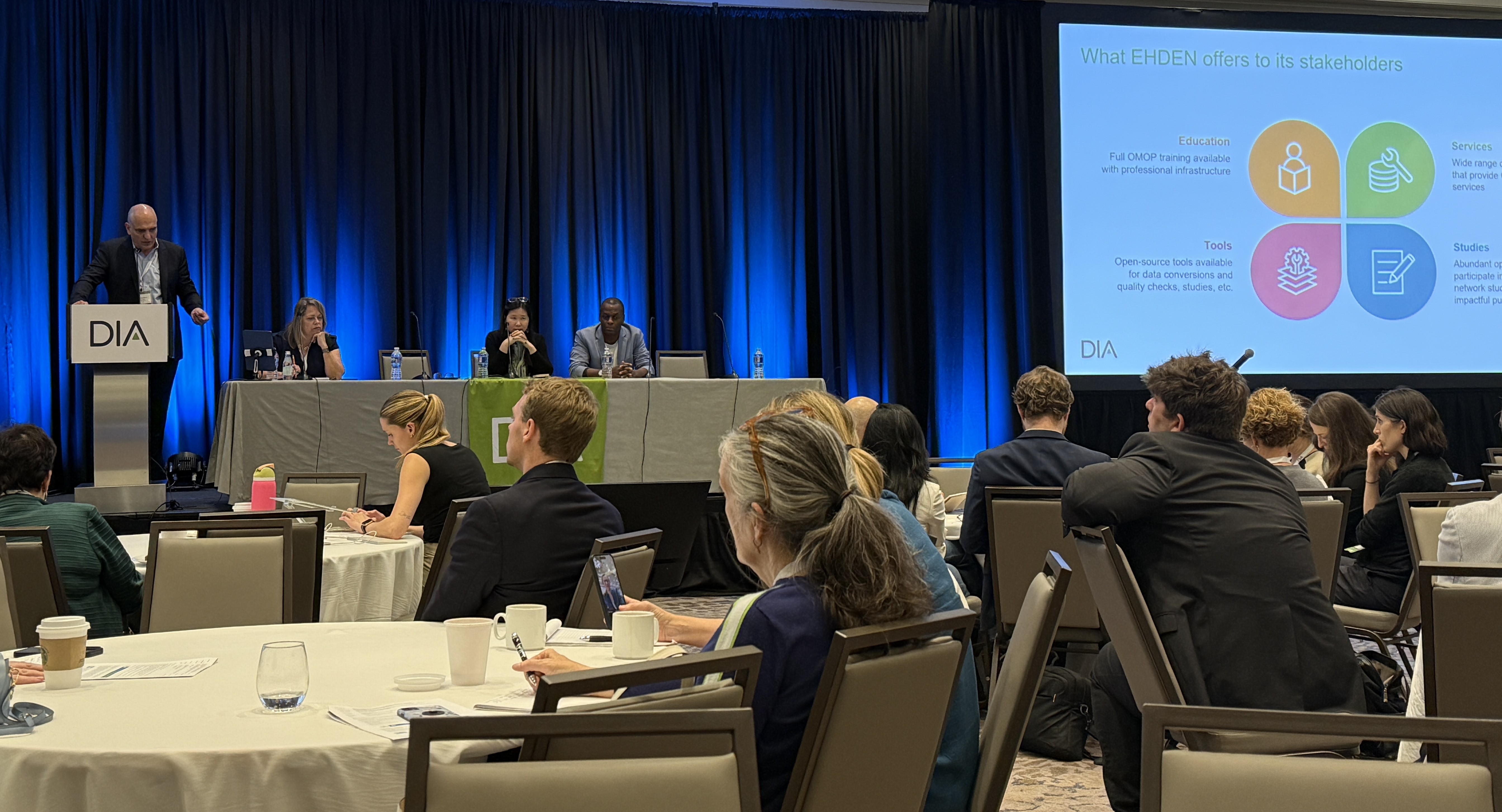
Reich opened with an overview of OHDSI’s progress: over 500 data sources across 49 countries now map to the OMOP Common Data Model (CDM), encompassing nearly one billion unique patient records – around 12% of the global population. The community itself spans 83 countries, six continents, and nearly 4000 collaborators. He emphasized that OHDSI’s success stems from open science, reproducibility and standardized tools, which together enable more reliable and cost-effective RWE. Honing in on OHDSI Europe, Reich highlighted initiatives such as DARWIN EU, EHDEN and the Harmony Alliance that illustrate how the OMOP CDM underpins federated data networks supporting regulatory decision-making.
Van Zandt detailed OHDSI’s rapid growth in the Asia-Pacific region since 2019 (OHDSI APAC), where collaboration is crucial due to the absence of a unifying regulator as in Europe. The first APAC study, published in JAMA Network Open in 2022, demonstrated how regional RWD can reveal cross-national differences in clinical practice. The 2024 APAC ETL Project – bringing together 136 participants across four teams – marked the first community-wide effort to convert data into OMOP format. Van Zandt acknowledged persistent challenges in funding, culture, language and expertise, but noted increasing publication output and growing institutional support.
Asiimwe concluded with the story of OHDSI Africa, launched in 2022 and now encompassing 200+ members across 16 countries with 12 OMOP databases. He described initiatives such as PANGHEA, the Pan-African Network Generating Health Evidence and Analytics, and the BRIDGE Network, a partnership to train infectious disease experts in health informatics and data science. Despite infrastructure and sustainability challenges, Asiimwe emphasized that those investing in African data capacity now are shaping the continent’s health evidence future, and highlighted that the first Africa Symposium will be taking place in November 2025.
The session illustrated how the OMOP CDM is serving as a unifying foundation for global RWE and underscored that the strength of OHDSI lies in its open-science ethos – linking diverse collaborators, fostering reproducibility and empowering every region to participate in advancing global health evidence.
Session 8: AI and machine learning innovations transforming real-world data from patient insights to regulatory-ready evidence
Session chair Rachele Hendricks-Sturrup (Duke-Margolis Institute for Health Policy, USA) opened the discussion by urging attendees to “think big” about the potential of artificial intelligence (AI) and machine learning (ML) to transform RWD into regulatory-ready evidence – while keeping patients at the center. She pointed to a striking 92% increase in published studies combining RWD and AI/ML between 2022–2023 and 2024–2025, and highlighted recent FDA guidance acknowledging the use of AI to process unstructured electronic health record (EHR) data. The session would, she said, explore how AI tools can close data gaps, optimize target populations and strengthen RWD study design through practical, real-world examples.
Carl Marci (OM1, USA) began by outlining how AI can fill gaps in patient journeys. Drawing on OM1’s large-scale, linked EHR and claims datasets, Marci described a four-step approach: ingesting and organizing multi-source data; identifying and extracting key clinical information from unstructured notes using large language models (LLMs); estimating and amplifying clinical endpoints not routinely recorded in practice; and finally, finding and predicting outcomes through digital phenotyping. He illustrated how OM1’s PhenOM platform can identify undiagnosed patients or forecast disease progression, such as in treatment-resistant depression, while stressing that human validation and expert review remain essential to ensure accuracy and reliability.
Building on that theme, Juhaeri Juhaeri (Sanofi, USA) examined the evolving role of AI in pharmacovigilance (PV), where accuracy and accountability are paramount. He described how AI is already being implemented across case intake, de-duplication, translation and narrative writing, always with human oversight. For signal detection, he compared traditional disproportionality analyses with newer tree-scan and social-media–based approaches, noting that while these tools show promise, they are “not yet ready for prime time.” Juhaeri also introduced a major public–private initiative under the Innovative Health Initiative (IHI) to develop and test AI-powered signal detection and risk prediction tools, an effort he explained is expected to enhance efficiency, patient safety and regulatory preparedness.
Concluding the presentations, Sherrine Eid (SAS Institute, Inc., USA) turned to the use of ML in clinical trial feasibility. She demonstrated how combining RWD with AI can refine eligibility criteria, optimize protocol design and accelerate site selection, provided strong governance frameworks are in place. Eid underlined the need to balance speed with responsibility, emphasizing data quality, transparency, bias detection and continuous model monitoring, summarizing with the reminder: “Just because you can doesn’t mean you should.”
In closing, Hendricks-Sturrup reflected that, across contexts, from clinical data enrichment to PV and trial optimization, AI and ML are proving most powerful when applied within clear guardrails. With robust governance and human oversight, they can enhance evidence quality, improve trial efficiency and ultimately support better decisions for patients.
Session 9: Shaping the future of real-world data and evidence through policy and collaboration
Moderated by Jaclyn Bosco (IQVIA, USA), the final session of DIA RWE 2025 brought together Motiur Rahman (FDA, USA), Ulka Campbell (Aetion, a Datavant company, USA) and Trevan Locke (Amgen, USA) for a fireside chat on advancing RWE through thoughtful policy, collaboration and innovation. The discussion explored opportunities for industry leadership, key policy initiatives, and the evolving expectations for data quality, transparency and regulatory engagement.
Where does industry have the most opportunity, or responsibility, to shape future RWE use for regulatory decision making?
Campbell highlighted the opportunity for industry to improve RWE quality and integrate RWD earlier in the research continuum, both to inform RCT design and to support alternative evidence strategies where RCTs are not feasible. Locke emphasized the industry’s role as a driver of implementation – through establishing data standards, conducting pilot studies and setting examples for ethical AI use. Rahman added that organizations have a responsibility to ensure transparency, invest in high-quality data, and include patients meaningfully in RWE initiatives.
Are there any initiatives or collaborations that have been particularly valuable in advancing RWE policy?
Campbell pointed to initiatives such as RCT-Duplicate, CARE and REPEAT, which use completed RCTs as benchmarks for evaluating observational study design, yielding critical insights into data quality and methodology. Locke praised collaborative platforms such as Duke-Margolis, which provide neutral spaces for sponsors and regulators to work through complex methodological and policy challenges together.
Where are we seeing the most uncertainty or debate regarding RWE acceptance?
Rahman identified drug efficacy as the area of greatest uncertainty, noting persistent questions about reproducibility, transparency and handling of unstructured data. Locke and Campbell echoed these concerns, adding that early regulatory engagement and clear expectations for data inspection are essential, with Locke praising the recent FDA publication. Both stressed that uncertainty persists around demonstrating RCT infeasibility and ensuring global data accessibility and interoperability.
How can regulators, sponsors, and other stakeholders align on acceptable evidentiary standards across product types?
All speakers agreed that alignment depends on shared learning through published use cases. Campbell and Locke both emphasized the importance of advance planning, early collaboration and transparent sharing of both successful and unsuccessful examples. Rahman noted progress toward greater consistency, citing eight approvals where RWD served as the primary evidence source, but called for continued collaboration and discussion.
In closing, the panel underscored that the future of RWE depends on partnership – between regulators, industry and patients. By embedding transparency, collaboration and early engagement into every stage of research, the field can move closer to a shared, globally coherent vision for evidence generation.
Looking forward and closing remarks
DIA RWE 2025 concluded with closing reflections from program Chairs Rachele Hendricks-Sturrup (Duke-Margolis Institute for Health Policy, USA) and Keri Monda (Amgen, USA), along with Sorcha McCrohan (DIA, USA), who celebrated the event’s success and looked ahead to the future of the RWE field.
Hendricks-Sturrup thanksed the attendees, speakers, poster presenters, and the DIA staff, recognizing the conference as “a unique opportunity to come together to be open, honest, candid, excited, and inspired about what we’re doing”. She emphasized the enduring importance of data quality, reliability, inspection readiness, synthetic data, peer-reviewed publication practices, and the role of policy and collaboration in RWD’s evolution. Audience polling highlighted key takeaways – transparency, data quality and collaboration – as recurring themes, alongside enthusiasm for future discussion topics such as AI, causal inference and regulatory data standards.
“The work we’re doing is so important – it’s important today and will be important tomorrow.” – Rachele Hendricks-Sturrup (Duke-Margolis Institute for Health Policy, USA)
Monda reflected on overarching themes from the meeting: global harmonization, data reliability, transparency and AI. She noted that while initiatives such as ICH’s efforts toward a global framework for RWD/E are advancing, regional implementation and consensus remain ongoing challenges. Monda underscored the need for better – not simply more – data, and the importance of collective action to ensure transparency and responsible innovation in AI.
McCrohan closed the session by encouraging attendees to provide feedback and continue their engagement with the DIA community. Thanking participants for their energy and insight, she affirmed optimism for the “bright future of RWD/E”.