

DIA’s 2025 Real-World Evidence Conference daily round-ups: Day 1
The Evidence Base is proud to partner once again with the DIA Real-World Evidence Conference 2025, taking place October 16–17 in San Diego, California. On site at the meeting, Laura Dormer and Joanne Walker share highlights from Day 1, exploring how this year’s theme, “Translating Insights into Real-World Value”, is shaping discussions on data quality, regulatory progress, and innovation in evidence generation.
Opening remarks
Sorcha McCrohan (Senior Scientific Project Manager, DIA) welcomed attendees to San Diego for two days of discussion on evidence-based medical product safety and effectiveness. She acknowledged both first-time and returning participants and thanked the program committee for their contributions, chaired by Keri Monda (Amgen, USA) and Rachele Hendricks-Sturrup (Duke-Margolis Institute for Health Policy, USA). McCrohan emphasized the importance of community in advancing RWE generation and highlighted networking as a key element of the conference, encouraging attendees, particularly those new to the meeting, to introduce themselves, engage actively, and collaborate with peers to foster shared learning and problem-solving across the RWE and regulatory science community.
Session 1: A year in review of advancing RWE globally
In a recurring format of DIA’s RWE meetings, the first session brought together experts to reflect on the past year’s major developments shaping global RWE practice. Moderated by Monda and Hendricks-Sturrup, the session offered an overview of regulatory milestones and emerging best practices, with presentations and panel discussion featuring Dan Riskin (Verantos, USA), Hidetaka Kobayashi (Pharmaceuticals and Medical Devices Agency [PMDA], Japan) and Robert Reynolds (GSK, USA).
Hendricks-Sturrup opened with a concise overview of recent international progress. She highlighted the FDA’s published RWD-based submissions and guidance on cell and gene therapy and small-population studies; the European Medicines Agency’s DARWIN EU initiative, which has produced eight study reports and eight protocols to date, along with the HARPER recommendations; and the finalization of ICH M14, alongside the forthcoming launch of ICH E23 on RWE for effectiveness. She also drew attention to Canada’s joint regulator–HTA guidance and to the Duke-Margolis dashboard tracking international RWE standards.
The panel then examined “Strategies and Best Practices Towards Relevant and Reliable RWE Globally”. Riskin emphasized that evidence validity depends on data fitness for use, distinguishing between relevance and reliability. Drawing on the FDA-sponsored TRUST study – a study led by Verantos that aimed to determine the impact of data quality in RWE and evaluate data reliability over three dimensions – he outlined how accuracy, completeness and traceability can be measured objectively and demonstrated that low-reliability data can misidentify patients and bias results. He urged inclusion of explicit reliability thresholds in study protocols.
Kobayashi provided the perspective of RWD in Japan, and described PMDA’s growing use of RWD for both drug approvals and safety evaluation, highlighting the recent publication ‘PMDA Perspective on Use of Real-World Data and Real-World Evidence as an External Control: Recent Examples and Considerations’ (previously highlighted on The Evidence Base here). He cited examples where registry data served a supportive role in new-drug applications and explained how Japan’s NDB and MID-NET® databases enable signal detection and risk-minimization studies. Ongoing priorities include adopting M14, expanding vaccination databases and leveraging AI for pharmacovigilance.
Reynolds, who served as pharma Topic Lead for ICH M14, outlined its development and core principles: a stepwise, iterative approach to study design and data selection; assessment of data relevance and reliability; and transparent, pre-specified protocols. He underscored the guideline’s goal of harmonizing non-interventional RWE studies across regulators and its foundation for the forthcoming E23 guideline.
In closing discussion, panelists agreed that AI and advanced data linkage will broaden the scope and speed of RWE, but warned that ensuring data quality and transparency remains critical as regulators and industry seek to translate real-world insights into trusted evidence for decision-making.
Session 2: Ensuring quality and integrity of real-world data: regulatory insights
Moderated by Motiur Rahman (US FDA), who joined remotely due to the ongoing US government shutdown, the second session explored how regulators, data experts and technology leaders are addressing the twin challenges of ensuring quality and maintaining integrity in RWD. Kassa Ayalew (US FDA), Kirk Geale (Quantify Research, Sweden) and Mayur Saxena (Droice Labs, USA) shared perspectives on regulatory expectations, data infrastructure and practical solutions for achieving inspection-ready RWE.
Ayalew, also participating remotely, outlined the FDA’s current approach to assessing data reliability in RWD/E studies. He traced the evolution of RWE use following the 21st Century Cures Act and noted that RWD is now routinely used in product submissions, licensing approvals and safety monitoring across global agencies. The FDA, he said, holds RWD to the same quality standards as clinical trial data, with inspectional focus on data relevance, privacy and integrity. Ayalew illustrated these principles with a case where a sponsor’s reliance on third-party registry data initially limited inspection access – highlighting the need for proactive agreements, consent planning and traceable records. He also connected ongoing harmonization under ICH E6(R3) to the strengthening of consent, ethics and oversight frameworks for RWD use.
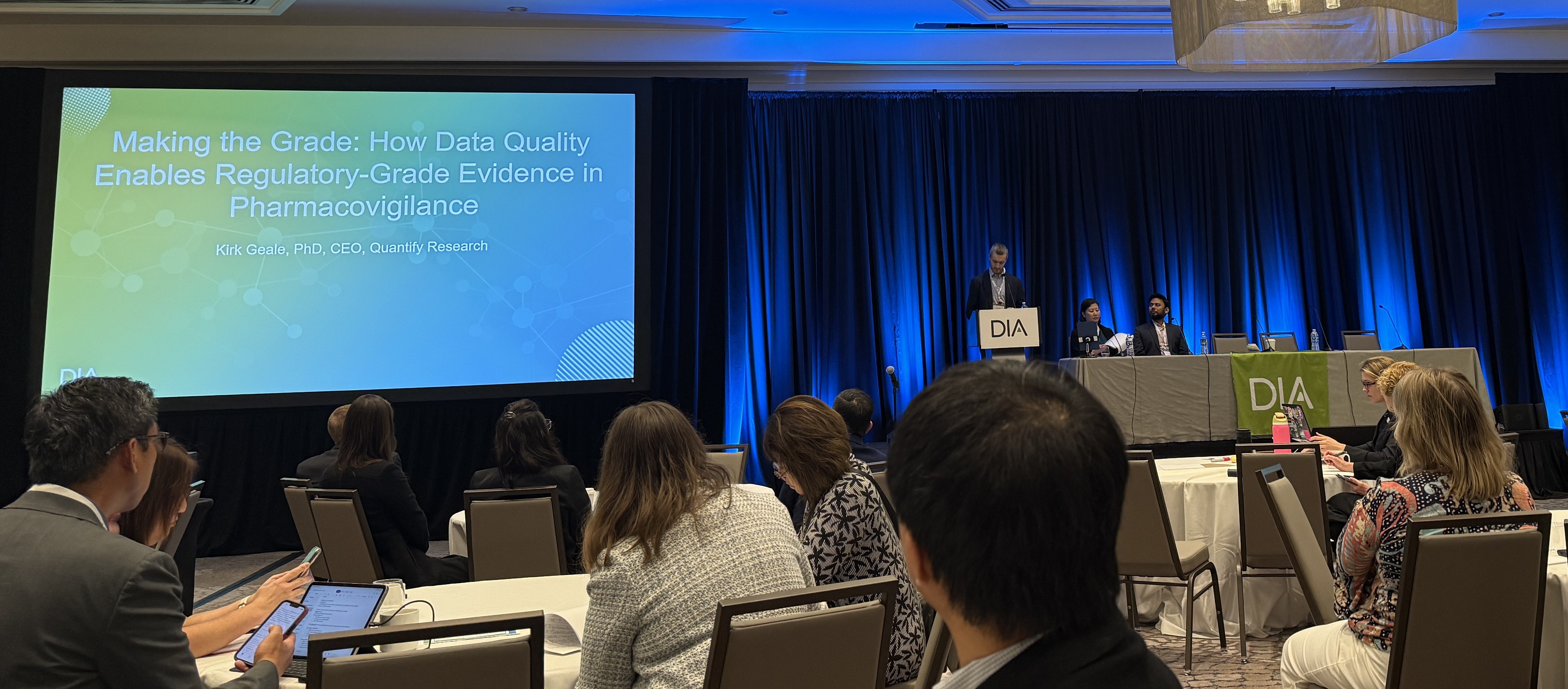
Geale discussed the European perspective, focusing on the “Nordic goldmine” of high-quality health data and how it supports regulatory decisions. Referencing EMA’s reflection paper on non-interventional studies and the HMA-EMA Data Quality Framework, he explained how extensiveness, coherence, timeliness, relevance and reliability define the data’s regulatory value. His case study on the long-term cardiovascular safety of ustekinumab in psoriasis and psoriatic arthritis demonstrated how Sweden’s national registries – spanning over 20 years of linked patient data – enable robust, confounder-controlled analyses meeting EMA and FDA standards.
Saxena concluded the session by contrasting RWD and randomized controlled trial (RCT) data, noting that while RCTs remain the gold standard, RWD studies can achieve regulatory rigor through strong design, embedded quality metrics and traceability. He stressed the importance of measuring data quality within each study’s context and ensuring reproducibility from data collection to submission.
In the closing discussion, the panelists emphasized collaboration, transparency and early engagement with regulators as essential to maintaining trust in RWE – particularly as global frameworks like ICH E6(R3) mature and new analytical tools emerge.
Session 3: RWD and RWE in support of clinical development: designs, guidance gaps, and practical strategies
Session co-chair Hetal Pansuria (Pacira Biosciences, USA) opened by emphasizing the growing value of RWD in clinical development, noting its potential to inform study design, enhance patient representation, and strengthen decision-making across the development continuum. The session focused on the evolving role of external control arms (ECAs) in regulatory and clinical research, examining new guidance, methodological advances, and practical strategies for integrating RWE into study design and execution.
John Seeger (RTI, USA) discussed the evolving regulatory landscape for ECAs, referencing early work by the International Society for Pharmacoepidemiology (ISPE) and the 2023 US FDA draft guidance developed under the 21st Century Cures Act. He emphasized the need for pre-specified protocols, transparent analysis plans, and early dialogue with regulators. Using the example of tegaserod for irritable bowel syndrome with constipation, he demonstrated how, in the absence of a built-in comparator, an observational ECA and mechanistic evidence helped the sponsor support FDA reassessment of cardiovascular risk.
Transitioning from regulatory principles to practical design, Xiang Zhang (CSL Behring, USA) discussed how RWE and simulations can inform hybrid trial strategies when traditional RCTs face feasibility barriers. Zhang described how his team used extensive simulation modeling to evaluate potential sources of bias and validate the design of a Phase 3 program. He emphasized that simulating trial parameters thousands of times under varying assumptions enables researchers to anticipate limitations and improve the robustness of non-randomized designs before implementation.
Shifting focus to long-term outcomes, Mingyang Shan (Eli Lilly and Company, USA) explored how ECAs can extend insight beyond the time horizons of RCTs. Using examples such as omaveloxolone for Friedreich’s ataxia and lecanemab for Alzheimer’s disease, Shan illustrated how natural history and registry data can support evidence on sustained treatment benefit. He also reviewed emerging analytical methods, such as synthetic control weighting, difference-in-differences, and matrix completion, that can strengthen inference while addressing heterogeneity across data sources.
In the Q&A discussion, audience questions centered on when ECAs are most appropriate and whether they should complement or replace randomized studies. Shan emphasized that the choice depends on context and estimand, while Zhang highlighted the importance of fit-for-purpose data and pre-specified mitigation strategies. Seeger added that sponsors should consider planning ECAs even when not strictly required, as they can inform regulatory and clinical decision-making.
Concluding the session, Lina Titievsky (GlaxoSmithKline, USA) noted that successful implementation of ECAs requires due diligence, methodological rigor, and collaboration across epidemiology, statistics, and clinical teams to ensure regulatory confidence in RWE approaches. She also reflected on the discussion’s broader theme, acknowledging that while enthusiasm for external controls continues to grow, their appropriate use remains context-dependent. Matching the right research question to the right application is complex, and ECAs should be viewed as complementary, rather than analternative, to RCTs. Titievsky suggested that future meetings could further explore regulatory perspectives on when and how ECAs are most appropriately applied.
Session 4: Leveraging RWD and synthetic data to advance research in special populations
Organized by Charles Lee (AstraZeneca, USA), the session examined how innovative data sources are being applied to address evidence gaps in hard-to-study and under-represented populations. Presentations by Red Thaddeus D Miguel (Thera-Business, Inc., Canada) and Michael Rozycki (Pacira Pharmaceuticals, USA) explored complementary examples of RWD and synthetic data use.
Miguel shared findings from an experimental project testing whether synthetic data could feasibly support substance-use research among young adults aged 18–25: a group often under-sampled in traditional surveys. Using Qualtrics’ Edge Audiences model, his team generated AI-based ‘synthetic respondents’ to mirror responses from the US National Survey on Drug Use and Health (NSDUH). The approach allowed iterative benchmarking and validation through propensity-score matching against NSDUH and National Health Interview Survey (NHIS) datasets. Miguel stressed that synthetic data are neither universally superior nor inferior to human-collected samples: they offer scale, fatigue-free consistency and rapid iteration, but require rigorous scrutiny of model design, question framing and provenance.
Rozycki presented a regulatory case study demonstrating how RWD can drive label expansion for a postsurgical recovery therapy in pediatric populations. By integrating registry and pharmacy data with population pharmacokinetic modeling, Pacira was able to justify dose selection, reduce trial burden and align with FDA requirements. This iterative use of RWD informed a successful supplemental NDA in 2021 extending use to children under 6.
Together, the presentations underscored how both synthetic and real-world datasets – when applied transparently and collaboratively – can help close persistent evidence gaps in special and small-population research.
Session 5: Real-world evidence studies in peer-reviewed literature: moving towards a better approach
In the final session of Day 1, Sarah Martin (Eli Lilly and Company, USA) explained that credible publication of RWE is essential for trust, yet variability in study quality persists as access to large datasets has expanded. An audience poll highlighted reproducibility, transparency, and reviewer expertise as the most pressing challenges – framing the discussion around how researchers, reviewers, and journals can strengthen standards across the publication lifecycle.
Jeffrey Brown (TriNetX, USA) highlighted lessons from COVID-19 retractions and a review gap in clinical journals where RWE studies often exceed reviewer expertise. He urged researchers to “show their work” by clearly linking the research question, data, methods, and intended use, and by documenting data capture, transformations, and source characteristics. Brown noted recurring pitfalls such as unclear study timelines and immortal time bias, recommending visual aids like target-trial diagrams to enhance transparency and reproducibility in published RWE studies.
Building on this, Shirley Wang (Harvard Medical School, USA) structured her talk around three questions: why, how, and what? She explained that inconsistent or poor-quality RWE can mislead decision-makers, an issue compounded by the rise of AI-generated research. Wang advocated for normalizing open-science practices such as pre-registration, protocol pre-specification, transparent data provenance, code sharing, and consistent reporting standards. She proposed visible transparency statements and benchmarking against established RCTs. Finally, she recommended a “Swiss cheese” model – multiple safeguards from regulators, journals, and sponsors – to strengthen study credibility.
Jaclyn Bosco (IQVIA, USA) connected publication practice to evolving guidance, noting the emphasis of the ICH M14 guideline on fit-for-purpose data, iterative alignment of design and data, pre-specification, and transparency, all which of should be relevant to journals as well as regulators and sponsors. She recommended that manuscripts explicitly state which frameworks and tools (e.g., RECORD-PE, HARPER) were used, and include data-quality signals in their methods incorporating completeness, linkage success and follow-up. Illustrating operational realities, she described the multi-country CLARION multiple sclerosis safety program, where investigators defined and published 28 data-quality indicators across heterogeneous registries to support interpretability.
In the Q&A, the panel agreed that open science and IP are not mutually exclusive; even when platforms are proprietary, algorithm logic, workflow steps, and validation evidence should be shared. There was cautious support for preprints (with guardrails) and a call for journals to cultivate reviewer pools with RWE expertise. Concluding, the speakers emphasized that transparency is necessary but not sufficient; credible RWE demands fit-for-purpose data, pre-specified design, measurable data quality, and clear communication that enables rigorous peer review.
Case studies
In the first case study, Conor Wyand (Truveta, USA) outlined how Truveta aims to transform evidence generation by providing clinically rich, large-scale, and timely data that can support decisions across the product lifecycle. He noted the growing demand among regulators, payers, manufacturers, and providers for faster, data-driven insights, while emphasizing the limitations of traditional clinical trials and registries, which are often slow, costly, narrowly focused, and unable to reflect real-world diversity or evolving standards of care.
Wyand described Truveta as a health system-founded and -funded organization representing 30 major US networks, encompassing data from more than 120 million patients. The company aggregates and standardizes full electronic health records, links them to claims and other modalities, and uses proprietary large language models (LLMs) with human oversight to clean and normalize unstructured data such as clinical notes, radiology reports, and biopsies. This process enables the creation of research-ready datasets that can support a range of use cases.
Wyand shared multiple case studies illustrating how RWD form Truveta’s network is being applied to inform trial design, comparative effectiveness research, and post-market evidence generation. Examples included optimizing a heart failure trial protocol by replacing an outdated registry with more contemporary RWD, helping refine inclusion criteria and validate treatment patterns for acute decompensated heart failure. Wyand also highlighted a comparative study of GLP-1 therapies, semaglutide and tirzepatide, where Truveta data generated findings consistent with later trial results, but nearly a year earlier and in a cohort more than 20-times larger. In another case, Truveta data were used to replicate a clinical trial that lacked long-term outcome data, providing additional evidence to support payer and reimbursement discussions. Further examples included the emulation of a single-arm study for a mitral valve device, generating evidence to inform label expansion and regulatory decision-making.
Lisa Charlton (Castor, USA) presented the next case study exploring how AI can accelerate and improve the quality of RWE generation by enabling ‘self-driving’ clinical trials. She introduced Castor as a technology company founded to democratize access to clinical research tools and improve global health equity. Its unified platform integrates patient recruitment and consent, ePRO/eCOA collection, electronic data capture, televisits and reporting – linking real-time data from diverse clinical and patient sources.
The session outlined Castor’s development of two agentic AI systems: Castor Catalyst, designed for automated data extraction and AI-enabled source data verification; and Castor Companion, which screens EHR data for trial eligibility and supports patient engagement and logistics. Charlton emphasized that RWE provides an ideal environment for applying AI, given its data heterogeneity and regulatory emphasis on provenance and traceability.
Charlton presented the example of the OMNIA Study, a long-term GLP-1 registry, which served as a proof-of-concept for Catalyst. The AI-driven system reduced chart review costs by around 90% and compressed data workflows from 4 weeks of manual effort to under an hour – achieving self-driving automation with no manual data transcription.
She concluded that combining machine learning, natural language processing and structured CDISC pipelines enables AI agents to deliver both speed and scientific rigor, ultimately supporting more efficient, transparent and patient-mediated real-world research.
| Register for free today to become a member of The Evidence Base and receive the latest news straight to your inbox. |