

ISPOR Europe 2026 – Inside the third plenary: Evidence that changes decisions

For the final plenary of ISPOR Europe 2026, Laura Dormer turns to the evidence itself, examining how HEOR may need to evolve as healthcare decisions become broader, more complex and increasingly shaped by new data and analytical approaches.
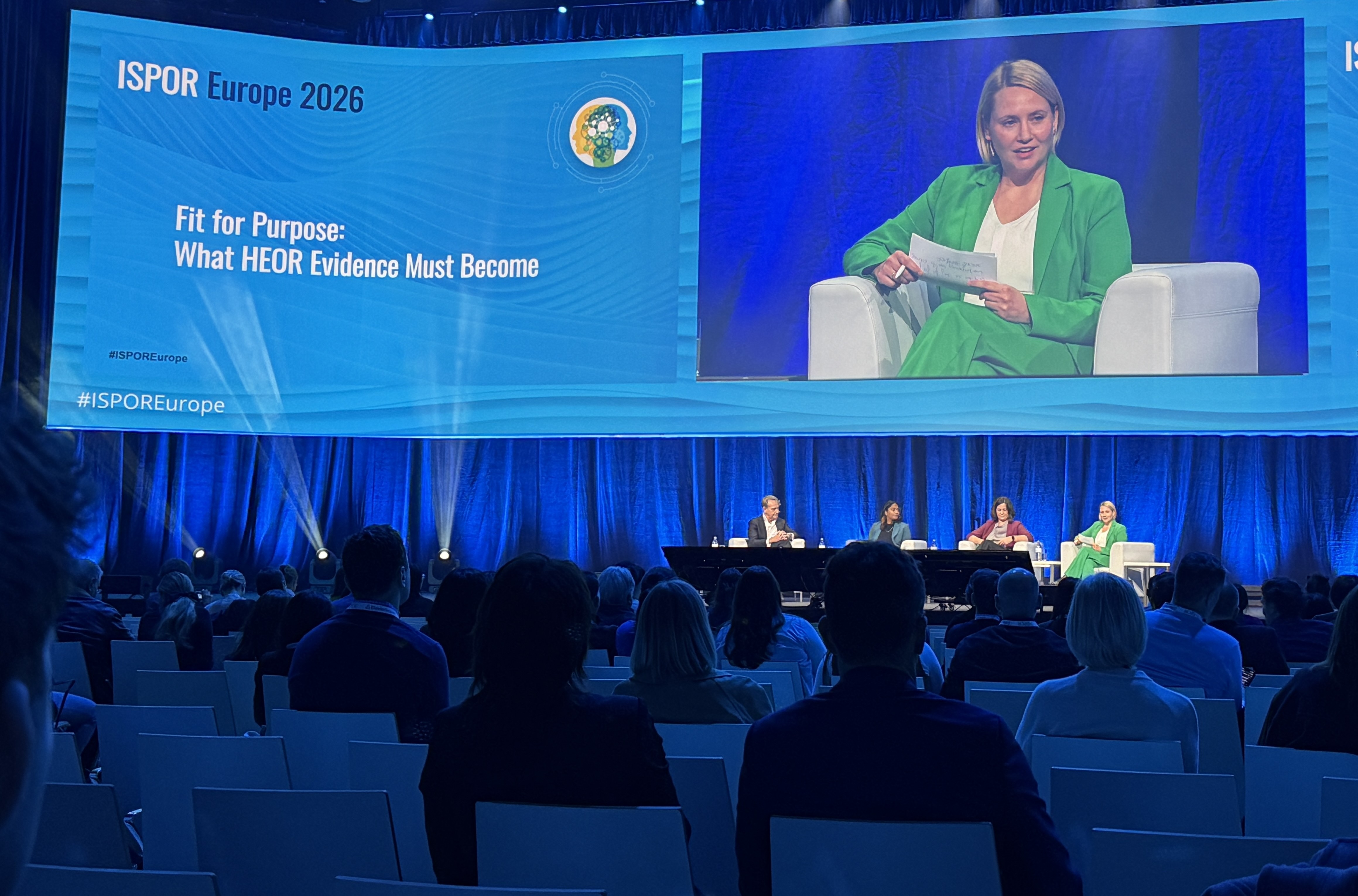
The final plenary of ISPOR Europe 2026, organized by ISPOR—The Professional Society for Health Economics and Outcomes Research, brought the meeting’s discussions back to the evidence itself.
Malina Müller (WifOR Institute) moderated “Fit for Purpose: What HEOR Evidence Must Become”, with Nick Guldemond (Leiden University Medical Center), Marie Gerstrøm Kristiansen (Amgros) and Nirosha Lederer (AstraZeneca). The panel considered the evidence needed to support decisions spanning population health, system resilience, sustainability and societal outcomes, alongside the growing role of AI and advanced analytics.
After three days of discussion around value, access and increasingly complex evidence needs, the question is not simply whether HEOR must evolve, but how. It is also a theme we have been exploring across The Evidence Base looking at how data, methods and evidence can better support healthcare decision-making.
What should fit-for-purpose evidence look like, and where does HEOR need to adapt next? This final plenary deep dive explores the panel’s perspectives.
Are we generating the evidence decision makers need?
Marie began with a distinction between strong evidence about a product and sufficient evidence to support an access decision. From the perspective of Denmark’s centralized procurement organization for hospital medicines, the task is to understand benefits, uncertainties and costs within limited budgets and competing priorities. As Marie explained:
“We don't need perfect evidence to say yes, but we need enough to understand the benefit and the uncertainties and the cost to make that responsible decision.”
A trial with 26 weeks of follow-up may leave considerable uncertainty about a treatment intended for lifelong use. Differences between trial participants and patients encountered in practice create further challenges, particularly when uncertainty accompanies a high price.
Country-specific studies against local standard care would make some decisions easier, but Marie acknowledged that fully tailored packages for every market are unrealistic. Instead, the aim should be a strong common evidence package that can be interpreted nationally. Marie was optimistic about Joint Clinical Assessment (JCA) providing a shared European clinical foundation, while value judgments, pricing, reimbursement and access remain national responsibilities.
Nirosha extended the discussion beyond product evaluation. Traditional post-market research addresses important questions about safety, effectiveness, comparative value and costs, but policymakers also make decisions across healthcare, transport, education and other public budgets. Evidence needs to make consequences outside the immediate drug or healthcare budget visible.
One example was AstraZeneca’s global potentially avoidable hospitalization study, which combined HEOR, real-world data (RWD), macroeconomics and capacity analysis. Nirosha described projections of increasing admissions across six countries as populations change, alongside the potential for guideline-based care to reduce that burden. The relevance was not simply financial: prevention and effective treatment could help release capacity in pressured systems.
“Workforce and health system capacity are at crisis point for many healthcare systems, and we can't hire our way out of it. But we can prevent, and we can treat.”
Producing such evidence requires co-creation to establish credibility and relevance. Nick added that compelling analysis does not guarantee political support, even when the economic case for prevention appears clear. Researchers must consider how evidence reaches political discussions, including conversations between health and finance ministries.
For Nirosha, the response was a continuous evidence-generation system: identify what is needed now, which uncertainties remain and what can be generated next. Policy and research timelines do not necessarily align, making early engagement important without relaxing methodological standards.
Clinical trials retain their role, complemented by RWE showing what happens in practice and transparent modeling exploring future consequences.
How can HEOR produce credible evidence?
The second discussion turned to the infrastructure, methods and expertise needed to deliver that evidence. Nick described the European Health Data Space as an opportunity to connect information across development, evaluation, implementation and surveillance.
Realizing that opportunity requires integration of data sources with appropriate quality. Nick cautioned, however, against concentrating on generating insights without considering what users can do with them. Policymakers, operational leaders, clinicians and patients require information that is contextualized and useful at different levels.
Nirosha applied the same principle to AI. The starting point remains a clear research question, including who will use the findings and what decision they will inform. AI can accelerate literature reviews, curation, extraction, analysis and scenario exploration, but researchers must understand what good performance looks like and oversee the process. Nirosha cautioned:
“AI cannot fix bad data. In fact, it could even exacerbate it.”
Transparency, provenance and data-fitness assessment therefore remain essential. Greater analytical speed cannot substitute for an appropriate source or a defensible question.
Marie offered a practical example of continuing evidence generation through conditional access. Where relevant RWD already exist, they may make the initial decision easier. Where gaps remain, conditional agreement can allow access while further data are collected to assess whether expected value is delivered. This connects learning to the uncertainty behind the decision, rather than collecting data without a clear purpose.
Broader questions also require broader expertise, with Nirosha describing the need to understand how health affects family life, participation in society and the economy, alongside clinical outcomes and resource use. Different data sources and disciplines are needed to examine those consequences.
“The multidisciplinary approach is really necessary when we think about generating this type of policy evidence.”
Nick encouraged learning from other sectors while recognizing healthcare’s complexity. Approaches successful in logistics or retail cannot simply be transferred unchanged. Collaboration across disciplines can help researchers test relevance and understand implementation throughout development and use.
Nirosha emphasized that progress also depends on who generates evidence together. Bringing patients, industry and policymakers into the process offers more than agreement on methods: relationships can expose different assumptions and priorities. This suggested an expanding professional skill set, combining technical expertise with the ability to work across disciplinary and institutional boundaries.
How does evidence change decisions?
The final discussion asked what happens after research is completed. Marie’s answer returned to uncertainty: evidence changes a decision when it addresses the uncertainty that matters to payers.
Reassessment may follow clearer evidence of benefit or longer follow-up confirming that an effect is sustained. Marie also acknowledged the commercial reality that reassessment is often driven by a price reduction. Evidence is one part of the access decision, alongside the terms under which treatment can be provided.
Earlier dialogue could establish which assumptions matter and where parties disagree. Complete agreement is unnecessary, but understanding differences sooner may help stakeholders identify solutions and manage uncertainty more effectively. Marie pointed to Nordic cooperation as an opportunity for smaller markets to strengthen discussions and learn from pilots.
Nick placed implementation at the center of HEOR’s responsibility by noting:
“The value of evidence is in its application.”
Outcome measures and comparisons are important, but improved care also depends on integrated pathways and practical changes in how services work. Measuring outcomes or adjusting incentives does not automatically create person-centered care.
Nick was concerned that health economics can be perceived primarily as budget reduction, leaving professionals expecting to do more with fewer resources. More constructive engagement could connect analysis with the changes needed to improve care. Co-creation approaches, including procurement that brings users and suppliers together, offered opportunities to apply HEOR within implementation itself.
Nirosha similarly argued that communication must suit the audience. An ISPOR abstract will not necessarily meet a policymaker’s needs; other formats and clearer explanations may be required. Dissemination is therefore part of making research usable, rather than simply reporting its completion.
An audience question about AI and junior economists raised a related concern about future skills. Marie emphasized that strong evidence will remain necessary regardless of the tools used, alongside understanding where the research ultimately leads. Technical capability must remain connected to the final decision.
Looking ahead to 2035
Malina closed by asking what evidence should routinely inform decisions by 2035 that does not today. The responses described ambitions for learning and implementation, alongside methodological development.
Marie hoped that learning would continue throughout the product lifecycle, with greater availability of RWE across countries to track outcomes and safety. Outcomes-based agreements already provide experience, but their resource requirements prevent routine use everywhere. Greater alignment between regulators and HTA bodies could also clarify shared evidence needs.
Nirosha’s ambition was to broaden the question from the cost of action to the consequences of inaction.
“My hope and my aspiration is that we move away from only asking how much does it cost, to asking the question what does it cost when we fail to act.”
Budget boundaries can obscure benefits elsewhere. Earlier identification and treatment of heart failure, for example, may require investment in one part of the system while reducing demands in another. Nirosha called for transparent evidence capturing these wider effects, so success is judged against patient and societal outcomes as well as expenditure.
Nick proposed a practical roadmap toward more sustainable, affordable and higher-quality systems, translating existing knowledge into coordinated implementation. Education should prepare students to apply evidence as well as understand its technical foundations.
Malina’s concluding message was to start earlier, engage those who will use the evidence and build trust while learning along the way. Across the three plenaries, the conversation had moved from defining value to changing systems and then to the evidence needed to support those changes. By 2035, the test will be how much of that evidence has helped improve the decisions and care that patients experience.
| Register for free today to become a member of The Evidence Base and receive the latest news straight to your inbox. |