

ISPOR 2026 – Inside the second plenary: Can healthcare systems balance cancer care costs with access and innovation?
Following Day 1’s plenary at ISPOR 2026, which examined the implications of US drug pricing reform, attention turned to cancer care, where questions of cost, access, and innovation remain closely intertwined. As healthcare systems face increasing pressure to manage rising treatment costs alongside continued scientific advances, the challenge was not only economic but also methodological and policy driven.
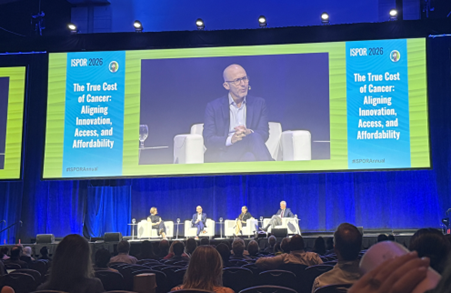
The second plenary, “The true cost of cancer: aligning innovation, access, and affordability,” at ISPOR 2026, the annual meeting of ISPOR—the Professional Society for Health Economics and Outcomes Research, shifted the focus of the conference from high-level healthcare policy to the lived realities of cancer care, exploring how financial toxicity, healthcare delivery systems, and reimbursement structures continue to shape patient outcomes. Moderated by Scott Ramsey (Fred Hutchinson Cancer Research Center), the session brought together Dawn Hershman (Columbia University Medical Center), Stacie Dusetzina (Vanderbilt University Medical Center) and Bobby Green (Thyme Care), to discuss the gap between advances in cancer treatment and the systems responsible for delivering care. The discussion was later expanded during a follow-up media briefing hosted by ISPOR CEO Rob Abbott, alongside Hershman, Ramsey, and Dana Goldman (USC Schaeffer Institute for Public Policy & Government Service), providing further insight into the policy and financial pressures shaping cancer care today.
Discussion 1 – The reality of cancer care today
Opening the session, Ramsey argued that many of the most important challenges facing patients occur outside the traditional endpoints captured in clinical trials and health technology assessments. While breakthroughs in oncology continue to accelerate, he noted that patients often struggle to access, afford, and adhere to these therapies in the real world. “The gap between what we study and what cancer patients actually experience in the real world is enormous,” he said, emphasizing that issues such as transportation, family support, financial stress, and healthcare navigation frequently determine outcomes as much as clinical innovation itself.
Much of the discussion focused on “financial toxicity,” a term used to describe the financial burden associated with cancer treatment. Dusetzina reflected on her own experience as both a health services researcher and the daughter of a patient with metastatic breast cancer, describing the difficulty of navigating treatment decisions when evidence surrounding high-cost therapies remained uncertain. She explained that many patients face thousands of dollars in out-of-pocket costs simply to begin treatment, often without clear evidence regarding meaningful survival benefits.
Hershman reinforced these concerns through examples from clinical practice, describing how issues such as co-payments, deductibles, insurance limitations, transportation costs, missed work, and fertility preservation expenses can collectively become overwhelming for patients. “It’s not fair to put somebody through that,” she said during the media briefing, referring to the impossible trade-offs patients often face between life-saving treatment and financial stability.
The panelists emphasized that these pressures are increasing as cancer care evolves from short-term treatment toward long-term disease management. During the media briefing, Ramsey described cancer as increasingly becoming “a chronic disease that’s treated over years and actually decades,” while warning that healthcare systems have not fully adapted to the financial realities this creates for patients and families.
Discussion 2 – Why the system struggles
Green, a former practicing oncologist and co-founder of Thyme Care, discussed how many critical patient needs remain poorly supported within the current fee-for-service healthcare system. He described examples of patients struggling with transportation, housing insecurity, medication management, and treatment coordination – issues that rarely appear in traditional datasets but significantly affect outcomes. “Our current system will pay $20,000 for a dose of a checkpoint inhibitor, but not a $15 Uber ride to get to the office to actually get it,” he said.
The panel repeatedly returned to the idea that healthcare delivery itself deserves greater attention within research and policy discussions. Speakers highlighted cancer navigation services, financial counseling, and system-level interventions as areas that can meaningfully improve outcomes but often remain underfunded or poorly integrated into existing reimbursement models.
Several speakers highlighted the growing burden associated with oral anti-cancer therapies, which often transfer costs directly onto patients. During the media briefing, Goldman argued that many of these challenges reflect “bad insurance” rather than simply high drug prices, noting that patients are often absorbing enormous financial strain in order to access potentially life-saving treatments. Goldman also emphasized that oncology innovation has largely occurred through incremental advances accumulated over time, rather than single transformative breakthroughs, creating additional complexity for reimbursement and value assessment frameworks.
The plenary also explored broader structural problems within cancer care delivery, including reimbursement models that may unintentionally discourage high-value care. Green described how current systems can financially penalize providers for selecting lower-cost but clinically equivalent treatment approaches, while Hershman argued that more research is needed into “de-escalation” strategies that identify minimally effective dosing and appropriate treatment duration. She highlighted the FDA’s Project Optimus initiative as an example of efforts to rethink traditional drug development approaches focused on maximum tolerated dosing.
Discussion 3 – What can be done: evidence, policy, and action
Discussion repeatedly returned to the need for stronger evidence generation around cancer care delivery itself, rather than focusing solely on new therapies. Hershman stressed the importance of pragmatic clinical trials, system-level interventions, symptom management research, and studies examining how care can be implemented more effectively within real-world settings. Speakers also highlighted the importance of federally funded and academic research in generating evidence that industry-funded studies may be less likely to address, particularly around implementation, delivery systems, and optimizing care models.
The panel also discussed quality of life and patient-reported outcomes, arguing that these measures should play a greater role in both clinical research and routine cancer care. Time toxicity – the burden associated with repeated healthcare interactions – was highlighted as an emerging area of focus, particularly as patients increasingly live longer with cancer and remain in treatment for extended periods.
Discussion also touched on how patients receive and understand information throughout their cancer journey. Responding to a question from The Evidence Base about how communication with patients may evolve in the future – particularly around treatment decisions and financial discussions – Hershman emphasized the importance of creating space for patients to raise concerns openly. She noted that providers may not always know what patients are experiencing financially, but healthcare systems, advocacy organizations, and pharmaceutical support programs can often provide assistance when challenges are identified early enough.
“Communication starts really with asking the question and creating the space so people feel comfortable letting you know.”
The discussion reinforced a broader theme running throughout the plenary: improving outcomes increasingly depends not only on developing better therapies, but also on building systems that better support patients in navigating treatment, financial pressures, and complex healthcare decisions.
During the media briefing, the panelists outlined several areas where meaningful progress could be made over the next 5 years, including insurance reform, value-based reimbursement, expanded financial counseling, improved navigation services, and greater alignment between reimbursement and patient outcomes. Hershman also emphasized the growing role of precision medicine in reducing overtreatment, arguing that more individualized approaches could help lower both physical and financial toxicity for patients.
The media briefing concluded with a broader reflection on how the definition of value in oncology may need to evolve. Closing the media briefing, Abbott described cancer care as involving a “cascade of burdens” extending far beyond clinical treatment alone, arguing that healthcare decision making must increasingly consider the full patient experience if healthcare systems are to truly improve outcomes for people living with cancer.
Takeaways
Closing the plenary session, panelists reflected on both the progress already made in cancer care and the work that still lies ahead. Hershman emphasized that while significant challenges remain, there is also substantial reason for optimism. She highlighted the remarkable progress made in cancer treatment over recent decades, with patients increasingly living both longer and better lives due to improved therapies and growing attention to factors affecting quality of life. Greater awareness, she argued, creates opportunities to ask better questions, measure issues that matter to patients, and continue improving care delivery.
Dusetzina reflected on the importance of pursuing research that directly addresses the challenges patients and families face in practice. While many more treatment options are now available, she emphasized that substantial gaps remain, creating ongoing opportunities for research and policy innovation to improve patient experiences and outcomes.
Green highlighted how perspectives within oncology have evolved over the course of his career. Issues such as financial toxicity, time toxicity, and quality of life are increasingly recognized as central components of cancer care rather than secondary considerations. The challenge now, he suggested, is translating that growing awareness into practical systems and policy changes that ensure these issues are addressed consistently across healthcare delivery.
While the panelists approached the challenge from different perspectives, the discussion suggested that healthcare systems can better balance cancer care costs with access and innovation – but doing so will require more patient-centered system design, stronger evidence generation, better alignment of reimbursement with value, and policies that ensure advances in cancer care remain both accessible and affordable.
| Register for free today to become a member of The Evidence Base and receive the latest news straight to your inbox. |