

ISPOR 2026 daily round-ups: Insights from Day 1
ISPOR 2026 is underway in Philadelphia, bringing together the global health economics and outcomes research (HEOR) community to explore the forces shaping policy, access, and value in healthcare. Hosted by ISPOR—The Professional Society for Health Economics and Outcomes Research, this year’s meeting reflects a field in transition, as evidence, policy, and practice become increasingly interconnected.
Day 1 highlights the breadth of these changes, with sessions focusing on US policy, real-world evidence (RWE), and the evolving role of HEOR in decision-making. The opening plenary sets the tone, examining the implications of recent pricing reforms, while a spotlight session on FDA use of RWE highlights growing expectations in regulatory decision-making.
Across concurrent sessions, discussions span patient experience data, broader value in health technology assessment (HTA), HEOR’s strategic impact, and the evolving data landscape, including AI and new sources of real-world data (RWD).
With The Evidence Base team on site at the Pennsylvania Convention Center, we are following these developments across the program. Here are some of the highlights from Day 1.
ISPOR Welcome Remarks and Keynote
ISPOR 2026 opened with a call for the global HEOR community to take an active leadership role in shaping healthcare policy, access and value. In his welcome remarks, ISPOR CEO Rob Abbott reflected on the rapidly changing healthcare landscape, describing a system being reshaped by new policies, emerging technologies and evolving stakeholder expectations. Against this backdrop, he emphasized that the field must remain united around a shared goal: creating healthcare systems that are accessible, effective, efficient and affordable for all.
Drawing on his experience as a motorcyclist, Abbott introduced the acronym “IPSGA” – information, position, speed, gear and acceleration – as a metaphor for how HEOR must navigate an increasingly complex environment. He challenged delegates to consider whether the field is gathering the right information, positioning itself effectively within the healthcare ecosystem, and moving at the appropriate pace to respond to change. Abbott argued that HEOR should not simply react to evolving healthcare systems, but actively lead the conversations shaping them, highlighting examples of ISPOR chapters around the world working directly with governments and health authorities. He concluded by encouraging attendees to use the conference to start conversations that could redefine how evidence is generated and applied globally.
Abbott’s introduction set the stage for the conference keynote from Inmaculada Hernandez (Centers for Medicare & Medicaid Services [CMS]), who explored the growing importance of pharmaceutical policy expertise in shaping healthcare access, pricing and decision-making.
Speaking from her perspective as both a pharmacist and health services researcher working at CMS, Hernandez highlighted the scale of pharmaceutical policy activity currently underway in the US, including GLP-1 obesity coverage initiatives, Inflation Reduction Act (IRA) drug price negotiations, international reference pricing models, pharmacy benefit manager (PBM) reforms, and multiple Centers for Medicare & Medicaid Innovation (CMMI) demonstration projects.
Hernandez argued that the challenge lies not only in the volume of policy change, but in the complexity of the regulatory framework into which these new policies are being introduced. She described pharmaceutical policy as a highly interconnected system of pricing rules, rebates and reimbursement mechanisms, where a single policy change can have effects across multiple areas. She emphasized that understanding these relationships requires highly specialized expertise that remains in short supply across government, academia and industry.
Concluding her remarks, Hernandez called on ISPOR and the wider HEOR community to help build the next generation of pharmaceutical policy experts.
Plenary 1: US Pharmaceutical Policy: Leading or Following?
The opening plenary at ISPOR 2026 explored whether US pharmaceutical policy is currently “leading or following” in the global healthcare landscape, with panelists debating topics including Most-Favored-Nation (MFN) pricing policies, PBMs, cell and gene therapies, and patient affordability. Moderated by Dana Goldman (USC Schaeffer Institute for Public Policy & Government Service), the discussion featured perspectives from Courtney Piron (Novartis), Liz Fowler (Johns Hopkins Bloomberg School of Public Health) and Inmaculada Hernandez (CMS), who examined the growing complexity of US drug pricing policy and the balance between rewarding innovation, ensuring patient access, and managing healthcare costs. While opinions differed on the best path forward, the session highlighted the increasingly global nature of pharmaceutical policy and the critical role of HEOR in evaluating the impact of rapidly evolving policy reforms.
Read our in-depth summary of Plenary 1 here >>>
Spotlight Session: Advancing Real-World Evidence in FDA Regulatory Decision Making
Moderated by Marie Bradley (FDA), the Spotlight explored how the US FDA is continuing to expand the role of RWD and RWE in regulatory submissions, while also refining the methodological and evidentiary standards needed to support decision-making.
Opening the session, Bradley reflected on the agency’s mission to realize the “full potential” of fit-for-use RWD to support the development and oversight of medical products. She outlined the evolution of the FDA’s RWE program following the 21st Century Cures Act in 2016 and the publication of the agency’s 2018 RWE Framework. Bradley highlighted the increasing use of RWD across safety and effectiveness studies, alongside ongoing development of FDA guidance documents, demonstration projects, and international collaborations. She also discussed the Advancing RWE Program, launched under PDUFA VII in 2022 to support early sponsor engagement with FDA experts.
Shirley Wang (Brigham & Women’s Hospital, Harvard Medical School) then presented lessons from the FDA-funded RCT-DUPLICATE demonstration project, describing the initiative as fundamentally focused on “learning through examples.” She explained that the broader aim of the project was to better understand when RWE studies can generate sufficiently robust evidence to support regulatory and healthcare decision-making.
Wang explained that the initiative benchmarked RWE studies against completed randomized clinical trials (RCTs) that they were explicitly designed to emulate. Importantly, she distinguished this work from target trial emulation, describing it instead as “reference trial emulation,” where investigators attempt to reproduce the results of an actual completed trial using RWD sources such as claims databases and specialty oncology electronic health record datasets. She noted that while bias is often the primary concern in benchmarking exercises, differences in study design and inability to fully replicate aspects of the original trial can also alter the research question itself and contribute to divergence in findings.
Reviewing results from more than 30 trial emulations, Wang reported relatively high overall concordance between RCTs and RWE studies; however, she also described several methodological challenges encountered during the work. These included difficulties capturing inpatient treatment initiation in claims databases, differences in treatment adherence between clinical trials and routine practice, limitations in oncology data quality, and the uncertain replicability of even randomized trials themselves. Wang stressed that benchmarking exercises can serve as a “humbling experience,” helping researchers better understand both the capabilities and limitations of RWD for estimating treatment effects. She argued that such benchmarking should not be used simply to reproduce existing trial evidence, but rather to evaluate whether specific data sources, study designs, and analytic approaches are sufficiently fit for expanded questions involving new populations, comparators, or endpoints.
Joel Weissfeld (FDA) focused on the FDA’s draft guidance for non-interventional studies (NIS), describing the document as “a roadmap of FDA recommendations, not a how-to manual.” Weissfeld outlined the guidance’s emphasis on four key domains: overall study approach, study design, data sources, and analytic methods. Central themes included protocol prespecification, early FDA engagement, careful consideration of confounding and bias, and rigorous assessment of data relevance and reliability.
To illustrate these principles, Weissfeld reviewed the FDA approval of Orencia for prophylaxis of acute graft-versus-host disease (GVHD), where an observational study contributed to the evidence package supporting approval. He highlighted several features that contributed to the study’s regulatory success, including the unmet need in an orphan setting, extensive early engagement with FDA reviewers, transparent protocol development, robust data quality assessments, and a large treatment effect observed within the registry-based analysis. Weissfeld also examined challenges surrounding the acceptability of the research design and endpoint relevance, noting that the registry captured overall survival data but not the precise onset date of GVHD.
Motiur Rahman (FDA) then discussed the FDA’s draft guidance on externally controlled trials (ECTs), which he described as one of the most widely used RWE approaches currently seen in regulatory submissions. Rahman emphasized that sponsors should finalize protocols and statistical analysis plans before beginning analyses and should carefully evaluate comparability between treatment and external control groups across multiple domains. He also highlighted persistent challenges involving missing data and data misclassification.
Rahman presented two examples where external controls supported regulatory approvals. The first involved Nulibry for molybdenum cofactor deficiency type A, an ultra-rare pediatric disease where randomized studies were not feasible. The second involved Lenmeldy for metachromatic leukodystrophy, where untreated natural history data provided the external comparator. Across both examples, Rahman emphasized the importance of clinically meaningful endpoints, strong data comparability, and confirmatory supporting evidence alongside the RWE analyses.
During the discussion session, panelists reflected on future directions for RWE in regulatory science. Wang highlighted the need for additional benchmarking work across more clinical areas and medical devices, as well as stronger linkages between RCTs and RWD sources. Weissfeld noted that while the FDA guidance documents aim to provide conceptual clarity, “the devil is in the details” when these principles are applied in practice. Rahman also acknowledged that while ECTs have become increasingly accepted in rare diseases and areas of unmet need, randomized studies remain preferable in many common chronic diseases where conventional trial recruitment is feasible.
Concurrent Sessions
Patient Experience Data As A Non-Negotiable: Can US Payers Afford To Stay Behind?
Speakers discussed the growing role of patient experience data (PED) in healthcare decision-making, while highlighting ongoing challenges around implementation, standardization, and payer adoption. Moderator Martin Rost (AESARA) noted that “patient experience data is becoming part of the expected evidence package used to evaluate value,” reflecting increasing expectations from regulators, HTA bodies, and healthcare systems to capture outcomes beyond traditional clinical endpoints.
Denise Sánchez Palomo (Opus Regulatory) outlined the regulatory evolution of PED, highlighting the FDA’s Patient-Focused Drug Development guidance series and stating that “the FDA, it's a big area of focus, and this guidance series has really helped push the matter forward.” Sánchez Palomo also stressed the need for early engagement with regulators and stronger cross-functional collaboration within companies to ensure PED is integrated throughout evidence generation and access planning.
Robyn Carson (AbbVie) emphasized the broader role of PED across the healthcare decision-making pathway, stating that “patients are the experts in their condition, and their voice matters.” Carson also highlighted the need to connect patient-centered outcomes research, market access, and RWE strategies earlier in development so that evidence generation better reflects both payer and patient needs.
From an HTA perspective, Brian O’Rourke discussed the value of structured patient involvement frameworks across the product lifecycle, warning that patient engagement often happens too late: “what really falls apart is when it's after you've already kind of made your decision on what you're going to do with that pharmaceutical, and then you ask the patients what they think, that is way too late.” O’Rourke emphasized the importance of incorporating patient perspectives on unmet need, quality of life, and treatment impact alongside clinical and economic evidence.
The Hows and Whys of Estimating Return on Investment (ROI) of HEOR to the Biopharmaceutical Industry
One of the opening workshops focused on estimating the return on investment (ROI) of HEOR in the biopharmaceutical industry, where speakers explored growing pressure on HEOR teams to demonstrate strategic and financial value within increasingly constrained healthcare and pharmaceutical environments. Moderated by Christopher Blanchette (Novo Nordisk), the session drew approximately 250 attendees and formed part of a broader ISPOR ROI of HEOR Working Group initiative examining how HEOR organizations can better communicate their contribution to decision-making and patient access.
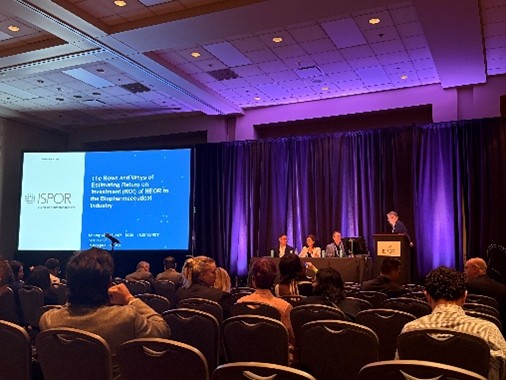
Blanchette highlighted how HEOR functions are increasingly challenged to justify spending despite rising demand for evidence generation, including publications, value dossiers, economic models, and RWE studies. He noted that traditional metrics such as publication counts or congress presentations often fail to resonate with financially focused stakeholders.
David Thompson (Rubidoux Research LLC) then outlined a proposed methodological framework for assessing ROI at the individual project level rather than attempting to estimate HEOR value across the industry. Thompson described how expected net present value (eNPV) modeling, decision analysis, and discounting techniques could be used to estimate how HEOR projects may influence pricing, market uptake, development timelines, or research efficiencies. He emphasized that ROI assessment should remain focused on evaluating the downstream impact of scientifically credible evidence generation rather than directly linking HEOR activities to promotional objectives.
Montserrat Vera-Llonch (Ionis Pharmaceuticals, Inc.) focused on criteria for selecting suitable projects for ROI assessment, proposing three core dimensions: topicality, quantifiability, and applicability. Vera-Llonch discussed examples including EU Joint Clinical Assessments, external controls, economic modeling, clinical outcome assessments, and value dossier development. She also highlighted practical and ethical considerations, including attribution challenges, time horizons, and the importance of ensuring that HEOR continues to be viewed as a strategic contributor rather than solely a technical support function.
Craig Roberts (Merck & Co., Inc.) closed the workshop by discussing by how biopharmaceutical companies might operationalize ROI thinking within research portfolio planning. Roberts argued that while not all HEOR activities require formal ROI calculations, understanding probabilities, payoffs, product lifecycle considerations, and diminishing returns could help organizations prioritize strategic investments more effectively. He concluded by emphasizing that the ultimate purpose of HEOR is not simply financial measurement, but improving decision-making and patient access, stating: “Why are we doing this? It’s to inform this decision, it’s to change this access, it’s to make this product more available to patients, and the more clearly we can describe how our work informs those decisions, the more our stakeholders will understand our value.”
The Evidence Advantage: How Life Sciences Leaders Are Winning With Real-World Data
Moderated by Myla Maloney (Premier Applied Sciences), the session examined how life sciences organizations are increasingly embedding RWD and RWE into evidence generation, regulatory strategy, commercialization, and clinical decision-making. Structured largely as a Q&A discussion led by Maloney, the session explored both the opportunities and operational challenges associated with scaling the use of RWD across organizations.
In response to Maloney’s opening questions on emerging data sources and digital innovation, Cheng Yang (Takeda Pharmaceuticals) focused on digital diagnostics and device-generated data, highlighting how digital biomarkers and machine learning-enabled tools are creating opportunities to generate insights beyond traditional clinical endpoints. Yang emphasized that evidence strategies should begin with the decision being supported rather than the available data, while also stressing the importance of adapting evidence narratives for different audiences, including regulators, clinicians, and payers.
Asked about how RWD is being integrated across the product lifecycle, Thomas Dougherty (Novo Nordisk) outlined how data are being used within Novo Nordisk for drug discovery, trial innovation, external control arms, and commercial activities. Dougherty also reflected on the obesity treatment landscape, noting that understanding patient perspectives through both quantitative and qualitative research is increasingly important. He additionally pointed to the growing value of multimodal datasets, tokenization, and AI-enabled analytics to accelerate insight generation.
Turning to evidence communication and stakeholder engagement, Ryan Farej (Bayer) described the challenges of creating robust evidence stories from datasets that were not originally designed for research purposes. Farej stressed that organizations must remain flexible in how they discuss and apply RWE, while ensuring evidence strategies are aligned with both internal priorities and external stakeholder expectations.
Offering a medtech perspective during the discussion on methodological rigor and operationalization, Stephen Johnston (Johnson & Johnson) highlighted the complexities associated with device-related datasets and comparative effectiveness studies in medical technology. Johnston discussed recent regulatory successes supported by RWD, including a label modification, and emphasized the importance of balancing methodological rigor with operational speed through causal inference methods, public–private partnerships, and collaborations with organizations such as OHDSI, ISPOR, and ISPE.
Throughout the session, speakers repeatedly returned to the idea that successful evidence generation depends not only on access to large datasets, exemplified by the Premier Healthcare Database, but also on selecting fit-for-purpose data, understanding the intended audience, and developing scalable frameworks capable of supporting increasingly rapid and AI-enabled decision-making.
Measuring What Matters: Broader Value Elements in HTA and Their Impact on Access
Moderated by Graham Cookson (Office of Health Economics), the discussion examined whether existing HTA frameworks adequately capture the full value of healthcare interventions, particularly in areas such as public health impact, adherence, equity, and broader societal outcomes.
Lotte Steuten (Office of Health Economics) argued that “the gap between what HTA is measuring and what technologies are delivering, is potentially widening,” particularly as healthcare innovation increasingly influences prevention, treatment persistence, and population health outcomes. Drawing on a review of HTA frameworks across multiple countries, Steuten highlighted that many broader value elements remain inconsistently recognized or absent from formal guidance.
Jon D Campbell (National Pharmaceutical Council) explored the US perspective, noting that while payers increasingly acknowledge societal benefits, “dollars aren't necessarily the same as value.” Campbell highlighted ongoing debate around how broader value elements can be incorporated into evidence generation and reimbursement decision-making within the complexity of the US multi-payer system.
Oriol de Sola-Morales (Fundacio HiTT) argued that “the current framework needs to be properly expanded,” particularly as healthcare systems face changing priorities, rising chronic disease burdens, and new models of innovation. Jon Tosh (ViiV Healthcare) similarly pointed to the UK antimicrobial resistance subscription model as an example of how broader value can be operationalized outside traditional HTA approaches, stating that it “doesn't have to be HTA that's actually driving how we provide reimbursement and access.”
Across the discussion, speakers agreed that broader value assessment will require stronger methodologies, improved evidence generation, and closer alignment between HTA frameworks, healthcare priorities, and wider societal objectives.
Resolved That HEOR and RWE Scientists Should Actively Architect RWD vs Be An End User of RWD: A Debate
Moderated by Eberechukwu Onukwugha (University of Maryland), the discussion explored whether HEOR and RWE scientists should actively shape RWD infrastructure or focus primarily on generating evidence from existing datasets.
Arguing for the “active architect” position, Aaron Kamauu (Navidence) stated that “the best statistical and informatics method cannot analyze data that was never collected.” Drawing on his background in clinical informatics, Kamauu argued that much of today’s RWD was not originally designed for research purposes, limiting downstream evidence generation and reinforcing the need for researchers to play a greater role in shaping how data are captured and structured.
Mary Beth Ritchey (Med Tech Epi) emphasized increasing regulatory expectations around data quality, provenance, and traceability, arguing that researchers should help shape data systems upstream rather than repeatedly adapting imperfect datasets for individual studies.
Presenting the “practical consumer” perspective, Sandipan Bhattacharjee (Bayer US LLC) argued that “our core competency is inference, and it's not the infrastructure,” emphasizing that HEOR and RWE scientists create value by analyzing, interpreting, and translating imperfect RWD into “credible decision-grade RWE.”
Ernest H Law (Pfizer) similarly argued that “the fundamental question of this debate is where do we spend our time,” noting that decision-makers and patients require evidence rapidly. Law maintained that HEOR and RWE scientists are best positioned to curate, interpret, and translate increasingly complex datasets into actionable evidence for regulators, payers, and clinicians.
Minutes, not Months: AI-Enabled Insights to Drive Evidence Strategy
Michael Simonov (Truveta) outlined how AI-enabled RWD platforms are being used to accelerate evidence generation while maintaining regulatory-grade rigor. Drawing on Truveta’s network of approximately 30 US health systems, Simonov described how the company has built a large-scale RWD infrastructure spanning electronic health records, claims, imaging, devices, mother-child linkages, and more than 8 billion clinical notes.
Simonov emphasized that high-quality data “as close as possible to the point of care” is foundational to generating meaningful evidence. He detailed Truveta’s use of human-in-the-loop AI systems to clean and normalize complex clinical data, alongside newer “agentic” AI systems designed to automate protocol development, code set creation, and research workflows. He argued that these tools can help reduce the lengthy timelines traditionally associated with data curation and feasibility assessments, enabling researchers to move more rapidly from emerging real-world signals to actionable evidence.
Several GLP-1 use cases were presented to demonstrate these capabilities in practice. Simonov showed how Truveta tracked rapid uptake of newly approved oral GLP-1 therapies, identifying prescribing trends, switching behaviors, and differences in provider adoption patterns. Additional examples shared examined the impact of formulary changes on treatment switching and used clinical note analysis to identify why patients discontinued therapy, including side effects, cost, switching, and medication availability.
Concluding the session, Simonov argued that AI-enabled systems will increasingly support an iterative model of evidence generation, where rapidly generated, “directional” insights can inform more rigorous follow-up analyses and accelerate the overall rate of discovery.
HEOR at US Federal Agencies: State of the Science
This forum session explored how HEOR is being integrated across major US federal agencies, including the FDA, NIH and CDC. Co-chaired by Peter Neumann (Tufts Medical Center) and Laura Pizzi (ISPOR), the session featured perspectives from Donna Rivera (Canal Row Advisors; former FDA), Kakoli Roy (CDC National Center for Chronic Disease Prevention and Health Promotion), and Rachael Fleurence (Apodeixis Strategies, LLC; former NIH). The panel highlighted that while HEOR integration varies considerably between agencies, areas such as RWE, pragmatic trials, AI, and advanced modeling continue to expand despite changes within federal institutions.
Rivera discussed the FDA’s increasing use of RWD and RWE within regulatory science, particularly in oncology and rare diseases, while Roy described how the CDC applies HEOR within “prevention effectiveness” research focused on evaluating public health interventions in real-world settings. Fleurence explained that although health economics is not a central NIH priority in the same way as basic science research, there are growing areas of activity related to pragmatic trials and data-driven research. The discussion also explored training opportunities, workforce development, and the need for strong collaboration between agencies, academia and organizations such as ISPOR to support the next generation of HEOR professionals.
The Metrics Behind the Money: Case Studies and Insights From Bridging Health Economics and Investment
Moderated by Melanie Whittington, the session explored how health economists are increasingly contributing to healthcare investment decision-making across venture capital, private equity, and equity research. Opening the discussion, Whittington contrasted health technology investment with traditional HTA, emphasizing that “the main thing we came to is that how it accounts for time is really different,” noting that investors are often making decisions years before regulatory approval based on future utilization, pricing potential, and lifecycle value. She also outlined the role of the Leerink Center for Pharmacoeconomics in integrating value assessment into investment and commercial strategy discussions.
Sorochi Van Sickle then provided an overview of healthcare-focused private equity and the work of the EMPIRIC Institute at Patient Square Capital. Van Sickle described the firm’s philosophy, stating that “if you do right by patients, improve patient lives, it creates that virtuous flywheel.” She also discussed the institute’s proprietary LIFT metric, developed to assess the patient impact of investments across portfolio companies.
Richard Xie highlighted how RA Capital Management evaluates scientific evidence, disease landscapes, and broader societal value when assessing investments, including the use of generalized cost-effectiveness analysis and societal value frameworks in early-stage planning. Meanwhile, Meng Li described how equity research within Stifel incorporates HEOR and market access perspectives into biotechnology valuation, using examples including pancreatic cancer therapies and obesity drug reimbursement.
The audience Q&A focused on topics including uncertainty, evidence generation, and the growing use of early-stage value modeling. Speakers discussed how investors often operate more comfortably with uncertainty than traditional HTA practitioners, while emphasizing the importance of clearer communication around assumptions, payer-relevant differentiation, and the iterative nature of investment analyses compared with academic HEOR research. Additional discussion explored how value frameworks could support evidence planning for medical technologies and AI-enabled care, particularly around provider adoption, reimbursement, and emerging payment models.
Beyond Claims and EHRs: Social Media as Real-World Evidence to Uncover Patient Experiences and Unmet Needs
Speakers explored how social media listening (SML), supported by advances in natural language processing (NLP) and large language models (LLMs), could complement traditional RWE approaches by capturing patient experiences and unmet needs directly from online discussions.
Opening the session, moderator Min-Hua Jen (Eli Lilly) noted that claims and EHR data “were never designed to fully reflect the life, the emotions, and the day-to-day challenges patients face,” particularly in rare or stigmatized conditions where patient perspectives are often underrepresented. Jen added that “patients already share their experience voluntarily online, creating very rich sources of real-time patient driven insights,” especially in areas where traditional data sources may not fully capture patient experiences.
Chao Song (UCB) described SML as the “systematic use of social media data to extract the useful insight for observation studies,” highlighting applications in understanding disease burden, treatment experiences, adherence, and pharmacovigilance. Song also outlined ongoing barriers, including “data qualities,” bias, privacy concerns, governance, and the lack of methodological standards and expertise.
Abeed Sarker (Emory University) focused on the technical challenges of converting unstructured social media content into actionable evidence. While generative AI has improved summarization and question-answering capabilities, Sarker noted that “zero-shot AI-based techniques… are actually not as good as supervised techniques” for many classification tasks. He concluded that “the question is not if social media listening should be leveraged, but how to leverage.”
Lixia Yao (Temple University) presented a lupus case study using Reddit posts to identify unmet needs, emotional burden, and healthcare barriers. She noted that “patients are not just going there asking clinical questions, they are there for the community and emotional support,” underscoring the value of social media data for understanding lived experiences beyond clinical settings. Emphasizing the importance of patient narratives, Yao stated that “to truly understand what those patients need, we need to listen to them in their own words.”
Looking ahead to Day 2
As ISPOR 2026 continues, Day 2 will provide another full agenda, with sessions exploring innovation, evidence generation, and collaboration across healthcare systems.
The morning plenary, “The true cost of cancer: aligning innovation, access, and affordability,” will examine how healthcare systems can better balance the pressures of cost, access, and continued innovation. The discussion is expected to highlight practical approaches to strengthening the relevance and impact of clinical research in real-world decision-making.
Check back tomorrow for our coverage of the plenary and highlights from key sessions across Day 2.
| Register for free today to become a member of The Evidence Base and receive the latest news straight to your inbox. |