
After the first JCA: Getting comparative effectiveness right

The first EU Joint Clinical Assessment (JCA) reports highlight a gap between the comparisons Member States need and those that pivotal trials can support. By the time the assessment scope is set, developers have already chosen their comparators, selected outcomes and determined how long to follow patients. Those decisions shape what assessors can conclude about relative benefits and harms and which questions remain open when national bodies consider a medicine’s added value.
When direct trial evidence is unavailable, how should developers plan indirect or non-randomized comparisons, and what do assessors need to judge whether the results are credible?
Join Miguel Hernán, Huseyin Naci and Radek Wasiak on January 27, 2027, for an audience-led webinar exploring these questions.
Developed in association with Adigens Health, this Spotlight also features an expert interview, an accompanying article and an infographic examining lessons from the early assessments and how the target trial framework could support JCA evidence planning.
Webinar
 |
WEBINAR: After the first JCA reports: How should comparative effectiveness be assessed? – January 27, 2027 Join Miguel Hernán (CAUSALab, Harvard T.H. Chan School of Public Health; Adigens Health), Huseyin Naci (LSE Health) and Radek Wasiak (Adigens Health) for an audience-led discussion on how to estimate comparative effects when randomized trials do not cover all the relevant questions. The panel will consider where the target trial framework could help and what assessors need to know about the design, data and assumptions behind a comparison. Questions are welcome in advance via the registration page. |
Expert interview
 |
What the first year of EU JCA reveals about comparative effectiveness and value assessment Radek Wasiak of Adigens Health speaks with Huseyin Naci of LSE Health about how assessors have applied the published methods and what that means for developers designing pivotal trials today. Naci discusses comparator choice, access to patient-level data and the role of early scientific advice. He also considers how the reports could inform future evidence requirements for payers in Europe and beyond. |
Partner feature
 |
Partner feature – Connecting JCA evidence needs with the target trial framework Specifying the randomized trial researchers would ideally conduct can clarify what an observational study needs to measure. But what happens when the available data cannot support that design? Drawing on recent policy and methodological publications, this article examines how the target trial framework can guide JCA evidence planning, which sources of bias may remain and why assessors need to understand whether changes to a study protocol alter the question it answers. |
Infographic
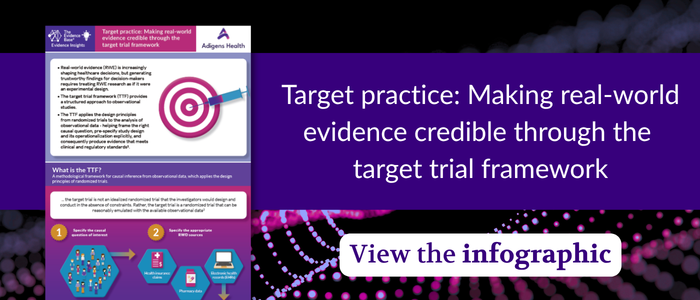 |
Infographic – Target practice: Making real-world evidence credible through the target trial framework Understanding the target trial framework provides a useful foundation for planning comparative evidence for JCA. This infographic explores how the framework helps researchers define causal questions, specify study designs and identify potential biases when using observational data, offering background to the evidence-planning challenges discussed in this Spotlight. |
Explore more resources about the target trial framework here.
In association with

Sponsorship for this Spotlight was provided Adigens Health.