

Sudlow Review outlines key recommendations and call to action to transform UK health data landscape
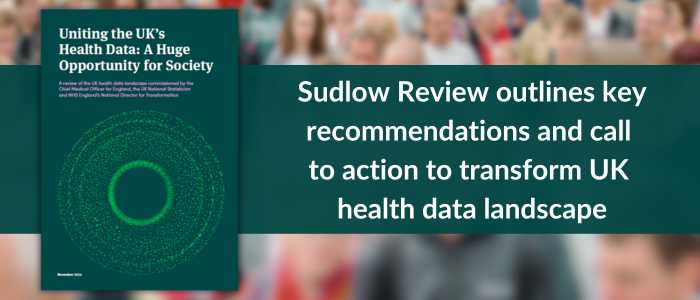
The long-awaited independent review by Professor Cathie Sudlow presents an ambitious strategy for addressing obstacles to the safe, secure, and effective utilization of health data in the UK.
The need for change
A new landmark report by leading UK health data expert Professor Cathie Sudlow, "Uniting the UK's Health Data: A Huge Opportunity for Society," has been published, offering a comprehensive overview of the UK's health data landscape. Commissioned by the Chief Medical Officer for England, the UK National Statistician, and NHS England’s National Director for Transformation, the 220-page report, published November 8, 2024, proposes solutions to enhance data use for the benefit of patients and the public, presenting an ambitious vision to overcome existing barriers and inefficiencies that hinder the safe and effective use of health data across the UK. The report follows the publication of Lord Darzi’s report in September 2024 that critically reviewed the NHS in England, calling for the need for a ‘major tilt towards technology’ to fully capture the richness of health data found within the NHS.
The Sudlow Review sheds light on both the opportunities and challenges faced by the UK's health data landscape. The report emphasizes that the UK is in a unique position to harness its comprehensive health data resources, largely due to the centralized nature of the NHS. With nearly 67 million residents receiving most of their care through the NHS, the UK has access to one of the largest and most complete health data collections in the world. The report identifies multiple sources of health data, including general practice, hospital visits, and health monitoring devices, as well UK-led health data systems such as UK Biobank and Our Future Health. Health data is also captured in other sectors such as social care, education as well as clinical research settings. These diverse datasets can unlock transformational insights and bring, “a huge opportunity, and indeed a responsibility, to use health data safely and securely to improve health, wellbeing and prosperity across society.”
The COVID-19 pandemic also demonstrated the immense value of health data in real-time decision-making. During the pandemic, the UK made rapid progress in utilizing linked health datasets to understand the effects of the virus and the impact of different interventions. The RECOVERY trial, for example, quickly identified treatments like dexamethasone, which saved countless lives worldwide. This success was made possible by quickly and securely linking patient data across hospitals and other settings to guide decisions.
Yet, despite some progress, this data is vastly underutilized, fragmented and linkages of different data sources are the exception rather than the norm. Although progress in linking health data across different regions has been made, particularly with the establishment of secure data environments (SDEs) to safely store and analyze data, barriers remain. More granular, complex datasets, such as text in medical records or imaging data, are often stored regionally, making them challenging to integrate into a national framework. For instance, while screening data exists, it is seldom linked with data on health outcomes, making it difficult to assess the true impact of screening efforts on conditions like breast or colon cancer.
Key recommendations
To facilitate change, the Sudlow Review provides five recommendations to, “recognize our national health data for what they are: critical national infrastructure that can underpin the health of the nation.”
- Develop a critical national infrastructure
The Sudlow Review recommends that all relevant national organizations should, by early 2025, develop a joint strategy to simplify the health data ecosystem and invest in a national health data infrastructure recognized as critical to the nation's wellbeing. Additionally, a UK-wide strategy for trustworthy data access and governance should be established.
- Establish a national health data service
By early 2026, a single national health data access system for England with streamlined and standardized data governance and access should be established. This system, designated as a ‘highest data priority’, would support areas of work such as mapping and understanding population health needs, designing and evaluating screening and vaccination programs, monitoring the safety of medicines and medical devices, and enabling clinical research and trials.
- Continue engagement with patients, public, health professionals and policymakers
The report stresses the need for an ongoing, coordinated strategy for engaging the public, healthcare professionals, and policymakers, focusing on transparency and involvement. This will help build trust, particularly regarding how health data is being used, and should facilitate patient access to their own health records.
- Create a UK-wide approach to data access processes and proportionate data governance
The review emphasizes providing clear guidance on health data access, focusing on governance that supports data use benefits, streamlining cross-sector linkages, and reducing inconsistencies in data access across the UK.
- Implement standards for SDEs
By late 2025, to ensure the safe use of health data for public benefit, a UK-wide system for accreditation and standards for SDEs should be developed. This will promote positive user behavior, improve user experience, and avoid an excess of separate SDEs.
Support from UK health leaders
In response to the report, several UK health leaders voiced their support for the recommendations. During the press briefing, Professor Sir Chris Whitty, Chief Medical Officer for England, emphasized that any system must be designed for multiple uses to benefit patients, rather than serving narrow organizational goals. He described it as ‘unethical’ for data owners to withhold data when it could clearly benefit patient care and improve health outcomes. He also highlighted that the report provides strategies to, “use data more effectively for current and future patients, whilst maintaining patient confidentiality.”
Nicola Hamilton, Head of Understanding Patient Data, reinforced the importance of public trust, stating that while reducing complexity is crucial, “public trust hinges on transparency, security, and clear accountability.” She warned that a more permissive data system must protect rights, as public trust, “that takes a long time to build can be lost in an instance.”
NHS England’s Director of Transformation, Dr Vin Diwakar, acknowledged the ‘unique opportunity’ presented in the UK health data landscape and welcomed the call to action for all stakeholders – NHS England, industry, patients and government – to, “leverage the benefits of living in this fantastic, diverse society that we live in in the UK.” Diwakar noted that, if implemented effectively, the recommendations made in the Sudlow Review could transform the NHS into a system, “that is personalized, that is integrated, that is digitally enabled and that is data driven,” enhancing both individual lives and communities through data-driven advancements and technological research.
Professor Sir Martin Landray (Professor of Medicine and Epidemiology, University of Oxford) stressed the, “sense of urgency and the need for action,” arguing that, “strategy without delivery would be a fundamental disservice to patients.” Prof Siddharthan Chandran (Director of the UK Dementia Research Institute) echoed these sentiments, highlighting the UK's potential for data-driven health breakthroughs, particularly in dementia research, and urged that, “we should seize the opportunity with both hands.”
Professor Andrew Morris, Director of Health Data Research UK, also called on immediate action, without which, "the UK risks falling behind in the global race to use health data for public good."
"Data is the engine underpinning progress in understanding disease, determining the best health and care, and it will power the responsible use of AI in health. Great progress was made during the pandemic in linking up the UK’s health data to tackle the new coronavirus through collaboration between the NHS, academia, policymakers and industry. But we are in danger of going backwards. The report’s recommendations show us the way to move forward again, involving the public in the best use of their data to improve all our health."
| Register for free today to become a member of The Evidence Base and receive the latest news straight to your inbox. |