

How AI-assisted screening can improve efficiency and accuracy in targeted literature reviews
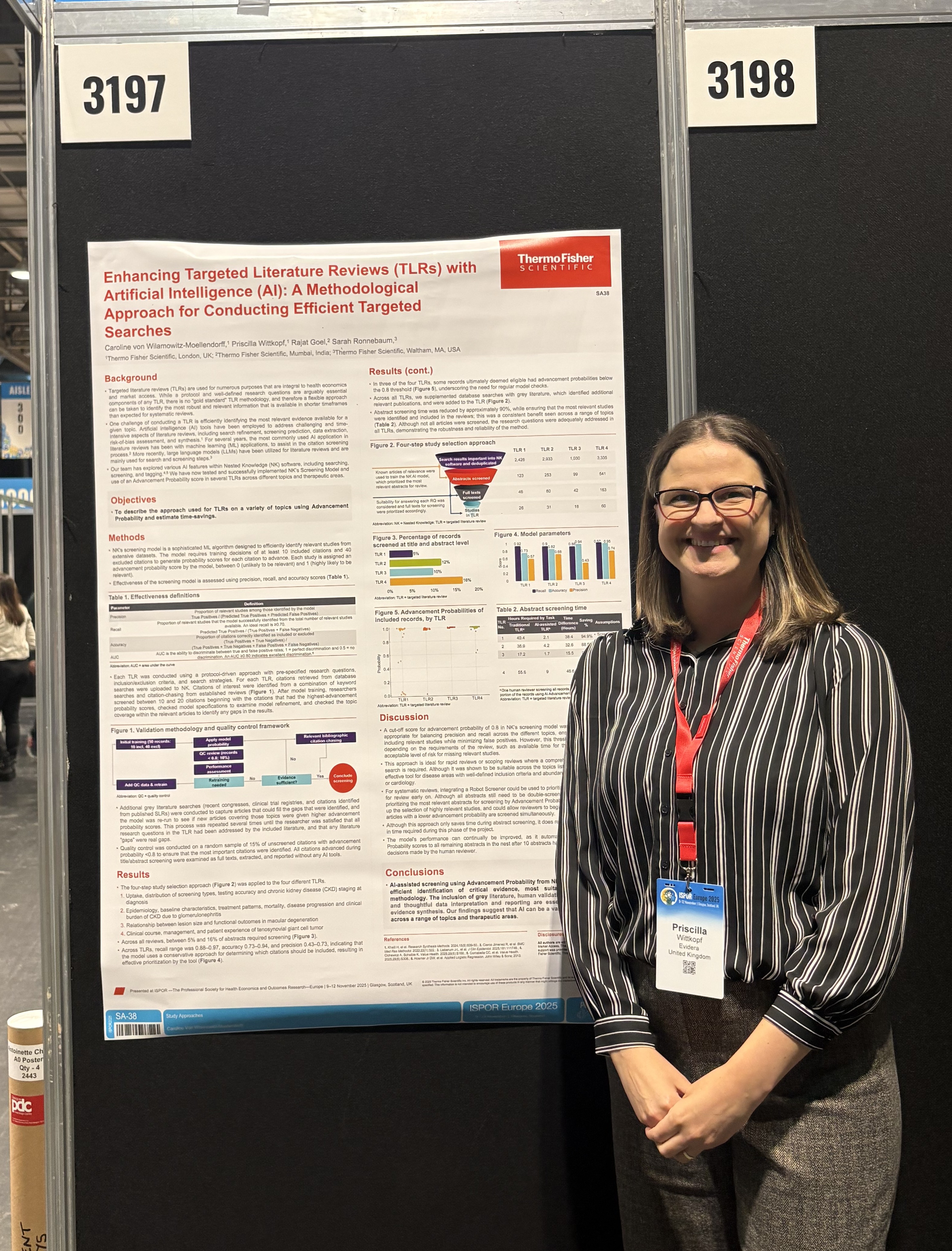
Targeted literature reviews (TLRs) are increasingly used across health economics and market access to identify focused, high-value evidence within tight timelines. However, the process remains resource-intensive and often lacks methodological consistency. In the study “Enhancing Targeted Literature Reviews (TLRs) with Artificial Intelligence (AI): A Methodological Approach for Conducting Efficient Targeted Searches” presented at ISPOR Europe 2025, researchers from Thermo Fisher Scientific evaluated how AI can support faster, more accurate study identification. In this interview, we speak with the study authors, Caroline von Wilamowitz-Moellendorff, Priscilla Wittkopf, Rajat Goel and Sarah Ronnebaum, about how AI-assisted screening can improve the efficiency and reliability of TLRs.
Many thanks for discussing your research with The Evidence Base. To begin, could you explain how TLRs differ from traditional systematic reviews, and why they are increasingly important in evidence generation for health economics and market access?
Systematic literature reviews (SLRs) follow predefined, well-established methodologies, as outlined in seminal resources such as the Cochrane Handbook of Systematic Reviews of Interventions. They are regarded as the gold standard of literature review – transparent, reproducible, and methodologically rigorous – designed to address specific research questions.
In contrast, there is currently no universally accepted framework for TLRs. Their methods are often tailored to address specific research needs, allowing greater flexibility in identifying and synthesizing relevant information. While TLRs can still be methodologically robust, they are not considered as rigorous as SLRs.
Key differences include the optional nature of a predefined protocol, more flexible approaches for study identification and selection, and streamlined data extraction processes that may focus on tagging or mapping. Screening may be conducted by a single reviewer with quality control rather than full dual review and adjudication.
TLRs are increasingly valuable for exploring disease burden in new indications, characterizing rapidly evolving therapeutic areas (such as COVID-19 and other infectious diseases), and identifying evidence gaps critical for HEOR and market access needs.
What prompted you to investigate how AI could be applied to TLRs, and which aspects of the process did you most want to improve or streamline?
Because TLRs are not bound by the strict methodological requirements of SLRs, they offer an opportunity to incorporate AI effectively. We explored AI applications across the literature review workflow – from scoping and refining research questions to citation screening, data extraction, and report generation. Current methodological evidence suggests that AI integration is particularly promising in the search and screening stages, where it can significantly enhance efficiency.
How was the Nested Knowledge screening model used within your workflow, and what steps were needed to train and validate the Advancement Probability mode?
We conducted extensive background research to identify relevant references and determine optimal model training parameters. Effective training required human screening of at least 50 citations, with a minimum of 10 citations deemed relevant for inclusion. In some cases, we trained the model using citations from existing systematic reviews on the same topic.
During training, we did not exclude studies based on factors that are difficult for the model to discern – such as sample size, data collection period, or geographic region – as doing so could compromise predictive reliability.
How did you determine the most appropriate threshold for Advancement Probability, and did this vary across therapeutic areas or review types?
We tested the model across multiple reviews covering diverse topics to determine optimal Advancement Probability thresholds. For each review, we conducted random checks on citations below the set threshold to assess whether model refinement or threshold adjustment was needed. This approach performed well in evidence-rich topics but was less effective when only a small number of citations were available.
Your results indicate substantial time savings while maintaining high accuracy and recall. How did you ensure the robustness of findings given the reduced screening burden?
A targeted review aims to collect the most relevant evidence, though not necessarily all available evidence. This approach combines the objectivity of systematic searches with the flexibility of targeted selection. Using comprehensive, predefined database searches, we identified numerous relevant citations that keyword browser searches might have missed.
To ensure completeness, we randomly reviewed excluded studies and conducted keyword searches within excluded citations to confirm that all key evidence had been captured.
What role did human oversight and quality control play in ensuring the AI-assisted process remained reliable, and what lessons did your team take away from combining automation with expert review?
Human oversight was essential to maintaining the reliability of our AI-assisted TLR process. While AI greatly accelerated screening, researchers continuously reviewed outputs to ensure accuracy, relevance, and context. We implemented multiple quality control checks and feedback loops, allowing human expertise to iteratively refine model performance.
“A key lesson was that AI functions best as a partner – not a replacement – for expert judgment. Combining automation with human review achieved both efficiency and confidence in the scientific integrity of our results.”
Based on your experience, which types of research questions or disease areas are best suited to benefit from AI-enhanced TLRs?
AI-enhanced TLRs are particularly effective in research areas characterized by rapidly expanding evidence, such as oncology, infectious diseases, rare diseases, and precision medicine. These fields generate large, complex datasets, making AI invaluable for efficiently screening, categorizing, and synthesizing information. AI also enables faster identification of emerging trends and evidence gaps. However, for highly specific or niche topics with limited literature, the added benefit is more modest.
As the use of AI in evidence synthesis continues to evolve, what developments do you anticipate in its integration with systematic reviews, gray literature searches, or real-time evidence generation?
We anticipate that AI will become increasingly integrated throughout all stages of evidence synthesis, with TLRs serving as a valuable testing ground for developing these capabilities. While human oversight will remain essential for SLRs, advances in natural language processing may soon streamline study screening and data extraction.
For gray literature, AI-driven algorithms could enhance retrieval from nontraditional sources such as conference abstracts, regulatory filings, and preprints.
“These innovations will transform evidence synthesis into a more dynamic, transparent, and adaptive process – evolving from static, time-bound reviews to “living” evidence ecosystems that support faster, data-driven decision-making.”
Interviewees
Caroline von Wilamowitz-Moellendorff, PhD
Research Scientist, Evidence Synthesis, PPD™ Evidera™ Health Economics & Market Access, Thermo Fisher Scientific

Caroline von Wilamowitz-Moellendorff is a market access consultant, with experience in a variety of different disease areas. She is a principal investigator, responsible for leading targeted literature reviews, SLRs, NMA feasibility studies, and evidence reviews. She has a special interest in evidence synthesis for JCA, targeted review methodology, and implementation of AI in literature reviews. She works with other researchers to develop their skills in medical writing, evidence synthesis, communication, and presentation skills. Caroline has a Doctor of Philosophy (PhD) focused on Science, Engineering and Technology.
Priscilla Wittkopf, PhD
Research Associate, Evidence Synthesis, PPD™ Evidera™ Health Economics & Market Access, Thermo Fisher Scientific

Priscilla Wittkopf is a market access consultant and scientific project manager who oversees the day-to-day delivery of evidence synthesis projects, including targeted and systematic literature reviews as well as direct and indirect treatment comparison analyses. She holds a PhD with a research focus on pain and analgesia.
Rajat Goel, MPharm
Research Associate, Evidence Synthesis, PPD™ Evidera™ Health Economics & Market Access, Thermo Fisher Scientific

Rajat Goel is a market access consultant specializing in evidence synthesis. He oversees the execution of targeted and SLRs, indirect treatment comparison feasibility assessments, and comprehensive evidence reviews to support market access strategies. Rajat holds a master’s degree in Pharmaceutical Technology from the National Institute of Pharmaceutical Education and Research (NIPER), SAS Nagar.
Sarah Ronnebaum, PhD
(Former) Research Scientist, Evidence Synthesis, PPD™ Evidera™ Health Economics & Market Access, Thermo Fisher Scientific

Sarah Ronnebaum is a market access consultant who leads systematic and targeted literature reviews, feasibility assessments for indirect comparisons, and evidence strength assessments. She especially enjoys conducting rapid reviews to support development of scientific platforms, inform discussions for early scientific advice, and enable economic model and dossier development. Sarah holds a PhD in Pharmacology.
Acknowledgments
We would like to thank Caroline Cole of Thermo Fisher Scientific, who provided editorial and graphic design support.
Disclaimers
All authors are employees of PPD Evidera Health Economics & Market Access, Thermo Fisher Scientific. This poster was funded by Thermo Fisher Scientific. The opinions expressed in this feature are those of the author and do not necessarily reflect the views of The Evidence Base® or Becaris Publishing Ltd.

Sponsorship for this Peek Behind the Poster was provided by Thermo Fisher Scientific.