

From potential to practice: perspectives on the evolving use of generative AI in evidence generation and health technology assessment
The integration of generative AI into evidence generation and health technology assessment (HTA) is rapidly advancing as decision-makers, industry, and analytics firms explore its potential to automate laborious processes, enhance productivity, and uncover new insights. What was once a field dominated by theoretical speculation has now evolved into a dynamic area of exploration, with tangible applications demonstrating the value of generative AI in practice.
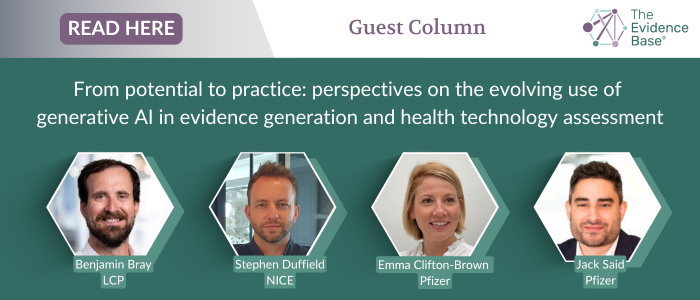
During a packed theater presentation at ISPOR Europe 2024 (Barcelona, Spain; November 17–20, 2025), experts delved into the evolving role of AI in evidence generation and HTA. Moderated by Benjamin Bray (LCP Health Analytics, UK), the session, titled, “Using Generative AI Methods for Evidence Generation and Health Technology Assessment: Perspectives from NICE and Industry,” featured perspectives from Stephen Duffield (National Institute for Health and Care Excellence [NICE], UK), Emma Clifton-Brown (Pfizer, UK) and Jack Said (Pfizer, UK), who shared insights from NICE and industry standpoints.
Contents:
- Generative AI for real-world evidence generation
- Perspectives of a HTA body: the NICE example
- Perspectives of industry: the Pfizer UK example
- Future uses of AI: Outlook for 2025 and beyond

Sponsorship for this Guest Column was provided by LCP Health Analytics.