

ISPOR 2026 – Inside the first plenary: Can US drug pricing reforms balance affordability with incentives for innovation?

Under the theme “HEOR at the Forefront of Policy, Access, and Value,” ISPOR 2026, the annual meeting of ISPOR—the Professional Society for Health Economics and Outcomes Research, reflects a period in which policy decisions are increasingly shaping how value is assessed and access is determined.
The conference opened with a focus on US drug pricing policy, an area that continues to shape healthcare discussions both domestically and internationally. As reforms such as Most-Favored-Nation (MFN) pricing and Medicare negotiation under the Inflation Reduction Act (IRA) moved from policy into practice, attention turned to their implications for access, affordability, and innovation.
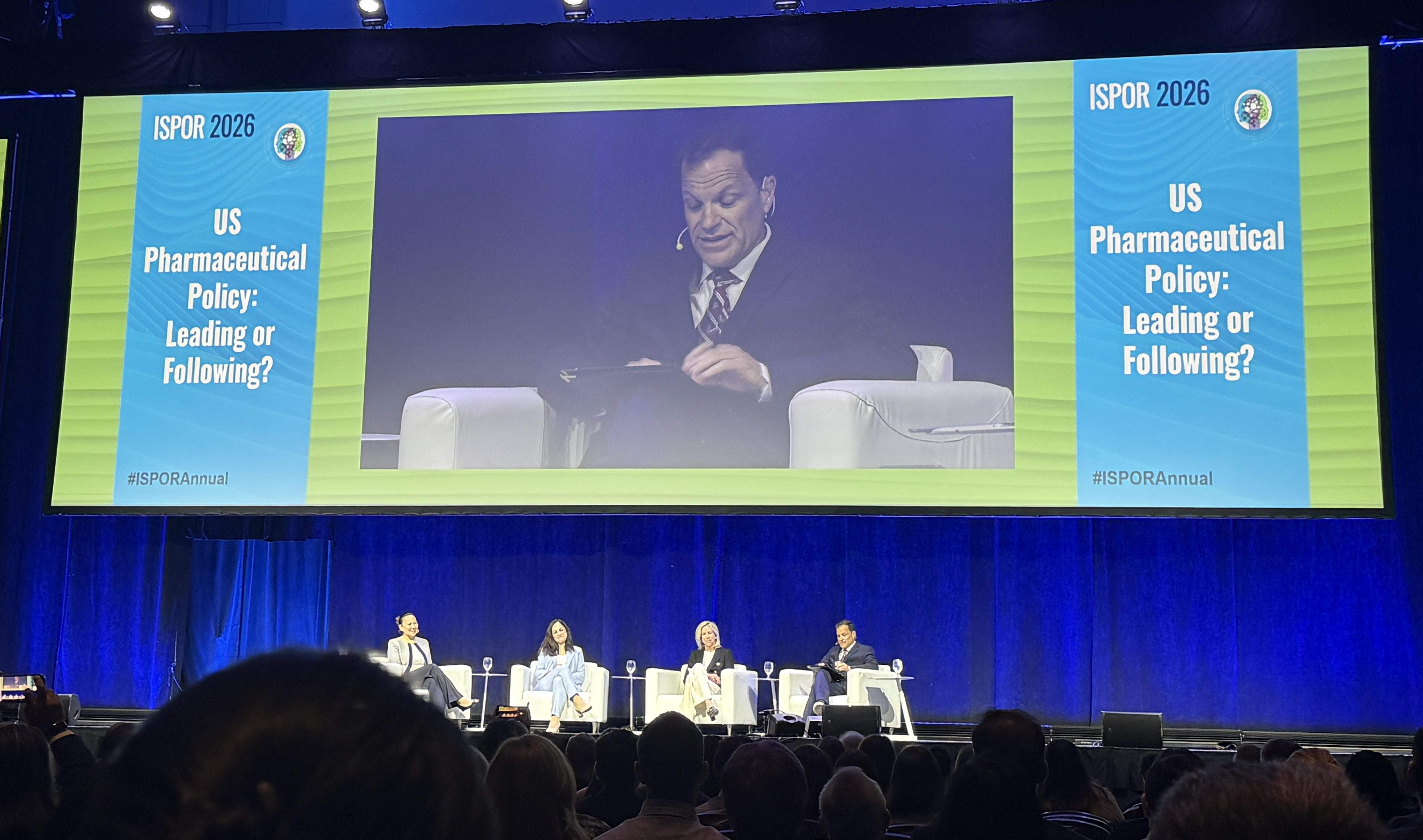
Aptly titled “US pharmaceutical policy: leading or following?”, the opening plenary explored how these reforms were being implemented and interpreted, bringing together policy and industry perspectives on how pricing frameworks, evidence requirements, and market strategies were evolving in an increasingly complex global environment. Moderated by Dana Goldman (USC Schaeffer Institute for Public Policy & Government Service), the panel featured Courtney Piron (Novartis), Liz Fowler (Johns Hopkins Bloomberg School of Public Health) and Inmaculada Hernandez (Centers for Medicare & Medicaid Services [CMS]), who discussed topics including MFN pricing policy, pharmacy benefit managers (PBMs), cell and gene therapies (CGTs), and patient cost-sharing trends.
Discussion 1 – Most Favored Nation
Opening the discussion on MFN pricing policy, Hernandez described the administration’s intention to rebalance global contributions to pharmaceutical innovation. She argued that the US currently subsidizes much of the global pharmaceutical enterprise, noting that Americans often pay substantially more for medicines than patients in other countries. Hernandez outlined the four pillars of the administration’s MFN framework:
- Commitments from manufacturers not to launch future drugs in the US at prices higher than comparator countries
- Provision of MFN pricing to Medicaid through the GENEROUS model
- Lower pricing through the direct-to-consumer TrumpRx platform
- Efforts to repatriate revenue gains generated through US trade policy
She emphasized that the framework was designed to encourage “price convergence” globally, rather than simply import international pricing structures into the US market.
Piron highlighted the structural differences between the US healthcare system and those in Europe and other single-payer markets, arguing that the US has historically prioritized rapid patient access and rewarded innovation more strongly than many other countries. However, she warned that persistent international pricing pressures could increasingly force manufacturers into difficult launch decisions. Piron noted that some companies have already delayed or withheld launches of innovative therapies in markets where pricing is considered unsustainably low, particularly where international reference pricing mechanisms could affect prices elsewhere.
Fowler praised the current administration’s willingness to pursue ambitious policy reforms, but cautioned that importing international pricing structures without broader healthcare system reforms could create unintended consequences. She contrasted MFN approaches with the IRA, which she described as a more targeted attempt to work within the existing US system. Fowler also emphasized the importance of understanding the legal and operational constraints surrounding the Centers for Medicare & Medicaid Innovation (CMMI) models underpinning several MFN initiatives, noting that such models must function as genuine policy tests with measurable outcomes and evaluations.
Discussion 2 – Intermediaries
The discussion then turned to the influence of intermediaries such as PBMs. Piron argued that PBMs and other actors within the healthcare system have become increasingly dependent on profits generated from innovative medicines, contributing to higher list prices and growing access barriers for patients. She pointed to increasing use of exclusion lists and delays in coverage for newly approved medicines, noting that many patients continue to face restricted access even months after FDA approval.
Both Hernandez and Fowler highlighted direct-to-consumer initiatives as potential mechanisms for improving pricing transparency and bypassing some intermediary structures. Hernandez explained that the TrumpRx platform was intended not only to provide access to medicines that may not be covered by insurance, but also to increase visibility into net pricing structures. Fowler expressed support for greater transparency and reducing reliance on intermediaries, while cautioning that legislative efforts targeting specific actors within the system may simply encourage stakeholders to adapt their business models in new ways.
Discussion 3 – Cell and Gene Therapies
The panel also explored the challenges associated with CGTs, which several speakers described as exposing weaknesses within the current US healthcare financing model. Fowler noted that the long-term benefits and potentially curative nature of CGTs often conflict with short-term insurance enrollment cycles, reducing incentives for payers to invest in these therapies. She highlighted the CMMI Cell and Gene Therapy Access Model as an example of innovative policy design, using outcomes-based payment arrangements and longer-term patient monitoring to support broader access.
Piron added that additional policy innovation would likely be needed to incentivize employers and insurers to make long-term investments in transformative therapies, while Hernandez highlighted the importance of considering practical barriers to access beyond insurance coverage alone. She pointed to fertility preservation support within the CGT model as an example of how policy design could address broader patient needs surrounding treatment access.
Discussion 4 – Patient cost-sharing trends
A final major focus of the discussion was patient cost-sharing and affordability. Piron emphasized that rising out-of-pocket costs remain a significant barrier to medication adherence, despite evidence showing that reducing cost-sharing improves treatment uptake and outcomes. Fowler highlighted the positive impact of the IRA’s Medicare Part D out-of-pocket cap, while warning that policymakers must continue to consider the broader and potentially unintended effects of cost containment measures on patient access and long-term health outcomes. Hernandez identified the eventual expiration of premium stabilization mechanisms associated with the IRA redesign as one of the major pharmaceutical policy challenges likely to emerge over the next several years.
Audience Q&A and final takeaways
Audience questions prompted further debate around value assessment, national HTA structures, biosimilars, and the future role of evidence generation in policymaking. While the panelists differed on whether the US should adopt a formal national HTA body, all agreed on the importance of rigorous evidence evaluation and transparent policymaking. Hernandez concluded by emphasizing the need for independent evaluation of the many overlapping policies currently being implemented. Piron called for further PBM reforms and reduced patient out-of-pocket costs, while Fowler stressed the importance of keeping patient access and affordability at the center of policy discussions. Closing the session, Goldman reflected on the remarkable pace of biomedical innovation, while warning that ensuring equitable access to these advances would remain one of the defining healthcare policy challenges of the coming years.
Overall, the discussions of Plenary 1 suggested that the US is increasingly attempting to lead global debates around pricing, access and innovation – even as policymakers continue to grapple with the complexity, trade-offs and unintended consequences of the evolving healthcare landscape.
| Register for free today to become a member of The Evidence Base and receive the latest news straight to your inbox. |