

Payer perspectives on key challenges in healthcare decision-making: actionable insights for life sciences companies

Including coverage of the winner of the 'Best General Poster Research Presentation' award for ISPOR Europe 2024!
Payer perspectives are essential in ensuring that new treatments demonstrate not only clinical efficacy but also cost-effectiveness, while aligning with the priorities and sustainability of healthcare systems. For life sciences companies, understanding payer approaches to the complex challenges of reimbursement decision-making—including budget impact assessments, cost-effectiveness analyses, and evaluations of clinical value—is critical for shaping patient access to innovative therapies and informing healthcare policy. Incorporating considerations of health equity further ensures that these decisions promote fair access, supporting underserved populations and advancing overall health outcomes in a more balanced and inclusive manner. By understanding payer views on real-world evidence (RWE), companies can also ensure that the evidence used in health technology assessment (HTA) is relevant and comprehensive, therefore supporting reimbursement decisions that reflect the true value of treatments in everyday clinical practice.
In this interview, we speak with Tijana Ignjatovic, Darrin Benjumea and Manica Agrawal of Genesis Research Group about new research that focuses on gathering payer perspectives on these key issues in healthcare. The survey results were recently presented at ISPOR Europe 2024 (November 17–20, 2024, Barcelona, Spain):
- Payer Perceptions of Health Inequalities in Reimbursement Decision-Making: Results of a Global Survey
- Health Equity Priorities for Pharmaceutical Manufacturers: Payer Perceptions From a Global Survey
- Payer Perspective on the Impact of Real-World Evidence in Health Technology Assessments of Precision Oncology Treatments Across Europe: Results From an Online Survey – Named Best General Poster Research Presentation for ISPOR Europe 2024
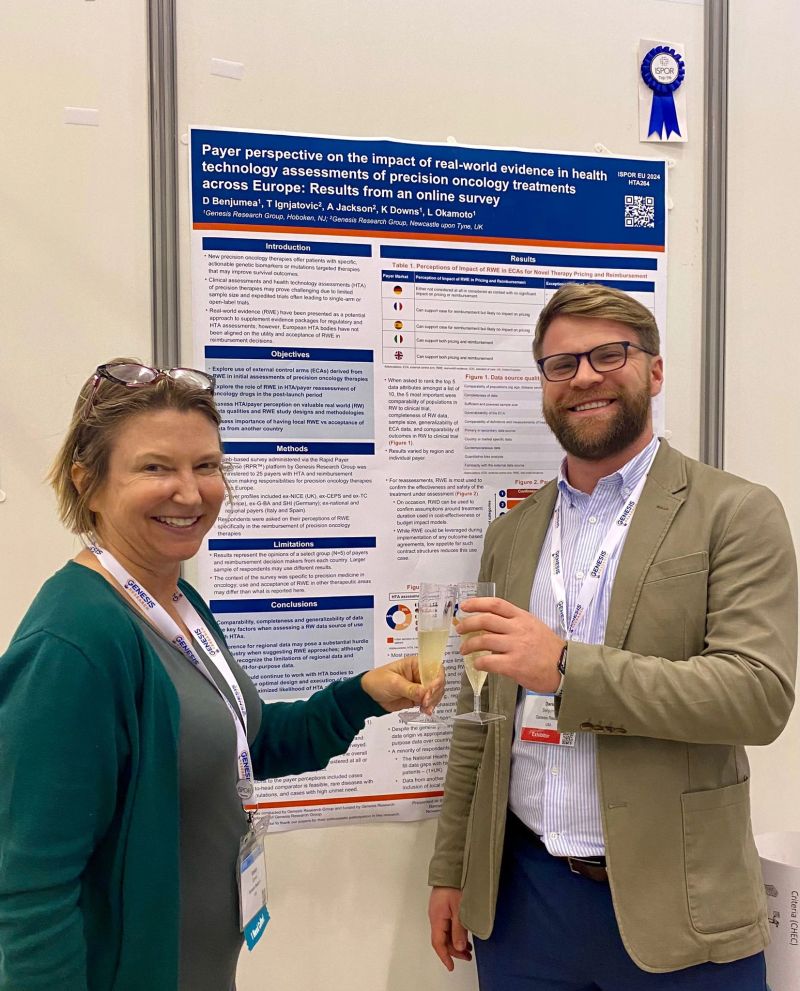
Kristen Downs and Darrin Benjumea, two of the co-authors of the winning poster.
USING STAKEHOLDER INSIGHTS TO INFORM ECONOMIC MODELS: READ OUR DEEP DIVE HERE
In your opinion, why is it important to gather payer perspectives in key areas like healthy equity and real-world evidence?
Tijana Ignjatovic: Engaging with payers in key areas such as health equity and RWE is crucial because they are key decision-makers committed to improving health outcomes for all populations, ensuring that no group is left behind. By soliciting insights from payers, our clients, the manufacturers, can identify current unmet needs, treatment gaps and uncover disparities experienced by specific subgroups, including those defined by ethnicity, race, socioeconomic status, gender, and genetics, and actively address these health inequities by strategizing their approach. Additionally, they can also plan to collect RWE to demonstrate the effectiveness and value of treatments in a broader context of health inequality, which can support more equitable access to care at a population level. All these insights are crucial to our clients so they can better understand and more effectively plan their evidence development and submission plans.
Based on the payer insights gathered, what are the key barriers to addressing health inequalities in reimbursement decision-making and how can these be overcome?
Tijana Ignjatovic: One of the primary barriers to addressing health inequalities in reimbursement decision-making is the lack of data that enables payers and HTA to understand the existing inequalities and whether new therapies could improve them or not. Further exacerbating this issue, most countries currently lack formal frameworks for the integration of health equity considerations into HTA evaluations. In addition, payers and HTAs have limited experience in advanced methodologies such as distributive cost-effectiveness analysis (DCEA), which can be used to incorporate health inequity in reimbursement decision-making. Lastly, payers have competing priorities and are facing substantial pressure to balance budgetary pressures, which can result in cultural inertia to change.
To overcome these barriers, increased collaboration among multiple stakeholders (payers, manufacturers, policymakers, HCPs) is essential. This includes defining best practices and frameworks for incorporating health equity into reimbursement processes and encouraging the use of RWE to bridge data gaps. By focusing on the impact of social determinants of health, stakeholders can highlight disparities and drive more informed, equitable decision-making in reimbursement strategies.
From your research, how do payers perceive pharmaceutical manufacturers' efforts toward health equity? Are there any areas where manufacturers could improve?
Manica Agrawal: Payers recognize the current efforts made by pharmaceutical manufacturers to promote health equity; however, they believe there is significant room for improvement. Specifically, payers highlight the need for manufacturers to diversify clinical trial populations to ensure representation of patients from various ethnicities, races, ages, genders, and socio-economic statuses. Additionally, payers encourage manufacturers to invest in data generation and RWE to better understand differences in outcomes and risks associated with different populations. They also advocate for prioritizing the research and development of treatments for diseases that disproportionately affect poorer populations or nations.
How can the insights gathered from these studies be used to foster more effective partnerships between payers, policymakers, and the pharmaceutical industry?
Manica Agrawal: “What is quite clear is that the payers agree that further strides need to be made in both addressing health inequities and helping make more robust decisions for new therapies.”
The objectives of payers and the pharmaceutical industry align in this regard, and payers acknowledge that the industry has a significant role in further developments. By fostering a shared understanding of health equity, stakeholders can drive collaborative initiatives and develop more supportive regulatory frameworks aimed at improving access to care for underserved populations. Additionally, these insights can encourage cooperation in generating and sharing evidence to inform data-driven decisions that address the distinct needs of various patient groups and help to align priorities for the development of treatments targeting diseases that disproportionately affect lower-income populations.
“By openly discussing the challenges and opportunities faced in the healthcare landscape, and engaging in regular dialogues, stakeholders can build trust and work collaboratively towards common goal of enhancing health outcomes across all populations.”
Now reflecting on your recent work on impact of RWE in the HTA for precision oncology, what are some of the opportunities and challenges payers mentioned regarding the use of RWE in HTA submissions?
Darrin Benjumea: While payer perspectives on the quality and appropriate uses of RWE in HTA submissions vary from market-to-market, most see the use of RWE as an opportunity to inform decision-making on reimbursement or pricing of precision oncology medicines by expanding the evidence base; particularly as these therapies are often approved based on single-arm trials or small trials. By leveraging RWE, stakeholders can address data gaps and increase confidence in clinical trial results, leading to more informed decision-making and potentially improved access to treatments.
Despite these opportunities, there are significant challenges associated with utilizing RWE in HTA submissions. Manufacturers face difficulties related to the complexity of data collection, which can include navigating data gaps, particularly for precision-oncology treatments that often target rare diseases. The scarcity of reliable, fit-for-purpose data, the ability to match populations (in the context of utilizing RWE to create an external control arm and supplement single-arm trial data), and often small sample sizes hinder the ability to leverage such evidence effectively. In addition, RWE is still seen as a significantly lower level of evidence versus randomized controlled trials or even indirect treatment comparisons, which limits the ability to maximize the value of RWE and to meaningfully inform decision-making for new therapies.
Furthermore, payers often prefer having local or regional data over data derived from another healthcare system, so making a compelling case for utilizing the most fit-for-purpose data available from a comparable healthcare system is important. Overcoming these challenges will be essential for maximizing the benefits of RWE in reimbursement.
Looking ahead, how do you see the evolving RWE payer landscape impacting patient access to precision oncology treatments in the future?
Darrin Benjumea: As the data sources expand and improve, and with the application of appropriate methods for evidence generation and growing stakeholder experience with RWE, we believe that RWE will be viewed as increasingly important and impactful to decision-making. This involves both growing technical abilities and advanced types of analytic applications that pharmaceutical manufacturers can deliver, while simultaneously working to increase the level of familiarity and confidence in the quality and accuracy of RWE.
“By more clearly outlining if, when, how, and the most appropriate circumstances under which RWE can supplement clinical trials, RWE can be a catalyst for more effective treatment development and expedited access to live saving therapies for the patients that need them.”
The emergence of more developed frameworks for utilizing RWE that we currently see among payers and HTA markets signals a shift that is likely to improve acceptance of RWE in various markets, specifically in precision oncology, where RWE greatly supplements clinical trials, expediting and improving access to patients who demonstrate greater benefits from these innovative treatments.
Interviewees
Tijana Ignjatovic, MA, PhD
Executive Director, Access & Pricing, Genesis Research Group

Tijana Ignjatovic has over 16 years of consultancy experience within market access, having conducted well over 100 pieces of research across a range of therapy areas. This experience has given Tijana in-depth knowledge on how to optimize research methodologies to meet the strategic intent of payer research and provide actionable recommendations.
Darrin Benjumea, MPH
Director, Client Strategy, Genesis Research Group

Darrin has been with Genesis Research Group over the last 6 years, focusing on RWE and HEOR strategy. He has contributed to numerous RWE and HEOR studies and initiatives across a wide variety of therapeutic areas, with particular expertise in rare diseases and oncology. Darrin holds a Masters in Public Health in Epidemiology from Columbia University.
Manica Agrawal, MSc
Senior Consultant, Genesis Research Group

Leveraging her 8+ years of consultancy and healthcare experience, and up-to-date knowledge of latest trends in the market access space, Manica conducts in-depth analysis and provides client insights that are comprehensive, relevant, and actionable. Manica holds an Masters in International Healthcare Management, Economics, and Policy, from SDA Bocconi.
Sponsorship for this Peek Behind the Posters was provided by Genesis Research Group
If you would like to receive copies of the posters or have any questions, please email [email protected], or visit genesisrg.com for further information.