

Innovative approaches to real-world data collection in UK Early Access Programs

Increasingly, Early Access Programs (EAPs) offer a treatment option to patients living with a serious or life-threatening disease or condition, who have exhausted or are ineligible for available therapeutic options and clinical trials. While the purpose remains treatment access and not research, with appropriate design and regulatory consideration, compliant data collection can yield valuable pre-approval insights. Regulators and payers are progressively open to EAP data collection and utilization. Most examples relate to rare disease, hematology or oncology, where EAPs provide global access for patients with substantial unmet need.
In this interview, we hear from Rakesh Davda (EVP, Real World Evidence Solutions, Bionical Emas) and Daniel Stevens (Senior RWD Scientific Operations Manager, Bionical Emas) about the research exploring RWD collection through EAPs outside the UK EAMS framework. The poster entitled “Navigating Real-World Data Collection from Early Access Programs in the UK: An Underutilized Opportunity” was presented at ISPOR Europe 2024 (November 17–20, 2024, Barcelona, Spain).
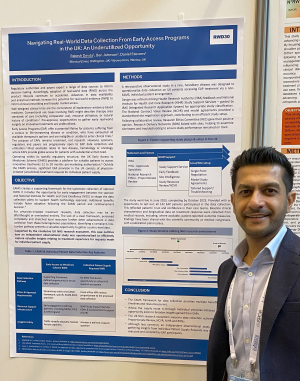
Can you explain EAPs in the UK and their potential for collecting RWD?
For patients in the UK with life-threatening or seriously debilitating conditions, within a specific regulatory structure, the Early Access to Medicines Scheme (EAMS) provides access to medicines (12–18 months pre-marketing authorization) when there is a clear unmet medical need.
EAMS includes a supporting framework for the systematic collection of real-world data (RWD). The planning phase includes opportunity for early engagement between the sponsor and National Institute for Health and Care Excellence (NICE) to shape RWD collection plans to support their health technology assessment (HTA) process.
The RWD collection methodology is chosen consensually, shaped by suitability and patient/physician burden. Ranging from use of an existing registry to a bespoke database and collection through an agreed electronic case report form, agreed upon by all parties in advance. An additional benefit is faster NHS adoption following reimbursement recommendation.
Where successfully operationalized, EAMS works well for patients with unmet need. However, with approximately five applications granted Scientific Opinion per year (2014–2023), most EAP provision in the UK is outside of EAMS (note, over 600 positive EMA opinions were granted over the same timeframe).
"Although the purpose of both these mechanisms remains granting access to treatments and not research, these early experiences in-clinic are nevertheless important for generating real-world insights. The UK NHS research-conducive ecosystem provides a great opportunity to create evidence and learn from these populations early in a product’s lifecycle."
Why are EAPs in the UK operated outside EAMS and what are the challenges for collecting RWD in these cases?
EAMS offers an established framework for treatment access and can incorporate broad data collection. However, a significant proportion of EAP provision is outside of this process, consisting of physician-initiated (unsolicited) treatment requests for individual patient supply. Sponsors’ choices may be influenced by urgency, resource availability, demand uncertainty, prior experience and timelines relating to the period of access.
For physician-initiated treatment requests, with the urgency of treatment provision, data collection can be overlooked. The lack of a clear framework, perceived complexity, physician/patient burden and population heterogeneity can further deter data collection. Additionally, research infrastructure is geared towards prospective clinical trials.
When considering individual unsolicited requests, where the sites, patient numbers and timing are not known or controlled, there needs to be a compliant low-burden pathway to gather and analyse these data. Further uncertainty with key elements relating to research, including a clear project plan and mechanism of electronic data capture. As an optional component, EAP RWD collection can seem a complicated “nice to do” and become a missed opportunity.
Can you tell us more about this research presented at ISPOR Europe 2024 and the key findings from the study?
We presented our experience of operationalizing a UK observational study in a rare, hereditary disease. The project followed a well-subscribed EAP providing access to treatment via a non-EAMS, individual patient arrangement.
The study went live in June 2023. Against a background of rising demand on scarce resources, and often at a difficult time for patients and families, patient and physician participation in research can be challenging around EAPs. Remarkably, provided with an opportunity to opt out, all 142 EAP patients participated in the data collection, reflecting their willingness and trust in their care teams.
Baseline clinical characteristics and longitudinal data on treatment response were collected from medical records, including, where available, patient-reported outcome measures. Findings have been shared with the scientific community at medical congresses, with a publication plan in place.
What could a framework for collecting RWD in access programs that fall outside the standard EAMS look like? How feasible could this be to develop?
Our experience highlights how the UK NHS research structure can effectively support data collection initiatives under EAPs.
We utilized Health Research Authority (HRA) feedback and National Institute for Health and Care Research (NIHR) Study Support Services—guided by IRAS (Integrated Research Application System) for appropriate study classification. The National Contract Value Review (NCVR) and model agreements provided a standardized site negotiation approach, contributing to an efficient study setup.
Following collaborative review, Research Ethics Committee (REC) gave their positive opinion. Research Delivery Networks (RDN) liaised with sites, helping to assemble site teams and troubleshooting to ensure study performance remained on track. Although not utilized for our study, other components such as Proportionate Review provide additional opportunities for efficient setup.
Developing a formal framework involving the HRA/REC, patients and their healthcare teams would further support sponsors in designing and operationalizing EAP data collection.
How can the learnings from this study be applied to improve the efficiency of future RWD collection efforts in EAPs?
Every EAP and treatment situation is different, but our general approach could certainly be applied to other UK EAPs to help learn from these important early clinical experiences. In particular:
- Setting up an invested steering committee of experts and investigators early in the process.
- Advocating inclusion of the patient perspective at all stages, developing documents, tailoring onboarding, and collecting patient-reported outcomes.
- Being ambitious, with a high aspiration for inclusion; this experience has shown patients and physicians are happy to be involved.
- Collaborating early with sites and UK reviewer/partner agencies during permissions/protocol development (e.g., HRA, Ethics Service and NIHR.)
Interviewees
Rakesh Davda
EVP Real World Evidence Solutions, Bionical Emas

Industry experience across commercial, medical affairs and market access roles. Working knowledge of international health technology assessment in multiple jurisdictions. Global exposure to EAPs from an industry and service provider perspective, leading teams liaising with sponsors, regulators, physicians and patient organizations in the design, approval and collection of RWD.
Danny Stevens
Senior RWD Scientific Operations Manager, Bionical Emas

Over 25 years in pharma, in commercial and field medical affairs leadership and consultancy. An interest in data generation and non-interventional research with experience across a broad range of therapeutic areas, most recently alongside EAPs.
Disclaimer
The opinions expressed in this feature are those of the interviewee/author and do not necessarily reflect the views of The Evidence Base® or Becaris Publishing Ltd.
 Sponsorship for this Peek Behind the Poster was provided by Bionical Emas.