

Bridging privacy and research in real-world evidence – a global data and secured data environment technology framework

With the increasing demand for real-world evidence (RWE) in healthcare decision-making, accessing sensitive patient data while ensuring compliance with stringent privacy regulations is essential. Secure data environments (SDEs) address these challenges by providing a secure, compliant environment for accessing and analyzing deidentified real-world data (RWD) from hospitals, biobanks, and research centers, allowing researchers to generate valuable insights while maintaining data privacy.
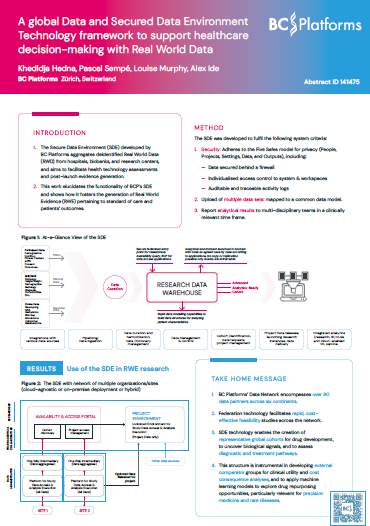
In this interview, we speak with Alex Ide (EVP, Global Lead Life Science, BC Platforms) to learn about the SDE developed by BC Platforms. The poster, entitled “A Global Data and Secured Data Environment Technology Framework to Support Healthcare Decision-Making with Real-World Data” was recently presented at ISPOR Europe 2024, discussing the functionalities of this SDE.
Please could you introduce yourself and your background?
I am Alex Ide, EVP, Global Lead Life Science at BC Platforms. I started my career in management consulting for pharmaceutical clients, but for the last 10 years my focus has increasingly shifted towards providing access to RWD and generating RWE.
What are SDEs and how can they support the generation of RWE?
SDEs, also referred to as trusted research environments (TREs), are secure computing platforms that allow authorized researchers to access and analyze sensitive health data without needing to copy or transfer it, and ensuring adherence to stringent privacy regulations.
This data can be drawn from electronic health records (EHRs), biobanks, pathology labs, imaging technology, and medical devices, and enables researchers to study disease diagnosis, disease epidemiology, treatment patterns, and patient outcomes in real-world settings. This work is crucial for bridging the gap between controlled clinical trial data, generated in tightly defined patient populations, and everyday healthcare scenarios, providing a holistic view of patient care.
Can you tell us more about the features of BC Platforms’ SDE?
The BC Platforms SDE is designed to support research by data custodians as well as external third parties. It provides data custodians with clinical data warehousing capabilities that allow institutions to manage and analyze their raw data securely.
For external researchers, the SDE enables high-level data discoverability and offers secure workspace environments in which authorized users can perform detailed analyses on defined cohorts of interest. This integrated approach ensures that data access is both secure and compliant, facilitating robust research collaborations.
How does the SDE ensure compliance with stringent data privacy recommendations, such as the Five Safes model?
The BC Platforms SDE adheres to the Five Safes framework to ensure data privacy and security: Safe People, Safe Projects, Safe Settings, Safe Data and Safe Outputs. It restricts data access to accredited and trusted users, allows data access only for approved and legitimate research purposes, and provides secure environments to protect data during analysis. The framework ensures that data is anonymized, de-identified or pseudonymized, and all research outputs are reviewed to prevent inadvertent disclosures of sensitive information. This structured approach helps maintain compliance with stringent regulations, including the European Union's General Data Protection Regulation (GDPR).
Can you discuss the types of RWD available through the network and how they are used to generate insights about patient care and outcomes?
BC Platforms' Global Data Network integrates diverse RWD types, providing access to over 80 million patient lives across six continents. The available data includes data on: diagnoses, treatments, procedures, and tests from medical records; radiological images and diagnostics from imaging technologies, test results from pathology laboratories, and genomic data from biobanks.
The network has a particularly strong footprint in Europe and APAC, and across five specialized disease areas: oncology, neurology, cardiology, hematology and rare diseases.
Insights and evidence from RWD can be used by pharmaceutical companies to enhance research and development focus and activities, support regulatory and health technology assessment (HTA) submissions, facilitate engage with healthcare professionals, and more broadly to contribute to the delivery of more personalized and effective healthcare solutions on a global scale.
The European Health Data Space (EHDS) is an initiative aimed at creating a unified framework for the secure sharing and use of health data across the EU. How does BC Platforms' SDE balance data accessibility for research and innovation with data privacy, in line with EHDS's principles?
BC Platforms' SDE aligns well with the European Health Data Space (EHDS) initiative. By leveraging secure processing environments and pseudonymization techniques, the SDE supports both data accessibility for research and adherence to privacy regulations. It also aims to harmonize healthcare data for accessibility and standards including the Observational Medical Outcomes Partnership (OMOP) Common Data Model (CDM), FHIR (Fast Healthcare Interoperability Resources) or openEHR.
Accordingly, BC Platforms’ approach is in alignment with EHDS principles, enables data-driven innovation and cross-border research collaboration, while safeguarding sensitive patient information.
Looking ahead, how do you foresee the adoption of SDEs evolving as the EHDS becomes more established across Europe?
As the EHDS framework continues to develop, SDE adoption will grow significantly. By providing a unified data-sharing and governance framework, EHDS will facilitate cross-border data collaboration and harmonization of standards within the EU. This will accelerate research, drive innovation, and foster international partnerships, making Europe a global leader in data-driven healthcare research, and a competitive and attractive environment for healthcare innovation more broadly.
BC Platforms’ EHDS-ready solutions are designed to support this evolution by offering scalable and compliant platforms for healthcare and research institutions across the EU. As more organizations adopt these environments, the ability to generate impactful RWE will continue to expand, enhancing healthcare outcomes and decision-making capabilities that will ultimately benefit patients across Europe and globally.
Interviewee
Alex Ide
EVP, Global Lead Life Science, BC Platforms, UK

Alex Ide, Executive Vice President (EVP), is the global lead for Life Science offerings. In his previous role at BC Platforms, he led UK sales, driving the development and implementation of the company’s commercial strategy and growth in the UK.
Alex is a healthcare executive with 20 years of experience in tech start-ups, large multinationals, and private partnerships. He has operated in functional leadership and business development roles across the scientific and commercial spectrums with global, regional, and national level clients at pharmaceutical, biotech, and medical device companies. Prior to BC Platforms, Alex worked at Prospection, IQVIA, and ZS.
Alex holds an MChem Chemistry degree from The Queen’s College, University of Oxford.
The opinions expressed in this feature are those of the interviewee/author and do not necessarily reflect the views of The Evidence Base® or Becaris Publishing Ltd.

Sponsorship for this Peek Behind the Poster was provided by BC Platforms.