

Understanding provider perspectives and real-world implications of clinical trial data: the DREAMM-7 trial results in multiple myeloma
Understanding physician awareness of data on new treatments is essential for ensuring that innovations reach patients who need them most. This is particularly true in multiple myeloma, a disease with more than 187,000 new cases diagnosed globally each year, where patients often become refractory to available therapies and new options are urgently needed. Gaining insight into provider perspectives on clinical trial results is a crucial step in understanding how likely these findings are to influence real-world treatment decisions.
In this interview, we speak with Sarah Lucht (Senior Scientist – Real-World Evidence & Insights, Cardinal Health) about the poster, entitled “Provider perspectives on the DREAMM-7 Trial Results and Belantamab Mafodotin (belamaf) in Combination with Bortezomib and Dexamethasone (B-Vd) as a Potential Treatment for Patients with Relapsed or Refractory Multiple Myeloma (R/R MM)” presented at ISPOR 2025.
In your opinion, why is it important to understand provider perspectives when evaluating the potential uptake of new or reintroduced therapies in oncology, such as belantamab mafodotin (belamaf)?
I think what's interesting when evaluating uptake of new therapies, especially now with new drug developments targeting different mechanisms, is that these therapies may come with unusual toxicity profiles. These aren't the familiar side effects from traditional chemo that providers have been managing for decades. In belamaf’s case, for example, ocular toxicity is something many providers haven't dealt with regularly. Clinical trials highlight efficacy and known side effects of therapies, which manufacturers highlight in their management guidelines for providers. But the providers are the ones managing these drugs day-to-day. Their perspectives help us understand how these management strategies play out in the real world. Are the guidelines practical, or do they create challenges? Are patients discontinuing because of toxicity? These insights from providers are crucial. They highlight barriers and opportunities to refine management approaches, improve provider comfort, and ensure patients can obtain maximum benefit from effective treatments.
“If there are things limiting physicians from following management guidelines from happening, I think provider perspectives offer interesting and actionable insights. You can say, "Here are the points in treatment these providers identified as barriers," and those barriers are things we can address to improve both their experience and the patient experience on these treatments.”
Could you briefly summarize the key findings from the DREAMM-7 trial and why they were significant in the context of relapsed or refractory multiple myeloma (R/R MM)?
To start, I’ll give a little background on DREAMM-7. One interesting part of belamaf is its regulatory history. It was approved by the US FDA in 2020 as a single agent based on the Phase 2 DREAMM-2 trial, which showed promising results in people with R/R MM. However, the Phase 3 DREAMM-3 trial, which reported results in 2022, did not meet its primary endpoint. Progression-free survival was not significantly better with belamaf treatment, leading to its withdrawal from the market later that year.
That said, the clinical development program continued, and other ongoing trials progressed. One of these, DREAMM-7, evaluated belamaf in combination with bortezomib and dexamethasone (called B-Vd), and compared it to daratumumab, bortezomib, and dexamethasone (or D-Vd). In this Phase 3 trial, patients receiving B-Vd had significantly better progression-free survival, around 36 months versus 13 months with D-Vd.
While the trial demonstrated encouraging efficacy, it also confirmed a unique toxicity profile, mainly ocular side effects such as blurred vision and dry eye, which was consistent with the findings seen in the DREAMM-2 and DREAMM-3 studies. In R/R MM, which is not curable and whose treatment requires a wide range of treatment options, this new combination may represent a meaningful addition, particularly for patients who have already undergone one or more lines of therapy.
Overall, DREAMM-7 is notable not just because of the efficacy, but also because belamaf has an interesting backstory. If approved again as part of this combination, it could become another valuable option for patients and physicians navigating this complex disease.
What motivated your team to explore provider receptivity specifically toward belamaf in combination with bortezomib and dexamethasone (B-Vd)?
At Cardinal Health, our Scientific Communications and Strategy team works closely with subject matter experts (SMEs) – around 30 oncologists across subspecialties. They work to highlight emerging research, whether it’s being presented at conferences like ASCO or from recently published manuscripts, which may influence the treatment landscape in the near term. We regularly convene market research summits – inviting oncologists, hematologists, and other relevant providers to discuss these developments.
DREAMM-7 was one of the studies our SMEs identified as particularly interesting. They noted that if belamaf potentially re-enters the market, its ocular toxicity profile could present a distinct barrier to uptake.
“Gathering provider perspectives was seen as critical to understanding current levels of comfort with prescribing the drug – would they still be willing to use it, given the safety profile, and how do they feel about it now that the DREAMM-7 results have been released?”
We agreed that this was a compelling case: a therapy with prior approval and real-world use, now supported by new clinical data and potentially returning to the market. It raised important questions about balancing efficacy with tolerability, and how providers' past experiences might influence future prescribing decisions.
From there, our team developed targeted questions for our market research summit. We asked providers whether they had used belamaf during its previous approval period, how they viewed the DREAMM-7 results, and how likely they would be to prescribe B-Vd if it were approved. Understanding current views of providers, particularly in the context of belamaf’s prior use and potential return to the market, was a key objective.
Based on your survey findings, what were the main factors influencing oncologists’ willingness to prescribe B-Vd if it were to re-enter the US market, and how did concerns about ocular toxicity shape their responses and potential prescribing patterns?
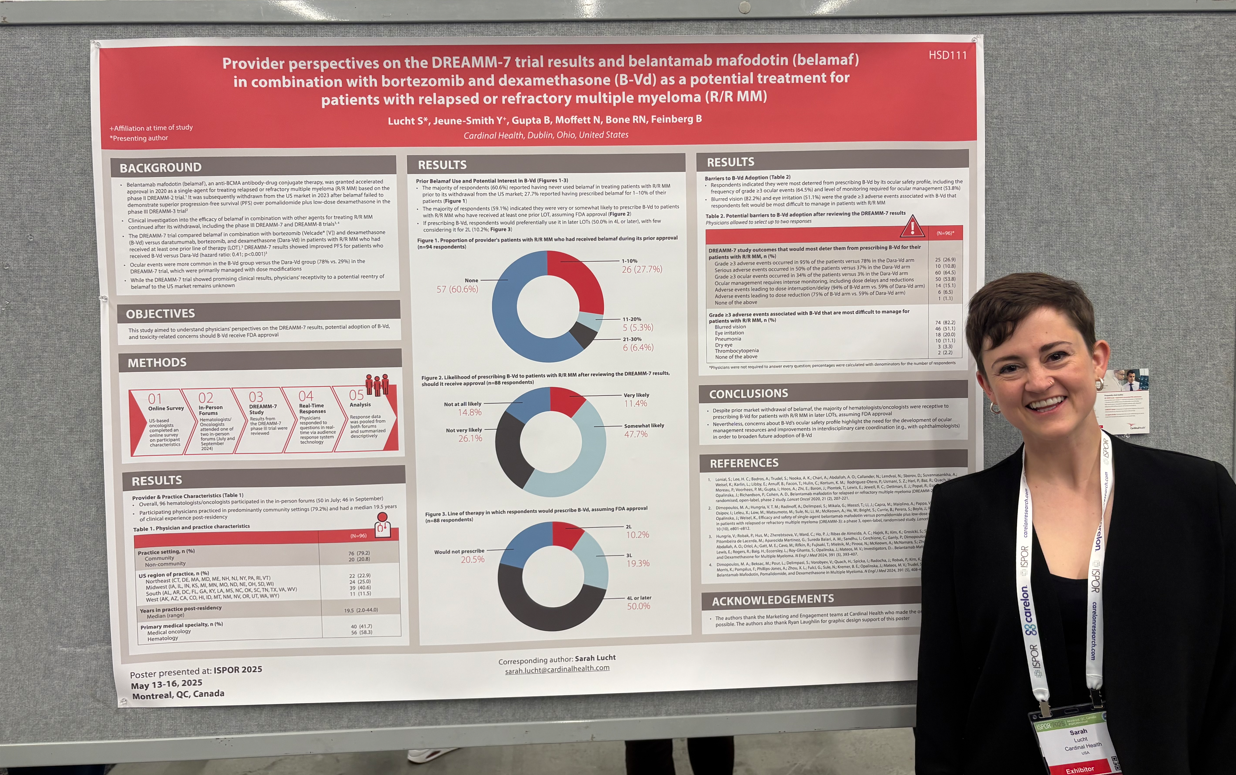
We found that about 60% of providers surveyed had never prescribed belamaf when it was approved as a single agent. Among those who had, most reported using it for only 1–10% of their multiple myeloma patients, indicating overall experience with the drug was limited. However, after reviewing the DREAMM-7 results, many providers found the efficacy data, particularly the significant improvement in progression-free survival, quite compelling. Despite limited prior use and awareness of the safety profile, about 60% of providers said they were somewhat or very likely to prescribe B-Vd should it be approved. That level of interest suggests they see real potential for this combination.
When asked about which line of therapy they would consider, only around 20% said they would not prescribe it at all. Most providers indicated they would use B-Vd in later lines, with about 50% suggesting fourth line or beyond, and around 30% considering it for second or third line.
When considering the preferred line of therapy, only approximately 20% of providers indicated they would not consider prescribing B-Vd at all. Providers were also asked about what might give them pause about using B-Vd, and the most common responses focused on the high rate of grade ≥3 ocular events, including blurred vision, dry eye, eye irritation, and visual impairment, which occurred in 34% of patients in DREAMM-7. Providers also noted the significant need for ocular management. These ocular events, even when asymptomatic, require intensive monitoring and coordination with ophthalmologists, which may lead to dose adjustments and places an added burden on prescribers. For those without an established relationship with an ophthalmologist, this would require additional effort. While not an insurmountable barrier, these ocular toxicities were the most frequently cited factors that could deter providers from prescribing B-Vd should it be approved.
In my view, when considered alongside the strong efficacy data, these issues are not insurmountable deterrents. Most providers identified a place for B-Vd in their treatment strategy. I think that highlights both the opportunity and the challenges ahead – understanding and managing toxicity will be key to broader adoption.
Were there any notable differences in receptivity or concerns based on provider setting (e.g., community vs academic) or years of experience?
This is an area that we haven’t looked at yet, but that we would like to explore in the future. While about 20% of our respondents came from academic settings, most respondents were community-based providers, which aligns with our focus and that most cancer patients receive care in the community setting. Representation of various practice settings is helpful as it reflects the range of oncology care settings in which patients receive care.
It would be valuable to investigate potential differences in barriers between these settings. For example, access to ophthalmologists or other specialists needed to co-manage ocular toxicities probably varies. Academic providers may have easier access, while smaller community practices (with maybe just two to five oncologists) could face more challenges.
When it comes to years of experience, ocular toxicities are not commonly encountered in oncology, so even highly experienced providers may have limited familiarity with managing them. Therefore, in that sense, everyone is still relatively new to handling this type of side effect, which is part of both the challenge and the opportunity that comes with novel drugs.
Overall, I do think this is a valuable area for future research, especially as guidelines evolve. If B-Vd is approved, it could be helpful to tailor management recommendations by practice setting to better support providers across different environments.
What impact do you hope this research will have on future treatment strategies for R/R MM?
As I’ve touched on earlier, with multiple myeloma being incurable, there’s hope that if approved again, belamaf as part of B-Vd could offer a valuable option for some patients. Not every treatment suits every patient, and even drugs in the same class differ in side effects and eligibility. The efficacy results from DREAMM-7 were quite compelling, so adding this option that providers can consider, particularly for relapsed or refractory patients in later lines of therapy, would be meaningful.
In terms of provider perspectives, the hope is that if belamaf returns to the market as part of B-Vd, the findings from this research can be leveraged to refine treatment guidelines. The aim is for the ocular toxicities and related safety concerns – which may currently cause providers to hesitate – to become more manageable with experience and guidance. There are precedents for this; for example, trastuzumab for HER2-positive breast cancer was initially associated with cardiotoxicity concerns that required close monitoring and made some providers hesitant. Over time, however, clear guidelines, supportive systems, and clinical experience helped make managing those risks routine.
I believe there’s a great deal that both biopharmaceutical companies and providers can do to prepare – from refining clinical guidelines to proactively identifying and addressing potential barriers. The goal is to prevent effective treatments from being delayed or facing slow uptake due to known, manageable challenges. In this case, the ocular side effects were not unexpected; they were observed in the original DREAMM-2 and DREAMM-3 trials. However, since the drug was withdrawn, those concerns may have faded somewhat from focus. As belamaf potentially re-enters the market, it's important to bring those issues back to the forefront – not only to support provider confidence in prescribing, but also to enhance patient quality of life.
We know that strategies like dose adjustments or treatment pauses can help patients remain on therapy at a level that is both effective and tolerable. With proper tools and support, including coordination with ophthalmologists, providers can manage these side effects more easily. The ideal outcome is that providers feel confident saying, “This is a drug we’re ready to use, and we’re glad to have it available.” That is the aim: to ensure promising treatments reach patients while enabling providers to deliver care without undue burden.
Looking ahead, in your opinion how can research involving provider insights continue to support the successful translation of clinical trial data into real-world treatment decisions?
I think the key issue here is that clinical trials, while essential, are inherently controlled settings. While they involve real patients with real diseases and real safety events and they generate the most rigorous data on efficacy and comparisons across treatment lines, they often have strict eligibility criteria and very rigorous monitoring processes. But once a drug enters the real world, that’s when the rubber really meets the road. What do providers think about it in practice? Are they encountering barriers? Can those barriers be overcome, or are they significant enough to prevent prescribing? Is uptake slower than expected despite strong efficacy data from trials?
“That’s where real-world data, and particularly provider perspectives, become so important. This type of feedback isn’t traditional real-world evidence like treatment patterns or claims data. It offers a complementary perspective to help us understand not just what is happening, but why it’s happening.”
It also gives us a sense of whether there’s genuine clinical interest: do providers believe this drug has a place in their treatment arsenal? In this case, I think the results suggest that there is interest – that providers would be open to using B-Vd if it were approved.
As I mentioned earlier, the more we can do to prepare providers, the more we support patients. These are patients who have often gone through multiple lines of treatment. If B-Vd is an effective option for them, we want providers to feel supported in prescribing it and managing any associated side effects. And we want patients to have access to treatments that not only help them live longer, but also improve their quality of life, including managing or reducing burdensome issues like blurry vision.
“This is really where provider insights can help because providers are the ones with both the treatment and the patient experience, and they can really give us these novel insights into what's happening in the clinic, and how patients feel about these side effects.”
Of course, integrating patient-reported outcomes and quality-of-life data is also crucial. But provider perspectives give us a unique view into the clinical realities and management challenges that influence treatment success. That’s what this type of real-world research brings to the table.
Interviewee
Sarah Lucht, PhD
Senior Scientist, Scientific Operations, Real-World Evidence & Insights

Sarah Lucht is a Senior Scientist on the Real-World Evidence and Insights team at Cardinal Health, where she leads studies on treatment patterns, safety outcomes, and clinical outcomes in real-world settings. With over 9 years working in academia and industry, her research experience includes observational study design, data analysis, cancer epidemiology, environmental epidemiology, and data interpretation. She holds a PhD in Medical Sciences from the University of Düsseldorf in Germany as well as a MSc in Epidemiology from the Harvard T.H. Chan School of Public Health.

Sponsorship for this Deep Dive was provided by Cardinal Health
© 2025 Cardinal Health. All Rights Reserved. CARDINAL HEALTH and the Cardinal Health LOGO are trademarks of Cardinal Health and may be registered in the US and/or in other countries. All other trademarks are the property of their respective owners. Patent cardinalhealth.com/patents.