

One size does not fit all: Preparing for vaccines under the EU Joint Clinical Assessment framework
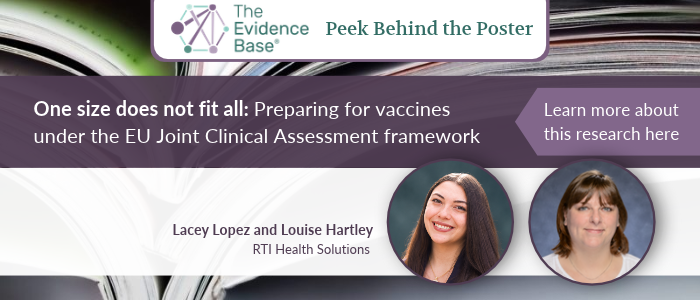
Preparing vaccines for EU Joint Clinical Assessment (JCA) in 2030 raises questions about how evidence generated today will meet future assessment needs. Choices about study populations, comparators and outcomes will influence both the European assessment and the evidence national immunization technical advisory groups (NITAGs) can use to inform vaccination recommendations.
For HEOR, HTA and market access teams, this raises a practical question. The JCA process was designed largely around therapeutics, while vaccines differ in important ways: they are preventive, immunization programs vary between countries, and follow-up at authorization is limited. What does that mean for evidence planning now?
In this Peek Behind the Poster, Louise Hartley and Lacey Lopez of RTI Health Solutions discuss a targeted literature review presented at ISPOR Europe 2026. They explain how the literature was identified and screened, what its limitations mean for the conclusions drawn, and what early expert and stakeholder views suggest about preparing for 2030. The discussion is aimed at teams planning vaccine evidence strategies ahead of the first vaccine-specific assessments.
Read the full interview to learn:
- How national immunization schedules can change who is included in a vaccine assessment and what it is compared with
- Where benefits beyond immune response, including protection of people who are unvaccinated, fit into JCA thinking, and where real-world evidence may help with duration of protection
- How the JCA could relate to national immunization decision-making, and what question a developer might bring to early scientific dialogue
About the interviewee
Louise Hartley, PhD
Executive Director, Value & Access, RTI Health Solutions

Louise Hartley has over 14 years of experience conducting systematic and targeted literature reviews across a wide range of therapeutic areas, with extensive expertise in evidence synthesis and meta-analytic methods. Dr Hartley has particular expertise in developing complex literature search strategies, conducting searches across major medical databases, and applying rigorous evidence synthesis methods to support evidence generation, HTA and market access. She is a member of the Cochrane Collaboration. Prior to joining RTI Health Solutions, Dr Hartley worked at the National Institute for Health and Care Excellence (NICE) as part of the surveillance team assessing the need to update clinical guidance, and at the University of Warwick, where she was lead author on a number of Cochrane reviews evaluating interventions for the primary prevention of cardiovascular disease. Dr Hartley holds a PhD in Health and Population Sciences, for which she used meta-analytic methods to investigate geographical differences in the clinical effectiveness of healthcare interventions, particularly those for patients at high risk of cardiovascular disease. She has an extensive scientific track record, including peer-reviewed publications and presentations at international scientific and HEOR conferences.
Lacey Lopez, PhD
Associate Director, Medical Communications, RTI Health Solutions

Lacey R. Lopez holds a PhD in microbiology and immunology and has over a decade of experience in scientific research and medical communications. She supports client portfolios in the vaccines space and develops strategic publications spanning HEOR, RWE, and patient-centered outcomes, bringing a multidisciplinary perspective to evolving considerations for vaccines under EU JCA.
Acknowledgments
We thank Margaret Mathes, Executive Director of Medical Editing at RTI Health Solutions, for editorial support.
Disclaimers
The opinions expressed in this feature are those of the author and do not necessarily reflect the views of The Evidence Base® or Becaris Publishing Ltd.
 Sponsorship for this Interview was provided by RTI Health Solutions.