

How are life sciences organizations creating value from real-world data?
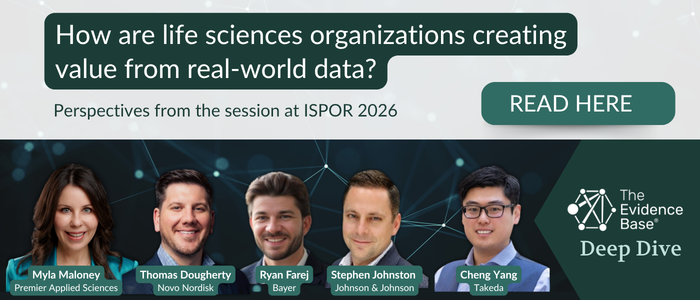
At ISPOR 2026, a panel of senior leaders from Novo Nordisk, Bayer, Johnson & Johnson, and Takeda came together for a panel discussion on one of the industry's most pressing questions: how to move real-world data from a supporting resource to a genuine strategic asset. Moderated by Myla Maloney of Premier Applied Sciences, the discussion, "The Evidence Advantage: How Life Sciences Leaders Are Winning with Real-World Data," explored what it actually takes to translate data into decision-relevant evidence across the product lifecycle.
The panelists discussed why "no dataset is perfect," how organizations are balancing methodological rigor against the growing demand for speed, and why the biggest barrier to treatment uptake in fields like obesity may not be data at all, but patient behavior. They also looked ahead, weighing where the industry is overinvesting in familiar approaches and underinvesting in emerging ones, from AI-enabled analytics to device-generated data.
The result is a wide-ranging, practitioner-level view of where real-world evidence strategy is heading next, and what separates organizations that are scaling their impact from those still working study by study.
Read the full Deep Dive for the panel's complete insights on evidence planning, stakeholder communication, and the future of AI in RWE.
About the speakers
Myla Maloney, MBA, BCMAS
Chief Growth Officer, Premier Applied Sciences

Myla Maloney is Chief Growth Officer for Premier Applied Sciences, the data and research division of Premier. With 24 years of experience in the healthcare industry, Maloney supports Premier’s mission of transforming healthcare by leading collaborations between Premier Applied Sciences and life sciences organizations to improve population health; enabled in part by real-world data from the Premier Healthcare Database – one of the world's largest healthcare data repositories with 1.5 billion data points from more than 1400 hospitals and healthcare systems Maloney joined Premier in 2018. She previously served as Chief Commercial Officer for Premier Applied Sciences as well as Premier's Vice President of Strategic Supplier Engagement, during which she partnered with leading biopharmaceutical and IT companies. Maloney received her Bachelor of Science in business administration and Master of Business Administration from East Carolina University.
Thomas Dougherty, MBA, PhD
Real World Data Strategy Lead- Diabetes & Obesity, Novo Nordisk

Tom Dougherty is the Real-World Data Strategy Director at Novo Nordisk, Inc., where he focuses on identifying gaps in the data portfolio and shaping long-term strategies to meet future RWE needs. Prior to joining Novo Nordisk, he served as Director of RWE Partnerships & Innovation at Pfizer. He brings over 20 years of experience in the life sciences industry. Tom holds a BS in Chemistry and an MBA from Villanova University and is currently pursuing a Doctorate at Thomas Jefferson University.
Ryan Farej, MS
Director, HEOR Modeling & Outcomes US Medical Affairs, Bayer

Ryan Farej has spent more than a decade at Bayer in a series of health economics and outcomes research roles and currently serves as Director of HEOR Modeling & Outcomes within US Medical Affairs. His work focuses on real-world evidence, evidence strategy, and the generation of decision-relevant evidence across the product lifecycle.
Stephen Johnston, PhD
Sr. Director, Real-World Data Analytics & Research, Johnson & Johnson

Stephen Johnston is a Senior Director in Johnson & Johnson's Global Epidemiology Organization, MedTech. Stephen joined J&J in 2016, prior to which he was Senior Director of Outcomes Research at Truven Health Analytics (now Merative). Stephen has 20 years of experience in RWE and has authored over 130 peer-reviewed manuscripts in the areas of epidemiology, outcomes research, and health economics, among other topics. Stephen holds a PhD in Public Policy with concentration in Health Economics from the School of Public Policy at University of Maryland Baltimore County (UMBC). Stephen’s current focus areas of research include robotics and digital solutions, surgical oncology, general surgery, and advanced methods for causal inference.
Cheng Yang, PhD
Digital Diagnostics Lead, Takeda

Cheng Yang is Digital Diagnostics Lead in Global R&D at Takeda, where he leads the development of AI-enabled diagnostic and clinical decision support solutions for earlier patient identification and more effective care pathways. His work integrates real-world clinical data, EHR-derived signals, digital biomarkers, and machine learning to translate unmet diagnostic needs into practical, evidence-based products.
His responsibilities span digital health product strategy, clinical and algorithm validation, evidence generation, and implementation within real-world clinical workflows. Cheng works across healthcare systems, technology partners, and cross-functional teams to ensure digital solutions are clinically meaningful, deployable, and trusted by end users. He holds a PhD in Analytical Chemistry from the University of Virginia and a Master’s in Healthcare Quantitative Management from Duke University.

Sponsorship for this Deep Dive was provided by Premier Applied Sciences.