

Following the patient journey: How connected data and evolving methods are reshaping real-world evidence
Cancer patients rarely receive all of their care in one place. Instead, their journey spans multiple providers and care settings, with critical clinical information scattered across disconnected data systems. How do researchers bring those fragmented pieces together to generate evidence that can support clinical and regulatory decision-making?
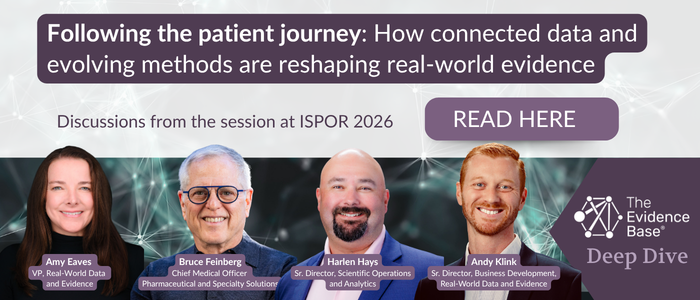
This challenge was the focus of a session at ISPOR 2026, where Amy Eaves moderated a discussion with Bruce Feinberg, Harlen Hays, and Andy Klink of Cardinal Health. In the session,"The Future of RWE: Claims and EMR Were Just the Beginning", the panel explored how real-world evidence generation is evolving to address increasingly fragmented patient journeys. Drawing on the perspectives of a practicing physician, a data scientist, and a business development leader, they discussed the growing role of first-party EHR access, tokenization, connected data ecosystems, physician-led data collection, and methodological advances in generating fit-for-purpose evidence.
For professionals working in HEOR, HTA, market access, regulatory affairs, and evidence generation, the discussion provides practical insight into how connected data and evolving methodologies are helping researchers generate evidence that reflects the complexity of modern healthcare and supports clinical and regulatory decision-making.
Read the full Deep Dive here.
About the speakers
Amy Eaves
Vice President of Real-World Data and Evidence, Cardinal Health

Amy Eaves is a senior commercial leader with expertise in real world evidence, data strategy, and technology enabled consulting. As Vice President of Real-World Data and Evidence at Cardinal Health, she drives growth, strengthens client partnerships and advances data driven solutions that support life sciences innovation.
With more than 20 years of experience across healthcare, life sciences, and IT services, Amy has led high performing sales and delivery teams, scaled multimillion dollar portfolios, and consistently delivered double digit growth. Her career includes leadership roles at a large Clinical Research Organization and private equity backed technology services firms where she built new offerings, elevated customer success, and shaped go to market strategies in competitive, rapidly evolving markets.
Amy holds an MBA in International Business from Arizona State University and a BS in Molecular and Cellular Biology from the University of Arizona.
Bruce Feinberg, DO
Chief Medical Officer, Cardinal Health

Bruce Feinberg, DO, is Vice President, Clinical Affairs and Chief Medical Officer for Cardinal Health. He is nationally recognized for his expertise in specialty oncology and the business of specialty healthcare. Dr. Feinberg has been instrumental in the development of clinical pathways that aim to control costs, improve quality, and increase predictability, all of which are key factors in developing a sustainable approach for caring for patients with high-cost diseases.
Dr. Feinberg maintains his license as a board-certified medical oncologist in the state of Georgia where he practiced for 23 years after completing his fellowship at M.D Anderson Cancer Center. A highly sought-after researcher and speaker on healthcare policy, value-based care, and real-world evidence research, Dr. Feinberg is the author of the bestselling Breast Cancer Answers and its follow-up book, Colon Cancer Answers. He has been consulted by prominent national media outlets, including the New York Times, Wall Street Journal, Forbes, and CNN. Dr. Feinberg is Host of The Weekly Check-Up on WSB Radio in Atlanta and The Weekly Check-up Podcast. With The Weekly Check-Up, he provides the community with the latest health information and an opportunity to express their views on health and medicine.
Harlen Hays, MPH
Senior Director of Scientific Operations and Analytics, Cardinal Health

Harlen D. Hays, MPH serves as the Senior Director of Scientific Operations and Analytics. He directs a team of senior scientists, statisticians and data scientists in the conduct of statistical analysis and database management of real-world data from medical chart reviews, administrative claims databases, electronic medical record databases, and other sources for biopharmaceutical manufacturers seeking to generate real-world evidence for internal and payer projects, medical communications, and regulatory bodies.
With over a decade spent at the Cerner Corporation leading research, analytics, and data science projects for multiple markets, he also served as the Principal Investigator for the HIV Outpatient Survey (HOPS); a grant funded by the Centers for Disease Control and Prevention. Mr. Hays also has experience working as an Epidemiologist for the State of Kansas with a focus in Substance Abuse prevention, has a Bachelor of Science in Microbiology and a Master’s in Public Health from the University of Michigan.
Andy Klink, PhD, MPH
Senior Director of Business Development, Real-World Data and Evidence, Cardinal Health

Andy Klink oversees a team of Business Development Directors who support clients in conducting studies involving real-world evidence, pharmaco-epidemiology, health economics, and outcomes research in a range of therapeutic areas with a focus in oncology, rheumatology, urology, and gastroenterology. He has over 15 years of experience in academia and industry with health economics and outcomes research, multi-level mixed-effects analysis, longitudinal analysis, comparative effectiveness, and patient-oriented research. Serving as strategic scientific oversight and business development, Klink currently supports the development of industry-sponsored research studies involving administrative claims data, electronic health records, chart reviews, and patient and physician surveys to assess healthcare resource utilization, costs, quality of life, treatment patterns, treatment response, and other clinical and patient-centered outcomes. More broadly, Andy provides strategic real-world evidence for biopharmaceutical manufacturers to communicate value messaging to various healthcare stakeholders including regulatory agencies, payers, providers and patients.
Disclaimers
The opinions expressed in this feature are those of the author and do not necessarily reflect the views of The Evidence Base® or Becaris Publishing Ltd.

Sponsorship for this Deep Dive was provided by Cardinal Health.