

Event preview: 14th IMPACCT Real-World Evidence Summit
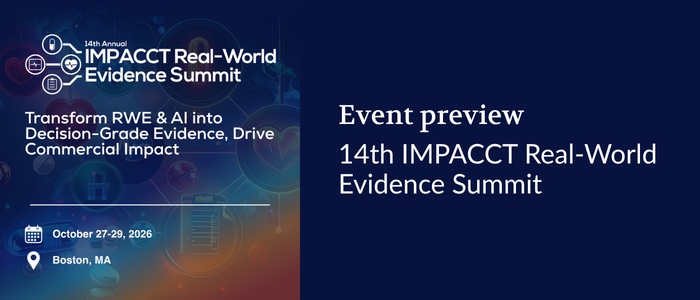
As real-world evidence continues to develop in 2026, the 14th IMPACCT Real-World Evidence Summit offers a timely opportunity to examine how advances in data, methods and AI can support decisions across clinical development, regulatory assessment and market access.
How can real-world evidence (RWE) more consistently inform decisions across the product lifecycle? This question connects many of the discussions shaping the field in 2026, from selecting data that can answer specific research questions to evaluating AI-enabled approaches and aligning evidence plans with decision-makers’ needs.
These priorities will come together at the 14th IMPACCT Real-World Evidence Summit, taking place in Boston, MA, on October 27–29, 2026. Organized by Hanson Wade under the theme “Transform RWE & AI into Decision-Grade Evidence, Drive Commercial Impact,” the meeting brings together senior leaders in RWE, health economics and outcomes research (HEOR), clinical development and market access.
Across the program, sessions will explore the scientific and organizational challenges of generating evidence that meets decision-makers’ needs. Discussions will consider how to assess data quality, incorporate AI into research workflows and coordinate evidence generation across teams. A recurring focus is why even well-conducted research can fall short of informing decisions, and how study design, timing and communication can help address that gap.
Day 1: Building confidence in data, methods and evidence
Following the pre-conference workshops, summit Co-Chair Kelly Zou (AI4Purpose) will open the first main conference day, setting the scene for discussions on how data strategy, AI adoption and organizational alignment can strengthen the role of RWE in development and access decisions. Sessions will examine practical approaches to selecting and linking fit-for-purpose datasets, validating AI outputs and addressing regulatory and payer evidence requirements, alongside the importance of capturing outcomes that matter to patients.
Selected sessions include:
- Designing Enterprise Evidence Systems That Deliver Decision Impact Across the Lifecycle: Christopher Blanchette (Novo Nordisk) will discuss coordinating RWE, HEOR and clinical evidence to support development and stakeholder needs.
- Why Strong Evidence Still Isn’t Enough & What It Takes to Secure Access, Pricing & Reimbursement in Today’s Market: Reg Waldeck (Bayer) will examine how pricing and reimbursement conditions influence access, alongside the evidence itself.
- What It Actually Takes to Scale AI in RWE From Experimental Success to Organizational Reality: David Nimke (Astellas Pharma) will consider the organizational challenges that arise when expanding AI use across research teams.
- Building Scalable RWD Assets Through Tokenization: Lauren Young (Novo Nordisk) will explore tokenization and opportunities to connect different sources of patient information.
- Current Status of RWD/E Use in Regulatory Decision Making: Lessons Learned, Ongoing Challenges, and Future Directions: Amit Raval (Bayer) will review applications of RWE in FDA decision-making and remaining challenges.
- If It Doesn’t Matter to the Patient, What Are We Measuring?: Nell Meosky Luo (Folia Health) will examine whether research captures the aspects of disease burden that matter to patients and caregivers.
- Panel discussion: Breaking Down Organizational Silos Between Strategy, Science & Execution for RWE With AI: The panel of Jason Zhu (AstraZeneca), Alexander Cole (Alexion Pharmaceuticals), Amit Raval and Seray Cicek (PointClickCare) will explore how teams can align expertise, validate AI outputs and establish accountability while maintaining scientific credibility.
Day 2: Making evidence relevant to development and access
Chaired by Alexander Cole, the second day of the Summit will examine how RWE can address uncertainty in development and inform access decisions. Discussions will examine approaches to characterizing rare disease populations, selecting methods appropriate to the decision context and addressing payer evidence needs, alongside the role of HEOR role in shaping evidence strategy.
Highlighted sessions will explore:
- Understanding the Invisible Patient & Mapping Rare Disease Journeys Beyond Diagnosed Populations: Cole will consider how epidemiology can help characterize rare disease patients whose conditions remain undiagnosed or misdiagnosed.
- Panel Discussion: How RWE & AI Are Actually Shaping Research & Development & Evidence Strategy Today From Methodology to Impact: Kelly Zou, Christopher Blanchette (Novo Nordisk), Ralu Vlad (Bristol Myers Squibb), Michael Bierl (Flatiron Health), David Nimke (Astellas Pharma) and Song Wang (Takeda) will examine how RWE and AI are informing R&D and lifecycle decisions. Discussions will address earlier integration of RWE, adoption of AI beyond pilot projects and the governance needed to balance efficiency with scientific defensibility.
- Designing Fit for Purpose RWE in Early Development Using Symptom Level Data to Inform Decision Making: Theresa Cassidy (Boehringer Ingelheim) will explore evidence generation where reliable diagnostic information is limited.
- From Linked Data to Lost Decisions: Why Integrated RWD Still Fails at Payer Review: Suzanne Morgan (Stealth BioTherapeutics) will examine why linking data does not necessarily resolve the questions that determine access.
- HEOR: More Than a Support Function – A Strategic Value Driver: Bonnie Donato (Boehringer Ingelheim) will discuss demonstrating value when research timelines extend beyond immediate business needs.
- Fit-for-Purpose RWE: A Practical Framework for Matching Methodological Rigor to Decision Risk: Irina Degtiar (Boehringer Ingelheim) will consider how study design and analytical rigor should reflect the decision being informed and its associated risks.
| Register for free today to become a member of The Evidence Base and receive the latest news straight to your inbox. |