

From potential to practice: Global considerations for AI in health system decision-making
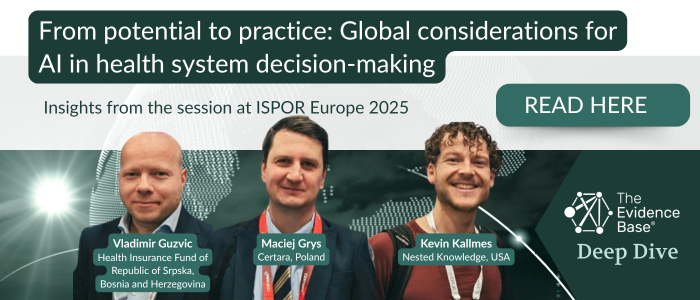
At ISPOR Europe 2025, the issue panel “AI in CEE Health System Decision Making: Can Payers, Patients, and Policy Align for Smarter Access?” considered how AI could strengthen the efficiency and credibility of evidence generation and health technology assessment (HTA). The session examined the governance structures, methodological safeguards, and operational requirements needed for responsible adoption across health systems.
AI is becoming a central focus in discussions about the future of evidence generation and HTA. Although adoption varies across countries and institutions, health systems worldwide are confronting similar questions about trust, transparency, governance, and methodological rigor. This Deep Dive, including access to an example 'Nest' exploring the ISPOR Europe 2025's AI-related posters, examines the ISPOR Europe 2025 issue panel, exploring how AI can support more timely and consistent decision-making across different system contexts.
Chaired by Vladimir Guzvic (Health Insurance Fund of Republic of Srpska, Banja Luka, Bosnia and Herzegovina), the session featured contributions from Maciej Grys (Certara, Poland) and Kevin Kallmes (Nested Knowledge, USA). Both speakers drew on their experience developing, evaluating, and implementing AI tools in evidence generation and HTA decision-making. Their insights highlighted how AI is currently being applied, the limitations that constrain its use, and the safeguards needed for credible adoption. Although several examples referenced Central and Eastern Europe (CEE), the issues discussed reflect global challenges and opportunities in integrating AI into evidence generation and HTA workflows.
About the speakers
Vladimir Guzvić
Health Insurance Fund of Republic of Srpska, Bosnia and Herzegovina

Vladimir Guzvić, MD, Clinical Pharmacologist, PhD, has over 15 years of experience in the healthcare system and the Health Insurance Fund, holding various roles involving health technology assessment (HTA), reimbursement decision-making and formulary listing of medicines. He has been actively engaged in health economics and outcomes research (HEOR) for more than a decade, particularly through participation in ISPOR initiatives, education programs, conferences and workshops. More recently, his work has focused on exploring the integration of artificial intelligence into healthcare decision-making processes, as well as its applications in health economics and outcomes research.
Maciej Grys
Consultant, Certara, Poland

Maciej Grys is a Consultant at Certara with more than seven years of experience in the clinical components of health technology assessment (HTA). He specializes in systematic reviews, evidence synthesis, benefit–risk assessment, and outcomes analysis across therapeutic areas including oncology, cardiology, HIV, rare diseases, and reproductive medicine. His work spans numerous international literature reviews and projects aligned with Polish Agency for Health Technology Assessment (AOTMiT) guidelines, and he has co-authored several peer-reviewed publications on innovative oncology therapies and medical devices.
Maciej also plays a leading role in advancing AI-enabled evidence workflows at Certara. He has evaluated and implemented AI-powered tools for literature review and appraisal, supported organization-wide adoption, and delivered internal training and knowledge-sharing initiatives. His research and AI innovation activities have been featured at major scientific meetings, including PTFE 2024/2025, ISPOR 2025, and the HTA Kraków Symposium.
Kevin Kallmes
Chief Executive Officer, Cofounder, Nested Knowledge, USA

Kevin is the CEO and co-founder of Nested Knowledge, a leading software for AI-assisted systematic literature review. As a serial entrepreneur in medical research, therapies, and software, Kevin contributes to best review practices, provides training, resources, and research, and explores the frontier of responsible, human-in-the-loop AI solutions. This has driven widespread adoption of Nested Knowledge from academia to HTA bodies to life sciences companies as the single, central provider of living evidence synthesis in health economics and outcomes research.

Sponsorship for this Deep Dive was provided by Certara.