

As AI becomes more autonomous, where does human oversight need to remain? Sessions on the agenda at ISPOR Europe 2026
AI is moving beyond individual tasks to support increasingly complex and autonomous workflows across HEOR and HTA. At ISPOR Europe 2026, attention turns to what this means for scientific rigor, accountability and professional expertise. We highlight sessions exploring where AI can take greater responsibility, and where human judgment must remain.
AI has become a prominent feature of the health economics and outcomes research (HEOR) landscape, with applications now extending across evidence synthesis, real-world evidence (RWE), causal inference, economic modeling and health technology assessment (HTA).
It is a rapidly evolving landscape that The Evidence Base has been exploring throughout 2026. As Dalia Dawoud put it, the field is effectively “building the plane as we fly it,” as the use of AI in evidence generation advances alongside efforts to establish appropriate standards, safeguards and oversight. Our coverage has also featured Jason Shafrin asking what AI could mean for the future of the HEOR profession, Flatiron Health’s Eunice Hankinson discussing how AI-generated real-world data can be validated, and John Diaz-Decaro, Nivantha (Nivi) Naidoo and Theodora Oikonomidi exploring why a living scoping review is needed to track emerging applications across the RWE research lifecycle.
At ISPOR Europe 2026, the annual European meeting of ISPOR—The Professional Society for Health Economics and Outcomes Research, taking place in Vienna, Austria, from November 8–11, that conversation moves further. Across the program, sessions explore not only what AI can do, but what happens as AI-enabled workflows become more sophisticated and increasingly autonomous.
What will speakers be debating about AI at ISPOR Europe 2026?
From “Humans at the Helm” to sessions on agentic AI, AI-assisted economic modelling and the future of HEOR expertise, the agenda puts human oversight at the center of the AI debate. Speakers will examine how far increasingly autonomous systems can be trusted to support complex analytical work, and where scientific judgment, validation and accountability still need to remain firmly human-led.
Key talking points include how AI-enabled workflows should be validated, what transparency and reproducibility should look like, and where guardrails are needed when outputs could influence healthcare decisions. The implications for the HEOR workforce are also firmly on the agenda, including which tasks can be delegated and where expert judgment and accountability must remain.
From agentic AI and economic modeling to validation, accountability and the future HEOR workforce, the sessions we have selected approach a growing challenge from different angles: as AI becomes more autonomous, where does human oversight need to remain?
Selected sessions
Humans at the Helm: Navigating Increasing AI Autonomy in HEOR and HTA
Date and time: Monday November 9, 2026, 10:30am – 11:30am
Moderator: Bill Malcolm (Bristol Myers Squibb)
Speakers: Dalia Dawoud (Cytel), J. Jaime Caro (McGill University/Thermo Fisher Scientific) and Siguroli Teitsson
Advancing Evidence-Based Medicine with Generative AI
Date and time: Monday November 9, 2026, 12:15pm – 1:15pm
Speakers: Jimmy Royer (Analysis Group), Maxime Leroux (DMined Consulting Services) and Eric Q Wu (Analysis Group)
Date and time: Monday November 9, 2026, 12:15pm – 1:15pm
Moderator: Uwe Siebert (UMIT TIROL – University for Health Sciences and Technology/Harvard Chan School of Public Health)
Speakers: Jag Chhatwal (Harvard Medical School/Massachusetts General Hospital), Beate Jahn (UMIT TIROL – University for Health Sciences and Technology) and Beth Devine (University of Washington)
AI in HEOR: Advancing Evidence Generation for Joint Clinical Assessment
Date and time: Monday November 9, 2026, 12:15pm – 1:15pm
Moderator: Dalia Dawoud (Cytel)
Speakers: Manuel Cossio (Cytel/Universitat de Barcelona), William Rawlinson (Estima Scientific) and James Ryan (AstraZeneca)
The Future of Causal Inference: How Large (or Small) Role Will AI Play?
Date and time: Monday November 9, 2026, 1:45pm – 2:45pm
Moderator: Radek Wasiak (Adigens Health Limited)
Speakers: Miguel Hernán (CAUSALab, Harvard T.H. Chan School of Public Health; Adigens Health), Gorana Capkun and Michael Haft (Xplain Data)
Real-Time Intelligence: AI-Enabled Insights to Drive Evidence Strategy
Date and time: Monday November 9, 2026, 3:15pm – 3:45pm
Speaker: Ryan Ahern (Truveta)
Artificial Intelligence Poster Tour
Date and time: Monday November 9, 2026, 4:00pm – 4:45pm
Moderator: Bill Malcolm (Bristol Myers Squibb)
Featured posters: Six studies exploring the use of AI across HTA and evidence generation, including NICE guidance production, AI-supported diagnostic detection, comparison of AI- and human-led qualitative analysis, AI-assisted EU JCA workflows, human-validation checkpoints and early economic evaluation.
Agentic AI Governance: How to Balance Innovation and Guidance
Date and time: Monday November 9, 2026, 4:45pm – 5:45pm
Speakers: Amir Mehr (The Synthesis Company), Thomas Paulsson (Recordati Rare Diseases), Amanda Hansson Hedblom (Valid Insight/Bioscript Group) and Michael J Merchant (NICE)
Can Agentic AI Deliver HTA-Ready Health Economic Models? Governance, Validation, and Trust
Date and time: Tuesday November 10, 2026, 10:30am – 11:30am
Moderator: Andrew Briggs (London School of Hygiene & Tropical Medicine)
Speakers: Andre Verhoek (AstraZeneca), Jag Chhatwal (Harvard Medical School/Massachusetts General Hospital) and Xiaoyan Wang (Tulane University)
Date and time: Tuesday November 10, 2026, 10:30am – 11:30am
Moderator: Beth Devine (University of Washington)
Speakers: Timothy Reason (Estima Scientific), Liza Zasukhina (MSD) and Dan Ollendorf (Institute for Clinical and Economic Review)
The Next Generation of HEOR: Career Pathways in an AI-Augmented Field
Date and time: Tuesday November 10, 2026, 11:45am – 12:15pm
Moderator: Ghayath Janoudi (Loon)
Speakers: Anggie Wiyani (Novartis), Erika Wissinger (Cencora) and Vandana Ayyar Gupta (NICE)
Train the Economist or Hire the Engineer? The Future of Expertise in AI-Native HEOR
Date and time: Tuesday November 10, 2026, 1:45pm – 2:45pm
Moderator: Ramiro E Gilardino (Insights & Impact)
Speakers: J. Jaime Caro (McGill University/Thermo Fisher Scientific), Manuel Cossio (Cytel/Universitat de Barcelona) and Mitch Higashi (ISPOR)
From Static to Dynamic Value: Can Living HTA and AI Reshape the Innovation Cycle?
Date and time: Wednesday November 11, 2026, 8:00am – 9:00am
Moderator: Esther Nzenza
Speakers: Olivia Wu (University of Glasgow), Nicholas Adlard (Novartis Pharma) and Sabine Vogler (Gesundheit Österreich GmbH)
Coverage of ISPOR Europe 2026 by The Evidence Base
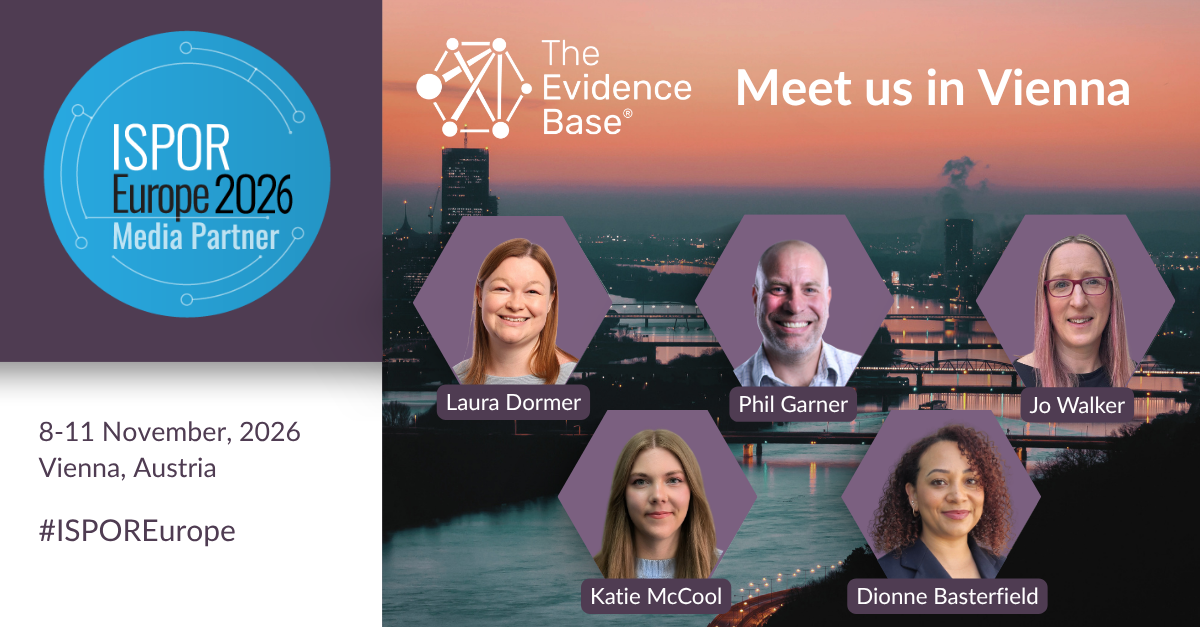
Our editorial team will be attending some of these key sessions, where we’ll be sharing key insights in our daily round-ups published at the end of each day of the conference. Follow The Evidence Base on LinkedIn for live updates throughout the meeting. And for exclusive post-event analysis and session round-ups, register on our site to receive regular updates.
| Register for free today to become a member of The Evidence Base and receive the latest news straight to your inbox. |